Zuck buys WhatsApp for an amazing $19 billion. (Yes, that’s billion. You read right.) More about this transaction in a moment. For now:
There is one overarching investment lesson here for all us investors:
It’s not the concept, it’s not the software, it’s not its uniqueness (WhatsApp is not unique), it’s not even the management that creates the enormous price that Zuck paid for WhatsApp. It’s its success. It’s its huge, fast acceptance by users, the great unwashed. Their acceptance is what gives WhatsApp’s value.
This is why these Internet success babies are not valued on traditional metrics of earnings and profitability. They’re valued because of their unassailable acceptance and position and (at least for now).
And that’s why companies like Google, Amazon, Priceline, Baidu, LinkedIn, OpenTable, Netflix, Yelp, Twitter, Facebook, TripAdvisor, YY and Pandora are valued so highly and will be valued even more highly as they grow and cement their effective unique position among consumers — assuming they don’t screw up along the way and assuming they maintain their consumer appeal and are not eclipsed by new, better services. Think what happened to Yahoo, eBay, and AOL.
This leads us Harry’s simple Internet Investment Game Plan. Get in early on all the promising Internet companies. Don’t even think about whether they make sense to you, or whether you’ll use their services or whether you think they’ll succeed, or whether they’ll have some bumps in their early days (Think Facebook). Get in on all. Ride the good ones up. Kick out the bad ones. As your winners succeed, take a little money off the table. Try to play this game with the bank’s money.
If Harry’s Internet Investment GamePlan isn’t new to you, it is to me. And frankly, I’m very excited. I’m an idiot because I didn’t adopt this plan earlier. I missed out on some of the early explosive growth in Internet companies because I just didn’t personally like what they were offering. I didn’t use their services. I don’t use Facebook or Twitter or TripAdvisor or Pandora (though Susan does). It’s time to listen more to people like Mary Meecker, and to try to identify new Internet trends, for example, the trend to privacy-based web services such as Ravetree, HushMail and DuckDuckGo. You should definitely try out some of these sites if you haven’t already. They’re really good, and you don’t have to worry about your personal information being data-mined and hacked. That’s a huge benefit to a lot of people — less so to me personally, since I don’t care if the NSA knows I’ve been shopping for slippers at LLBean. These three are not pubic companies but there soon will be others in their space.
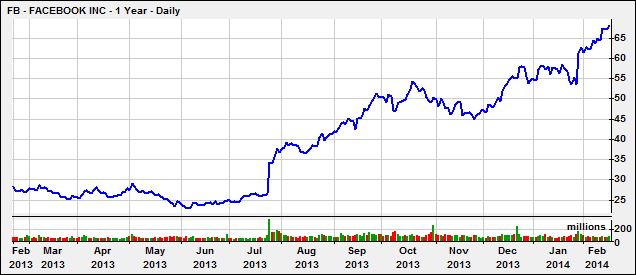
Here are some Internet companies over the past year. I missed all of these four, though I did ride Google, which has had a similar trajectory.



Now to the Facebook acquisition of WhatsApp:
Mark Zuckerberg is 29. He just spent $19 billion to buy an app called WhatsApp. That’s seriously amazing. He’ll be 30 on May 14.
Can you name one person under 30 who spent that much on anything?
You’ve never heard of WhatsApp. I hadn’t until last night. Whatsapp describes itself:
How it works
WhatsApp Messenger is a cross-platform mobile messaging app which allows you to exchange messages without having to pay for SMS (text messages). WhatsApp Messenger is available for iPhone, BlackBerry, Android, Windows Phone and Nokia and yes, those phones can all message each other! Because WhatsApp Messenger uses the same internet data plan that you use for email and web browsing, there is no cost to message and stay in touch with your friends.
In addition to basic messaging WhatsApp users can create groups, send each other unlimited images, video and audio media messages.
I asked Michael my son about WhatsApp. He said our family didn’t need it because we all had iPhones. And iMessage (Apple’s name for SMS / text messaging) between iPhones and iPads was free. But overseas where the local cell phone companies charge like wounded bulls for each SMS message, you really did need WhatsApp. In fact, WhatsApp has basically destroyed those huge profitable SMS revenues — doing to the cell phone companies’ SMS revenues what Skype has already done to their phone calling revenue.
I once played marketing consultant to one of the largest phone companies — New York Telephone –and came away, staggered at how unimaginative they were. I could give you a list of inventions they ignored — from cell phones to computer telephony. My favorite is they’ve allowed themselves to lose the revenue from millions of landlines — without doing one thing to entice users to keep them — like dropping the price, coming up with family plans, integrating the landline with a cell line (having both ring simultaneously), designing a landline phone that works like a cell phone, with backspace erase, dialing a phone with a computer and leaving a text or sending a voice message. There are a million potential improvements. But the traditional telephone industry ignored all of them, and let itself be raped and pillaged by the likes or WhatsApp,, Apple’s iMessage, BlackBerry Messenger, Skype and others I see forming. One of my favorite cell phone resellers, Ultra Mobile, ships its international phone calls over the Internet, completely bypassing both landline and cell phone companies and depriving them of erstwhile lucrative revenues.
Why did Facebook’s Zuckerberg spend $19 billion to buy a company with remarkably little exciting new technology. WhatsApp wasn’t the first SMS app that bypassed the cell phone companies. But it was the first to achieve more than 450 million monthly users, with 70 percent of those active on a given day. By that measure, Facebook is paying about $40 per user. Which is really cheap if you had to advertise for them. Figure $100 a user. What’s most remarkable is that WhatsApp never spent a nickel we know of on advertising. 450 million people heard of it virally — by word of mouth. That very impressive.
Is WhatsApp good for Facebook? Any time you can pick up 450 million customers in one fell swoop you’ve made a huge coup. “WhatsApp is on a path to connect one billion people. The services that reach that milestone are all incredibly valuable,” Zuckerberg said in last night’s statement.
The Wall Street Journal commented last night:
Even by the get-big-fast standards of Silicon Valley, WhatsApp’s story is remarkable. The company, founded in 2009 by Ukrainian Jan Koum and American Brian Acton, reached 450 million users faster than any company in history, wrote Jim Goetz, a partner at investor Sequoia Capital.
Facebook had fewer than 150 million users after its fourth year, one third that of WhatsApp in the same time period. WhatsApp processes 50 billion messages a day, Mr. Goetz wrote, yet has only 32 engineers and does not employ any marketing or public-relations people.
WhatsApp built its business on the idea of offering instant messaging without the fees that carriers often charge. The app lets uses send text, pictures and video to anyone else who has the software, free. Unlike Apple Inc.’s iMessage, it works on all the major mobile operating systems.
The company goes out of its way to remain private, offering little in the way of information to government agencies trying to track people. Once delivered, messages are deleted from the company’s servers. Privacy was particularly important to Mr. Koum, who grew up in a communist country with a secret police.
I had this fleeting vision that the cell phone could easily destroy WhatsApp. Simply drop international SMS charges, as some have already done with domestic SMS charges. But they won’t. They won’t enhance their crappy 140-character SMS messages with images or video. They’ve never seen the threat –And I go back in the industry to 1969 when AT&T had 100% monopoly on long distance and 95%+ plus on local calling. They never saw a tiny upstart called MCI taking any of their business. And they certainly never thought for one single moment they’d lose an anti-trust suit brought by the Feds, and the Feds would break them up.
If Facebook’s stock falls today, buy some.
Oh yes, so how does WhatsApp make money, if it does? It’s vehemently against advertising. From the WhatsApp website:
Advertising has us chasing cars and clothes, working jobs we hate so we can buy shit we dont need. – Tyler Durden, Fight Club
Brian and I spent a combined 20 years at Yahoo! working hard to keep the site working. And yes, working hard to sell ads, because that’s what Yahoo! did. It gathered data and it served pages and it sold ads. We watched Yahoo! get eclipsed in size by Google..
When we sat down to start our own thing together three years ago we wanted to make something that wasn’t just another ad clearinghouse. We wanted to spend our time building a service people wanted to use because it worked and saved them money and made their lives better in a small way. We knew that we could charge people directly if we could do all those things. We knew we could do what most people aim to do every day: avoid ads.
No one wakes up excited to see more advertising, no one goes to sleep thinking about the ads they’ll see tomorrow. We know people go to sleep excited about who they chatted with that day (and disappointed about who they didn’t). We want WhatsApp to be the product that keeps you awake… and that you reach for in the morning. No one jumps up from a nap and runs to see an advertisement.
Advertising isn’t just the disruption of aesthetics, the insults to your intelligence and the interruption of your train of thought. At every company that sells ads, a significant portion of their engineering team spends their day tuning data mining, writing better code to collect all your personal data, upgrading the servers that hold all the data and making sure it’s all being logged and collated and sliced and packaged and shipped out… And at the end of the day the result of it all is a slightly different advertising banner in your browser or on your mobile screen.
Remember, when advertising is involved you the user are the product.
At WhatsApp, our engineers spend all their time fixing bugs, adding new features and ironing out all the little intricacies in our task of bringing rich, affordable, reliable messaging to every phone in the world. That’s our product and that’s our passion. Your data isn’t even in the picture. We are simply not interested in any of it.
When people ask us why we charge for WhatsApp, we say “Have you considered the alternative?”
Allegedly WhatsApp collects 99 cents from everyone who downloads the app. That’s allegedly. Michael and I signed up yesterday evening. Neither of us paid anything to download WhatsApp from Apple’s AppStore. But maybe if you download it for an Android phone you’ll pay the 99 cents.
There is one other moral of this entire amazing story. This clip is from their web site:
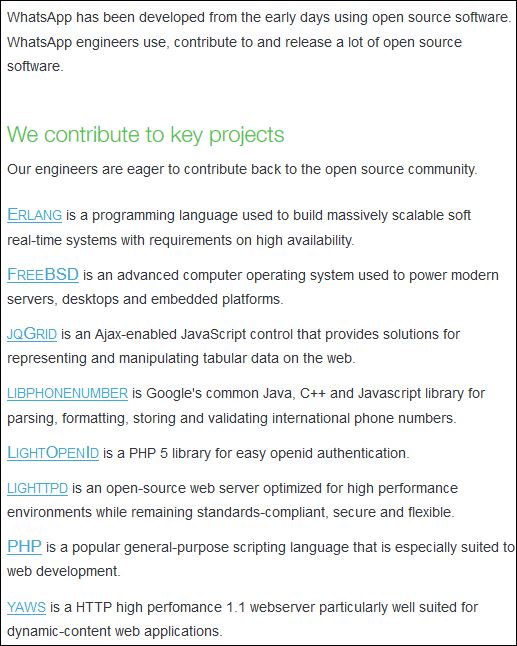
If the amazing WhatsApp story doesn’t convince you that your kids ought to learn computer science and software programming in every grade level in every semester, then nothing will.
Super Google Maps trick.
Want to save a Google map on your iPhone or iPad for when you’re out of GPS or Wi-Fi range?
Get the screen you want. Search for OK Maps. Hit Search.
Bingo, it’s saved.
Make sure you have the latest version of Google Maps.
Emergency Crews Attempt To Rescue Olympic Figure Skater Who Fell Through Ice

SOCHI, RUSSIA-In a race against time, local emergency crews reportedly rushed to rescue Italian figure skater Carolina Kostner Wednesday after the Olympian plunged through a hazardous thin patch of ice during her short program at the Iceberg Skating Palace. “Unfortunately she skated way out into the middle of the rink where the ice was weak and it collapsed instantly when she landed her triple axel,” said rescue worker Ignativ Barkov, adding that Kostner ignored the sounds of cracking ice while performing an otherwise flawless step sequence and combination spin. “We have to act fast or she’ll succumb to hypothermia. Granted, a world-class athlete like Kostner can withstand the initial shock for a few minutes, but her thin, sparkly leotard will do little to protect her from the deep and frigid water below the ice.” At press time, crews were attempting another dive after initial efforts had only managed to recover a sequined headband and several loose rhinestones.
And if you think any of this is true, you just got your leg pulled big-time.

Harry Newton who wishes Claire Newton a happy birthday today and her husband, Ted Maloney, whose birthday is also today. What a brilliant idea marrying someone with the same birthday. That way you’ve got a good chance of not forgetting the birthday. Maybe!

But wait, there’s more! Skype was doing this SMS thing long ago. Who bought Skype for billions? Yeah, the Redmond bunch. What happened? Skype became “clunky”. The app is deadly. No fun. Gee, Microsoft missed out on this great market share. Who could have seen THAT coming??
As an aside, does this mean the Ukrainian guy can now buy the country from Russia, let in the EU bankers who are starting this whole fur ball, and stop the shooting?
Viber is another app for text and voice services used esp. for international calling. Viber lost $29M last year so its a pretty crowded field of ponies.
———
Rakuten Inc., the Japanese online retailer controlled by billionaire Hiroshi Mikitani, plummeted in Tokyo trading after announcing it will buy the Viber Internet messaging and calling service for $900 million.
Rakuten fell 9.5 percent, the most in more than four months, to close at 1,499 yen in Tokyo trading, wiping out more than $2 billion in market value.
Mikitani, seeking to boost sales after missing analyst estimates for two years, has bought stakes in social-network operator Pinterest Inc. and digital book seller Kobo Inc. Losses at overseas operations and new businesses are approaching levels that may test investors’ patience, Kuni Kanamori, an analyst at SMBC Nikko Securities Inc., said in a note.
“The deal is large and comes despite the absence of contraction in Kobo operating losses,” Kanamori wrote. “As we had hoped to see shrinking losses on M&A projects overseas, the deal leaves a negative impression.”
With Viber, Rakuten will be competing with Naver Corp. (035420)’s Line service and Tencent Holdings Ltd.’s WeChat, which both combine instant messaging with shopping and gaming, and Microsoft Corp.’s Skye service. Viber had a $29.5 million net loss last year, Rakuten said in a statement last week.
So what?
There are billions of cell phones still to sign up.
So you know as copied from WhatsApp: We currently do not support tablets, computers, or Wi-Fi only devices, and do not plan to do so in the foreseeable future.
I like that blub that the founders of WhatsApp wrote on their website as to why they created their company and what makes it work. However, I don’t understand how these companies: Yelp, Facebook, Twitter etc are valued where they are when they don’t profit nearly that much. Is it me or is this a bubble in the making because it’s all money on paper unlike a company like Tesla creating tangible products that earn a ‘real’ profit. I can understand how WhatsApp is worth a billion but beyond that it boggles my mind.