I’ve in San Francisco for a one-day startup gig. The kids do their elevator pitches. 70 of us fat-walleted gamblers roll the dice on those we like. With luck, one will be the next Facebook, Whatsapp, Amazon, Google or Netflix. The world will be a better (or at least a different) place. And, with luck, our wallets will be little fatter.
The start-up biz is exploding on both ends — money pouring in — from VCs to crowd-sourcing, from angel investors to alternative banks (click here)— and rewards are skyrocketing — from hot IPOs to pricey takeovers (viz. Facebook buying Whatsapp for $19 billion). This is Startups’ Salad Days.
Yesterday, I talked about the virtues of starting your own business. (Click here.). Today I get to hear from a bunch of startups. I’m psyched. I’ll be looking for:
+ Scaleability. A corner coffee shop has no appeal, unless …
+ Management. None of the startups have any management skills. They’re too young. But they do have enthusiasm. That often works. It worked for me.
+ A product or service that turns me personally on. If I like it, it means nothing to the ultimate success. (Heck, I didn’t think Google would succeed. And I hate Facebook.) But I’d still rather invest in a product that turns me on. It’s more fun.
The fees we pay to mutual funds are ginormous, and buried. It’s no secret that most mutual funds do worse than the S&P 500. For the privilege of getting lousy performance, investors, who’d better off with an S&P 500 index ETF, pay through the nose.
So, what’s new? Basically nothing. Except that occasionally a writer spells it out brilliantly. Enjoy:
One Simple Change Could Save Money For Millions Of Investors, by Morgan Housel, The Motley Fool
Fidelity Investments brought in $12.6 billion in revenue last year, according to Forbes. Ned Johnson, the son of the company’s founder, is worth $9.3 billion, making him the 47th richest man in America.
Fidelity has done an amazing job bringing mutual funds to investors around the world. That’s created an extraordinary business: The average Fidelity retirement account had $89,300 in it last year, and Fidelity’s average management fee was 1.01% of assets, according to Advisor Investments. The average customer, then, paid Fidelity $901 for its services last year. Not even Apple earns that much annual revenue from each customer.
But there’s something incredible about this success. No Fidelity customer actually received a bill for $901 last year. No customer wrote a check for that amount. No one put $901 on their credit card, or wired that much to Fidelity through PayPal. No one receives a bill from Fidelity in the same way they receive a phone bill from AT&T, and no one pays Fidelity for its services in the same way they pay their power bill or their mortgage.
I’m picking on Fidelity, but this is how the entire money management industry works. Most mutual-fund revenue is received based on a simple calculation: At the end of each day, an annual management fee is divided by 365, and multiplied by the amount of assets under management. That amount – its daily fee – is deduced from the fund. It’s automatic. Customers are charged (big) fees for each day they invest in their funds, but no one pays – or even sees – an actual bill.
There’s nothing sinister about this. Mutual funds are upfront about their fees and are required to clearly disclose annual management fees in annual investor reports.
But I can think of no other industry where customers can pay literally tens of thousands of dollars per year and not even realize it. Since fees are disclosed as a percentage of assets, rather than a dollar amount, they’re harder for lay investors to put into context. And since they’re deducted automatically, rather than billed directly, they’re out of sight, out of mind.
I began thinking about this last year when talking to a family member who, after digging through his 401(k), realized he was paying $350 a month for the privilege of investing in a mutual fund that had underperformed its benchmark for a decade. That blew him away. He’s a penny-pincher who will walk a mile to avoid paying a $5 parking fee. But he was paying 70 times that amount each month for his mutual fund. The fees he paid on his fund were enough to cover a great vacation each year for the 15 years he owned the fund. Literally, 15 trips to Europe.
The worst part is that he didn’t even realize he was paying that much. Sure, he could have looked at the fund’s prospectus and discovered his 1% management fee. But like most of us, he didn’t. And it took him more than a decade before he did the simple calculation that showed a 1% management fee on his $420,000 account came out to a staggering $350 a month – again, for a poorly managed fund.
I imagine there are tens of millions investors in the same position. The same people who are appalled at paying $5 a month for their checking account service fee could easily be paying 20, 50, or 100 times that amount for their 401(k) without even knowing it.
What if this were different? What if mutual funds and money managers had to charge fees like all other businesses: a monthly bill sent directly to customers?
You can guarantee one thing: There would be an investor revolution.
Imagine if every month, while paying your mortgage, your power bill, and your cell phone bill, you had to write a check to your mutual fund manager for $200. You wrote another check to your 401(k) plan administer for $75, and perhaps another check to a custodian bank for $25.
You would instantly become keenly aware of fees. You’d probably become obsessed with them. You wouldn’t put up with a high-fee investment manager who chronically underperforms his benchmark. You’d shop around to see who offered the lowest costs, and you’d relentlessly harass your H.R. department to find a retirement-fund administrator with lower fees.
Very little of that behavior is happening right now.
Two years ago, the Department of Labor created a new rule mandating that 401(k) accounts disclose all the fees participants are being charged each year. This is a step in the right direction, but only a small one. According to a study by industry researcher LIMRA, 22% of 401(k) participants think they don’t pay any fees or expenses, up from 38% before the new disclosures went out. That’s progress, but still appalling: One-in-five Americans is likely paying hundreds of dollars a year in fees while thinking they’re not paying a penny. Fully half of investors in LIMRA’s survey said they still didn’t know how much they were paying in fees, and most of those who said they knew were wrong, often by an order of magnitude. Until investors actually have to write a check themselves, they are going to be oblivious to the fees they’re paying. That promises more bad investing decisions, and a wealth transfer from workers to Wall Street based solely on a lack of understanding.
According to Demos, the average two-earner couple will pay $155,000 in 401(k) fees over their lifetime. That’s enough to buy two-thirds of an average American house. Is it asking too much to bring a little light to these fees by making customers pay them directly? I don’t expect any mutual funds to do this – it’d be a logistical nightmare, and the current system works wonders at maximizing revenue. But I know customers would make better decisions if they would.
TV’s brave new world. “In the world of YouTube, not only is every device a television, but every viewer is a potential network and content provider.” You’ll find that nugget and a zillion others in Ken Auletta’s New Yorker piece on Netflix and the Future of Televsion, which begins:
In the spring of 2000, Reed Hastings, the C.E.O. of Netflix, hired a private plane and flew from San Jose to Dallas for a summit meeting with Blockbuster, the video-rental giant that had seventy-seven hundred stores worldwide handling mostly VCR tapes. Three years earlier, Hastings, then a thirty-six-year-old Silicon Valley engineer, had co-founded Netflix around a pair of emerging technologies: DVDs, and a Web site from which to order them. Now, for twenty dollars a month, the site’s subscribers could rent an unlimited number of DVDs, one at a time, for as long as they wished; the disks arrived in the mail, in distinctive red envelopes. Eventually, Hastings was convinced, movies would be rented even more cheaply and conveniently by streaming them over the Internet, and popular films would always be in stock. But in 2000 Netflix had only about three hundred thousand subscribers and relied on the U.S. Postal Service to deliver its DVDs; the company was losing money. Hastings proposed an alliance.
“We offered to sell a forty-nine-per-cent stake and take the name Blockbuster.com,” Hastings told me recently. “We’d be their online service.” Hastings, now fifty-three, has a trimmed, graying goatee and a slow, soft voice. As he spoke, he was drinking Prosecco at an outdoor table at Nick’s on Main, a favorite Italian restaurant of his, in Los Gatos, an affluent community in the foothills of the Santa Cruz Mountains. The sounds of Sinatra carried across the patio.
Blockbuster wasn’t interested. The dot-com bubble had burst, and some film and television executives, like those in publishing and music, did not yet see a threat from digital media. Hastings flew home and set to work promoting Netflix to the public as the friendly rental underdog. By the time Blockbuster got around to offering its own online subscription service, in 2004, it was too late. “If they had launched two years earlier, they would have killed us,” Hastings said. By 2005, Netflix had 4.2 million subscribers, and its membership was growing steadily. Hastings had rented a house outside Rome for a year with his wife, Patty Quillin, and two children and was commuting to his Silicon Valley office two weeks each month. Hollywood studios began offering the company more movies to rent; the licensing arrangements presented a new way to make money from their libraries and provided leverage against Blockbuster. . . .
You should be able to read the rest of this brilliant article here. If that doesn’t work, you’ll have to subscribe to the New Yorker and read their digital achives, or find a copy of the February 3, 2014 issue and read the magazine on paper. The dead tree version.
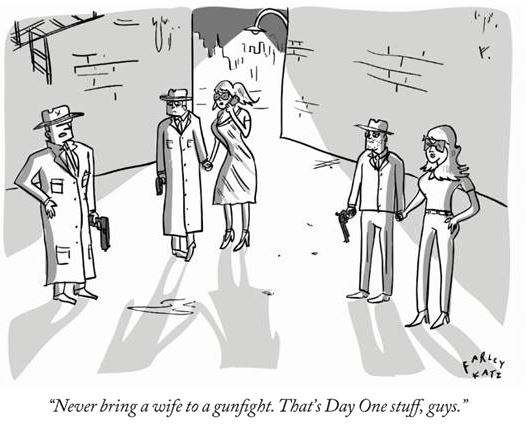
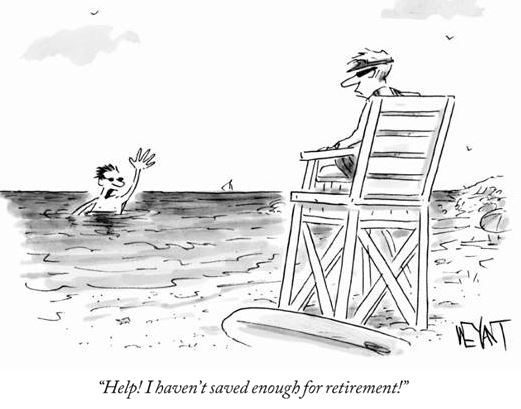
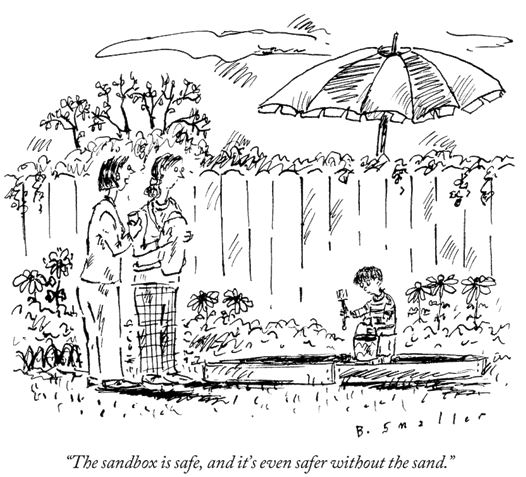
Favorite recent New Yorker cartoons.

Harry Newton who stayed the night on a houseboat in the San Francisco harbor, replete with a glorious view of the Golden Gate Bridge. We should all be so lucky to live in this wonderful city. Amazingly, the floating, bobbing houseboat enjoys Internet speeds most Americans would die for:

The New Yorker article above mentions “Today, the audience for the broadcast networks (ABC, CBC and Fox) is a third of what it was in the late seventies.” The article ponders the idea that the cable providers (Comcast, Time Warner, etc.) may give up carrying broadcast TV altogether and focus on delivering (and charging for) fast Internet — the pipe that carries Netflix, Hulu, HBOGo, Aereo, Amazon Prime, YouTube, and zillion other on-demand “TV” channels, which you and I are now watching. The Internet delivery biz is being fueled by Google, which is delivering (in a handful of cities) speeds a hundred times faster than my houseboat and, hence, ushering in a whole new era of spectacular 4K HD on demand video — for entertainment, education, gaming, and one-day broadband participatory democracy. We should be so lucky to be our children. What a world they will enjoy.
I’m so excited, I got up at 3:00 AM to write today’s blog. I don’t feel tired. Adrenaline works.

Was disappointed to miss you on your San Fran visit. Trust it went well. Up here we have two-three events every week with startups making pitch presentations. Interestingly enough, of companies that do get incubator funding, one popular source of money, 2/3rds do NOT ever get further funding. In general, even well over 50% of VC funded companies FAIL. Of pure tech startups, about nine out of ten fail. That’s a pretty steep mountain to climb.
Sheese I wish the “one simple change” in the Motley Fool article was the change that _I_ needed make to avoid those fees! I already lean to index funds, are there any other tricks? Do I need to learn more about ETFs?
And you could have been staying on our San Fran based luxury 45′ sailboat while walking a few feet for a phenomenal GG Bridge view, sun setting wow(!), while eating at our St Francis Yacht Club. Plus watching lovely joggers going back and forth on the Marina there. Maybe next time….if you’re good!
thanks for your efforts, harry