Everyone has their own idea of “risk.”
“Phil Michelson’s the kind of guy who will bet you his luggage comes off the airport carousel first,” Bob Verdi, a writer for Golf Digest who knows Mr. Mickelson, said in a 2002 Sports Illustrated profile. “If he ever flew commercial, that is,” Mr. Verdi added.
Michelson, who clearly doesn’t need the money he made from “insider trading,” is being investigated for it. So are Carl Icahn and William Walters. And they don’t need the money. But they may need the rush.
The Times did a big piece on “Insider Trading is a Game of Risk” and concluded there were some people who just simply loved the rush. Like these three. Click here.
When I ran my own business, I never thought about risk. I knew my business intimately. I had started it. I knew the industry. I knew what we were doing. There was no risk. I could control the outcome — cutting expenses and ramping up selling and marketing when things were tough.
The stockmarket is different. I can know “everything” about the stock I own. But I also know there’s stuff I don’t know, like the next sub-prime mortgage catastrophe, which seems to be due soon — if you look at the tea leaves in business cycles. We’re clearly due for a downturn. Things have been too good since the big upturn in March 2009. And there’s a real bubble in some areas of the economy — chiefly pricey real estate and some stocks.
The BIG Discussion with some friends is cash. They have too much of it and don’t know what to do with it. Corporations have the same problem, e.g. Apple.
Cash is behind the explosion in apartment prices in New York City. Nothing justifies the rise. You can’t buy an apartment, rent it out and take home a decent living. If you’re a Russian oligarch afraid of Putin’s next quirk, you’ll want to to own pricey artwork and a pricey New York apartment. But not if you’re Harry Newton, who doesn’t live in Moscow and is a “normal” investor who’s got to keep an eye on the cash flow. For, cash flow is the ultimate determinant of something’s value.
Cash is not King. Cash loses value against inflation. There is very little inflation at present, so people feel comfortable (and uncomfortable) with cash.
Personally, I have some cash. But I’m not sitting on it because I’m scared. I’m sitting on because it simply takes time to figure opportunities.
On Saturday, the New York Times picked up on the cash floating around:
Fear of Equities Drives More Investors to Cash
IF a lot of your portfolio is still sitting in cash after a five-year bull market in equities, you’re not alone. Investors at all wealth levels around the world are holding substantial amounts of cash that have increased since 2012. What this means for investors and the markets that depend on their money is intriguing.
According to new research on investors in 16 countries by State Street’s Center for Applied Research (click here), retail investors globally were holding an average of 40 percent of their assets in cash, up from 31 percent two years ago. That’s a compounded annual growth rate of a whopping 13 percent.
The lowest levels of cash holdings were in India, at 26 percent, and China, at 30 percent; the highest was 57 percent in Japan. The United States was in the middle at 36 percent, but that was an increase of 10 percentage points in just two years. The survey, done by State Street, one of the world’s largest asset managers and custodians, was conducted in the first quarter of this year. It considered cash to be money held in savings and checking accounts as well as cash equivalents like money market funds.
Despite the run-up in equity markets, people have resisted rushing into stocks and have instead added to cash. They’ve done this regardless of their age or amount of wealth. The study found that millennials who are under 33 and have the longest time to invest their money were increasing their cash positions at the same rate as baby boomers, who will need to draw on their investments soon.
Why is this happening? Suzanne Duncan, global head of research at State Street’s Center for Applied Research, chalked it all up to fear – even though it has been more than five years since the Standard & Poor’s 500 stock-index hit its low.
“If it wasn’t fear, there’d be a much different variation by age,” Ms. Duncan said. “Certain cohorts need more liquidity than others. When you find consensus across age cohorts, you realize it’s not for liquidity needs but lack of trust across all age and wealth levels.”
She said her own client meetings confirmed this deep-seated worry about the markets, like the one with the 90-year-old woman who had most of her money in cash. “She said she was afraid of high-frequency trading and dark pools,” Ms. Duncan said. “Then she said, `I don’t know what those are, but I don’t want to put my money with them.’ “
That meeting, she said, was before Michael Lewis’s “Flash Boys” came out about the rigging of the stock market by big financial firms and the impact of high-speed trading.
While fear is propelling people to hoard cash on one end of the spectrum, overconfidence is driving the investments people are making on the other end, the State Street study found. Two-thirds of the investors polled said their best investment was “entirely” their decision, and the investment that topped the list was “buying land or property.”
Yet 45 percent of investors didn’t know what the annual returns on their investments were and 64 percent said they didn’t know what fees they paid.
“They’re disenchanted with what the markets returned, and they’re comparing a physical property to this abstract market return,” she said. “They remember significant pain going through the downturn. But they don’t even know what their returns are on their investments.”
With results like these, the study’s least surprising finding may be just how poor financial literacy is around the world. It asked 13 fairly specific questions about how compound interest, fees and active or passive management affect returns. Singapore came in first, with a C-minus. Citizens of five countries, including Germany, Japan and France, failed. Americans barely passed, with a score of 60 percent.
So what does this mean for investors? It depends on whom you ask. Ms. Duncan noted that cash hoarding decreased at higher wealth levels. Investors with less than $250,000 have 50 percent of their wealth in cash, while those with $250,000 to $1 million have 38 percent. People with more than $1 million have 32 percent. (This was the one data point where the study did not have a comparative figure from 2012.)
The money not held in cash, the State Street study found, generally went into equities and alternatives, like real estate and hedge funds.
This phenomenon has led some analysts to argue that high cash positions will buoy the stock market. Bill Stone, chief investment strategist at PNC Wealth Management, said he had been doing his own cash calculations, comparing the average level of cash investors had to invest with the market capitalization – the value of the outstanding stock – of the companies in the broad Standard & Poor’s Composite 1500-stock index.
Right now, he said, that cash available for investment relative to market capitalization is just about average. In December 1999, on the eve of the technology bubble’s bursting, that level hit a low, he said. It hit a high in February 2009, but that, he said, was a function of the market capitalization being so low.
“What I was trying to get to was to decide if there was firepower out there,” Mr. Stone said. “Some function of the stock market still going up is the next guy to buy. Valuation is in there, of course. But if the last person has just bought, you have a problem.”
He said he believed that there was still money to drive stocks higher but that investors were only slowly becoming less hesitant. “People saw the value of having some cash,” he said. “It was the only thing that could save you if you’ve gotten out over your skis too far.”
Jose A. Rasco, head of investment strategy at HSBC Private Bank, took a different view in support of the same thesis that the stock market was not overvalued and that investors would continue to support it. He said that while the S.&P. 500 was up 30 percent last year, economic growth in the United States and the developed world was still below historical averages.
If that growth picks up and company earnings begin to improve, Mr. Rasco said, the bank’s clients, who are extremely wealthy but still have large cash positions, would see that as a signal to invest more of their cash.
Of course, there is no guarantee that those large pots of cash will flow into equities and support a continued rally. “I’m not as compelled or convinced that cash will propel the market,” G. Scott Clemons, chief investment strategist at Brown Brothers Harriman, said. “Behaviorally, it makes sense, but empirically it doesn’t. Large cash positions are not necessarily dry powder waiting to be deployed.”
He suggested cash could be a safety net for some. For others it could be money held in reserve for a future market decline.
Still, Mr. Clemons sees continued value in holding cash, even though it neither grows nor offers a return like other assets. “If you believe future volatility will increase, the option value of cash increases and outpaces the return on a money market fund,” he said. “It’s a little theoretical, but it represents potential buying power.”
Yet he drew a line at 50 percent of a portfolio in cash because of the impact that even moderate inflation would have on that money. At 2 percent inflation, for example, $1 million would be the equivalent of $615,000 in 25 years.
Whatever the outcome, for Ms. Duncan, investors clinging to cash around the world confirmed her belief about the magnitude of the psychological effect of the financial crisis.
“We are accustomed to thinking about other crises like the dot-com crash,” she said. “In this case investors haven’t come back because they were painfully affected by the financial crisis. It’s interesting to see if the buy high/sell low pattern comes into play in a couple of years.”
Until then, the mattresses may stay stuffed.
The New York Times wrote a thoughtful editorial on Bowe Bergdahl. It’s worth reading in full. I agree with it. I’m glad we brought him home.
The Rush to Demonize Sgt. Bergdahl
Four months ago, Senator John McCain said he would support the exchange of five hard-core Taliban leaders for the release of Sgt. Bowe Bergdahl. “I would support,” he told CNN. “Obviously I’d have to know the details, but I would support ways of bringing him home and if exchange was one of them I think that would be something I think we should seriously consider.”
But the instant the Obama administration actually made that trade, Mr. McCain, as he has so often in the past, switched positions for maximum political advantage. “I would not have made this deal,” he said a few days ago. Suddenly the prisoner exchange is “troubling” and “poses a great threat” to service members. Hearings must be held, he said, and sharp questions asked.
This hypocrisy now pervades the Republican Party and the conservative movement, and has even infected several fearful Democrats. When they could use Sergeant Bergdahl’s captivity as a cudgel against the administration, they eagerly did so, loudly and in great numbers. And the moment they could use his release to make President Obama look weak on terrorism or simply incompetent, they reversed direction without a moment’s hesitation to jump aboard the new bandwagon.
The last few days have made clearer than ever that there is no action the Obama administration can take – not even the release of a possibly troubled American soldier from captivity – that cannot be used for political purposes by his opponents.
Though we criticized the administration for ignoring the law in not informing Congress of the transfer of the Taliban detainees 30 days in advance, leave it to Senator Lindsey Graham of South Carolina and other hyperventilators to claim that continued release of prisoners from Guantánamo without prior notice is now considered an impeachable offense, a ludicrous leap.
Gov. Rick Perry of Texas says the whole exchange was cooked up to distract the public from the Veterans Affairs scandals, and the talk-show crowd has piled on Sergeant Bergdahl’s father for his suspiciously long beard.
Cowering politicians now even seem to regret their initial burst of joy that a prisoner was coming home. “A grateful nation welcomes him home,” said Representative Lee Terry, Republican of Nebraska, in a Twitter message on Sunday. The statement on his website was deleted a short time later. “Warmest regards to his family with gratitude for his/their service and sacrifice,” wrote Representative Stephen Lynch, Democrat of Massachusetts, in another quickly deleted tweet.
This duck-and-cover response is the result of the outrageous demonization of Sergeant Bergdahl in the absence of actual facts. Republican operatives have arranged for soldiers in his unit to tell reporters that he was a deserter who cost the lives of several soldiers searching for him. In fact, a review of casualty reports by Charlie Savage and Andrew Lehren of The Times showed there is no clear link between any military deaths and the search.
And a classified military report shows that Sergeant Bergdahl had walked away from assigned areas at least twice before and had returned, according to a report in The Times on Thursday. It describes him as a free-spirited young man who asked many questions but gave no indication of being a deserter, let alone the turncoat that Mr. Obama’s opponents are now trying to create.
If anything, the report suggests that the army unit’s lack of security and discipline was as much to blame for the disappearance, given the sergeant’s history.
Thousands of soldiers desert during every war, including 50,000 American soldiers during World War II. As many as 4,000 a year were absent without leave for extended periods during the Iraq war. They leave for a variety of reasons, including psychological trauma, but whatever their mental state, it is the military’s duty to get them back if they are taken prisoner. That’s what the Obama administration did in this case, and there was a particular sense of urgency because a video showed that Sergeant Bergdahl’s life might be in danger.
But the critics seeking political advantage don’t care about the life or mental state of a particular soldier, or of a principle of loyalty that should provide comfort to any soldier in danger of capture. They live only for the attack.
The greatest invention since sliced bread. Got marks on your walls? These things will get rid of them instantly.
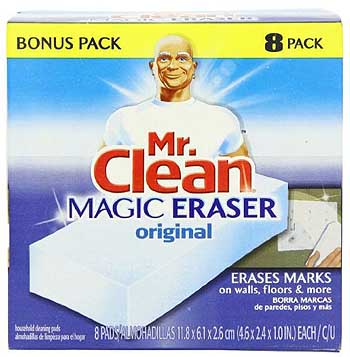
A warning. When you see your nice, new clean wall, you’ll spend the next hour wandering your house looking for more spots to remove. These things are truly magic (and addictive). Most hardware stores have them. Amazon has them for $12.98. Click here.
Favorite recent New Yorker cartoons.
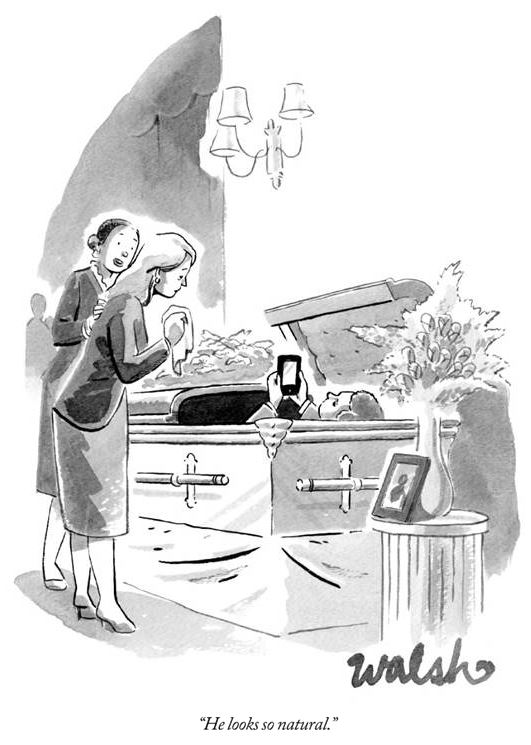
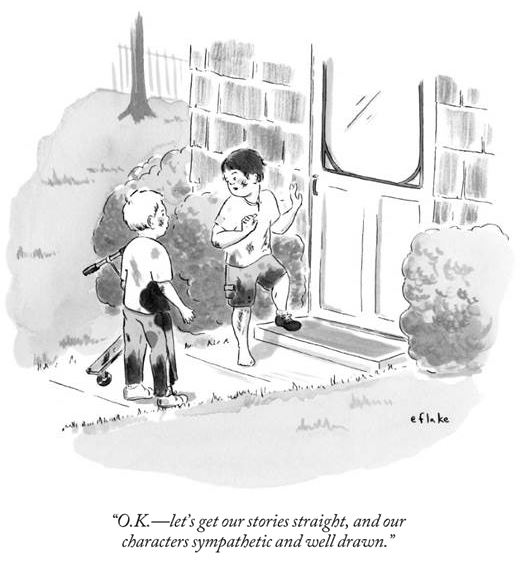
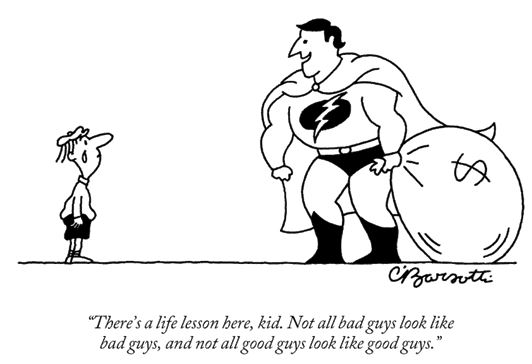

Harry Newton whose birthday is tomorrow. For his present, he would like every reader to send him their three best stock picks. I’ll talk about them all in the next few days. Anonymously, of course.

My three stocks and why I like them. TSLA becuase I would love to have one, NFLX becuase I watch it all the time and SAM because I need a beer while watching Netflix.
DIS– best brand on the planet; well-run divisions in TV, Sports, Theme parks, and movies. It’s always expensive, just buy a little at a time.
AMLP– group of gas pipeline MLP’s. Income from owning the toll takers in energy.
GTAT– take a flyer on the sapphire display screen maker for Apple. Sapphire could change LED technology as well. Sure, a big player (GLW?) might take over the sector, but GTAT has patents and has stability with a big Apple investment in it’s AZ plant.
What drives me nuts is the fact that we did this purely for political reasons. However, it didn’t work out that way as Obama misjudged once again. Trading five top-of-the-list Terrorists for one possible deserter isn’t in the nations best interest. Our [correct] policy always was, we don’t negotiate with terrorists. Now that they know we will make an unequal trade, they won’t hesitate to kidnap others. Insane.
The hypocrisy of the Republican party is what drives me nuts. And they don’t come up with any ideas, instead, they just criticize. 3 stocks – 1. RRD 2. CCMP and 3. DE
RRD is compelling, but I know as soon as I chase that fat 6.5% dividend it will tank. Lol.