I bought 200 shares of BHP for $66.09 for a cost of $13,218. On June 9 I sold 2 Jan $65 calls for $7.01 and collected $1,393.
If on Jan 22nd 2011 BHP is below $65 I keep the $1,393 and my 200 shares of BHP for a 10.6% gain, but if BHP is above $65 I will keep the $1400 and sell your 200 shares of BHP for $65 and take a capital loss of $200 and net out a capital gain of $1200 for a gain of 9%. Yesterday I placed a BTC (buy to cover) order at $3.50. if BHP does drop say to $60, I will net out a 5% gain, still own 200 share of BHP and be able to write more covered calls before Jan 2011.
A reader Steve Littlejohn wrote:
Consider the July 70 calls – with BHP at $66.80 at the moment, you can get $1.55. You could do this seven times by January for a total of $10.85. You are selling out of the money calls that will have a higher probability of expiring worthless….. Obviously you will have to adjust the strike price to match the price. In addition if the stock rises suddenly, it is easy to buy back a front month option and sell something higher in strike further out for the same or more money.
Another reader commented:
Hi Harry! Congrats on your first covered call sale. I’m not sure that your statistics on what percentage of covered calls expire worthless are correct. I took a seminar at the CBOE last year, and they said that it was more like 1/3 expire “out of the money” (worthless to the purchaser), 1/3 expire “in the money” (and thus are exercised, resulting in the purchaser of the calls calling away the stock at the strike price), and 1/3rd are bought back by the seller/market maker and thus “closed out” prior to expiration. My first thought upon reading that you sold calls was — wow, January is a long time from now. It is true that you get a much higher premium for those longer dated options — the option buyer is paying for that time value or “theta.” However, you are sort of locked in now until January. If you sell more contracts, may I consider looking at closer in months? The premiums are lower but the turnover is faster and generates income without long term commitment. I like to sell calls on Fridays when the market is up. You get some automatic price deterioration over the weekend with the loss of two days’ time. Best of luck!
A more profitable strategy might be to write covered calls on a company like NLY, which is presently yelding 14.86%. So long as your stock isn’t called away (and 80% to 90% aren’t – I still believe that number), you keep the dividend and the the money on the sale of the covered call. Yesterday Annaly announced a 68 cent quarterly dividend to be paid later this month. For more on Annaly’s dividends, click here.
Several things about the strategy of writing covered appeal:
1. Your chosen stock doesn’t have to rise for you to make a profit. Which means you don’t have to go crazy picking “winnners.”
2. You don’t have to write covered calls on stocks you think might be winners. I wouldn’t write calls against Apple or Treehouse Foods.
3. You get to keep the dividends, so long as you own the stock.
4. You can actually manage your returns better than sitting there, throwing darts at the board, praying for your stock to rise.
5. The is probably a good time to crank up writing covered calls. Personally I don’t see the market exploding upwards in coming months. But I also don’t see it tanking 25% in one day. Stranger things have happened.
The “big” downside is what happens when your stock falls. You can’t sell it, because you’ve written a covered call on it. But you can buy the call back — by then it will be cheaper. And then you can sell the stock. The good part is that the money you get for writing the call cushions you against the loss on the stock.
I’m learning this stuff. Like it’s best to sell covered calls when the market ticks up. Email or comment below with your thoughts.
Looking to put a portfolio together? For owning or writing covered calls against? Here are some excellent ideas:
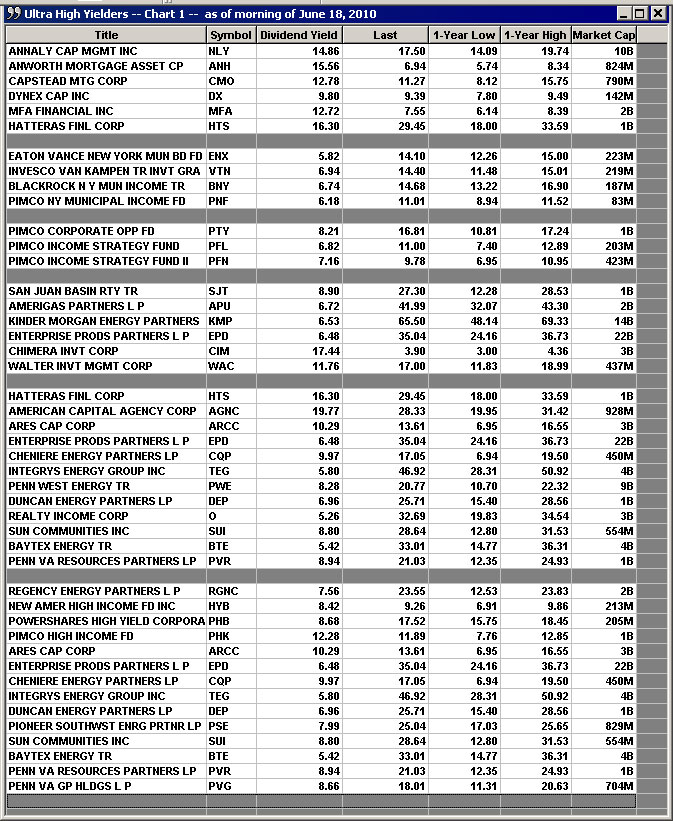
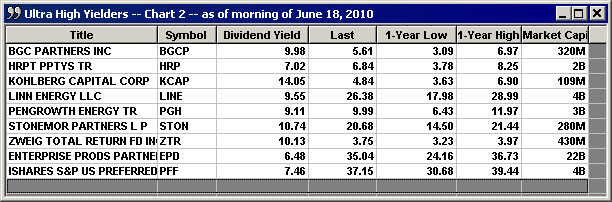
There’s no difference between the two charts in quality of stocks. I needed a second chart because I couldn’t fit all the stocks onto one chart. Also I notice there’s some duplication — like PVR in twice. That’s unintentional — a mistake.
This time is different, says the title. But it’s not. My friends who are in trouble borrowed too much money. Virtually all my investments with leverage are in big trouble. Fortunately, I have no personal borrowings. So I’m down, but liquid and sane. This big book is fascinating:
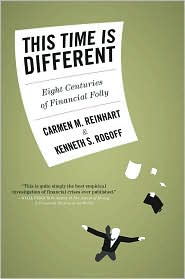
From this new book’s preface:
This book provides a quantitative history of financial crises in their various guises. Our basis message is simple: We have been there before. … If there is one common theme to the vast range of crises we consider in this book, it is that excessive debt accumulation, whether it be by the government, banks, corporations, or consumers, often poses greater systemic risks than it seems during a boom. Infusions of cash can make a government look like it is providing greater growth to its economy than it really is. Private sector borrowing binges can inflate housing and stock prices far beyond their long-term sustainable levels, and make banks seem more stable and profitable than they really are. Such large-scale debt buildups pose risks because they make an economy vulnerable to crises of confidence, particularly when debt is short term and needs to be constantly refinanced. (My emphasis.)
Sometimes BubbleVision is a hoot. I keep it mostly on mute. It’s my financial eye candy. This screen grabbed me. It really says it all.
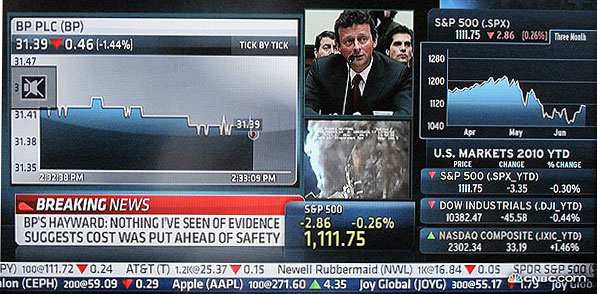
BP’s CEO is talking to Congress. The well is still spewing oil into the Gulf. Mr. Market doesn’t believe Hayward; BP’s shares are tanking (which is good, since I’m short them). Meantime, Apple is up $4.35 (which is good since I’m long Apple).
In an exclusive interview with The Wall Street Journal today, Russian President Dmitry Medvedev says the Gulf of Mexico oil spill could threaten the survival of BP. Couldn’t happen to nicer people. Why hasn’t the board fired Mr. Hayward?
Boom. The Story of Deepwater Horizon. GQ magazine ran a big story on the rescue. The story began: “Lost in the catastrophic aftermath of the Gulf of Mexico oil spill is the gripping tale of the rig workers and the Coast Guard crewmen who rescued them. Sean Flynn re-creates their long, harrowing, heart-pounding night.”
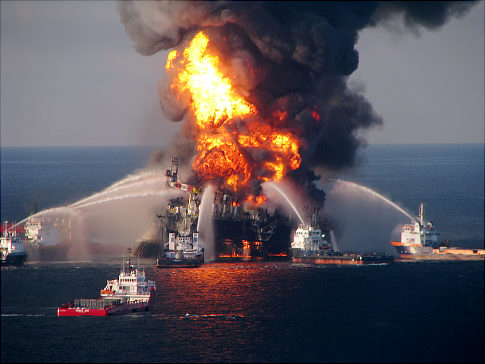
Inside the story:
Deep-sea drilling is a risky and complicated process, of course—the oil industry’s equivalent of a moon shot—and it’s vulnerable to all sorts of delays. Subterranean textures shift and soft layers collapse and gas from punctured pockets surges up the bore. Macondo has been particularly troublesome. Drilling the well and preparing it for a production rig was scheduled to take twenty-one days, but by the time Mike Williams helicopters to the Horizon on Monday, April 12, the job is into its fifth week. British Petroleum, which is leasing the rig from Transocean for $502,000 a day, is already $5 million over budget on rent alone; Mike hears the project as a whole might be as much as $150 million in the red.
Mike is 38 years old and a chief electronics technician on the Horizon, which means he monitors certain systems on the rig, makes sure the ventilation and the computer network and the gas sensors function properly. He used to manage the truck division at a Toyota dealership in Tyler, Texas, but the hours were brutal, working seven days every week, never seeing his wife, Felicia. He had a friend working offshore, and that was how Mike got on the rigs. “The good ol’ boy network,” he says. He’s been on the Horizon now for almost two years.
The problems with Macondo started on his last hitch, about two weeks into the job. Twice drilling had to stop—oilmen call it getting stuck—once to patch a crack in the bore hole, then again to drop a cement plug into a tender spot in the subsurface that collapsed around the drill string, the miles of pipe attached to the drill bit. All told, the Horizon lost at least ten expensive days. And no one gets a completion bonus when a well comes in late.
Mike senses the crew is frustrated but still determined, muscling through the final days of a job gone wrong. The well’s been drilled almost to depth, 18,000 feet, and then all that will be left is sealing it off until a production rig starts pumping out the oil and gas. Another ten days and the Horizon will move on to another site. And the news on the rig isn’t all bad. Next week, executives from BP are flying out to congratulate the crew for its safety record. In seven years, it hasn’t lost even an hour of operating time because someone got hurt.
At the time of the accident, Macondo was significantly behind schedule. Read the entire GQ piece here.
Be wary of investing in banks.Most are ticking time bombs. For more, read Nothing Fine About Our Banks.
If you’re 60+, you must get immunized against Shingles. But getting the vaccine is a mess. Susan and I continue to wait for our vaccine to arrive at our local pharmacy. We don’t know what the delay is. If you’re over 60, you should read this piece from last week’s New York Times.
Why Patients Aren’t Getting the Shingles Vaccine
By PAULINE W. CHEN, M.D. in the New York Times. June 10, 2010
Four years ago at age 78, R., a retired professional known as much for her small-town Minnesotan resilience as her commitment to public service, developed a fleeting rash over her left chest. The rash, which turned out to be shingles, or herpes zoster, was hardly noticeable.
But the complications were unforgettable.
For close to a year afterward, R. wrestled with the searing and relentless pain in the area where the rash had been. “It was ghastly, the worst possible pain anyone could have,” R. said recently, recalling the sleepless nights and fruitless search for relief. “I’ve had babies and that hurts a lot, but at least it goes away. This pain never let up. I felt like I was losing my mind for just a few minutes of peace.”
Shingles and its painful complication, called postherpetic neuralgia, result from reactivation of the chicken pox virus, which remains in the body after a childhood bout and is usually dormant in the adult. Up to a third of all adults who have had chicken pox will eventually develop one or both of these conditions, becoming debilitated for anywhere from a week to several years. That percentage translates into about one million Americans affected each year, with older adults, whose immune systems are less robust, being most vulnerable. Once the rash and its uncomfortable sequel appear, treatment options are limited at best and carry their own set of complications.
While the search for relief costs Americans over $500 million each year, the worst news until recently has been that shingles could happen to any one of us. There were no preventive measures available.
But in 2006, the Food and Drug Administration approved a new vaccine against shingles. Clinical trials on the vaccine revealed that it could, with relatively few side effects, reduce the risk of developing shingles by more than half and the risk of post-herpetic neuralgia by over two-thirds. In 2008, a national panel of experts on immunizations at the Centers for Disease Control and Prevention went on to recommend the vaccine to all adults age 60 and older.
At the time, the shingles vaccine seemed to embody the best of medicine, both old school and new. Its advent was contemporary medicine’s elegant response to a once intractable, age-old problem. It didn’t necessarily put an end to the spread of disease, in this case chicken pox; but it dramatically reduced the burden of illness for the affected individual. And, most notably, its utter simplicity was a metaphoric shot-in-the-arm for old-fashioned doctoring values. Among the increasingly complex and convoluted suggestions for health care reform that were brewing at that moment, here was a powerful intervention that relied on only three things: a needle, a syringe and a patient-doctor relationship rooted in promoting wellness.
Not.
In the two years since the vaccine became available, fewer than 10 percent of all eligible patients have received it. Despite the best intentions of patients and doctors (and no shortage of needles and syringes), the shingles vaccine has failed to take hold, in large part because of the most modern of obstacles. What should have been a widely successful and simple wellness intervention between doctors and their patients became a 21st century Rube Goldberg-esque nightmare.
Last month in The Annals of Internal Medicine, researchers from the University of Colorado in Denver and the C.D.C. surveyed almost 600 primary care physicians and found that fewer than half strongly recommended the shingles vaccine. Doctors were not worried about safety — a report in the same issue of the journal confirmed that the vaccine has few side effects; rather, they were concerned about patient cost.
Although only one dose is required, the vaccination costs $160 to $195 per dose, 10 times more than other commonly prescribed adult vaccines; and insurance carriers vary in the amount they will cover. Thus, while the overwhelming majority of doctors in the study did not hesitate to strongly recommend immunizations against influenza and pneumonia, they could not do the same with the shingles vaccine.
“It’s just a shot, not a pap smear or a colonoscopy,” said Dr. Laura P. Hurley, lead author and assistant professor of medicine at the University of Colorado in Denver. “But the fact is that it is an expensive burden for all patients, even those with private insurance and Medicare because it is not always fully reimbursed.”
Moreover, many private insurers require patients to pay out of pocket first and apply for reimbursement afterward. And because the shingles vaccine is the only vaccine more commonly given to seniors that has been treated as a prescription drug, eligible Medicare patients must also first pay out of pocket then submit the necessary paperwork in order to receive the vaccine in their doctor’s office. It’s a complicated reimbursement process that stands in stark contrast to the automatic, seamless and fully covered one that Medicare has for flu and pneumonia vaccines.
Despite this payment maze, some physicians have tried to stock and administer the vaccine in their offices; many, however, eventually stop because they can no longer afford to provide the immunizations. “If you have one out of 10 people who doesn’t pay for the vaccine, your office loses money,” said Dr. Allan Crimm, the managing partner of Ninth Street Internal Medicine, a primary care practice in Philadelphia. Over time, Dr. Crimm’s practice lost thousands of dollars on the shingles vaccine. “It’s indicative of how there are perverse incentives that make it difficult to accomplish what everybody agrees should happen.”
Even bypassing direct reimbursement is fraught with complications for doctors and patients. A third of the physicians surveyed in the University of Colorado study resorted to “brown bagging,” a term more frequently used to describe insurers who have patients carry chemotherapy drugs from a cheaper supplier to their oncologists’ offices. In the case of the shingles vaccine, the study doctors began writing prescriptions for patients to pick up the vaccine at the pharmacy and then return to have it administered in their offices. However, the shingles vaccine must be frozen until a few minutes before administration, and a transit time greater than 30 minutes between office and pharmacy can diminish the vaccine’s effectiveness.
Dr. Crimm and the physicians in his office finally resorted to what another third of the physicians in the study did: they gave patients prescriptions to have the vaccine administered at pharmacies that offered immunization clinics. But when faced with the added hassles of taking additional time off from work and making a separate trip to the pharmacy, not all patients followed through. “Probably about 60 percent of our patients finally did get the vaccine at the pharmacy,” Dr. Crimm estimated. “This is as opposed to 98 percent of our patients getting the pneumonia and influenza vaccines, immunizations where they just have to go down the hall because we stock it, roll up their sleeves then walk out the door.”
With all of these barriers, it comes as no surprise that in the end only 2 percent to 7 percent of patients are immunized against shingles. “There’s just so much that primary care practices must take care of with chronic diseases like obesity and diabetes and heart disease,” Dr. Hurley noted. “If a treatment isn’t easy to administer, then sometimes it just falls to the bottom of the list of things for people to do.”
“Shingles vaccination has become a disparity issue,” Dr. Hurley added. “It’s great that this vaccine was developed and could potentially prevent a very severe disease. But we have to have a reimbursement process that coincides with these interventions. Just making these vaccines doesn’t mean that they will have a public health impact.”
How to sell toothbrushes
The kids filed back into class Monday morning. They were very excited. Their weekend assignment was to sell something, then give a talk on productive salesmanship.
Little Sally led off: “I sold girl scout cookies and I made $30,” she said proudly. “My sales approach was to appeal to the customer’s civic spirit and I credit that approach for my obvious success.”
“Very good,” said the teacher. Little Jenny was next: “I sold magazines,” she said. “I made $45 and I explained to everyone that magazines would keep them up on current events.”
“Very good, Jenny,” said the teacher.
Eventually, it was Little Johnny’s turn. The teacher held her breath as Little Johnny walked to the front of the classroom and dumped a box full of cash on the teacher’s desk. “$2,467!” he said.
“$2,467!” cried the teacher, “What in the world were you selling?”
“Toothbrushes,” said Little Johnny.
“Toothbrushes!” echoed the teacher, “How could you possibly sell enough tooth brushes to make that much money?”
“I found the busiest corner in town,” said Little Johnny, “Then I set up a Dip & Chip stand and gave everybody who walked by a free sample.”
They all said the same thing, “Hey, this tastes like dog shit!”
Then I would say, “It is dog shit. Wanna buy a toothbrush?”

Harry Newton, who apologizes for today’s length. If you think it will take you too long to read, think of how long it took me to write it. Michael, my son, arrives this morning for his bachelor’s party this weekend. His August wedding approaches. Anne, his fiancee and my wife had minor meltdowns last night on accommodations for our expanding families. I offered to sleep in my pup tent and hang my pricey wedding suit on the nearest tree. They may take me up. They assume me it never rains in August. I’ll be OK. Knowing my luck, there’ll be a tornado and Harry Daddy (i.e. me) will wake up in Kansas, uncovered.

The best way to jump in and out of options is in a self-directed IRA. That way you reduce the short-term investment tax burden, making your return all the better.
Once you get shingles, you cannot get the vaccine. Get the shot, don't even think about anything else.
Another thought, we no longer need any more regulations. We have all we need, but they pale against the desire of greed. Another Solution: make the death penalty mandatory for any fraud greater than $500,000. ;-}
Traders are taught that the Holy Grail to Investing doesn't exist. Real people were taught that all the planet's move about the earth, don't go to far out into the ocean(you'll fall off the earth), on and on……….
When one looks outside the box(inventor), goes against the group(thinks for self), said they found(developed) something that is supposed to be impossible(airplanes), they were once killed. Now these people are called bad names and delegated to be unheard, and ignored group.
The ultimate business solution. The ability to cut the cost of any business expense, or just plain invest.
I developed multiple arbitrages that enable me to trade(not invest) in the finacial markets, without risk(The Holy Grail to Investing), or arbitrage that anyone can do. Over 30% a year.
Thomas
thomasadair@live.com
I was a participant in the original trials for the development of the shingles vaccine. I have had the shot and encourage everyone to make the effort to obtain the shot. The personal friends I have that developed shingles went through hell. It is worth it to seek out the shot. glenn
Harry — FYI — if you sell an OTM covered call against a dividend paying stock and the price of the stock rises enough such that the option is now ITM prior to the payment of the dividend, the option owner may choose to exercise the option early and call your stock away before the dividend is paid so that he gets it instead of you. This doesn't happen often but you should be aware especially if trying this strategy in the high-yielding group.
RE: Macs and Windows PCs
My MacBook Pro is the best Windows machine I have ever owned. When I bought it Mac versions of all my Windows apps were not available so I used Boot Camp to load XP and my Windows apps. I never bothered to replace the Windows apps because they work so well now — much better than on a PC. I almost never reboot it, Windows never crashes, etc. I used to be in the semiconductor business and from first-hand experience know why Mac's are so much better Windows machines than PCs.
RE: call options
I have made a fair amount of money selling covered calls the past few years. I generally take a conservative approach if I am writing calls on stocks I want to keep: I only write calls at strike prices above my cost basis; I do not select strike prices too close the current price (A couple of times I got too aggressive (i.e. greedy) and had shares I wanted to keep assigned); I write calls with expiration dates up to six months but prefer 2 or 3; I only close a position before the contracts expire if the premium is almost $0 and if I can replace it with a higher premium contract. It's not a very sophisticated approach, but it takes very little time and I make money with no risk. Of course, good premiums come and go so I haven't been able to turn covered calls into a monthly income, but I have been able to make a couple of percent per year on the stocks I am holding.
Harry,
Firefox is Great! Be sure to look into the “Pipeline” adjustments you can make that will improve speed. Let me know if you want some links. Also, look into the following Addons which I find useful – some more than others.
Ad block Plus
Colorful Tabs
FasterFox
GetMailPlus
IE View
Rights To Close
Vacuum Places Improved
Open Book
MultirowBookmarksToolbar
Burt Stuttman
About this point you made: “The “big” downside is what happens when your stock falls. You can’t sell it, because you’ve written a covered call on it. But you can buy the call back — by then it will be cheaper. And then you can sell the stock. The good part is that the money you get for writing the call cushions you against the loss on the stock.””
You can fix this by being authorized by your brokerage to buy/sell Naked puts/calls…. Then you can sell your stock and automatically convert the covered call to a naked call.
Hi Harry
Re: Shingles Vaccine
We have a fantastic insurance program here (Maricopa County, AZ only). It is an HMO called CIGNA for Seniors. No monthly premium and too many other benefits to mention…however…last year we got our Shingles Shots. We witnessed the horrible experience our neighbor had with shingles. CIGNA stocked the vaccine so we picked-up our prescription from our doctor, paid our $30.00 each, walked across the lobby to the nurses station and received our shots. Simple as that. There are many benefits to being retired in Arizona!! Not the least is living in geriatric heaven. (Just don't tell anyone our secret)
Harry,
Glad to see you are finally taking advantage of 'free money'- selling options. The next thing to experiment with, on a small scale, is selling puts. Let's say you want to buy another 100 shares of AAPL, which is trading at $272 as I write this. But, you would rather buy it at $270. If you sell a June $270 put, which expires effectively today (technically tomorrow), you collect $1 for that put. $1 per share x 100 shares = $100 which you keep, no matter where the stock closes. If it closes below $270, you will be forced to buy 100 shares at $270, but your effective cost basis is $269, as you collected the put premium. I rarely buy stocks outright anymore, I just sell puts. I do agree with the poster who recommended you stick to close-in months, rather than going out to January. If you do an analysis, you will find you collect more in premium by selling month after month, rather than going for the longer-out time premium. Good luck.
Harry,
please do your readers a favor and make sure they understand covered calls inside and out……… A COVERED CALL nothing more than selling a naked put it has the exact same risk………… and if anyone does not understand that I would be happy to explain it in detail……………
Please do explain.