Give a person a fish and you feed them for a day. Teach a person to use the Internet and they won’t bother you for weeks, months, maybe years.
My country Internet came back. What a joy to be back in the 21st century and endlessly read about all the world’s disasters I can’t affect.
Two things I learned: Deductive reasoning still works. Replace one thing at a time. Eventually you’ll find the problem. Second, summer lightning and thunderstorms really mess up electronic equipment — often not killing it completely, but killing it enough to stop it working properly. The last thing we swapped out was the DSL modem. The old one shone the right lights, so our logic was it was working. It wasn’t. A new one worked like a charm.
Always put surge arrestors behind everything — including your phone lines. I know I sound like a cracked record. But the amount of time you waste trying to fix this complex stuff — or even getting the techies to visit — is mindblowing.
I’m not impressed with Triple AAA, the car fix people. After waiting 20 minutes on hold in 90 degree heat, I gave up on them and fixed it myself. This was the first time I’d called them for emergency service is 30 years. They just lost me as a paying member. Yelp does a better job.
Repurposing dead real estate is a huge opportunity. Wal-mart moves to a bigger store. Price Chopper moves to a bigger store. Buy the old, abandoned building cheap and rent it cheap. Light manufacturing, cheap retail, for storage, for whatever. The classic repurposing was 111 Eighth Avenue in New York City. It was repurposed as a teleocmmunicatoins carrier hotel / server farm way back. Want the world’s most reliable telecom and computing service, locate here. Look at Google aerial photo. The place bristles with emergency generators, satellite antennae:
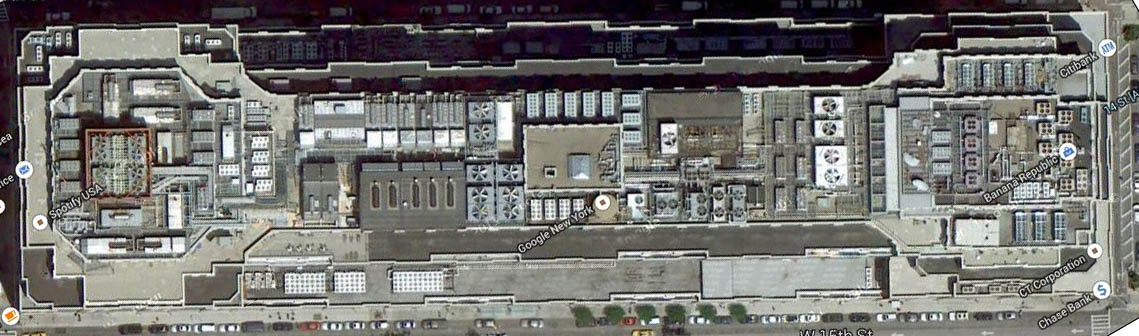
Best to go into Maps.Google and search for the address. On a big screen, the view is amazing. Google now owns the building.
Intel’s answer to Apple’s iPad: cheap tablets. Read the WSJ’s story. It shows how desperate a big tech company can be when its lunch gets eaten by competitors. Click here.
VC View: Investable Trends. Rich Karlgaard, publisher of Forbes Magazine writes this in the current issue:
Hewlett-Packard began in 1939 in a Palo Alto, Calif. garage and is known as Silicon Valley’s first startup. But the first use of the term “Silicon Valley” would come 32 years later. Don Hoefler, a writer, used it in 1971 to label a series of stories in the weekly newspaper Electronic News. “Silicon” stood for the area’s semiconductor companies: Fairchild Semiconductor, National Semiconductor and a three-year-old startup called Intel INTC, among others.
Venture capital in Silicon Valley got going around the same time. Kleiner Perkins Caufield & Byers began in 1972. It went on to fund AOL AOL 0%, Amazon, Compaq, Genentech, Sun Microsystems, Netscape and Google GOOGL. Rival firm Sequoia Capital was also founded in 1972. It went on to fund Apple AAPL, Oracle, Cisco, Electronic Arts, Google, YouTube, LinkedIn and WhatsApp (sold earlier this year to Facebook).
The technology/venture capital partnership has been pure gold. It has made Silicon Valley a champion in the global economy. The Valley has suffered busts-notably the 2000-02 dot-com crash-but mostly it’s leaped from boom to boom, thanks to this powerful pairing.
So which technologies are Silicon Valley venture capitalists backing today? My FORBES colleague Bruce Upbin and I recently moderated a panel on funding trends with top Valley VCs.
-Enterprise IT will be radically transformed. Incumbents, such as IBM, HP, Cisco and Oracle, are going to face new competition from startups that will bring gamelike software to accounting, inventory management and logistics.
-Commercial banks will suffer a relative decline. Peer-to-peer lending models à la the Lending Club will snatch traditional banking’s customers.
-Digital home networks that link everything from televisions and telephones to heating and air-conditioning systems will become common.
But there’s a dark side. Digital home networks will be a hacker’s paradise. Teenage pranksters won’t call your home to ask if your refrigerator’s running. They’ll hack into your home network to turn off your refrigerator. Professional hackers will probe your home network for credit card and banking passwords. Therefore, home digital security will become a big business.
-The health insurance industry will be seriously disrupted by employers. Most companies with more than 500 employees will self-insure. They’ll use technology networks to eliminate physician networks and payment systems. The future can be seen at Stanford Medicine, which contracts directly with many Silicon Valley companies.
-Tiny technology and big data will transform health diagnostics and treatment courses. Like in a scene out of the 1966 sci-fi thriller Fantastic Voyage, a patient will swallow or be injected with a tiny chip. The chip will relay huge amounts of microbiomics (the study of the interlocking systems of human cells and microbial life in our bodies) data. This will be analyzed by doctors and reviewed by analytics engines so that a diagnosis and treatment plan can be made.
-The “last-second economy” will continue to grow. An already successful example of this is Uber, the car-ride service that’s reachable via a mobile phone app. More and more products and services-even physician services-will be priced based on the Internet’s real-time auction price.
-Spot pricing for health care procedures will become the norm. Consider MRIs. The cost of a new MRI machine is around $2 million, yet it’s typically used from 9 a.m. to 5 p.m. Why not create a market for discount MRIs scheduled during off-hours-for example, 50% off at 11 p.m. or 80% off at 3 a.m. This is coming, say the VCs.
-A woman entrepreneur (relatively rare in the Valley) will start a company with a $50 billion exit plan (either as an initial public offering or an acquisition). That would make it Facebook-size. But would this be a first? Cisco was started in 1984 by Sandra Lerner and Leonard Bosack, who at the time were married. It reached a market value of $555 billion in early 2000, so in a sense this has already happened.
-Smartphones will be slimmer, lighter. Credit cards will become smarter and have apps, just like cellphones. The war to dominate your wallet has started.
Silicon Valley venture capitalists are investing in these ideas today. That means the VCs expect these ideas to gain traction within five years and make money within ten. Stay tuned.
Microsoft’s new CEO lays out the future for Microsoft. And it’s vision-less.
I couldn’t believe the drivel Microsoft’s new CEO, Satya Nadella, just put out in a public memo to employees and the world, which included:
Microsoft was founded on the belief that technology creates opportunities for people and organizations to express and achieve their dreams by putting a PC on every desk and in every home.
More recently, we have described ourselves as a “devices and services” company. While the devices and services description was helpful in starting our transformation, we now need to hone in on our unique strategy.
At our core, Microsoft is the productivity and platform company for the mobile-first and cloud-first world. We will reinvent productivity to empower every person and every organization on the planet to do more and achieve more.
We think about productivity for people, teams and the business processes of entire organizations as one interconnected digital substrate. We also think about interconnected platforms for individuals, IT and developers. This comprehensive view enables us to solve the more complex, nuanced and real-world day-to-day challenges in an increasingly digital world. It also opens the door to massive growth opportunity – technology spend as a total percentage of GDP will grow with the digitization of nearly everything in life and work. …
Our first-party devices will light up digital work and life. Surface Pro 3 is a great example – it is the world’s best productivity tablet. …
Finally, every team across Microsoft must find ways to simplify and move faster, more efficiently. We will increase the fluidity of information and ideas by taking actions to flatten the organization and develop leaner business processes. Culture change means we will do things differently. Often people think that means everyone other than them. In reality, it means all of us taking a new approach and working together to make Microsoft better. To this end, I’ve asked each member of the Senior Leadership Team to evaluate opportunities to advance their innovation processes and simplify their operations and how they work. We will share more on this throughout July.
A few months ago on a call with investors I quoted Nietzsche and said that we must have “courage in the face of reality.” Even more important, we must have courage in the face of opportunity.”
You can read the entire drivel here.
I feel sad. He has zero idea of what he’s doing. He has no Vision for the company. No guidance for the poor employees. Except that many of them will be canned soon. Watch out.
He ain’t no Bill Gates.
Ask yourself one question: Why does Microsoft exist at present?
He doesn’t answer the question.
I feel I could manage the place better. I’d instantly split Microsoft into separate companies. Spin off gaming. Spin off the hardware, like the ridiculous Surface Pro and the Nokia phones. Spin off Bing, Skype, etc. Spin off Office. Spin off the enterprise software division. Spin off the cloud. I’d probably keep Windows.
Imagine if there were real entrepreneurs running each of the new companies. It would be bonanza for investors, for employees and for computing.
Four neat apps for your iPhone:
+ Waze. Best car travel app ever. Alerts you to police traps. Gets you where you’re going the easiest. Detours you around blockages.
+ TKTS. Cheap tickets for that evening to New York Broadway shows. The online version of the booth on Times Square. Saves you lining up with all the unwashed.
+ Trover. It will tell you what’s neat where you currently find yourself. Brilliant idea.
+ Dark Sky. The absolute best weather app for where you are.What’s happening and when. Alerted me to when the rain would stop so I could walk Rosie.
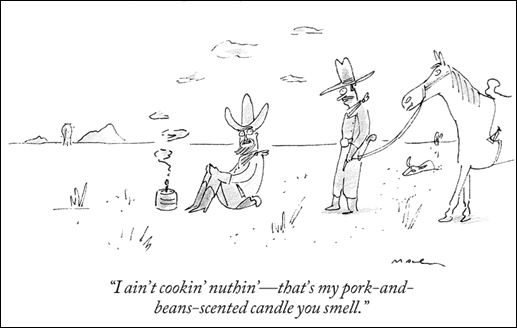
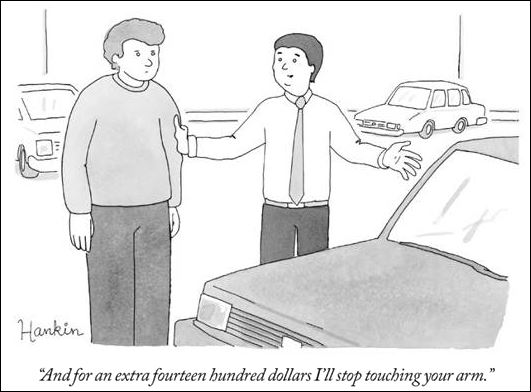
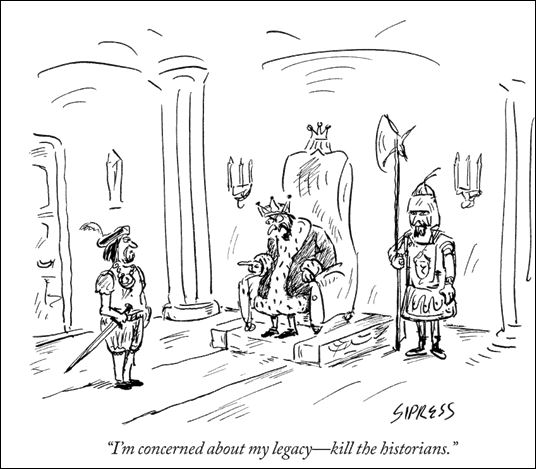
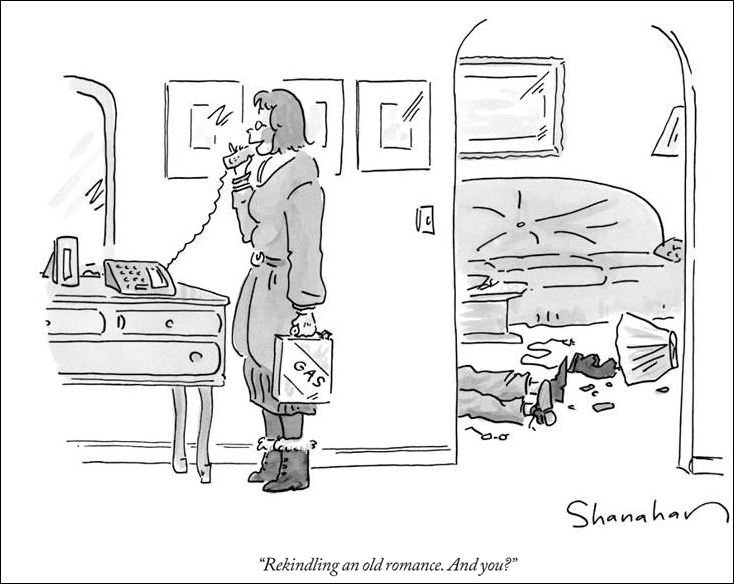
Best recent New Yorker cartoons.
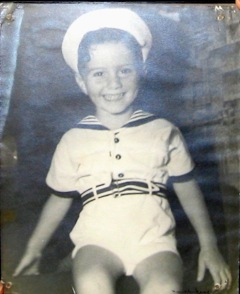
Harry Newton whose family suggested I used this picture of me. I was six. I was a cute kid. Not so cute as a crabby old man, still missing a front tooth. Oh, did I tell you about my new implant just fell out? “Harry, you have no luck with your teeth,” says my hygenist.

Harry…get a “Whole House” surge arrestor installed on your farm house…after our neighbor to our cottage had a serious fire from lightning shooting out of a wall outlet and catching bed cloths on fire plus knocking out all electrical appliances we had one installed for $50.00+ and stopped worrying. Those so called guaranteed for life power strip surge protectors often fail. Contact your electrician, they install ahead of your main electrical box.
Harry, I recall you writing about a whole house arrestor. Didn’t you get one? Ron
i thought we had one. But it doesn’t protect against lightning surges coming up phone lines and affecting DSL modems.
Excellent piece from Rich Karlgaard. Thanks! I forget how good he is and don’t follow him closely enough.
As far as keeping “Windows” if you were King of Redmond… the OS takes tremendous resources to maintain. I would bet it has a crappy bottom line if you do your cost accounting correctly. Ideas like the Chromebook are picking off the low hanging fruit (education and corporate markets). On hardware: the King of Redmond should ask, “Why does my Microsoft do such a good job with game console hardware and such a crappy job with every other kind of hardware?” There is something to learn there, but I’m not sure what it is.