Is this 1929, 2000 or 2008? Many people believe it is.
The VIX is up:
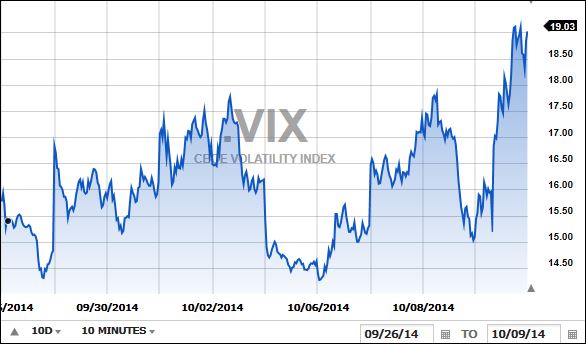
We’ve had huge volatility in recent days:
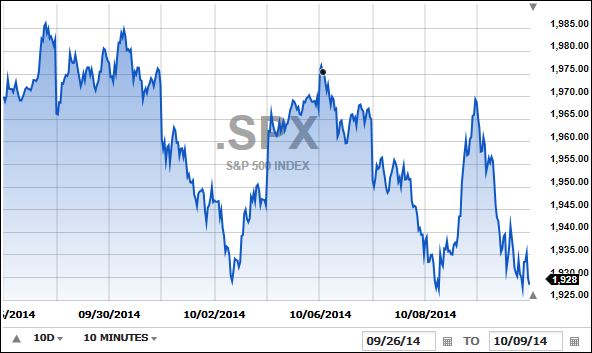
And now this chart has become popular:
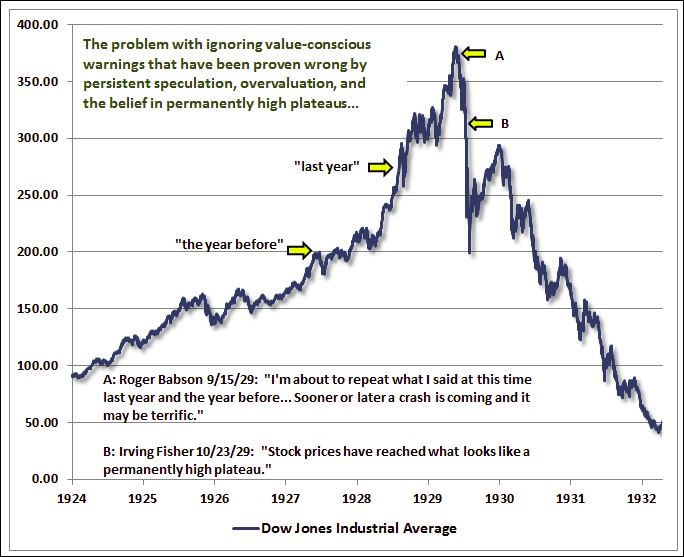
I found this chart on John Hussman’s latest commentary, which he headlined “Dancing Without a Floor.” Hussman is famous. He runs funds, writes extensively on the market and sticks his neck out with predictions of disaster, that are often right. From his latest column:
As I did in 2000 and 2007, I feel obligated to state an expectation that only seems like a bizarre assertion because the financial memory is just as short as the popular understanding of valuation is superficial: I view the stock market as likely to lose more than half of its value from its recent high to its ultimate low in this market cycle.
From a valuation standpoint, this assertion is based on the same methods that brought me to warn of those risks in 2000 and 2007. It is based on the same methods that encouraged me to be a leveraged bull in the early 1990’s, allowed us to shift to a constructive stance after the 2000-2002 bear market, and identified market undervaluation in late-2008 (see Okham’s Razor and the Market Cycle for more on these valuation estimates). All of this has certainly been obscured as a result of my unfortunately-timed 2009 decision to stress-test our methods against Depression-era data, and the later need to incorporate various overlays to the resulting ensemble methods in order to narrow their defensiveness during overvalued, overbought, overbullish periods. We’ve adapted quite a bit as a result, but don’t imagine that valuations or present market conditions can be dismissed because we encountered those challenges.
Emphatically, we do not rely on a severe decline as a precondition to encourage a constructive position. As I’ve frequently noted, the most favorable market return/risk profile we identify emerges where a material retreat in valuations is coupled with an early improvement in our measures of market action. We will shift our stance toward market risk when our measures of valuation and market action shift materially, even if (as was the case in early 2003) valuations remain well above historical norms when that occurs.
In my view, the problem for investors here is that they are placing elevated multiples on cyclically elevated profits without recognizing that the S&P 500, for example, is a claim not on some multiple of next year’s earnings, but on a long-stream of deliverable future cash flows with an effective duration of about 50 years. Moreover, our measures of market action and trend uniformity have shifted negative, removing our best measure of the speculative support that has underpinned the market and helped overvalued, overbought, overbullish conditions to be persistently extended in recent years. Understand that distinction, because as in 2000 and 2007, such shifts can make seemingly meaningless overvaluation matter suddenly and with a vengeance.
Remember also that while interest rates do affect valuations, that effect is measurable, and it’s essential to do the arithmetic. If one expects 3-4 more years of zero short-term interest rates rather than a more normal level of say, 4%, it follows that one can justify stock prices that are 12-16% (3-4 x 4%) above historically normal valuations. Unless one expects zero interest rates or sustained profit margins at record highs for the next quarter century, it’s difficult to justify stock prices on the basis of low interest rates or cyclically elevated profit margins.
You can read Hussman’s entire comments here.
If you worry about this market, as I do, you have several “strategies”:
+ Buy puts.
+ Dump your stocks whose growth does not match their hugely-high P/Es, e.g. ADSK, WWAV, HAIN, and V. (I already dumped MA.)
+ Dump stocks down 10%+ from their recent highs.
I don’t think it’s a good idea to dump everything.
I have sold a little in recent days. Last night I checked my sale prices versus last night’s close. In most cases — but not all — I’d sold at above where it closed last night.
Best to sell on up days.
When and why banks fail. At the end of each day, banks rely on each other for balancing their accounts. They lend each other money. They become borrowers and lenders. When they nervous about one or more of their brethren, they back off and the world collapses. That’s why we now have the FDIC et al. The financial world collapsed in 2007 and the market in 2008 because bank executives juices their returns (and their bonuses) with risky bets, like sub-prime mortgages and derivatives. When crises happened in the past, bank managements got changed. Not in 20027-2008. The only thing that changed was the realization among the executives managing our big banks that if they screwed up again with risky bets, the government would be there to bail our their banks and allow them to keep their bonuses.
Baiing out the banks does not mean bailing out investors, like you and me. Think 2007-2008. They bailed the banks out in 2007. The following year you and I got hit big-time , as our stocks plummeted.
Am I worried now about banks misbehaving again? Yes!
You can’t make big money today being a banker. Interest rates are too low and spreads too thin. But there are other gambles around, like derivatives. Read this piece from the Economist:
Derivatives
Armageddon delayed
Throwing sand into the gears of the financial doomsday machine
“WE WILL not kick you when you are down, at least not for a couple of days”: that is the gist of a putative deal struck by 18 global banks this week, which agreed not to pull abruptly out of contracts with each other if one of them hits the buffers. As modest as that may sound, regulators see it as the foundation of a firewall to halt the spread of future financial crises.
The agreement concerns derivatives, contracts whose value “derives” from the performance of an underlying asset such as a share, currency or bond. Banks use them to hedge themselves or speculate, to the chagrin of regulators who dislike how hard they are to value and how easily they can entangle financial institutions in a web of interdependency.
If a bank will benefit from invoking its right to demand early settlement of such contracts when a counterparty runs into trouble, it tends to do so, naturally enough. Lehman Brothers discovered this in 2008; bankruptcy lawyers are still untangling the mess. If everyone cuts and runs at once, however, the stricken party has to hand over cash when it can least afford it, deepening the crisis.
By contrast, a brief stay might give regulators time to right a listing bank, by forcing it to sell off still-healthy units, say. America and Europe have instituted such moratoriums since the crisis, but these do not apply to cross-border deals. Global rules which extend the principle to asset managers and others are in the pipeline.
Banks hope their voluntary fix will assuage regulators’ concerns that many of them are still “too big to fail”. Officials are increasingly anxious to find a way to close ailing financial firms without sparking a global panic. American regulators recently sent back for revision all 11 “living wills” they have received from banks, detailing how they might be wound down in a crisis. But at least one element of such a resolution is now clearer.
“Free” life insurance update. Many readers have emailed me. They have asked for more information. I don’t have any yet. When I get it, I’ll let you know. One reader asks “How could this be legal?” I don’t have all the answers.
“Remove Israel from That Map!” A fascinating story of what happened when two young Arab Israelis singers appeared on the Arab world’s most popular TV show called Arab Idol. Click here.

Harry Newton who’s playing tennis aggressively this weekend.

Ugly…What was I thinking…..Should have listened to Warren, don’t fall in love with a stock….The horror! The horror! You were right Harry, smart boys were loading up on puts….
But-But-But, I thought you recently wrote that your friends thought it was a good time to buy? (This was about 3 weeks ago) Your friends are down about 10% so far.