I closed out my Petrobras short, for three reasons. First, it had already fallen enough to make me a nice profit. Second, it was looking like it had hit a floor and would maybe rise. Third, there was talk that Dilma might come up with some new policies in her second presidential term to deal with the disastrous policies of her first term. (Fat chance.) Here’s PBR over the past two days:
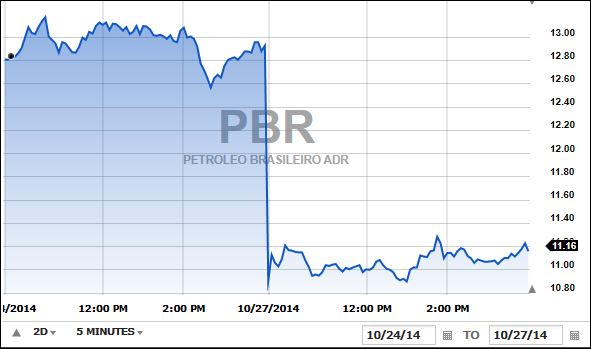
A look at it through this year tells the story of false hopes and broken promises. I bet it’s still a good short.

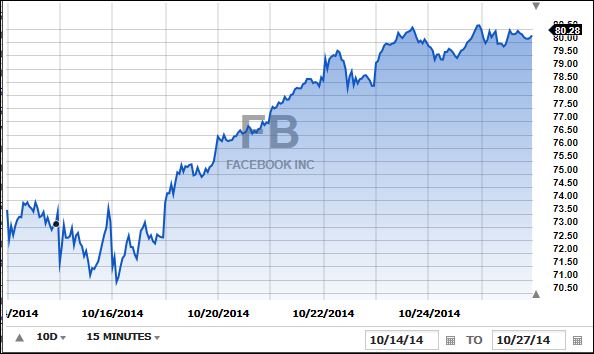
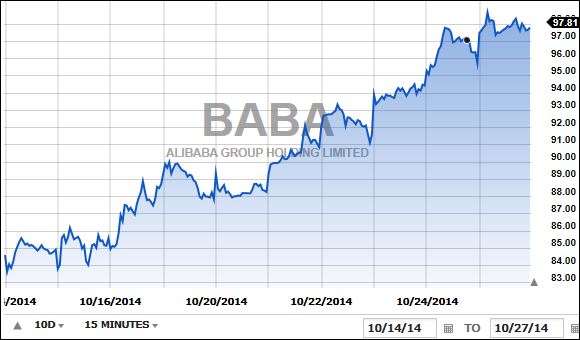
This market loves stocks with a strong story and lots of publicity (especially on CNBC), and especially being relentlessly pushed by Cramer). Examples:
This one is my favorite cyber-security stock. Security is a hot space. There are millions with great ideas. This Israeli one has the best idea — follow the admin portals on corporate networks. The portals are the most vulnerable part.
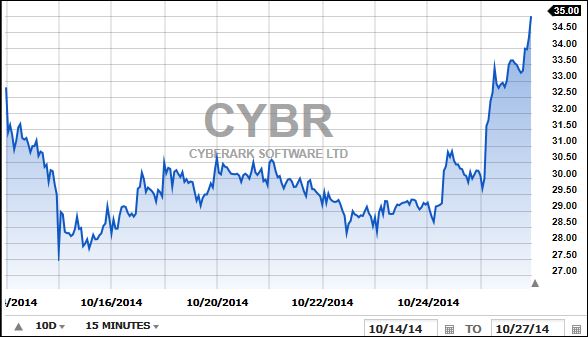
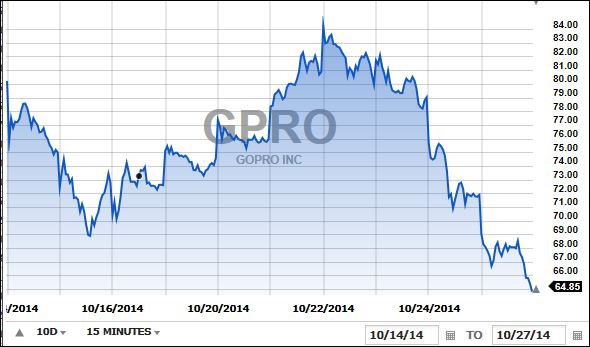
You have to play these momentum stocks ultra-carefully. If their earnings or guidance disappoint and they turn on you, it’s time for that inviolate stop loss order (despite the fact that you might love their product), e.g.:
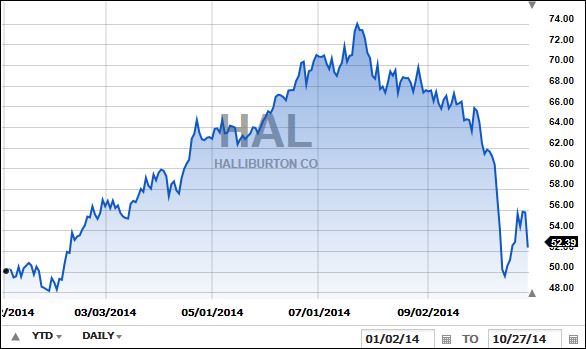
You also have to be aware of fashions. Oil has fallen. Hence oil stocks are being thrown out with the bathwater, even if they don’t drill for the stuff, e.g.
Oil is why we’re in DAL and AAL.
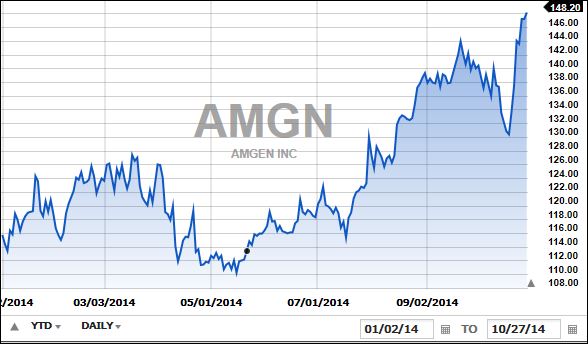
Did I mention Amgen a few days ago. You see their latest results? The stock should be up strongly this morning:
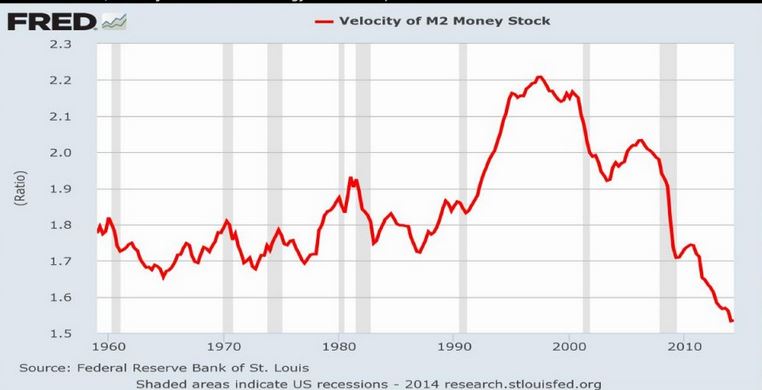
Business Insider’s amazing charts: From them:
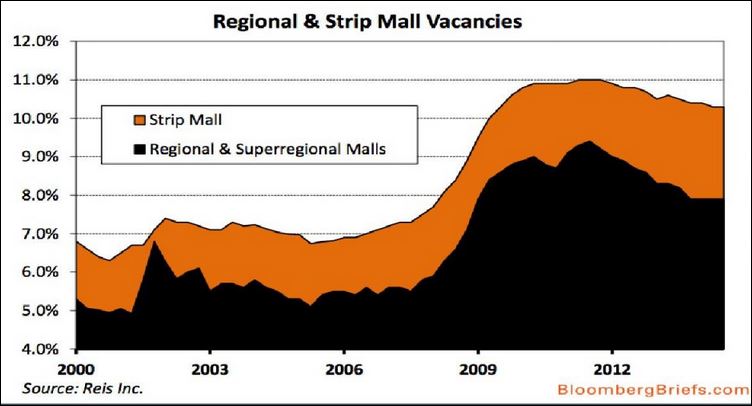
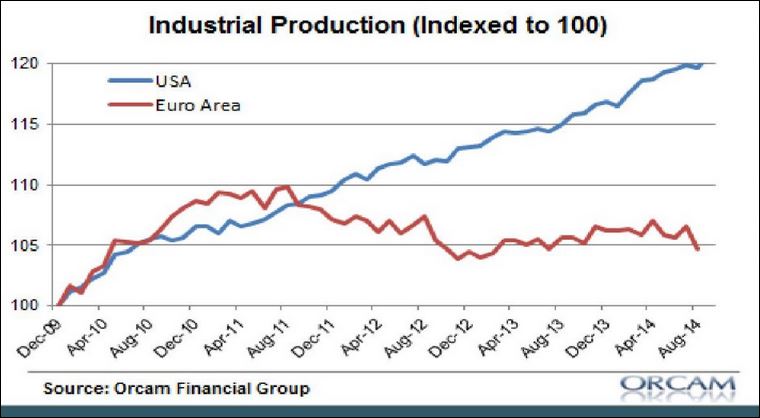
Here they are: the most important charts in the world.
A lot has changed since the last time we published this collection back in July.
The economic situation in Europe has deteriorated, the unemployment rate in the US has fallen below 6%, and the Fed looks poised to conclude its quantitative easing program this week.
Volatility has returned to markets, with the S&P 500 recently declining more than 9% before sharply rebounding, while the bond market had one of its most volatile days in history as the US 10-year yield fell 37 basis points in just a few hours.
And in the background of all of this is the declining price of oil, which on Monday fell below $80 a barrel for the first time in over two years, and a Russian economy that is looking at a dramatically depreciating ruble.
We asked our favorite economists, analysts, bloggers, and hedge fund managers for the chart they’re watching right now. What they responded with was a collection of charts reflecting the increasing market fears about deflation, the economic malaise in the eurozone, and the growing suspicion that maybe the Fed’s QE program will be reinstated faster than many people currently expect.
And despite the uncertainty, many of our experts offered reasons why we should be optimistic.
So without any further ado, here is what some of the sharpest folks on Wall Street are focused on right now.
You can see the full collection beginning here.
Amazing. Simply amazing.
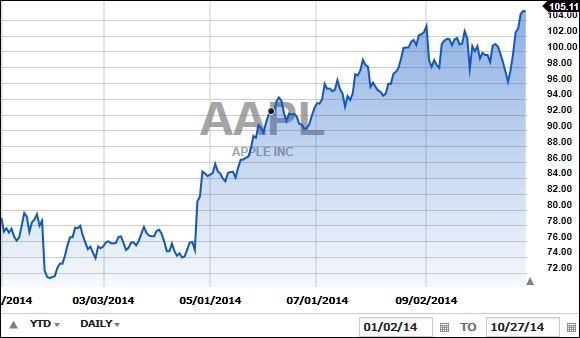
Yesterday Tim Cook said more than one million credit cards were activated on the company’s new Apple Pay service within 72 hours of its debut last week. Apple Pay only works on the new iPhone 6. That gives you an idea of how many of the phones he’s sold . I was wrong about Cook. He’s doing good:
Advice for your kids.From Brian Chesky of Airbnb, on Scratching the Itch to Create
What advice do you give to graduating college students?
I’d say, don’t listen to your parents. They’re the most important relationships in your life, but you should never take your parents’ career advice, and I’m using parents as a proxy for all the pressures in the world.
I also say that whatever career you’re in, assume it’s going to be a massive failure. That way, you’re not making decisions based on success, money and career. You’re only making it based on doing what you love.
For his full interview, click here.
Readings on Islam. I admit to being fascinated with Islam. Probably because I have visited so many Muslim countries — in the good old days. Suffice, here’s an excerpt from a Wall Street Journal piece called Let’s Talk About How Islam Has Been Hijacked. I’m appalled by what is done in the name of my religion. Yet my American friends don’t want to hear it. His best paragraphs:
As a teenager growing up in Egypt in the 1980s, I liked to stroll through Cairo’s outdoor book market, fishing out little gems like an Arabic translation of “War and Peace.” One day I stumbled upon a book that shook everything I believed in.
The book was “In the Shadows of the Quran,” Sayyed Qutb’s magnum opus. The Egyptian writer, who died in 1966, remains arguably the most influential thinker in contemporary Muslim societies. He was the principal theorist of the Muslim Brotherhood and the intellectual impetus behind the Islamist parties it spawned. Qutb’s ardent disciples included Osama bin Laden and Ayman Zawahiri of al Qaeda. It is not an exaggeration to say that Qutb is to Islamism what Karl Marx is to communism.
Qutb’s brilliance as a theorist was in how he applied Western-style literary criticism to the Quran to interpret God’s intentions. He concluded that the reason for the Muslim world’s decline were external cultural and political influences that diluted Islam: The culprits included everything from Greek empiricism and liberal democracy to socialism, Persian poetry and Hegelian philosophy. The only path to an Islamic renaissance was to cleanse Muslim societies of these contaminants and restore Islam to its seventh-century purity.
Today, Qutb’s outlook-Islamism-is the dominant political ideology in most Muslim-majority countries, often taking root in vacuums where secular politics have never had space to develop. Polls by the Pew Research Center, such as 2013’s “The World’s Muslims” indicate that in many Muslim countries, the population is overwhelmingly in favor of veiling for women, the death penalty for leaving Islam and stoning as punishment for adultery; rabid anti-Semitism is rampant. The few exceptions to these statistics tend to be countries with a long history of militant secularism (like Turkey), or former communist states (Tajikistan, Bosnia, Albania, etc.) where religion was effectively wiped out of the public sphere. But Islamism is now growing even in those places.
For the full Wall Street Journal, click here.

Harry Newton flew to Portland late last night to visit granddaughter Eleanor. All flights to Portland are miserable because they’re so long, but JetBlue makes it less painful with more access seats (you pay more), DirecTV which sometimes works and now Fly-Fi which is free Wi-Fi in the air. Not fast, but fine for browsing and emails. It’s now five in the morning. Dark and drizzly outside. Time to go back to bed. But first, read this New York Times piece on Brazil and its new, old president:
SAO PAULO, Brazil – Business leaders and market strategists are hoping that Brazil, one of the world’s largest economies, can regain its footing in the wake of the re-election of Dilma Rousseff as president.
After Ms. Rousseff’s victory, markets, as expected, swooned on Monday. Brazil’s currency, the real, fell 2.7 percent against the dollar, while the stock market fell 2.8 percent, largely in reaction to the election. For the year, the Brazilian markets have been stuck in a malaise, down 2 percent this year, after a slide of 15.5 percent in 2013.
Since Ms. Rousseff took office in January 2011, the stock market has fallen 27 percent. Taking the currency’s depreciation into account, the loss for a foreign investor, in dollar terms, has been nearly 50 percent.
Against this backdrop, the newly re-elected president must contend with a stagnant economy and a growing budget deficit while seeking to reassure would-be investors of the country’s promise.
Tens of millions of Brazilians benefited from record low unemployment and generous social programs during Ms. Rousseff’s first term. Yet economic growth ground to a halt, the budget deficit rose, investment fell, and inflation is now above 6.5 percent.
Business leaders in Brazil had unabashedly endorsed her centrist opponent, Aécio Neves, who had promised to appoint as finance minister Arminio Fraga, a hedge fund manager and pro-business economist. Now, those same leaders are wondering whether Ms. Rousseff will move to restore business and investor confidence to help revive the fortunes of Brazil’s economy, the largest in Latin America.
Benjamin Steinbruch, chief executive of one of Brazil’s largest steel companies, CSN, said in August that unless policies changed “only a madman would invest in Brazil.”
Now that the reality of Ms. Rousseff’s victory sinks in, market analysts are cautiously waiting to see if her second term will bring new policies. Ms. Rousseff, a former Marxist guerrilla, emphasized her populist policies in her campaign.
Robert Ellison, managing partner of the law firm Shearman & Sterling’s Sao Paulo office, said companies and investors were particularly wary of how Ms. Rousseff “has been pulling levers throughout the economy to achieve political ends.”
She announced before the election that her finance minister, Guido Mantega, will resign “for personal reasons,” but she has not named his replacement.
“There’s been no definition yet of economic policy,” said Juan Jensen, chief executive of the Sao Paulo consulting firm Tendências. “We need to find out who the next finance minister will be.”
Although Ms. Rousseff is widely seen as the real policy maker on economic issues, her choice of finance minister should telegraph her intentions.
Many expect that the government will continue to spend generously on social programs, as it did under her predecessor and mentor, Luiz Inácio Lula da Silva. And certainly, several business sectors benefited from such support.
Home construction, private education companies and retailers did well during Ms. Rousseff’s first term, as her government’s policies subsidized homeownership, offered generous student grants and loans, and made consumer credit more accessible.
Yet some of her populist policies have directly affected corporate profits. The government has for months required the petroleum company Petrobras to sell gasoline at a loss, and it also obliged many utilities to cut consumer prices despite rising costs to generate electricity.
Ms. Rousseff promised low interest rates when she was first elected in 2010, and her central bank cut rates to a historic low, but inflation rose, and the central bank has since had to raise its basic lending rate to a level higher than it was when Ms. Rousseff took office.
Jean-Marc Etlin, chief executive of the Brazilian investment bank Itaú BBA, said that Ms. Rousseff’s victory speech, in which she promised to fight inflation and increase fiscal responsibility, was a good sign that her second term would be better than her first.
The sluggish markets, however, have weighed on stock offerings. Brazil had once been expecting a more hospitable climate for stock offerings to meet pent-up demand. But so far this year, only one company, a veterinary medicine company little known outside Brazil, has gone public.
Some financiers, however, are looking at the robust market for mergers and acquisitions. Now that prices are lower, foreign companies may be even more interested in buying stakes in Brazil’s growing consumer market.
Walgreen and CVS are reportedly both looking to purchase big Brazilian drugstore chains. CVS already bought a small local chain, Onofre, in 2013.
Consolidation in the telecom sector, where Brazil has an unusually large number of carriers, is also expected to continue.
Oi, Brazil’s largest fixed-line phone company, hired BTG Pactual to try to structure an acquisition of Telecom Italia’s Brazil subsidiary TIM, possibly in conjunction with Mexico’s América Móvil and Spain’s Telefónica. And Telecom Italia has indicated it may want to buy Oi.
Fernando Borges, president of the Brazilian Private Equity and Venture Capital Association, said that private equity firms – which generally buy big stakes in privately held companies and hold them for years – are also waiting to see how government policy evolves.
But he was optimistic that once the dust settled, big investments would take place as investors seek to tap Brazil’s huge consumer market and growing middle class.
Remember, folks, it was only a year or two back that BRIC were the hot countries — Brazil, Russia, India and China. How the the world has changed!

Suppose you’re fascinated with Nazis too. Pick something else to tickle your fancy besides
perverted pubic faced sand niggers.