Our economy continues to improve. The U.S. added 214,000 jobs in October. Unemployment rate is down to 5.8%, lowest since 2008.
From a New York Times news alert this morning:
This latest report represents 56 consecutive months of private-sector job growth, which Jason Furman, chairman of President Obama’s Council of Economic Advisers, characterized this week as “the longest streak in U.S. history.”
All good for markets.
Not easy to find bargains. Hence standbys like AAL, AAPL, BLK, BRKA, DAL, GILD, HAIN, HD, MU, NKE, UNH, WFM, WWAV and newer ones like BABA, CYBR and GRPO. Put in ultra-low bids — GTC — good till cancelled.
It’s really hard to predict. That’s not new. What is new is a slight miss can lead to a disastrous drop in share price, viz.
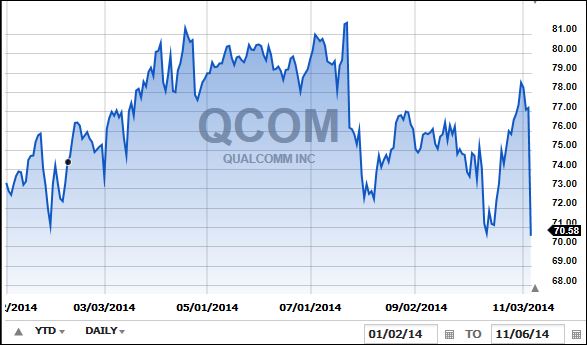
Time to sell (or buy more) Qualcomm? I read their report. Fact: China is meant to be “Big Growth” for Qualcomm. But remember that Qualcomm gets royalties. And the Chinese don’t like paying royalties. And they have a history of stealing our IP — intellectual property. Hence (from Forbes):
China has been a ongoing concern for analysts and the company in recent quarters. There has been a dispute over royalties with Chinese customers. This has affected Qualcomm’s stock in recent quarters. In Q3, Qualcomm’s shares dropped the most in three years as a result of this dispute. Qualcomm is also the subject of an investigation by a Chinese regulator, the China National Development and Reform Commission (NDRC). And China is still an issue for Qualcomm in this quarter, too.
“We also believe that certain licensees in China currently are not fully complying with their contractual obligations to report their sales of licensed products to us (which includes certain licensees underreporting a portion of their 3G/4G device sales and a dispute with a licensee),” said Qualcomm, “and that unlicensed companies may seek to delay execution of new licenses while the NDRC investigation is ongoing.”
Though I love Qualcomm technology, I dumped my Qualcomm, taking a small loss. It’s hard for my tender nerves to live through the gyrations that you can see in the chart above.
Where goes the next two year of Obama’s presidency? The economy should slowly improve under its own steam, as it has. But anything else? Like working with the new Republican Congress? Good luck. for more on what we might expect, this New York Times book review is insightful:
Anatomy of a Presidency While It’s Still Unfolding.
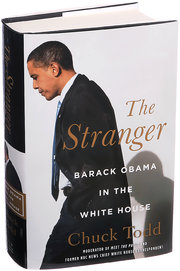
Chuck Todd’s ‘The Stranger,’ About Barack Obama
For his inaugural program this September as moderator of NBC’s “Meet the Press,” Chuck Todd landed a big guest: Barack Obama. If the president reads Mr. Todd’s new book “The Stranger,” it’s hard to imagine him wanting to return to the program anytime soon. The book delivers a stinging indictment of his presidency so far, one underscored by this week’s elections, which resulted in huge gains for Republicans and are widely seen as a repudiation of Mr. Obama and his policies.
In these pages, Mr. Todd dissects “the promise versus the reality of Obama” and concludes that he will be regarded, at least in the near future, as “a president whose potential wasn’t realized.” He writes that “income inequality is worse than ever,” that the Middle East could well be “more unstable when Obama leaves office than when he took it,” and that while he “wanted to soar above partisanship,” his tenure in office will likely “be remembered as a nadir of partisan relations.”
Chuck Todd Credit NBC News
The underlying problems Mr. Todd diagnoses have already been pointed out by many reporters and politicians, especially in the run-up to the midterm elections. Those problems include what critics see as Mr. Obama’s passive leadership and lack of managerial experience; his disdain for, but inability to change, politics as usual in Washington; and his reluctance to reach out to Congress and members of both parties to engage in the sort of forceful horse trading (like Lyndon B. Johnson’s) and dogged retail politics (like Bill Clinton’s) that might have helped forge more legislative deals and build public consensus.
Mr. Todd acknowledges the challenges the president faced entering office: a tottering economy, two wars inherited from the Bush administration, and an obstructionist Republican opposition. But he suggests that Mr. Obama was frequently his own worst enemy, allowing his temperamental inclinations (his detachment, his caution, his impatience with the often-irrational aspects of politics) to hobble the implementation of his vision of transformative change. Mr. Todd goes so far as to write that “Obama’s arrogance got the better of him,” and chides him for an unwillingness to apply the necessary elbow grease to make progress on difficult issues like gun control and immigration.
The overall picture that emerges here is that of a highly insular and centralized White House that is reluctant to listen to outside experts, prone to cutting cabinet members out of the loop and unable or unwilling to learn from its mistakes.
Though he writes in workmanlike, utilitarian prose, Mr. Todd, who is also NBC News political director, has grounded his arguments in hundreds of interviews with Washington sources and his intimate knowledge of how that city works or (more often, these days) fails to work. Many of his conclusions echo the reporting of other journalists (like James Mann and The New York Times’s Mark Landler) and observations made by former administration insiders (like the former defense secretaries Robert M. Gates and Leon E. Panetta).
If many of this book’s overarching arguments will be familiar to those within the Beltway, “The Stranger” nonetheless provides the lay reader with a brisk, if depressing overview of the Obama White House, while giving Washington insiders plenty of colorful new details.
In contrast to Bob Woodward with his I-am-a-tape-recorder approach, Mr. Todd does not shy away from analysis, which mostly proves revealing, though it can tip over into the speculative. For instance, citing unnamed “circumstantial evidence,” Mr. Todd suggests that Vice President Joseph R. Biden Jr.’s opposition to “almost every troop increase the Pentagon proposed” for Afghanistan might have been part of a “good cop/bad cop” routine: that is, “The president needed someone to take another position in order to rein in the Pentagon” and Mr. Biden filled that role.
The book’s one gaping hole – and it’s significant – has to do with Mr. Todd’s hop-skip-and-jump approach to Mr. Obama’s handling of the Iraq war. This volume fails to grapple seriously with how the White House’s eagerness to exit that war (and failure to make a concerted effort to persuade the prime minister at the time, Nuri Kamal al-Maliki, to make a deal regarding United States troops) helped set the stage for the rise of the Islamic State today. There is also scant attention paid to many national security issues, including the N.S.A.’s surveillance programs, the growing reliance on drones in the war on terror, and redactions made to a Senate committee’s report on the C.I.A.’s detention and interrogation program.
Of the president’s flip-flops on Syria – initially leaning toward limited military action (after concluding that President Bashar al-Assad’s forces had used chemical weapons against their own people) then deciding to back away and seek approval from Congress – Mr. Todd writes that here was one of the few times that many of his advisers “quickly and vociferously disagreed with their boss.” Mr. Obama announced his change of mind after taking a walk with his chief of staff, Denis R. McDonough, who, Mr. Todd notes, had also been one of the dwindling number of aides skeptical of arming the Syrian rebels.
The aftermath of an American-led airstrike last month in Kobani, Syria, against Islamic State militants. Credit Gokhan Sahin/Getty Images
Like Mr. Gates and Mr. Panetta, Mr. Todd points to this administration’s proclivity for trying to centralize decision making in the White House. He writes that as secretary of state, Hillary Rodham Clinton felt that Mr. Obama’s White House, in Mr. Todd’s words, “tended to micromanage American diplomacy to an extent unprecedented in previous administrations,” adding, “It’s one of the undertold stories” that “the Obama national security team sometimes treated Clinton almost as a figurehead, and they certainly drove policy and the agenda.”
As for the administration’s handling of the Arab Spring, Mr. Todd reports that Mr. Gates, Mrs. Clinton and Mr. Biden all believed – and were hoping – that Egypt’s longtime president, Hosni Mubarak, would survive the 2011 protests against him; they worried that without him the country could spiral “into the unknown.” But Mr. Obama, writes Mr. Todd, sided “with his younger staff” (including Mr. McDonough, Susan Rice, Samantha Power and Benjamin J. Rhodes) “over the more seasoned principals,” and told Mr. Mubarak that he needed to step down.
Egypt would, in fact, begin to spiral downward: Last year, military officers removed the country’s first democratically elected president, Mohamed Morsi and suspended the constitution; its new leader, Abdel Fattah el-Sisi, has presided over a highly repressive regime, jailing political opponents and cracking down on dissidents (acts that in turn have threatened to radicalize civilians). Mr. Todd reports that a prominent, recently retired Democratic senator argues that the Obama White House made a “fundamental policy mistake” in “getting involved in Egypt, which led to Libya then Syria,” and sending mixed messages to the Middle East.
Much of this book focuses on domestic policy and politics, including a stale chapter about Mr. Obama’s 2012 campaign. Mr. Todd uses the roller-coaster story of the administration’s health care plan as a kind of window into both its ideals and dysfunction. He contends that as a candidate Mr. Obama pledged himself to speedy and concrete action on universal health care “almost on a whim,” needing a way, in an early 2007 speech, to differentiate himself from his Democratic primary opponents, Mrs. Clinton and John Edwards.
Although several top Obama aides like Rahm Emanuel cautioned against rushing into health care as the administration’s first big initiative (as opposed, say, to financial regulatory reform), the president decided to push ahead. The process would bog down in Congress and only barely squeak through after a nerve-racking year.
The rollout of health care reform would become a public fiasco when the site went live in October 2013 with systemic problems. For three years, outside advisers had been warning about technical challenges and the need for managerial accountability, Mr. Todd reports, but a self-absorbed White House allowed turf battles, politics and simple inertia to lead to continued delays. “Like some of the administration’s other missteps,” he writes, the website disaster, “was rooted in poor management, in this case not designating someone, anyone, to own implementation.”
The troubles with health care, combined with a cascade of other crises – the rise of the Islamic State, an increasingly chilly relationship with Vladimir V. Putin’s Russia and the Ebola epidemic in Africa – have further wounded the White House, creating the impression of a reactive, even flailing administration. Republicans racked up big wins in this week’s elections in no small part because of Mr. Obama’s growing unpopularity. (According to exit polls, nearly six out of 10 voters expressed negative feelings about his administration.)
Some of the dysfunction that came to be associated with Mr. Obama’s tenure, Mr. Todd says, “was forced upon” him, and “some of it came from him.”
“If a huge reason for the failure of Washington to get anything done is a focus on means instead of productive ends,” he writes, “Obama’s struggles came from his focus on ends to the exclusion of productive means.”
If I had run my business the way Obama has been running the country, my business would have gone broke, instantly, if not sooner. And, to think I voted for the man.

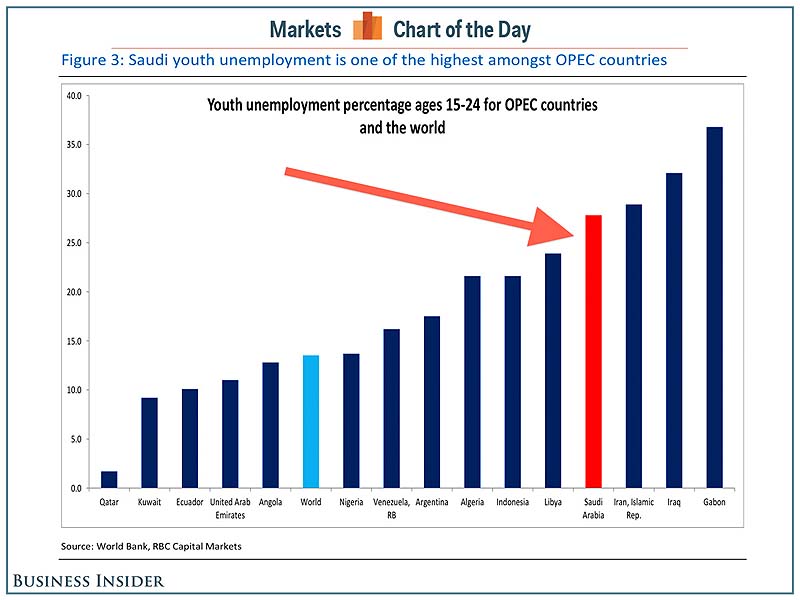
Harry Newton who looks at our 5.8% and then looks at Saudi Arabia with its huge youth unemployment and low female participation in the workforce — only 18% (according to the World Bank). If their oil ever runs out, or oil gets very cheap, the country is in big trouble. People without jobs are not happy campers. This chart is from Business Insider. (If the chart is too big for your screen, tap or click on it.)

Meet the woman JPMorgan Chase paid one of the largest fines in American history to keep from talking
By Matt Taibbi | November 6, 2014
She tried to stay quiet,
she really did. But after eight years of keeping a heavy secret, the day
came when Alayne Fleischmann couldn’t take it anymore.
“It was like watching an old lady get mugged on the street,” she says. “I thought, ‘I can’t sit by any longer.'”
Read more: http://www.rollingstone.com/politics/news/the-9-billion-witness-20141106#ixzz3Icoj38eG
Follow us: @rollingstone on Twitter | RollingStone on Facebook
“a president whose potential wasn’t realized.”
Seriously? It must be something other than governing.
I don’t know if the President is deeply flawed even though I am critical of him. But I do know the obsession with the president, whoever he is, is to a large extent a sideshow and distraction. I also know that our politics is largely expensive theater. Strange to be writing this on a financial website- taking money out of politics would be first step towards healing the system. Is Obama unpopular? Yes, sort of- but in our nutty political theatre: if he were to run again for office, if he could, I would not be shocked if he won. Americans are good people; they deserve a better system, not a better President, because whoever he may be he’s presiding over something broken that can only be fixed by the real leaders, the people.
Obama has sucked all the meaning out of “hope and change.” Romney was a proven manager and a man who could have lead events instead of leading from behind like Obama. Obama is the living,breathing example of why voting your straight ideological inclination is grossly stupid.
Harry, not only did you vote for Obama you personally, along with your wife, went to other states and participated in the ground-game campaign. Both of you went door to door encouraging people to vote for this Nazi. I remember you being so sure of yourself as though you actually had a slight clue as to what you were talking about. Do you remember what I said to you? It went something like this; “Ain’t no fool like an old fool.”
Now some day you’re going to have to tell your grandchildren that not only did you give money to and vote for Obama, but you openly campaigned for him.
This only proves my point, and Harry you’ve herd me say this before too: “having money and being smart have absolutely nothing to do with each other.”
Obama is a total disaster thanks to you liberals the country may well never fully recover.
WE went door to door on his first election. We did not do any canvassing on the second. The country is doing nicely economically. (See above.) He pulled us out of two land wars. And he got some people health-care insurance. The stock market is up. Low interest rates have saved borrowers huge amounts of money. I don’t think he’s been the disaster from which the country will ever fully recover.
Wrong on multiple counts. The economy is NOT doing nicely…remove the 85 bil per month the corrupt Fed is pumping, you have a depression. The stock market is simply a result of the US market being the only whore without the clap. He did not pull us out of two land wars:he replaced US troops with mercs which we are also funding. surprised you dont know the difference. Low interest rates have killed no spec savers. There is no real risk/reward because the lawless govt has bailed out even more lawless industry by not enforcing the laws on the books.
His lawlessness is absolutely something, along with what Reid did by eliminating the filabuster, is something the US wont soon recover from.
s l mccollum
President Obama pproved again that winning an election is not the same as governing the country. He was extremely competent in two national campaigns and must less competent in providing leadership and management of the country.
So, what’s new? Giving a good speech and managing a country are very different animals. Few people have both skills.
If you ignore the huge population of underemployed and worse, those who’ve given up looking for work, our employment “improvement” is just another gov’t farce. A lie to deceive the populace. The liberal media love it, based on our local Press Democrat newspaper and others like the NYTimes.. And as Harry shows, it works! 🙂
Employment numbers improve. the percentage of people out of the workforce falls. I see a huge change in the workforce. Freelance workmen and women everywhere. Laptop-touting youngsters at Starbucks. I speak to my young friends. They seem to be working hard and not suffering.
New York City is not America. Employment numbers, if you even believe them, improve but so does the population grow, particularly the welfare and “disabled”.
Ain’t no fool like an old fool….
The actions of the FED have inflated asset prices. including stocks. and have facilitated deficit spending.
But stock ownership is concentrated in the hands of the already-wealthy They are the beneficiaries of FED/Obama policies. Such concentration of wealth has never lead to good things… to political stability.
Also, those deficits will have to be addressed one way or another. Creating money instead of creating good and services has never lead to anything except disaster.
Lastly, come on Harry, who is benefiting for zirp? Can you borrow at .25%? The average schmuck can’t get a loan at 8 times that rate ….and as you know, a lot of old folk live off of the coupon on bonds. Yeesh.
“Nazi”, you’re an idiot.
That said, the reviewer of Todd’s book – and likely the book itself – fail to note a couple of Obama’s earliest and most enduring failures: Namely, the appointment to the FED and to his economic team of the very criminals who crashed they system; and the appointment of Holder who failed to go after the biggest financial crimes in the history of the planet. As soon as he announced these appointments “hope and change” went out the window.