Mr. Market fell 3% yesterday:
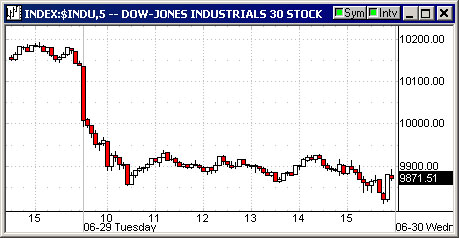
It fell because of lots of simultaneous bad news. The Wall Street Journal reported the reasons as “slumping U.S. consumer confidence, the downward revision of a Chinese economic indicator and worries about the health of Europe’s banks.” The Journal also reported that yields on 10-year Treasury notes fell below 3% to their lowest level since April 2009, a sign investors were seeking out safe investments.
The market has been in freefall since late April 2010.
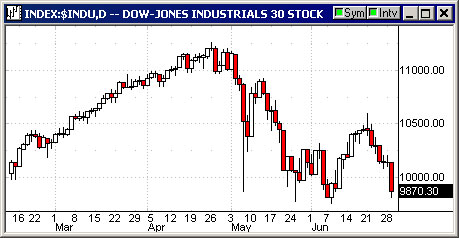
An example:
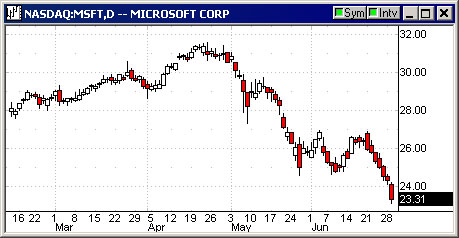
Yields on virtually all our high-yielders have improved.
Wall Street does good by its selected clients. Tesla Motors was a hot IPO. It rose 41% yesterday — its first day of trading.

The IPO was managed by Goldman Sachs Group Inc. (GS), Morgan Stanley (MS), J.P. Morgan Chase & Co. (JPM) and Deutsche Bank AG (DB). I’m a long-time client of two of them — GS and MS. I didn’t get a nickel’s worth of shares. But that’s to be expected. Here’s how IPOs work on Wall Street. If the IPO is hot, institutions are given the shares. If the IPO is fair to poor, retail (that’s you and me) get it.
Wall Street remains stacked against you and me. Surprise. Surprise.
This is beyond disgusting. Goldman Sachs remains a cockroach stock. From today’s Bloomberg:
Scrutiny of Goldman’s Board Focuses on Silence Over Conflicts
By Richard Teitelbaum – Jun 30, 2010
Greg Palm, Goldman Sachs Group Inc. general counsel, took a call in his 37th-floor office at One New York Plaza on Dec. 16, 2008. It was his old boss, Stephen Friedman, a former Goldman chairman who was then head of the audit committee of its board of directors. Goldman’s stock was down 65 percent from its 52-week high during an accelerating global financial breakdown.
Friedman, who had become chairman of the Federal Reserve Bank of New York that year, told Palm he wanted to buy, Bloomberg Markets magazine reports in its August issue.
Palm says he couldn’t think of a reason why Friedman shouldn’t: Goldman had made the necessary disclosures in that day’s filings, Palm says.
“We’d just reported earnings,” says Palm, whose job includes approving trades by directors. “There was no material information that wasn’t public from Goldman’s standpoint.”
Friedman, 72, who is still a Goldman director, bought 37,300 shares at an average of $80.78 each on Dec. 17. Five weeks later, he picked up 15,300 more at an average of $66.61. By yesterday, the stock had doubled to $133.76, giving Friedman a paper profit of $3 million.
Now, the U.S. House Oversight and Government Reform Committee is investigating Friedman’s stock purchases. It wants to know why he was permitted to buy stock in a bank he was regulating as chairman of the New York Fed.
Friedman held both that post and his Goldman board seat when the firm became a bank holding company in September 2008. The Federal Reserve Act forbids an official at the New York Fed in his position from also being a director of a bank or buying its stock.
The New York Fed sought a waiver from the Federal Reserve Board in September 2008 so that Friedman could keep his position there. Michele Davis, a spokeswoman for Friedman, says New York Fed general counsel Tom Baxter told Friedman that the rules were in abeyance while the waiver was pending.
“Therefore, Mr. Friedman’s purchases of Goldman Sachs stock were perfectly legal,” she says. The waiver was granted in January 2009.
Jerry Jordan, a former president of the Cleveland Fed, says the section of the Federal Reserve Act barring Friedman from owning bank stock or buying new shares could not be waived. “It was not allowed,” he says. “You can’t get permission to violate the law.”
Goldman Sachs’s ties to the New York Fed pose another potential conflict for Friedman, says James Cox, a professor at Duke University School of Law. Goldman was a prime beneficiary of the New York Fed-engineered bailout of American International Group Inc.’s bank counterparties, receiving, by its own count, $12.9 billion for the credit protection it held on mortgage- related securities. That figure was not publicly disclosed by AIG until March 2009 — after Friedman had bought his shares.
“It raises at the least an eyebrow in terms of what he knew about those payments,” Cox says.
New York Fed spokesman Jack Gutt responds: “Friedman had no involvement in nor was he provided with confidential information related to the New York Fed’s negotiation with any AIG counterparties.”
Friedman resigned from the New York Fed on May 7, 2009, days after the Wall Street Journal reported his stock buying. At the time, Baxter said in a statement, “It is my view that these purchases did not violate any Federal Reserve statute, rule or policy.”
As the Friedman saga unfolds — and Goldman’s regulatory and legal entanglements escalate — the firm’s nine outside directors, who aren’t Goldman employees, are keeping mum.
The board members said nothing publicly, for instance, when on April 16 the U.S. Securities and Exchange Commission filed a civil suit alleging Goldman had committed fraud in underwriting and marketing a mortgage-related security called Abacus 2007-AC1 without disclosing to clients that a bearish hedge fund customer, Paulson & Co., was involved in creating it.
Goldman calls the SEC suit “completely unfounded.”
Federal prosecutors in New York are also investigating Goldman transactions to determine whether to pursue a criminal fraud case, according to two people familiar with the matter.
Nell Minow, co-founder of the Portland, Maine-based Corporate Library, a governance research firm, says that when the SEC suit was filed, the outside directors should have immediately set up a committee to investigate, hired independent counsel and announced that they would make the results of their probe public.
The board should also have been riding herd on its members’ stock trades, says Cornell University Law School Professor Robert Hockett, who specializes in financial regulation from his office in Ithaca, New York. Goldman spokesman Lucas van Praag says directors are periodically informed of such trades. The bank received a Wells notice dated July 28, 2009, notifying the firm that it was the target of an SEC fraud investigation.
At least three company executives, including Vice Chairman Michael Evans, unloaded more than $27 million of Goldman stock from October 2009 through February 2010 in open market sales unrelated to the recent exercise of options or delivery of restricted stock, according to data compiled by Bloomberg. (Harry’s note. The sales were made at much higher prices than where GS closed last night.)
Van Praag says Goldman’s board was informed of the Wells notice, which was not made public until after the SEC filed its suit. He says the firm’s lawyers determined it wasn’t material. (Harry’s note: And pigs will fly.)
“On the face of it, the idea that that would not be material — I can’t imagine anybody saying that with a straight face,” Hockett says.
Jacob Zamansky of Zamansky & Associates LLC filed a class- action lawsuit on April 30 on behalf of Goldman shareholders, saying that Goldman made false statements relating to the SEC suit and failed to disclose adverse facts about the company to shareholders.
“The Wells notice was a material fact going to the heart of their business,” he says. Goldman had not formally responded to the suit as of late June.
The number of issues Goldman executives, and their board, need to address continues to build.
Director Rajat Gupta did not stand for re-election to the board in May. U.S. investigators suspect him of leaking word of a $5 billion investment in Goldman by Berkshire Hathaway Inc. in 2008, according to a person with knowledge of the matter.
Gary Naftalis, a lawyer for Gupta, former worldwide managing director of McKinsey & Co., says, “Rajat Gupta has never violated any law or rule.”
On April 27, the Senate Permanent Subcommittee on Investigations held an 11-hour hearing on Goldman’s role in the financial meltdown.
“Goldman repeatedly put its own interests and profits ahead of the interests of its clients and our communities,” Senator Carl Levin, a Michigan Democrat, said at the hearing.
“We respectfully disagree,” van Praag says.
On June 7, the Financial Crisis Inquiry Commission subpoenaed Goldman, accusing it of attempting to hinder its probe of the firm by electronically sending it the equivalent of more than a billion pages of documents. Yesterday the leaders of the commission told journalists in a conference call that the firm has become more responsive.
“The outside directors haven’t been visible on any of this,” says Patrick McGurn, special counsel at RiskMetrics Group, a New York adviser to shareholders. “You have to ask if it’s setting the correct ethical tone.”
Van Praag says: “Board chairman Lloyd Blankfein has made the views of the board well-known.”
Goldman’s board consists of two insiders, Chairman and Chief Executive Officer Blankfein and President Gary Cohn, and nine outsiders. There are five scheduled meetings per year and more as needed, the company says.
The outside directors are: Friedman; Lois Juliber, 61, former vice chairman of Colgate-Palmolive Co.; William George, 67, ex-CEO of Medtronic Inc.; Lakshmi Mittal, 60, CEO of steelmaker ArcelorMittal; John Bryan, 73, ex-CEO of Sara Lee Corp.; Lee Scott, 61, ex-CEO of Wal-Mart Stores Inc.; Claes Dahlback, 63, ex-CEO of Sweden’s Investor AB; James Johnson, 66, vice chairman of merchant bank Perseus LLC and former CEO of Fannie Mae; and James Schiro, 64, former head of insurer Zurich Financial Services AG.
Directors who completed a full year in 2009 were paid an average of $460,852 in stock and options compared with $255,519 in cash and stock for JPMorgan Chase & Co.’s 10 outside directors and $337,803 for Morgan Stanley’s 11 outsiders, proxies show.
Goldman’s board may have been able to preempt criticism of the company by speaking out, says Sean Coffey, a former partner at Bernstein Litowitz Berger & Grossmann LLP, who’s running for New York state attorney general.
The board should have established a committee of outside directors with an independent counsel to investigate ethics matters and get the facts, says Coffey, who won more than $50 million from WorldCom Inc. directors in a 2005 settlement with the telecom company.
“The right decision might be to take out advertisements and apologize or it might be to batten down the hatches,” Coffey says. “Don’t omit disclosing material information that investors ought to know.”
Minow says the Goldman board should have nominated someone who had securities law enforcement experience, who could have led an internal investigation.
Instead, in March, Goldman nominated — and shareholders later approved — the appointment of Walmart’s Scott. After an exchange in which a person at the May 7 annual meeting asked how Scott had been selected, CEO Blankfein deadpanned, “Actually, I like shopping at Walmart.”
At the meeting, Goldman announced the creation of an internal committee that will examine possible conflicts of interest and other issues such as transparency and disclosure. It’s headed by Vice Chairman Evans and E. Gerald Corrigan, chairman of Goldman Sachs Bank USA. No board members are involved.
Former EBay CEO Meg Whitman, who joined Goldman’s board in 2001, says then-CEO Henry Paulson brushed aside her questions to move a meeting along.
“They wanted to keep acting like a group of partners who did much of their discussion and decision-making in private and then expected to get the board’s rubber stamp,” Whitman writes in her new book, The Power of Many (Crown, 2010). She resigned after 15 months.
Whitman is now the Republican candidate for governor of California.
Cornell’s Hockett says that if Friedman violated any laws, the entire Goldman board is to blame.
“Boards are intended to police the actions of their members,” he says.
Friedman spokesperson Davis says the waiver exonerates him.
The New York Fed’s nine-person board consists of three classes of directors serving staggered terms. Class A directors are elected by member banks to represent commercial banks; one class A director today is JPMorgan Chase Chairman and CEO Jamie Dimon. Class B directors are elected by member banks to represent the public, while class C directors such as Friedman, who also represent the public, are appointed by the Fed Board of Governors.
Former Cleveland Fed President Jordan says the law is clear: As a Class C director, Friedman could not own, much less buy, bank stock.
Section 4, Number 15 of the Federal Reserve Act reads, “No director of class C shall be an officer, director, employee, or stockholder of any bank.”
The New York Fed argued that because Goldman was a bank holding company and not a bank, a waiver could be granted, according to a person with knowledge of the matter. The Fed agreed.
How much the Goldman board’s silence in the face of adversity has cost the firm is difficult to gauge. Goldman shares have surged 157 percent as of June 29 since hitting an all-time low in November 2008. In May, shareholders approved those directors standing for election by margins of more than 95 percent or greater.
Still, says Coffey, the board’s somnolence in the face of so much controversy has done nothing to support Goldman’s storied franchise.
Buy your kids a headphone. Get them (and youself) a corded one. Insist they use it. It’s an important precaution.
I’ve been in telecom ever since cell phones were invented. The FCC cut power to handhelds (from car phones) by 80% because it believed in the danger. Can you get cancer from a cell phone? Scientists say Yes. The industry, naturally, says No.
Last week, the Board of Supervisors in San Francisco passed a law — the first in the nation — requiring retailers to inform their customers how much radiation the cellphones on their shelves emit, so shoppers can figure out how close the devices come to the upper limits on radiation set by the Federal Communications Commission.
The law, which goes into effect early next year, didn’t mention the word, but it was all about one thing: cancer, and whether cellphones cause it.
In 2006, Lennart Hardell, a professor of oncology and cancer epidemiology at the University Hospital in Orebro, Sweden, reported that adults he followed who had used cellphones for more than 10 years “give a consistent pattern of increased risk for acoustic neuroma and glioma,” forms of brain tumors. That study has been used as the basis for public health alerts by way of commercials, billboards and warning labels in nations including Britain, Israel, Finland and France, but it has had little resonance in the United States.
Hardell published a report last year that said teens and children have a fourfold increased chance of getting brain cancer.
In a Senate subcommittee hearing in September, a member of the NTP (The National Toxicology Program part of the National Institutes of Health), said there is potentially a greater risk that children, with their thinner skulls, would suffer from the absorption of radio frequencies in their brain tissue.
Some companies offer guidelines of their own. The Nokia 1100, for instance, warns that the phone meets radio-frequency guidelines only when it is held at least 1.5 centimeters from the body. Motorola recommends keeping the antenna of a device at least 2.5 centimeters (1 inch) from the body. BlackBerry warns that one of its devices “SHOULD NOT be worn or carried on the body” without a BlackBerry-approved belt clip.
The easiest way to avoid the danger is to use a corded headset.
For more on this, Click here.
China’s energy. China is now the world’s largest maker of wind turbines and solar panels. It plans to be the biggest builder of nuclear power plants in the coming decade. China will continue to rely on coal. It has the world’s third largest reserves after the U.S. and Russia. they also have much of our manufacturing.
Miracles happen.This obituary is from the New York Times.
Nicolas Hayek Dies at 82; His Swatch Saved an Industry
Nicolas Hayek, a Lebanese-born business consultant who is widely credited with having saved the Swiss watch industry with the introduction of the Swatch, the inexpensive, plastic — and, as it transpired, highly collectible — wristwatch that made its debut in 1983, died Monday in Biel, Switzerland. He was 82.
Mr. Hayek, a founder and the chairman of the Swatch Group, died of heart failure while working at the company’s headquarters, according to an announcement on the company Web site.
The formation of the Swatch Group, which in addition to Swatch today comprises high-end watch brands like Breguet, Omega, Longines, Tissot, Calvin Klein and Mido, made Mr. Hayek one of Switzerland’s wealthiest men. The exquisite irony is that the company came about after Mr. Hayek was brought in to help shut the foundering Swiss watch industry altogether.
A flamboyant figure with a roguish sense of humor, Mr. Hayek was “a rare phenomenon in Europe — a genuine business celebrity,” as The Harvard Business Review described him in 1993.
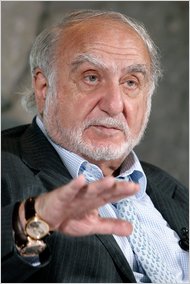
Nicolas Hayek was born in Beirut in 1928 and moved to Switzerland as a young man. After studying mathematics, physics and chemistry at the University of Lyon in France, he started a consulting firm, Hayek Engineering, in Zurich in the early 1960s.
By the 1970s, the vaunted Swiss watch industry, a pillar of the national economy for centuries, was in jeopardy. Japanese watchmakers like Seiko had begun to undercut Swiss prices. And public tastes were shifting from the finely wrought analog timepieces in which Swiss artisans had long specialized to the pale flickering faces of mass-market digital watches.
In the early 1980s, with no apparent remedy in sight, a group of Swiss banks asked Mr. Hayek to compile a report on how the watchmaking industry might best be liquidated. Instead, he merged two of its former titans, Asuag and SSIH, which between them owned brands like Omega, Longines and Tissot.
Mr. Hayek bought a majority stake in the reorganized group, known as SMH — the Société Suisse de Microélectronique et d’Horlogerie. (He was fond of telling interviewers that the initials stood for “Sa Majesté Hayek” — “His Royal Highness Hayek.”)
In 1983, SMH introduced the Swatch. Lightweight, with vibrantly colored bands and breezy novelty faces, it was remarkably inexpensive to produce. (It had 51 parts, as opposed to the nearly 100 needed to make a traditional wristwatch.) It retailed for less than $35 when it was first marketed in the United States later that year.
The Swatch quickly became a sought-after collector’s item worldwide. It was very likely the first time that ordinary people had even considered owning multiple watches. (Mr. Hayek himself was known to appear in public wearing as many as eight — four to an arm — though at least a few of these were from his luxury brands.) Several hundred million Swatches have been sold since the brand’s inception.
The success of the Swatch also resuscitated the high-end brands under the SMH umbrella. The company, whose name was changed to the Swatch Group in the 1990s, generated about $4.9 billion in sales last year, The Wall Street Journal reported on Monday.
By redirecting consumers’ attention to Swiss watchmaking as a whole, the little plastic watch lifted all boats. Even the expensive brands, like Breguet, “we will continue to sell — and sell well,” Mr. Hayek told the publication Swiss News in 2008. He added, “We sell the mentality of Switzerland.”
Mr. Hayek stepped down as the Swatch Group’s chief executive in 2002 and was succeeded by his son, Nicolas Jr. His daughter Nayla sits on the company’s board. Information about other survivors could not be confirmed.
Over time, the humble Swatch itself was borne upward by its own success: the company has issued limited-edition Swatches designed by noted artists like Keith Haring. In 1992, The New York Times reported, a Swatch by Kiki Picasso, a pseudonym of the French artist Christian Chapiron, sold at auction at Christie’s in London for $28,000.
Let’s take the dog for a walk.
A little girl asks her mum, ‘Mum, can I take the dog for a walk around the block?’
Her mum replies ‘No, because she is on heat.’
‘What does that mean?’ asked the child.
‘Go and ask your father. I think he’s in the garage.’
The little girl goes out to the garage and says, ‘Dad, can I take Lulu for a walk around the block? I asked Mum, but she said the dog was on the heat, and to come ask you.’
He took a rag, soaked it in petrol, and scrubbed the dog’s backside with it to disguise the scent, and said ‘Ok, you can go now, but keep Lulu on the leash and only go one time around the block.’
The little girl left and returned a few minutes later with no dog on the leash..
Surprised, Dad asked, ‘Where’s Lulu?’
The little girl said, ‘She ran out of gas halfway round the block. Another dog is pushing her home.’

Harry Newton,who fears the temptation to pick up “suddenly cheap” stocks might not be such a great idea in the face of the continuing awful economic news — despite the ebullient nonsense coming out of the White House. My favorite (and best) money manager, Paul Lobosco, emails me this morning:
Have you ever seen this web site from The Economist? It’s very enlightening (and very scary):
http://buttonwood.economist.com/content/gdc?source=features_box4
You can see the stark differences in debt burdens between the western world (overwhelming) and the emerging countries (manageable). As recently as the 1980s, the notion of a trillion dollars was never discussed. It was beyond our comprehension. Now, our federal government has borrowed 13 of those trillions, state and local governments trillions more. We forgot one tiny fact: that money has to be paid back. This begs two basic questions:
1) How will this borrowed money be repaid? Damned if I know.
2) If we have trouble paying off the liabilities (i.e. debt), does that not put pressure on equity prices?
My greatest asset in managing money over the last several years has been to keep it simple. Accounting 101 tells us that Assets-Liabilities= Equity. Wall Street, Bubblevision, and most of the press have chosen to complicate the basics, opting for delusion over reality. To me, it’s one of the great delusions in human history.
I like to use the term ‘Financial Reaper’. The Reaper is out there. He lies in waiting. Yesterday he reared his ugly head again. Today he might go back into hiding. But he’ll be back soon. WE created him, and he’s a real monster.
There might ultimately be a way for financial markets to operate successfully in such a debt-laden world. I just don’t see it. If anyone has a theory on how, I’m all ears. One theory, which gets pretty complicated, is that the government can simply print money.
Meanwhile, until we get our arms around this stuff financially and politically, the more likely scenario is continued pressure on asset prices.

Ingnored your comment regarding 'Knight & Day” and went to see it with my daughter anyway…..you were the smart one you left half way throught….Elio
Harry,
Hi! If the economy is so bad then why did Mario Gabelli talk it up so highly today on CNBC?
Because he attracts investors to his funds. Why else waste your time appearing on CNBC. They don't pay their guests.