I know of investors who have gone to 100% cash. That means they have sold all their stocks. Others are at 20% cash and going higher.
They are worried:
+ That the 46% plunge in oil (it hit $55.02 yesterday — a five year low) will hurt business in the U.S. For example, From John Hempton of Bronte Capital last night emailed:
I am reading the annual report from United Technologies – which owns, amongst other things, a helicopter company. To quote: On the commercial side, Sikorsky finished the year with a backlog of nearly $3 billion — its largest ever — driven by growing demand for offshore transportation in the oil and gas industry. He wonders how good that backlog is now.
+ That the plunge in oil stocks pulls on averages — it’s 12% of the S&P 500. That pulls on performance. That forces investors in hedge funds, mutual funds, etc. to ask for their money back. That in turn causes more selling.
+ That Europe and Russia and their “hurts” will hurt us. We can’t be a shining beacon blazing an independent path. The world is too intertwined. The Russian ruble dropped over 10% yesterday. That’s huge move. You don’t see that very often. In fact, I don’t think I’ve ever seen that much in one day. To save the ruble, the Russian central bank is today raising its key interest rate to 17 percent from 10.5 percent. The move was the largest single increase since 1998, when Russian rates soared past 100 percent and the government defaulted on its debt.
The interest rate hike didn’t work,” said Business Insider this morning, “After rallying briefly, the ruble collapsed to new lows. Just before 7 a.m. ET, Russia’s currency fell to as low as 75 rubles per dollar.”
Bloomberg ran this story last night:
Why 1998 Was Different, and Same, to Emerging-Market Crisis Now
Oil prices were tanking. Emerging-market currencies were in a freefall. Venezuela was mired in a financial crisis and Russia had sunk into a debt default and devaluation.
The year was 1998.
Emerging markets today look a lot like they did back then. Yet there have been key changes that could help most of them escape full-blown crises. Here’s a look at the similarities and differences between now and then.
Similarities
*Falling Oil Prices
Crude has dropped 48 percent since June to about $55 a barrel, squeezing exporters from Venezuela to Russia and Nigeria. Credit default swaps show a 97 percent probability that Venezuela will default on its bonds within five years, according to data compiled by Bloomberg. The Russian economy, which is under sanctions by the U.S. and the European Union over the Ukraine conflict, will contract as much as 4.7 percent next year if oil remains at $60, the central bank said.
*Currencies Sink
A Bloomberg index tracking 20 of the most traded emerging-market currencies fell to the lowest since 2003 on Dec. 15. The ruble tumbled past 64 per dollar for the first time, Turkey’s lira fell to an all-time low while Indonesia’s rupiah retreated to levels last seen in 1998.
During the Asian financial crisis in 1997 and 1998, countries from Thailand to Malaysia capitulated on defending their currencies, leading the Thai baht to lose half its value in six months. South Koreans lined up in the streets to donate gold jewelry to help the government refill their depleting foreign reserves amid the currency slump.
*Fed Policy
The U.S. Federal Reserve is laying the ground for its first interest rate increase since 2006, threatening to drain capital from developing nations. The World Bank estimated last year that private capital inflows to developing nations could drop 50 percent should long-term U.S. bond yields rise one percentage point.
Countries with large current account deficits, including Turkey, South Africa and Brazil, are vulnerable, according to Credit Agricole CIB. So are nations such as Malaysia, where foreign investors account for 30 percent of local government debt. A series of Fed rate increases in the mid-1990s helped trigger the run on Asian currencies that would in turn lead to Russia’s default.
Differences:
*Flexible Exchange Rates
Developing countries have allowed their exchange rates to fluctuate, moving away from the fixed exchange-rate regimes prevailing during the crisis in the late 1990s. While weaker currencies fuel inflation, they can also stimulate economic growth by making exports cheaper.
*Foreign Reserves
Developing countries’ foreign reserves dwarf the amount they had in the late 1990s, which will help them weather the volatility in financial markets. As a group, emerging markets hold $8.1 trillion, compared with $659 billion in 1999, according to data compiled by the International Monetary Fund.
*Debt
Instead of borrowing in dollars, the governments now mostly raise financing in local currencies, allowing them to pay back the debt without having to draw down foreign reserves. External debt amounted to 26 percent of developing nations’ gross domestic product last year, down from 40 percent in 1999, the IMF data show.
One caveat is that companies have replaced governments as a source of concern on debt issuance. Corporations in developing countries sold about $375 billion of international debt between 2009 and 2012, more than double the amount in the four years before the 2008 financial crisis, the Bank for International Settlements said in September.
*Interest Rates
While rates are rising in some developing nations, they remain a fraction of the levels seen in 1998. Russia raised its benchmark rate 6.5 percentage points to 17 percent effective Dec. 16 at a late-night meeting. Some short-term rates soared over 100 percent back in 1998. In Brazil, policy makers have raised benchmark rates to 11.75 percent. That’s still less than half the rate levels from 1998.
Bloomberg and others are publishing lots of doom and gloom stories. From today’s Bloomberg site:
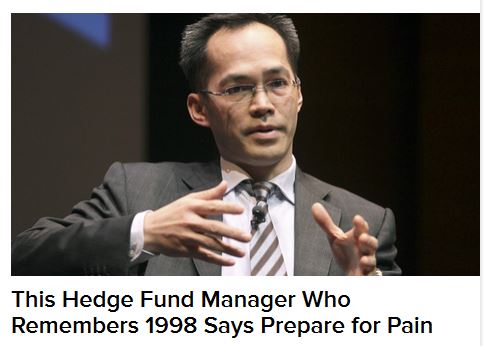
Excerpts from the piece:
If the 48-year-old native of Taiwan, with a PhD from Massachusetts Institute of Technology, sounds a little jaded now, it’s not without some reason. He says he worries that many emerging-market analysts are too young to remember the late 1990s. Instead they learned the ropes in an era dominated by the rise of Brazil, Russia, India and China — a supposed one-way bet to prosperity.
“Many became EM specialists after the term `BRIC’ was coined in 2001 and don’t know any serious crisis,” says Jen, who now runs the London-based hedge fund SLJ Macro Partners LLP.
The youngsters are about to be schooled. Jen says echoes of 1997-1998 may be at hand.
Investors woke up today to Russia’s 1 a.m. interest-rate increase to defend the ruble. There’s the mounting likelihood of a Venezuelan default. Stocks from Thailand to Brazil are reeling. The Fed hasn’t even begun raising interest rates.
Jen is bracing for more pain.
“At some point, the risk of fractures in parts of EM will rise sharply,” said Jen.
Currency Dangers
While unwilling to draw up a blacklist for now, he says exchange rates reveal emerging-market dangers. Russia’s ruble, Brazil’s real, Mexico’s peso, Turkey’s lira, the South African rand and Indonesian rupiah have all hit the skids.
The biggest causes for worry, bigger than a recession in Russia or the oil-price plunge: the slowdown in China, which has already upended commodity prices, and the likelihood U.S. growth will propel the dollar higher and suck assets out of emerging markets.
Sounding a similar alert, the Bank for International Settlements has warned an appreciating dollar could have a “profound impact” on the world economy. It estimates that international lending to non-financial companies totalled $9.5 trillion at the end of June. Claims on China alone have been growing at an annual rate of 50 percent to reach $1.1 trillion.
International Monetary Fund economists also reported this month that the frequency of sovereign debt crises is 15 percent higher at the start of a U.S. monetary tightening cycle.
“My long-standing view on EM currencies is that they could melt down because there has simply been way too much cumulative capital flows,” said Jen. “Nothing the EM economics can do will stop these potential outflows as long as the U.S. economy recovers.”
You can read his pain piece here.
The best news today is Ladder Capital (LADR). It’s becoming a REIT and starting to pay a dividend. It in our list of stocks we own — see right hand column.
Last night they had a conference call. Excerpts:
+ The REIT election with a target date of January 1, 2015 will be about 55% accretive to earnings.
+ They figure a cash distribution of $100 million a year. Also Ladder may from time to time declare a “true-up” distribution as necessary. In English that means they’ll pay more dividends. Under the law, REITs have to pay out 90% of their earnings. This is good for Ladder management, since they all own LADR stock and lots of it. (I do too.)
+ They will continue to manage themselves. They have good management. Hence this move to becoming a REIT s a good thing.
+ No change to business lines or asset mix is needed. That’s also a good thing, since they know what they’re doing.
I especially liked this chart from the conference call:
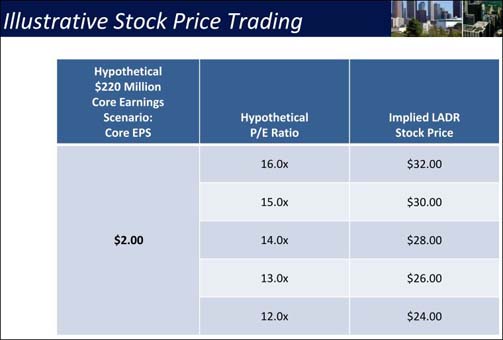
LADR closed last night at $18.95.
Ladder describes itself as “providing fixed-rate and floating-rate commercial mortgages, mezzanine financing and preferred and direct equity to our partners since 2008.”
You can listen to last night’s conference call here. You can see all the slides. Click here.
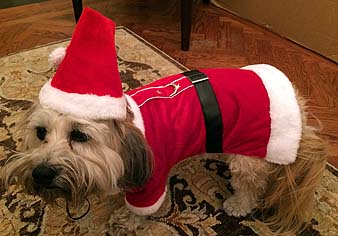
Rosie as Santa. Trying on her festive outfit. She is not a happy camper.
How bad is your BMW? Pretty bad according to this BMW owner. Check out his call for help. You’ll die laughing. Click here.
Great taunts
“I’ve just learned about his illness. Let’s hope it’s nothing trivial.” — Irvin S. Cobb
“I have never killed a man, but I have read many obituaries with great pleasure.” — Clarence Darrow
“He is not only dull himself, he is the cause of dullness in others.” — Samuel Johnson
“He had delusions of adequacy.” — Walter Kerr
“I’ve had a perfectly wonderful evening. But this wasn’t it.” — Groucho Marx
“He loves nature in spite of what it did to him.” — Forrest Tucker
“I didn’t attend the funeral, but I sent a nice letter saying I approved of it.” — Mark Twain
“His mother should have thrown him away and kept the stork.” — Mae West
“He has no enemies, but is intensely disliked by his friends.” — Oscar Wilde
“He has Van Gogh’s ear for music.” — Billy Wilder

Harry Newton who warns once again “Don’t do stupid.” Our Stress Meters are peaking — volatility in the stockmarkets, the holiday parties, the family visits, etc. A good time to fall down stairs, slide on the snow, etc. Don’t do stupid. Take a few extra moments. Hold the railing.

Rosie is cute!
Some years back I landed in Russia and changed US$200. and become an instant millionaire!
Somehow I have difficulty feeling sorry for the poor, poor oil industry. I suspect they have plenty of cash reserves stashed away. By this time next year it will be business as usual…$4.00 per gallon at the pump.
Harry…..that’s doggy abuse…lol
Not my idea.