Three “events” could spook the markets:
1. Slowdown in the U.S. economy, with Europe unable to get its footing and China continuing to slip.
2. Even more mayhem in the middle east, culminating with Iran testing its new nuke, and or Israel eliminating it.
3. A sudden “realization” that “it’s time for a pullback.”
There are few things we know about markets, but the major one is you definitely cannot time them; And the second one is that you can’t outperform them long-term.
Yesterday I talked about Friday’s “sloppy” jobs report and the “mystery” of our recent economic news. Click here. I’m not worried.
Today I start by looking at whether you, me (or anyone) can routinely outperform the market long-term. Then I look at Mohamed El-Erian’s move to cash. And finally the middle east.
The market has held in:
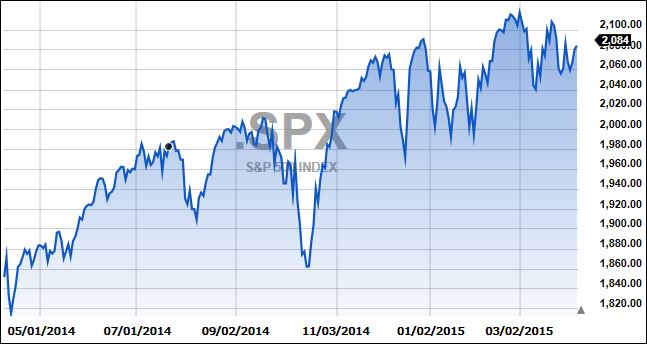
And I’m holding also. I’ll probably buy some more VFIAX.
The good news is I’m returning to New York today. Somehow I relate better to markets and investing when I’m there.
Meantime, here’s some of the best stuff I’ve read recently:
How many mutual funds routinely rout the market? ZERO! From the New York Times by Jeff Sommer:
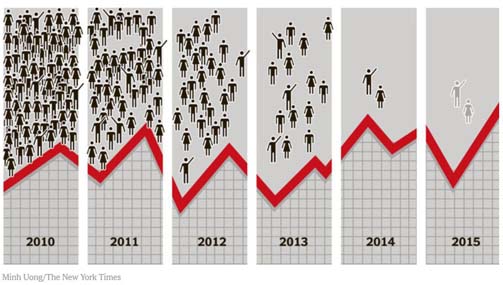
The bull market in stocks turned six last Monday, and despite some rocky stretches – like last week, when the market fell – it has generally been a very pleasant time for money managers, who have often posted good numbers.
Look more closely at those gaudy returns, however, and you may see something startling. The truth is that very few professional investors have actually managed to outperform the rising market consistently over those years.
In fact, based on the updated findings and definitions of a particular study, it appears that no mutual fund managers have.
I wrote about the initial findings of that study last summer. It is called “Does Past Performance Matter? The Persistence Scorecard,” and it is conducted by S.&P. Dow Jones Indices twice a year. The edition of the study that I focused on began in March 2009, the start of the bull market.
It included 2,862 broad, actively managed domestic stock mutual funds that were in operation for the 12 months through 2010. The S.&P. Dow Jones team winnowed the funds based on performance. It selected the 25 percent of funds with the best returns over those 12 months – and then asked how many of those funds actually remained in the top quarter in each of the four succeeding 12-month periods through March 2014.
The answer was remarkably low: two.
Just two funds – the Hodges Small Cap fund and the AMG SouthernSun Small Cap fund – managed to hold on to their berths in the top quarter every year for five years running. And for the 2,862 funds as a whole, that record is even a little worse than you would have expected from random chance alone.
In other words, if all of the managers of the 2,862 funds hadn’t bothered to try to pick stocks at all – if they had merely flipped coins – they would, as a group, probably have produced better numbers. Instead of two funds at the end of five years, basic probability theory tells us there should have been three. (If you’re curious, I explained how the math works in a subsequent column, “Heads or Tails? Either Way, You Might Beat a Stock Picker.”
The study seemed to support the considerable body of evidence suggesting that most people shouldn’t even try to beat the market: Just pick low-cost index funds, assemble a balanced and appropriate portfolio for your specific needs, and give up on active fund management.
The data in the study didn’t prove that the mutual fund managers lacked talent or that you couldn’t beat the market. But, as Keith Loggie, the senior director of global research and design at S.&P. Dow Jones Indices, said in an interview last week, the evidence certainly didn’t bolster the case for investing with active fund managers.
“Looking at the numbers, you can’t tell whether there is skill involved in what they do or whether their performance is just a matter of luck,” Mr. Loggie said. “I believe that many of them do have skill. But even if they do have it, based on how they’ve done in the past you really can’t predict how they will perform in the future.”
Still, those two funds did manage to perform splendidly in that study. Their stubborn persistence at the top of the heap over that five-year period suggested that there was some hope for active fund managers. If they could do it, after all, others could, too.
But we’re now about two weeks away from the completion of another 12 months since the end of that study, and it’s been a mediocre stretch, at best, for those two mutual funds. When the month is over, to borrow from Agatha Christie, it looks as though we’ll be saying: And then there were none.
Here are the dismal statistics: The SouthernSun Small Cap fund has actually lost money for investors over the 12 months through Thursday. It was down 3.2 percent, according to Morningstar, and for the nine months through December, it was in the bottom quartile of funds in the S.&P. Dow Jones study. The Hodges Small Cap fund has done better, gaining almost 6 percent through Thursday. S.&.P. Dow Jones Indices says that put it in the third quartile – or second-to-worst one – through December. While it’s mathematically possible, it is highly unlikely that either will climb to the top quartile in the next few weeks, Mr. Loggie said.
Michael W. Cook, the lead manager of the SouthernSun Small Cap fund and the founder of the firm that runs it, was traveling last week and was unavailable to comment for this column. Craig Hodges, manager of the family-run Hodges Small Cap fund in Dallas, spoke to me on the telephone and told me that he wasn’t surprised that his fund had stumbled. “We’re not that good,” he said. “It was going to happen sooner or later. We’ve never expected to outperform all of the time.” And despite disappointing recent returns, both funds are still beating the market handily over the last five years.
Late last year, Mr. Hodges said, his fund was hurt by falling energy prices, which pulled down the returns of several of its holdings. “That kind of thing will happen,” he said. “You can expect that.” Last summer, he told me that over the long run – which he said is probably 50 years or more – he expects that his fund will do better than average. And he reiterated that view last week. “We’ll come out all right in the end,” he said. “I think if you pick a good manager, someone you believe in and you think you can trust, you’ve got to stick with him for a long time, and if he’s good, he’ll perform for you.”
Mr. Loggie and his crew are continuing their regular monitoring of mutual fund performance. Right on schedule, they did another winnowing of mutual funds through the five years that ended in September – and they will do another one for the five years ending this month.
The September performance derby produced more funds that ended up consistently in the top quartile – nine of them, Mr. Loggie said. “That’s not surprising,” he said. “Some periods you have more funds, some periods you have less.”
But what you never have, he said, is any indication that past performance predicts future returns. “It’s possible that any one of these funds will beat the market over the long term,” he said. “Some of them will do that. But the problem is that we don’t know which of them will do that in advance.” And that, in a nutshell, is the kernel of the argument for buying index funds.
Jeff Sommer’s full article is here.
Should you follow Mohamed El-Erian and move your investments to cash? From MarketWatch:
Q. Where is your money? Stocks? Treasuries? Bonds?
A. “It is mostly concentrated in cash. That’s not great, given that it gets eaten up by inflation. But I think most asset prices have been pushed by central banks to very elevated levels.”
Q. So we’re nearing a bubble?
A. “Go back to central banks. Central banks look at growth, at employment, at wages. They are too low. They don’t have the instruments they need, but they feel obliged to do something. So they artificially lift asset prices by maintaining zero interest rates and by using their balance sheet to buy assets.
“Why? Because they hope that they will trigger what’s called the wealth effect. That you will open your 401(k), see it has gone up in price, and you’ll spend. And that companies will see their shares are going up and they will be more willing to invest. But there is a massive gap right now between asset prices and fundamentals.”
From MarketWatch April 6, 2015. Click here.
This chart blew me away, when I first saw it. It was in the Economist’s “The World In Transition.” It’s pretty amazing.
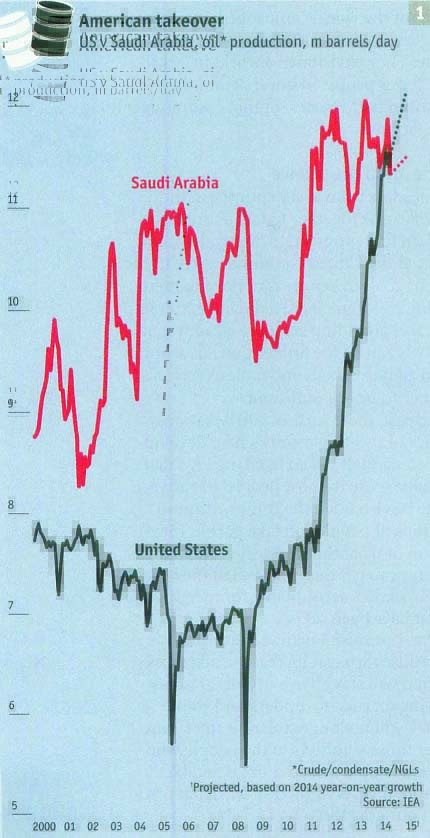
Wrote the Economist:
The most remarkable shifts are geo-economic. America will overtake Saudi Arabia to become the world’s largest producer of oil, thanks to the shale-gas revolution (chart 1). Many aspects of international relations are built around American access to oil, and these will be viewed in a new light. The International Energy Agency forecasts that America’s oil pre-eminence will last until 2050 and beyond.
Suggestions for your next trip. (Hint: Europe is on sale.)

From Travelers Choice:
1. Marrakech, Morocco
2. Siem Reap, Cambodia
3. Istanbul, Turkey
4. Hanoi, Vietnam
5. Prague, Czech Republic
6. London, England
7. Rome, Italy
8. Buenos Aires, Argentina
9. Paris, France
10. Capetown Central, South Africa
11. New York City
12. Zermatt, Switzerland
13. Barcelona, Spain
14. Goreme, Turkey
15. Ubud, Bali, Indonesia
16. Cusco, Peru
17. St. Petersburg, Russia
18. Bangkok, Thailand
19. Kathmandu, Nepal
20. Athens, Greece
21. Budapest, Hungary
22. Queenstown, New Zealand
23. Hong Kong, China
24. Dubai, United Arab Emirates
25. Sydney, Australia
I’ve been to 19 of their choices. I go along with the list. For the writeups plus gorgeous photos, click here.
The best to read about Iran and the Middle East:
+ A dangerous deal? How the Iran nuclear deal could divide Americans and allies alike. From The Week Magazine. For the full piece click here.
+ Negotiating with Iran. Is this a good deal? FOR years Iran has lied about its nuclear plans. The Islamic Republic insists that it wants peace, but it has built secret, bomb-proof facilities for enriching uranium and, most outsiders conclude, begun work on designs for nuclear weapons. At the same time, it has spouted anti-Semitism and sponsored terrorists and militias in Lebanon and the Gaza Strip. It is fighting directly or by proxy in Syria, Iraq and now Yemen, often supporting vicious sectarian clients. And yet, despite Iran’s transgressions, this week’s progress towards an agreement to limit its nuclear programme is still welcome. for the full Economist piece, click here
+ Tell Me How This Ends Well. In 2002, a group of Arab social scientists produced the U.N.’s Arab Human Development Report. It said the Arab world suffered deficits of freedom, knowledge and women’s empowerment, and, if it did not turn around, it would get where it was going. It was ignored by the Arab League. In 2011, the educated Arab masses rose up to force a turnaround before they got where they were going. Except for Tunisia (the only Arab country whose autocrat was also a modernizer), that awakening fizzled out. So now they’ve gotten where they were going: state collapse and a caldron of tribal, sectarian (Shiite-Sunni, Persian-Arab) civil wars – in a region bulging with unemployed, angry youths and schools that barely function, or, if they do, they teach an excess of religion not math.
I read President Abdel Fattah el-Sisi of Egypt declaring that “the challenges facing our national Arab security are grave, and we have succeeded in diagnosing the reasons behind it.” And that was? Too little Arab cooperation against Persians and Islamists. Really? Some 25 percent of Egyptians are illiterate today after $50 billion in U.S. aid since 1979. (In China, illiteracy is 5 percent; in Iran, 15 percent.) My heart goes out to all the people in this region. But when your leaders waste 70 years, the hole is really deep. By Thomas Friedman in The New York Times. For the full piece click here.
+ The Obama Doctrine and Iran. In September 1996, I visited Iran. One of my most enduring memories of that trip was that in my hotel lobby there was a sign above the door proclaiming “Down With USA.” But it wasn’t a banner or graffiti. It was tiled and plastered into the wall. I thought to myself: “Wow – that’s tiled in there! That won’t come out easily.” Nearly 20 years later, in the wake of a draft deal between the Obama administration and Iran, we have what may be the best chance to begin to pry that sign loose, to ease the U.S.-Iran cold/hot war that has roiled the region for 36 years. But it is a chance fraught with real risks to America, Israel and our Sunni Arab allies: that Iran could eventually become a nuclear-armed state.
President Obama invited me to the Oval Office Saturday afternoon to lay out exactly how he was trying to balance these risks and opportunities in the framework accord reached with Iran last week in Switzerland. What struck me most was what I’d call an “Obama doctrine” embedded in the president’s remarks. It emerged when I asked if there was a common denominator to his decisions to break free from longstanding United States policies isolating Burma, Cuba and now Iran. Obama said his view was that “engagement,” combined with meeting core strategic needs, could serve American interests vis-à-vis these three countries far better than endless sanctions and isolation. For the full Thomas Friedman piece, click here.
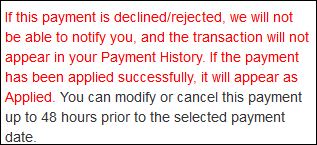
Thank you Time Warner for this helpful explanation:

Harry Newton. Back to cold, wet New York April weather. Flying into New York on a jet plane, courtesy American.
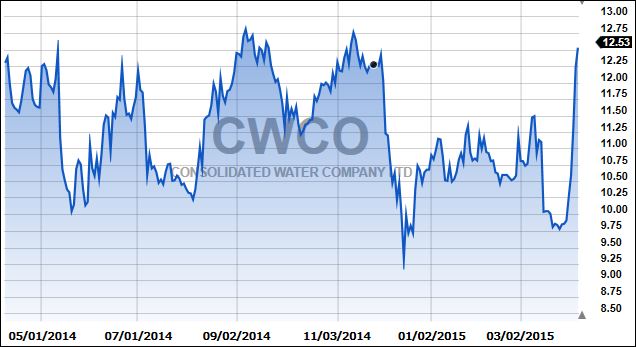
I ‘m a fan of desalinization as one solution to California’s horrible drought. CWCO is up over 15% in the last few trading days. Is this California’s solution?

In reference to Economist’s “The World In Transition.”: We should say a little prayer of thankfulness for fracking every day. Fracking has cushioned us from the miserable policies of the Obama administration. If it weren’t for the lower price of oil and the revenue from fracking our national (and personal) deficit would be much worse, the middle class would be in even worse shape, and Obama would be nationalizing our IRAs. Bill Clinton got an undeserved boost from the Internet, but we have been saved from bigtime horrors by fracking.
Make sure you watch the NY Times Link with Friedman and Obama. How many un-truths can you detect in Obama’s comments? This President scares the hell out of me.
Harry now that you have grandkids your perspective might use some tuning:
http://www.desmogblog.com/2014/10/07/central-california-aquifers-contaminated-billions-gallons-fracking-wastewater
Harry, since you are clearly a liberal rag junkie I’m a little surprised that you didn’t post some bullshit article from Rolling Stone Magazine today. Not that the recent lies they have now admitted to would cast any negative aspersions on a rebound writer as say a Mile Taibbi…LOL
Me, personally I’m hoping for the UV frat house to sue Rolling Stone out of business as soon as possible.