I was right. Sort of. Back the truck up when Apple opened yesterday. It was over hurt by dumb Wall Street expectations.
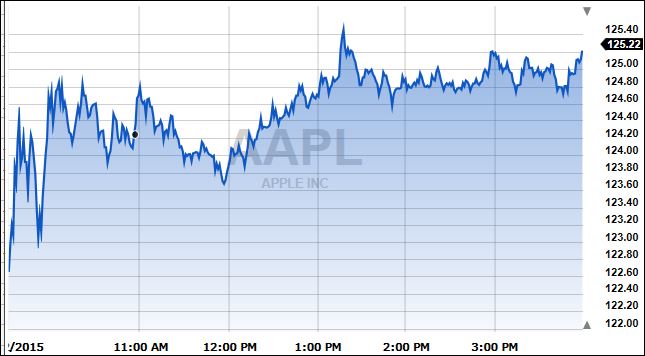
Now watch it fly as real investors figure out it was a really good quarter for Apple. Here’s yesterday upkick:
Apple Support talked me through getting my Apple Watch/iPhone combo to work. It took several hours as we took the iPhone back to its original factory beginnings. Then we re-loaded my zillion apps sitting peacefully on my Lenovo Windows ThinkPad X230 (not on iCloud). And then we waited while the App Store re-loaded my apps.
Do not try this if you don’t have most of a day to waste.
The upshot is Apple stock is back to $125 and going higher.
Apple is remarkable in the free ink it can secure. to me, this is a measure of long-term success. I tell other technology companies that spending on marketing and public relations is often as good as spending on engineering. My “advice” usually falls on engineering deaf ears. I wonder what Honeywell could have done with its Lyric home thermostat control device if it had simply read the user reviews on Amazon (awful) and spent a little time wooing New York Times (and other) technology editors with an improved product. I instance Google’s Nest, which is the number seller and clearly dominating that sector — the beginnings of the Internet of Things explosion.
Remember Yahoo? It was once an all-purpose destination web site with many useful free features, from search to news, from finance (all about stocks) to email, from jobs to auto, from movies to travel. From dating to food. While Yahoo was busy enlarging (but not improving) its offerings, a new generation of start-ups was focusing on perfecting one single beautiful product. Soon Yahoo was losing out to eBay in auctions, Google in search and email, Craigslist in classifieds, Rotten Tomatoes in movies, etc. Then Facebook came along, replacing Yahoo as the home page for millions of people. Now Yahoo’s only decent asset is its shares in Alibaba and a handsome, smart CEO who’s spending furiously to fluke a new business opportunity. Good luck.
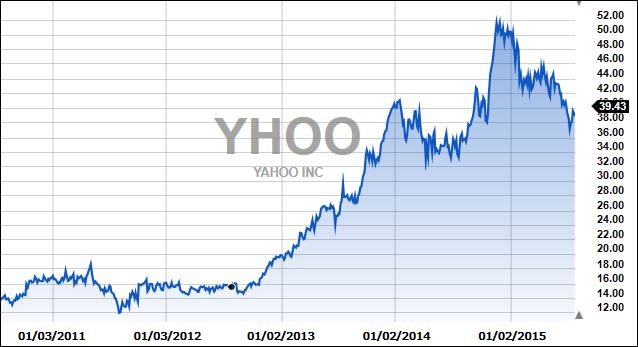
Here’s Yahoo over the past five years. Hard to predict. Hard to play:
When I ran a bunch of magazines, there were some companies that worked enthusiastically with us — providing us help on filing all those empty editorial pages — one for each page of advertising. Apple was one. Motorola wasn’t one. Microsoft was one. Intel wasn’t one.
You could pick the long-term investment winners and losers by their attention to marketing, public relations. and the press.
Which brings me to the free story on the Apple Watch in today’s New York Times:
In Apple Watch Debut, Signs of a Familiar Path to Success
Stuart Goldenberg.
Asking if the Apple Watch will become a hit or a flop is a bit like asking if my 2-year-old daughter is destined to go to Yale or to jail. Interested parties can speculate on the basis of thin evidence – she learned to walk pretty early, though on the other hand, she still thinks cats say “bow wow” – but youth is inherently unpredictable, and anyone venturing a long-term forecast based on short-term performance runs the risk of looking quite silly.
Technology pundits tend to be a rash bunch, though, so there has been no shortage of prognostication about the Apple Watch, a device that went on sale three months ago. Because reviews (including mine) were mixed and the device hasn’t proved to be culturally revolutionary, some are declaring the watch dead on arrival.
Apple has declined to provide sales figures for the watch, its newest product. In its earnings report for the fiscal third quarter, released on Tuesday – the first to include sales of the Apple Watch – the company was cagey about sales, with Timothy D. Cook, the chief executive, saying the device had “a great start.”
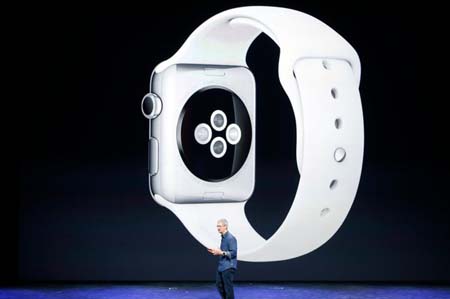
Timothy D. Cook announced the Apple Watch in September at an event in California. Credit Stephen Lam/Reuters
Analysts’ estimates vary wildly, with many originally predicting that Apple sold three million to five million watches from April to the end of June. After studying Apple’s opaque earnings report, several analysts revised their estimates down to about 1.5 million to three million watches. Even at the lower end, that’s the opposite of instant death: Luca Maestri, Apple’s chief financial officer, pointedly said the watch sold more in its first nine weeks on the market than either the iPhone or the iPad did in that same period.
Yet the future of the Apple Watch will not be determined by first-quarter sales. Apple’s product debuts tend to follow a well-worn script: A first-generation device is always criticized as overpriced and a bit lacking in utility and is often vulnerable to the charge that it is a solution in search of a problem. Then, over a few years, Apple and its customers figure out the best uses for the gadget, and the company methodically improves design and functionality to meet those needs. It also tends to lower its prices. Correspondingly, sales explode.
Given this history, the question to ask about the Apple Watch isn’t how well it has sold so far, but how well Apple is following that script. Is it moving quickly to address the early criticism of the watch and to expand access to and functionality of the device?
The answer here is far more definitive than the murky sales figures: So far, Apple is following exactly the same playbook for the watch that it did for the iPod, the iPhone and the iPad. If it sticks to that pattern – trying to add new capabilities to the device while perhaps lowering prices and expanding distribution – the future of the Apple Watch could be bright. The only catch is that determining success will take months, if not years. Waiting may be too much to ask of itchy tech observers, especially because Mr. Cook’s legacy is riding on his ability to introduce a new product category to the world’s tech-obsessed masses. But waiting may be the only option.
Of the data we have on the watch so far, much of it leans positive. Owners of Apple Watches, for one, seem to like them. Creative Strategies and Wristly, two research firms, recently conducted a study of more than 800 Apple Watch owners. About 97 percent reported being either very or somewhat satisfied with the device. That level is better than corresponding levels of satisfaction for the original iPhone and iPad, both of which scored in the low 90s in early customer-sentiment studies.
Ben Bajarin, an analyst at Creative Strategies, said the study also revealed a point of perhaps deeper importance. There is a split, the research found, between people who describe themselves as tech-obsessed – people who work in the industry or build apps for a living – and those outside the tech world, also known as normal people. Early adopters were pickier about the watch’s shortcomings, the study found. Only 43 percent of app developers described themselves as “very satisfied” with the watch, compared with 73 percent of nontech users who were delighted by the device.
Fortunately for Apple, according to the study, a slim majority of Apple Watch owners did not describe themselves as techies – a finding that surprised Mr. Bajarin.
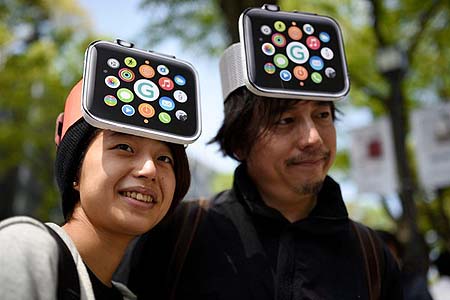
Makoto Saito and Kazumi Oda in Tokyo on April 24, when the device went on sale. Some have called it a flop, but the watch sold more in its first nine weeks than the iPhone or iPad did in the same period. Credit Franck Robichon/European Pressphoto Agency
“My assumption was that a high proportion of people who bought the Apple Watch early were probably going to be people who are investors or they’re super into gadgets,” he said. “We certainly have those people in the survey, but we also have people from Milwaukee who are insurance agents and are not early adopters.”
He added that the appeal for those outside tech bodes well for the watch. “There are clearly way more mainstream users in Apple’s ecosystem than there are early adopters, so it’s good that the watch is already not confusing for people who aren’t your bleeding-edge techies,” he said.
The split between the tech elite and mainstream users echoes a story that has been repeated throughout Apple’s history. The iPod, the iPhone and the iPad all confounded tech insiders, who loudly criticized faults with the devices that they claimed would be fatal – and that, it turned out, didn’t much matter to ordinary people, or to Apple’s long-term success. The first iPod, which sold for $399, was called too expensive, and it worked only with Macs. The iPhone didn’t have a copy-and-paste function, it ran only the slow Edge network and it didn’t have a removable battery. Also, it couldn’t run third-party apps. The iPad didn’t load websites with Flash animation, and it didn’t have a camera.
A few of these were genuine shortcomings, and Apple eventually addressed them. The company created a Windows version of the iPod, added an app store to the iPhone and put a camera on the iPad. But in many instances it ignored the techies: Apple never added Flash to iOS, and you’d be hard-pressed to find anyone in tech these days who thinks that was a bad idea.
The point here isn’t that the tech critics are always wrong. Instead, the pattern suggests the early criticism isn’t necessarily the best long-term guide. It takes time to figure out which shortcomings in a new product are significant and which are merely symptoms of an outmoded way of looking at technology.
With the Apple Watch, the company is clearly studying these patterns now, and it has already shown off some coming changes. There have been two main criticisms of the watch thus far: It’s too slow, and it’s not necessary – it doesn’t do all that much you can’t do on your phone. A more pernicious problem is that developers have not yet hit on killer ideas for the watch, and some of the world’s largest tech companies are moving cautiously to create apps for it.
Apple is fixing these problems faster than it addressed major shortcomings with other first-generation products. At its developer conference in June, the company unveiled an update to the watch’s operating system that Apple said would greatly improve its speed. The new operating system, appearing later this year, will also let developers use more of the sensors and other technologies on the watch, allowing for more powerful apps.
These advances might sound small, but in tech, incremental improvements can drive big changes. Jan Dawson, an independent tech analyst, told me the new operating system would “be a big part of generating more compelling-use cases for the watch for mainstream users, because that’s when we’ll really start to see a flood of third-party apps that make sense.”
What’s more, bit-by-bit improvements are part of Apple’s modus operandi. We saw it with the iPod, the iPhone and the iPad. After creating something new, the company continually adds small new features over time. Over a few years, this turns an initial burst of interest about Apple’s newest thing into a long-term tech institution that just about everyone can use and enjoy. That’s happening with the watch, and the strategy just might work.
The greatest baby toy ever. it’s called Learning Walker. Amazon sells it for a bargain $25, which includes batteries. Others sell it at $35.
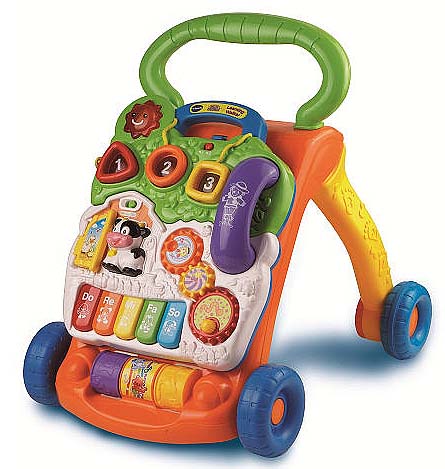
It kept Sophie endlessly amused. She hasn’t yet figured out why G*d gave her legs. But she loved opening and closing the yellow door which, when opened, yelled “Peekaboo. I see you.”
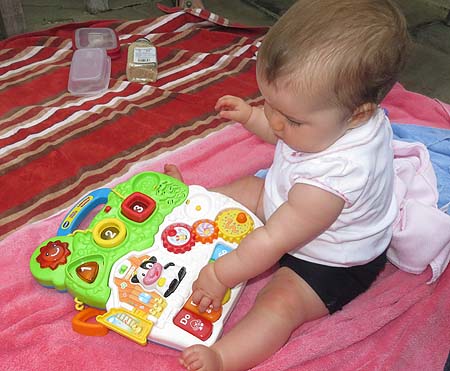
The product’s brilliance is its flexibility. You can lift off the gadgetry part and play with that. Later when she figures why she has legs, she can use it as a walker.
Perhaps a larger version would be useful for me? I played tennis so poorly this morning, I could have used a walker. Of course, playing a 27-year old who’s won a bunch of tennis championships isn’t great for my battered ego. Congratulations Matt Wood, who is also the world’s best insurance broker. Hint: next time play a customer tennis. I’m 2.7 times your age.

Harry Newton, who savoring the incredible weather in New York’s Columbia County. As proof, here’s Rosie this morning. She won’t come in.

By the way, if you have Yahoo mail, change and get Gmail. Yahoo censors your mail and — worst — doesn’t tell you it’s playing Big Brother. Yahoo censored yesterday’s blog email, simply rejecting dozens of my emails. It sent them to me, but didn’t tell my subscribers they’d been denied the pleasure of my “wisdom.” Even worse, Yahoo runs email for several companies and censors their mail also. You need to check who your company is using. I checked Yahoo on what I had said that so offended them and got this:
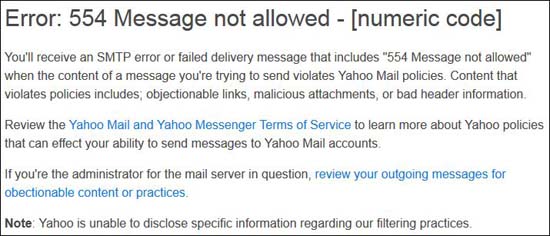
This gives arrogance a whole new meaning. In contrast, Gmail has never censored my blog emails. NEVER. EVER.

Harry, do you have a formal education?
What do you consider “a formal education?” An MBA from Harvard, perhaps? An undergraduate degree in Economics? And accounting board membership.
Harry, if you believe your formal education is impressive let me see you go get a degree in mechanical engineering. Ask any mech eng who has an MBA how difficult that masters was compared to the eng degree. The next sound you’ll hear is roaring laughter.
In Australia a formal education is completing the fourth grade.