I am the worst. I panic and sell when prices are low. And I buy when prices are high.
Every book says you should not do that. You should look at the charts.
Which ones?
Certainly not the last five days (doesn’t include today, which is mercifully up).
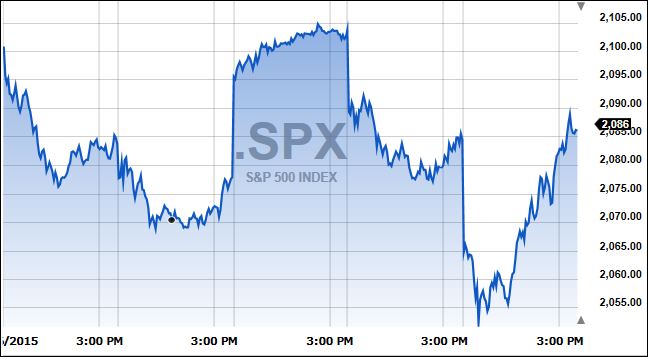
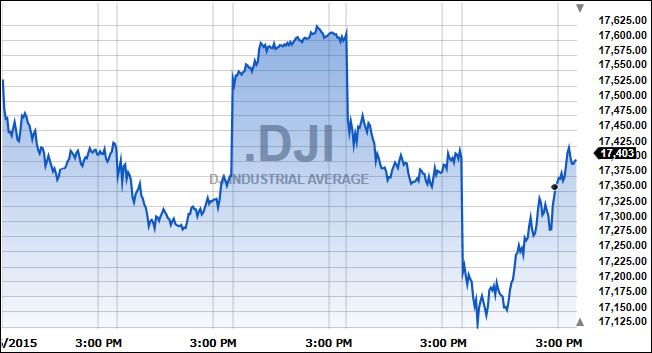
You should look at the last five years. Reassuringly up.
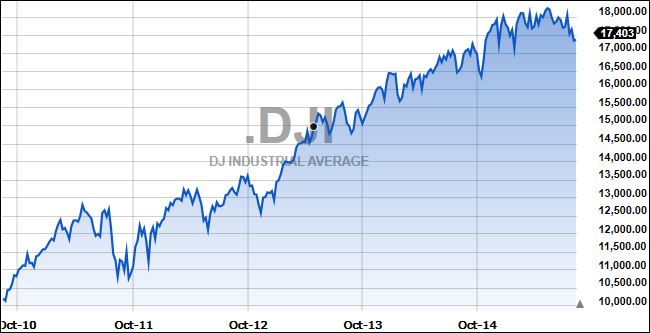
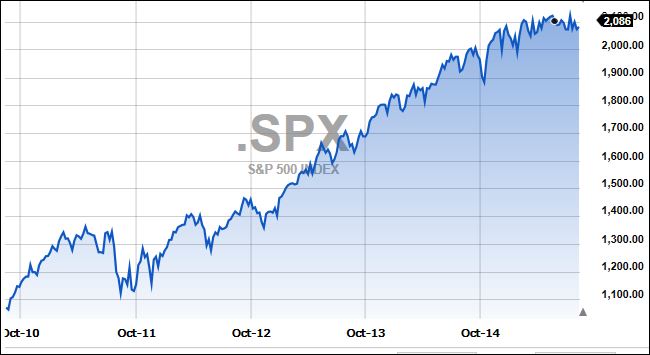
So, it’s discipline I need. Deep breaths and, maybe — just maybe — meditation.
I’m depressed at my idiocy. I pick up a New Yorker next to the bed. Its only distinction is that it’s on top of the pile. My red friends say the New Yorker is a pinko commie left-wing POS. Which makes the New Yorker even more interesting.
I open to:
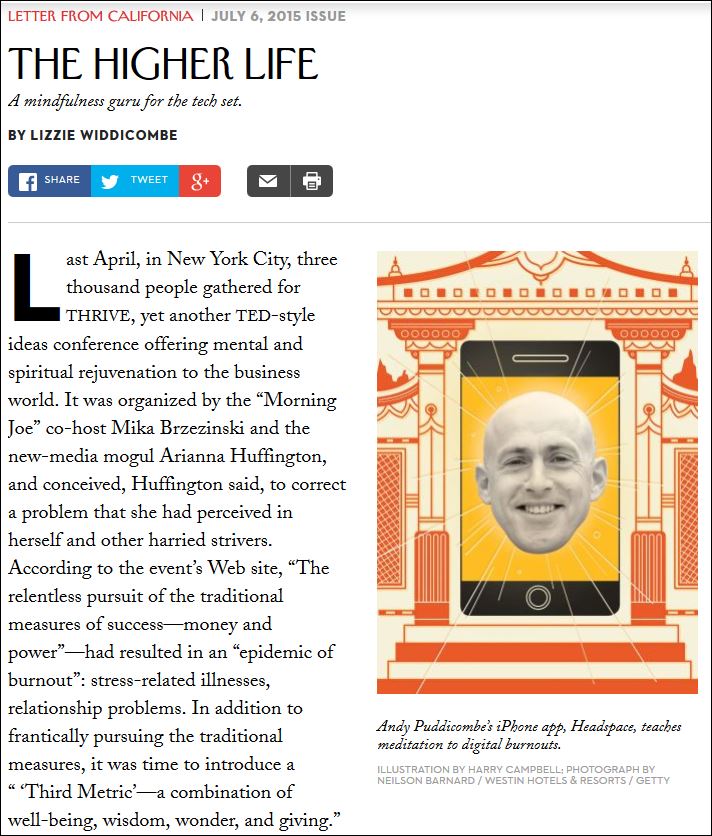
It turns out that the iPhone meditation app called Headspace has been downloaded three million times — without the hindrance of any marketing!
Turns out also that a Reuters article called “Meditation and the Art of Investment” quotes Ray Dalio, of the hundred-and-seventy-billion-dollar hedge fund Bridgewater Associates: “Meditation more than anything in my life was the biggest ingredient for whatever success I’ve had.”
Meditation eases anxiety — like my insane anxiety of this week, when I have been ready to pack my goods and chattels and move to a Buddhist monastery in Northern Vermont — not with Bernie Sanders as a room mate. Thank you very much.
I’m not into meditation, yet. I prefer naps. Some of my friends really like it and say it helps their investment performance.
I’m now the three millionth and oneth person who’s downloaded Headspace onto their iPhone. I’ll let you know if I get less crazy.
For now, you really should read the New Yorker meditation piece — Click here.
What’s happening in China? Fears of it slowing down, hurting commodities, American businesses, and its rulers getting desperate have hurt our stock markets of late. This long piece from today’s New York Times gets to the issues. It’s really good. Read it.
Devaluation Hints at China’s Rising Distress Over Economy
By NEIL GOUGH AUG. 12, 2015
HONG KONG – Whenever China’s economy swooned in recent downturns, its currency never buckled. It held steady, or strengthened, even as China’s neighbors or trading partners scrambled to cut the value of their own currencies to deal with the fallout.
With the Chinese renminbi now taking its biggest plunge in decades, the worry is that the country’s already slowing economy is even worse off than reported and that the government is panicking. On Thursday, China allowed the renminbi to weaken significantly for a third consecutive day.
The situation is shaking the aura of supremacy surrounding President Xi Jinping and the Communist Party, which has portrayed a sense of ultimate authority. But the Chinese government’s response to the country’s financial woes is creating concerns about its ability to manage a slowdown.
“People are used to growth and rising living standards,” said Jonathan Fenby, an author and co-founder of the research firm Trusted Sources. “But now they are in a `real’ world, and the leadership has to convince them both that slower growth is in their long-term interests and that it is in control.”
By the official measures, the economy is growing at 7 percent, right in line with government targets. It is a steady pace that the leadership has indicated can support decent job growth and put more money into consumers’ pockets.
But a look below the surface shows a different, more worrisome picture. Core parts of the economy, like construction, are weaker than ever as the real estate industry struggles. Consumer spending, which was supposed to pick up the slack, is not that strong. And financial services, a major driver of economic growth when the stock market was booming, are slipping.
The data coming out of China, too, is somewhat suspect. Economists now wonder whether, despite official figures showing growth, some provinces and regions could be dealing with outright recessions.
“To be honest, no one has a clue where the economy is, and I don’t think that it’s properly measured,” said Viktor E. Szabo, a senior investment manager at Aberdeen Asset Management.
“Definitely there is a slowdown,” he added. “You can have an argument about what level it is, but it’s not 7 percent,” he said, referring to the rate of growth.
The government’s aggressive action on the currency has brought the economy into sharp focus.
The currency’s official rate, at 6.4 renminbi per dollar, is down 4.4 percent over the last three days. On a typical day, the renminbi rises or falls just a small fraction of a percentage point.
While the government said the decision was intended to make the currency more market-oriented, the devaluation also was largely a gift to exporters. In relative terms, it makes China’s shipments of clothing or electronics to consumers in the United States or Europe more affordable.
“I don’t see this mini-devaluation as some kind of outrageous act,” said George Magnus, an economic adviser to the bank UBS and an associate at Oxford University’s China center. “But it is part of an array of other economic and financial stimulus measures designed to shore up the flagging growth rate.”
The government has taken the usual steps by cutting interest rates and freeing up more money for banks to lend. But the leadership has also turned to more unconventional means in recent months to try to cushion the blow as the economy’s once-runaway expansion sinks back to earth.
It relaxed a rule that banned investment companies tied to local governments from piling on debt. When the stock market slumped, it aggressively moved to halt the slide, by encouraging borrowing to buy stock and pouring money into the system. It has also pledged tens of billions of dollars in support to state-controlled policy banks for loans to favored projects.
China’s plan has been to wean itself off a debt-driven growth model that has led to wasteful, government-led investment. Instead, policy makers want consumers to become the main engine for the economy, but that will take time.
They had hoped to maintain growth by keeping credit flowing to favored projects, a nationwide program that amounts to trillions of renminbi worth of investment in new infrastructure. The money is going to redevelop shantytowns and to build wastewater treatment facilities, as well as expand road and rail networks.
In the city of Liupanshui in Guizhou, one of China’s least affluent provinces, the local government is building its first subway line. Officials hope to bring in private investment to help finance the project, a 49-kilometer line expected to cost 10 billion renminbi, or about $1.6 billion.
But such efforts have not been enough. While infrastructure investment is rising, it has failed to offset the nationwide pullback in spending on new factories and apartment block towers. In July, overall investment in fixed assets rose 11.2 percent, the slowest increase in 15 years.
The troubles can be seen in mid-tier cities like Zhanjiang, on the southern coast, which is home to the navy fleet that patrols the South China Sea. While property prices in major metropolises like Shenzhen or Beijing have rebounded, those are exceptions. Prices of new homes in Zhanjiang fell 9.8 percent in June from a year earlier, the most recent data available.
China’s devaluation of the renminbi was the latest in a series of moves over the past two months to help boost the slowing Chinese economy.
No one is under the illusion that the main (if not the sole) reason Beijing devalues RMB is to boost its exports to the west (chiefly, US)….
China’s builders just are not building as much. For years, double-digit growth was the norm in construction materials, as cities across the country went on a building spree. That situation has reversed sharply, and output of many crucial materials has been declining this year.
Cement output fell 5 percent by volume last month, while plate glass production declined 13.5 percent. Steel output fell 1.8 percent in July, the most on record. Exports of steel soared as mills, many of them operating at a loss and unable to find buyers at home, shipped their excess stock overseas.
Consumers aren’t yet able to shoulder the burden of driving the economy. While incomes are still rising, the job market has started to show signs of stress. Vacancies are declining across the market as companies reduce hiring in response to slowing business growth.
The stock market slump has also taken a toll, with the main Shanghai index down about a quarter from its peak two months ago. Ordinary investors have poured money into the markets over the last year, and many are now sitting on losses.
The overall result is that consumers are spending less. Retail sales grew 10.5 percent in July from a year earlier, near the slowest pace in a decade. Share prices of big multinationals that sell heavily into the China market, like LVMH, the spirits and luxury goods retailer, or Yum Brands, which operates the KFC and Pizza Hut fast food chains, have suffered since the renminbi’s devaluation.
Even homegrown e-commerce companies, held up by China’s leaders as builders of a new economy, have not escaped the rout. Shares in Alibaba, in New York, and Tencent, traded in Hong Kong, have both declined over the last two days.
The stock market slump is a double blow. In the first half of the year, the flurry of new share sales, strong brokerage business and other market-related activities helped mask some underlying issues.
Without that boost, China’s gross domestic product would have risen notably less than the 7 percent reported rate. Instead, it would have been about 6.2 percent in the second quarter and 6.5 percent in the first, economists at Standard Chartered estimated in a report last month.
As the government pumps money into the market and the broader economy, it will help, along with moves like the devaluation. It is just not clear how solid the economy will actually be.
“It’s all about the quality of growth,” said Victor Shih, a China scholar at the University of California, San Diego. “If they want to, they can always achieve the right rate of growth.”
The Chinese government, he added, just needs to find a group of people and “tell them to go dig a ditch.”
The whole article has some charts and photos. Click here.
The funniest article on the GOP Race:
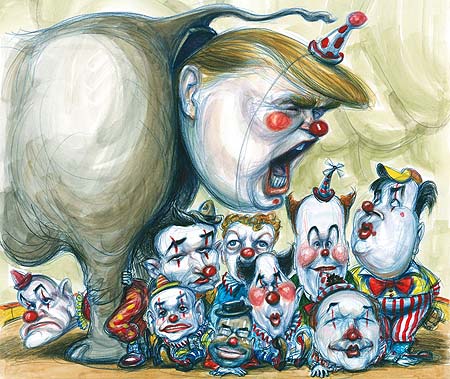
It’s called:
Inside the GOP Clown Car
On the campaign trail in Iowa, Donald Trump’s antics have forced the other candidates to get crazy or go home
It’s by Matt Taibbi in Rolling Stone. It’s still funny, even if you are Republican or a Democrat. In fact, it’s hysterical. Click here.
Substituting entertainment for substance. This one on Donald is not funny. It’s a serious piece by one of my favorite financial writers, James Surowiecki, writing in the New Yorker. (Oops another pinko magazine.)
Why Do Working-Class Voters Love Donald Trump?
Donald Trump’s campaign slogan is “Make America Great Again!” A better one might be “Only in America.” You could not ask for a better illustration of the complexity of ordinary Americans’ attitudes toward class, wealth, and social identity than the fact that a billionaire’s popularity among working-class voters has given him the lead in the race for the Republican Presidential nomination. In a recent Washington Post/ABC poll, Trump was the candidate of choice of a full third of white Republicans with no college education. Working-class voters face stagnant wages and diminished job prospects, and a 2014 poll found that seventy-four per cent of them think “the U.S. economic system generally favors the wealthy.” Why on earth would they support a billionaire?
Part of the answer is Trump’s nativist and populist rhetoric. But his wealth is giving him a boost, too. The Democratic pollster Stanley Greenberg, who’s published reams of work on white working-class attitudes, told me, “There is no bigger problem for these voters than the corruption of the political system. They think big companies are buying influence, while average people are blocked out.” Trump’s riches allow him to portray himself as someone who can’t be bought, and his competitors as slaves to their donors. (Ross Perot pioneered this tactic during the 1992 campaign.) “I don’t give a shit about lobbyists,” Trump proclaimed at an event in May. And his willingness to talk about issues that other candidates are shying away from, like immigration and trade, reinforces the message that money makes him free.
Trump has also succeeded in presenting himself as a self-made man, who has flourished thanks to deal-making savvy. In fact, Trump was born into money, and his first great real-estate success-the transformation of New York’s Commodore Hotel into the Grand Hyatt-was enabled by a tax abatement worth hundreds of millions of dollars. Yet many voters see Trump as someone who embodies the American dream of making your own fortune. And that dream remains surprisingly potent: in a 2011 Pew survey, hard work and personal drive (not luck or family connections) were the factors respondents cited most frequently to explain why people got ahead. Even Trump’s unabashed revelling in his wealth works to his benefit, since it makes him seem like an ordinary guy who can’t get over how cool it is to be rich.
For someone who talks a lot about winning, Trump has a résumé dotted with more than a few losses. On four occasions, companies he’s been involved with have gone bankrupt. Yet these failures haven’t dented his reputation at all, contributing instead to a sense that he’s had to deal with adversity. In other countries, such failures would make it very hard for him to campaign as a visionary businessman. But the U.S. has always been exceptionally tolerant, in terms of both attitude and the law, toward business failure and bankruptcy. Indeed, Trump brags about how he used the bankruptcy code to get better deals for his companies; as he put it not long ago, “I’ve used the laws of the country to my advantage.”
Trump is hardly the first Western plutocrat to venture into politics. Think of William Randolph Hearst or, more recently, Silvio Berlusconi. But both Hearst and Berlusconi benefitted from controlling media empires. Trump has earned publicity all on his own, by playing the role of that quintessential American figure the huckster. As others have observed, the businessman he most resembles is P. T. Barnum, whose success rested on what he called “humbug,” defined as “putting on glittering appearances . . . by which to suddenly arrest public attention, and attract the public eye and ear.” Barnum’s key insight into how to arrest public attention was that, to some degree, Americans enjoy brazen exaggeration. No American businessman since Barnum has been a better master of humbug than Trump has.
Take the debate over how much Trump is worth. It’s impossible to get a definitive accounting of his wealth, since almost all of it is in assets-mainly real estate-that don’t have clear market values. Still, he’s clearly enormously rich. Bloomberg estimates his wealth at $2.9 billion, while Forbes pegs it at $4.1 billion-both tidy sums. But Trump will have none of that: thanks to the value of his brand, he says, he’s worth at least a cool ten billion. This number seems so absurdly over the top as to be self-defeating. But there is a kind of genius in the absurdity. Trump understands that only an outrageous number can really “attract the public eye and ear.”
Trump’s lack of interest in policy and his inflammatory rhetoric make it easy to dismiss him as a serious candidate, and it’s highly improbable that he could ultimately win the nomination. But his bizarre blend of populist message and glitzy ways has allowed him to connect with precisely the voters that any Republican candidate needs in order to get elected (including many whom Romney couldn’t reach). As Greenberg says, as long as he’s in the race, “Trump is a huge problem for the Party. He’s appealing to a very important part of the base, and bringing out the issues the other candidates don’t want to be talking about.” Republicans may be praying that his campaign is just a joke, but right now Trump is the only one laughing.
The worst blonde men jokes
+ A woman phoned her blond neighbor man and said: “Close your curtains the next time you and your wife are having sex. The whole street was watching and laughing at you yesterday.”
The blond man replied: “Well, the joke’s on all of you because I wasn’t even at home yesterday.”
+ A blond man goes to the vet with his goldfish. “I think it’s got epilepsy,” he tells the vet.
The vet takes a look and says, “It seems calm enough to me.”
The blonde man says, “Wait, I haven’t taken it out of the bowl yet.”
+ A blond man shouts frantically into the phone “My wife is pregnant and her contractions are only two minutes apart!”
“Is this her first child?” asks the Doctor.
“No,” he shouts, “this is her husband!”

Harry Newton who is late today because he went to the eye doctor. Things he learned:
+ Eyes change. You should be checked at least every two years.
+ If you buy glasses from one of the cheap online places — like Zenni Optical — you need to be very clear about your PD measurements. Mine is changing from 68 to 67. That tiny change makes a hug difference. Should stop my occasional double vision.
+ Eye medicine and surgery has made huge strides. But, like everything, please follow another of my inviolate rules — CHECK. CHECK. CHECK.

For many, Trump seems to be the last hope to keep us from the insanity of the ruling class. He is right on one thing; for what ever the reason, an opposition party no longer exists. This does not bode well for the future.
The article from James Surowiecki was pretty good. As he points out, Trump’s primary value to the world is in getting the politicians to talk about real issues. AND he is also correct about the hatred of corruption in government.
Regarding “Rolling Stone’… they do GREAT coverage of Taylor Swift. Anything else… not interested.
Don’t forget the very insightful coverage that Rolling Stone does with regards to rape at our college campuses….it’s very well researched journalism……an unequivocal rag.