First, the year to date. Second, the last two days.
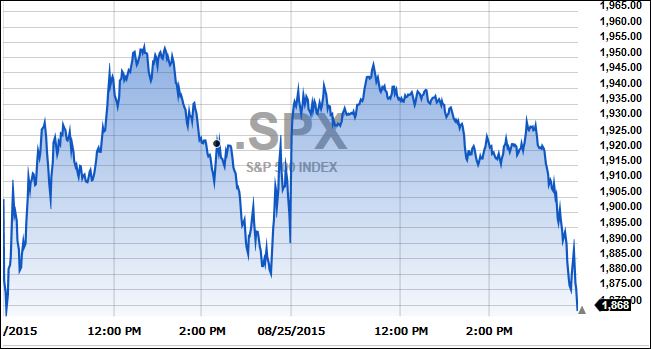
The causes:
1. No one wants to buy. Everything being written by learned “experts” talks about stocks being overvalued. The crux: P/Es are higher than they “should” be.
2. Automatic stop loss orders have kicked in.
3. Day traders having a ball selling stocks short. Something I’d be doing if I were not in California tootling around seeing the sights and the sites.
4. High-speed computers playing the downward trend. What my friend Todd calls “machine driven.”
5. Margin calls. As stock prices drop, brokers sell stocks to cover the money borrowed by the client to buy the stocks. This means that, in effect, the baby gets thrown out with bathwater.
I checked into a hotel last night, surveyed the damage and read whatever I could. Here’s a sensible piece I found in — of all places — USA Today:
Don’t freak. Buy, because stock carnage never lasts
by Peter Dunn, Special for USA TODAY 5:03 p.m. EDT August 24, 2015
Are you gonna look?
The market is getting nasty, the fear index is spiking (yes, there’s a fear index), and politicians have begun to weave market instability into their messaging.
The pressure is mounting, retirement is getting closer, and the financial media won’t stop talking about your money. What are you going to do?
To be fair, you’re getting mixed messages. The TV and the headlines scream at you to look and act – yet you hear quiet whispers that tell you to not even open your investment statement in order to avoid the visual carnage.
Whether the sudden stock market downturn of the past several days is a blip, a crash, a correction or a normal market cycle, controlling your emotions is paramount. You are the one who decides whether this market downturn affects you or not. No, I’m not suggesting you have some sort of metaphysical power. You do, however, have restraint – hopefully.
To be fair, some people will suffer greatly from the market dumping. And not to be glib, but they had it coming. As insensitive as that may seem, when time horizon, diversification and risk tolerance are victims of a thumb-nosing, bad things happen. Patient, diversified and prudent investors will be telling tales of this particular crash five years from now to their friends at a cocktail party, and yes, everyone will be chuckling.
Before we dig into ideas on how to handle this downturn, do yourself a favor and name the last crash that stuck.
Go ahead.
Did the catastrophic market chaos of 1929 prove to be permanent? Did Black Monday in 1987 end up being the beginning of the end for wealth? Did October 2008 mark a ceiling for the stock market? Nope. Nope. And nope. In fact, the market didn’t even finish down for the year on Dec. 31, 1987! Who had a bad year in 1987? People with undiversified portfolios who freaked out and sold.
It’s become important for stock soothsayers to “call the crashes.” Some pros have been warning us about this week for six years. Those people who listened to those pros missed some of the most fruitful years in the market’s history. Those people who turned a blind eye to the prognosticators had amazing years. These days, a good investor needs a diversified portfolio and earplugs.
This is what the market does. It gets out of balance, and then it finds balance. We’re not seeing a new trick. We are seeing exactly what we’ve seen, every few years, for the last 80 years or so. Same song, different verse.
If you must take action, then focus your efforts toward something tangible: buying. Develop a plan to improve your financial standing in spite of whatever the market decides to do. Buy the crash. If you look at the S&P 500 dating to 1970, you’ll notice that this index ended down at year’s end just nine times (based on total annual return, including dividends). There were certainly some scary times. The first were 1973 and 1974. You didn’t feel too good during 2000-2002 either. And we all remember how we felt in 2008. But in each one of those instances, the market was able to recover to pre-fall levels within about five years. In other words, the S&P 500 index fell, recovered and surpassed its pre-fall value within five years or so. The folks who sold during this time locked in their losses. The people who bought into the crashes ended up even better than the people who held still and did nothing.
A stock market crash (correction, whatever) can be mesmerizing. It can paralyze and induce panic. Even schadenfreude, the deranged pleasure that comes in others’ suffering, can begin to set in. That is, until you realize you are the one who is potentially suffering. The realization is misleading. You aren’t suffering. Numbers on papers are getting smaller. You bring them to life when you sell.
So, are you gonna look?
Does Goldman know? BusinessInsider focused did a piece on what happened with the big Asian markets slump in 1998 and now. It writes:
There were a lot of unfavorable comparisons on Monday between the massive sell-off in Asian markets and the Asian financial crisis of the late 1990s.
There are some similarities, and some big differences.
Here’s the crux of Kostin’s argument (emphasis ours):
S&P 500 has corrected for the first time in three years, declining by 11% from its May record high. Concern about China economic growth was the immediate catalyst for the correction. We expect the US economy will avoid contagion and continue to expand. S&P 500 will rise by 11% to reach 2100 at year-end. Such a rebound would echo the trading pattern exhibited in 1998 when US equities rallied and largely ignored the Asian financial crisis. Next week’s macro data may provide reasons for investors to have confidence in durable US growth. Own stocks with high US sales.
Here’s the chart of what happened in ’98 against what’s expected now:

It’s a little less impressive — in 1998, the S&P 500 ended up some way above above where it did at the pre-crisis peak. Goldman only expects the index to climb back to where it was in the spring this year.
Here’s their explanation:
We expect the market will recover but at a slower pace than during 1998. Unlike the current episode, the 1998 correction occurred in the midst of the Tech Bubble. Info Tech stocks returned 25% between September and December 1998, driving a 28% rally in the overall S&P 500 index. The S&P 500 P/E multiple also expanded by 33% during the last four months of 1998.
Effectively, they think stocks aren’t undervalued in the way they were during 1998, and that there’s no bubble to support them this time.

Harry Newton, who shares two more pictures from the west. The first, just outside the Lassen Volcanic National Park he titles “My Portfolio”:

The second he calls “Latest Stockmarket Strategy”. It’s from southern Oregon, near Ashland.

I should have taken my own advice and sold everything two weeks ago. This morning it’s opening up, as it did yesterday. We’ll see how long that lasts….
Today we visit Lake Tahoe and get to play tennis amid the pines and maybe take a canoe ride. The weather is stunning. I wish it would rain. They need it so badly. It’s so dry.
