It’s hard to know what causes a major financial crisis, or when it will happen.
And I’m not one of those professional doom and gloom forecasters (e.g. Ron Paul or Marc Faber).
But when crises happen, they happen fast and furiously.
And they usually happen for a reason different to the last time.
So today’s concerns? Falling commodities/oil/mineral prices and problems in emerging markets. From yesterday’s New York Times:
Brazil is one of the emerging-market economies – Turkey, Mexico and South Africa are among the most prominent others – whose currencies have tumbled of late as global investors withdraw as fears of a broader slowdown in economic growth spread. The retreat has been spurred by a slide in commodity prices, a stronger dollar and by China’s devaluation last month.
You can add some others — e.g. Russia.
You should read the New York Times piece on Brazil, “Sharp Drop in Currency Adds to Growing List of Woes in Brazil“. Click here.
So where are stocks going?
BlackRock is the biggest manager of money in the world.
To get more of it to manage, you’d think they’d be optimistic about what they are selling — their brilliance at managing your money.
Yet yesterday Russ Koesterich, the global chief investment strategist for BlackRock, published this gruesome article in Barrons. The headline was “BlackRock’s Forecast for U.S. Stock Market.“
Is it a case of underpromising and overdelivering, or he is simply trying to CYA (cover his tuchas) when things in the stock market go awry? I asked my knowledgeable friend Dan Good. He mischievously answered: “Who knows. Disgruntled whistle blower? Bernie Sanders supporter?” Here’s Russ’s depressing piece:
BlackRock’s Forecast for U.S. Stock Market
Valuations suggest returns will be below average for the long term, writes the firm’s top strategist.
With market volatility recently reaching its highest level since the financial crisis, investors are understandably questioning what the outlook is for U.S. stocks in 2015 and beyond.
While I don’t believe the recent volatility represents the start of a new bear market-I expect the U.S. market should finish the year higher than where it’s at now-today’s valuations suggest U.S. returns may be below average over the longer term.
First the good news. Despite growing fears of a recession, the U.S. economy is sound, even if growth for the year is likely to once again disappoint. Recent economic data point to some growth firming, inflation remains hard to find and long-term rates are up by barely 10 basis points (bps) from where they started the year, according to data accessible via Bloomberg. Meanwhile, the Federal Reserve (Fed) is highly unlikely to raise rates more than once in 2015, and will probably adopt a similarly languid pace to tightening in 2016. All of this suggests that, absent more scares from China, the U.S. market probably will finish 2015 with a nominally positive return for the year.
What’s to come after 2015?
Looking ahead to 2016, the big risk to U.S. stocks remains an emerging market-induced global recession. Emerging markets account for a growing percentage of global growth, and the recent slowdown in the emerging world isn’t limited to China, as data from Bloomberg demonstrate. Economies in Brazil and Russia are contracting, and most large emerging markets, with the possible exception of India, are slowing, according to the data. But while 2016 is likely to be another year of slow global growth, I don’t foresee a global recession. While China remains a genuine threat, the government has additional monetary and fiscal tools to manage its slowdown. As such, I also don’t see a bear market starting during the first half of 2016.
That said, investors looking out 12 months or more may need to have modest expectations for U.S. stocks. While domestic fundamentals are solid, there are headwinds. Margins are at record highs and are likely to come under pressure as wages firm and rates creep higher. A strong dollar is proving problematic for U.S. companies that sell abroad. But arguably the biggest headwind is valuation. According to Bloomberg data, U.S. large-cap equities, as represented by the Standard & Poor’s 500, trade at roughly 17.5 times trailing earnings and more than 25 times cyclically-adjusted earnings. Both measures are comfortably above their long-term averages. In the past, similarly high valuations have been associated with below-average returns over the longer term.
To be sure, markets have staged big rallies from high valuations-stocks had a number of stellar rallies in the late 1990s when valuations were already high, for instance. However, valuations have mattered in the past, particularly when you look at time horizons of a year or longer using data from Bloomberg. Looking at annual price returns over the past 60 years, Bloomberg data show that annual price returns have been roughly 5% when the starting valuation on the S&P 500 was above the long-term median, roughly 16.5 times trailing earnings. In contrast, according to the data, when the starting valuation was below the median, annual returns were generally in the low- to mid-teens. Investors should also take note that poor years-those in the bottom quartile of returns-tended to be worse when starting valuations were more elevated over the long-term average.
For investors the main takeaway is that while U.S. stocks are still likely to outperform U.S. bonds, neither may provide particularly exciting returns over the next few years.
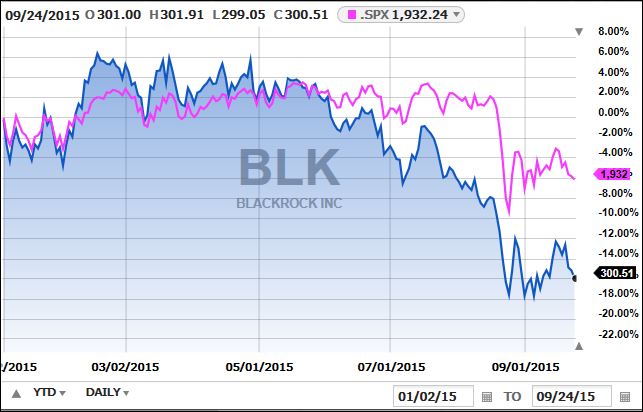
What’s semi-interesting to me is the performance of BlackRock’s own stock recently — in a word miserable. Here’s this year compared to the S&P500.
Me? I’m long SGOL (gold) and short IRDM, KMI, BHP, BABA, WYNN, XOM, GS and CAT. They’re doing well.
Generally, I’m still long. My shorts are a “hedge.”
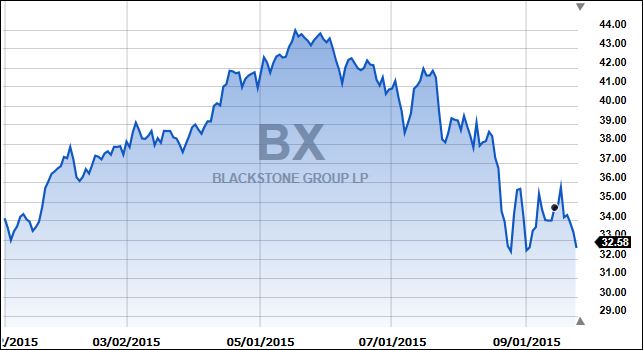
I just bought a few BX, eyeing a marvelous 8.7% yield. But the damn thing can’t get out of its own way and keeps falling. I don’t know why.
Meantime, The US Government’s Economics and Statistics Administration reported soem good news this morning:
Real gross domestic product (GDP) increased at an annual rate of 3.9 percent in the second quarter of 2015, according to today’s third estimate.
Corporate profits from current production increased $70.4 billion in the second quarter, following a decrease of $123.0 billion in the first.
That’s a lot better than a slap in the belly with a cold fish. (Australian expression).
Nike did good in its latest quarter. The stock should up big today. Fortunately they’re on our list and I own some. See right hand column. Click here.
I upgraded to to Apple’s new iOS 9. It’s working fine. No problems. I like the new Notes.
NEW YORK (The Borowitz Report)-As Pope Francis makes his historic first visit to the United States, millions of Americans are turning out to thank the Pontiff for temporarily displacing Donald Trump from the news.
As the Pope visits Washington, New York, and Philadelphia, people from every walk of life are expressing profound gratitude that the news media is offering non-stop coverage of Francis’s every move instead of Trump’s, if only for five days.
Carol Foyler, of New York, said that the Pope’s visit would wreak havoc with traffic in Manhattan this week, but added, “I would put up with that all year long if it meant seeing less of that [expletive] Trump’s face.”
Even Americans who would not normally be expected to take an interest in the Pope’s visit, like agnostics and atheists, are wildly enthusiastic about the role Francis has played in momentarily ousting Trump from the headlines.
“I have never believed in God and I never will,” said Harland Dorrinson, who is a Philadelphia-based atheist. “Still, a miracle like a week without Trump kind of makes you think.”
Avram Heselstein, an Orthodox Jew, said he will join thousands of New Yorkers in Central Park, on Friday, to pay homage to the Pope. “This isn’t about being Jewish or Catholic,” he said. “This is about a man who just did something wonderful for everybody.”

Harry Newton, who’s going off to play tennis in a few minutes. I have more success figuring my backhand than figuring the stock market at present.
Meantime, they sure grow up fast. This is granddaughter Eleanor, nearly two:

She’s cute? Her Papi (that’s me) loves this picture.

Harry,
There is a factor nobody considers in the wild, mostly poor, world developments, economies and stock markets of today and that is a basic fear and concern for the lose of the United States as a world stabilizing force. We’ve purposefully given up that role and there is no trusted replacement. The new nasty powers replacing us include Iran (soon to be a nuclear power), Russia, China, ISIS and chaos. We all underestimate how important and “normal” US leadership was until Obama came to power and implemented his “lead from behind” cowardly policies.
Almost anybody running for the office, either party, would be a huge improvement here except for Hillary who shares many of Obama’s views. (Check out her college essays and role models.) Power hates a vacuum and freedom is not free. Ask Putin.
I like much about the new pope, except his Argentina views on economies, the poor and capitalism. These would be a disaster for the world, as they have been for the last 20 years for Argentina as it sinks and poverty there accelerates. I also note the Vatican accepts no immigrants, none, and Pope Francis is grossly obese. Doesn’t seem to follow his own advice. Bring back Trump!
Don’t try and talk any sense to Harry, he is a major Kool-Aid drinker who will support Obama and the other democrats until the end.
Amen and Amen
Yes, power vacuums tend to get filled. But do you reserve any vitriol for your fellow FoxNewsian neocons who advocated the removal of secular dictators in Iraq, Libya, and now Syria, This is what created the vacuum.