Today is
+ 2:15 PM for news about a Fed rate hike.
+ 8:00 PM for Republican debate on CNBC.
There, two thrilling events to make your day!
Earnings season is hard.
Hard to predict earnings.
Hard to predict Wall Street reaction.
The world is weirding out. The U.S. is doing well. But the rest of the wall. Not so good. Sweden upped its QE program. Brazil has gone from bad to worse, a combination of horrendous corruption, plummeting commodity prices and and insane political decisions — like promising huge benefits to win elections and appointing incompetents to power.
Consumer sentiment in China has dropped to an all-time low. Which headline sounds awful. Until you realize they only started measuring consumer sentiment eight years ago, in 2007.
Hard. Hard. Hard. If I were a hedge fund, my investors would take all their money out. I wouldn’t ask them what they’re going to do with the money. That would be impolite, and hurtful. But actually I’m up this year — chiefly as a result of real estate dividends (i.e. rent) and a lucky deal early on. And valuing impending disasters at cost. Ain’t accounting fun?
The ONLY intelligent investment plan today is:
+ Put in ultra-low limit buy orders on stocks you think you might like to own. I have limit buys on BX, UA, NFLX, CAT, AMGN, CELG, GE, GILD, HD, NKE, NLY, and STWD. I own some already.
+ Keep enough cash to be able to pounce.
+ Don’t buy stocks for their high dividends. Many are precarious. See AGNC. Stay away from REITs and MLPs.
+ Check out the new highs list. Click here. One of them (on last night’s list) — Henry Schein (HSIC) is on our list of recommended stocks — see right hand column.
+ Buy a little AIG. Carl Icahn has bought a big stake the company. He is calling to break up AIG into three independent companies. Not a bad idea. But remember, his biggest stake in Apple. And it hasn’t gone nowhere, despite last night’s earnings beat on top and bottom line.
+ Try a few obvious shorts — like my favorites Volkswagen and IBM. I’ve written about thems apples before.
CHECK. CHECK. CHECK.
+ Check that your auto-pays suddenly didn’t go through the roof. Are you listening NYSEG?
+ Check that your scanner is scanning all the pages. Sometimes the pages get stuck together.
+ Check that your car tires have air in them. Not a good idea to have one grossly under-inflated tire. It happened to me last weekend. Aluminum rims leak air when they age. Good idea to carry a cigarette lighter tire inflator. Buy one here. After I pumped it up, it stayed up. I wish that would work elsewhere.
SLEEP. NAP.. SLEEP.
Don’t want a cold? New study shows that people who slept for six hours or fewer are four times more likely to get sick than those who’d slept for seven hours or more. Personally, I’ll take the seven hours and one hour nap at lunchtime.
The disaster in search of a happening.
Valeant has become an acute embarrassment to money managers everywhere. But heck, the stock was pandering to what Wall Street wanted. It followed a familiar pattern of rapid mindless pricey acquisitions and channel stuffing — desperately trying to please Wall Street. Valeant was a disaster in search of a happening. Here’s a piece from the New York Times yesterday by a professor of law. The piece explains all.
Valeant Stock Plunge Shows the Risk of Following the Leader
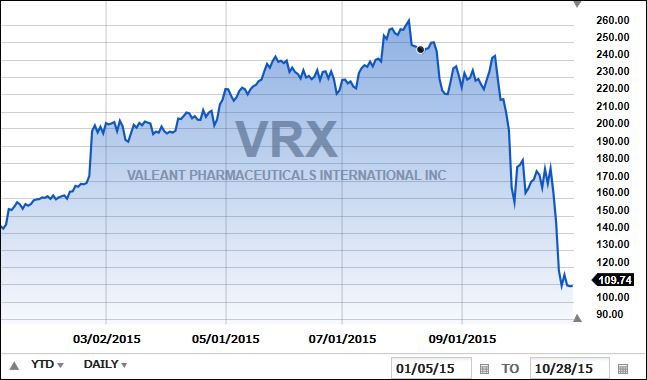
Hedge funds often justify their high fees by saying that they offer distinct approaches to investing. But the recent turmoil in the shares of Valeant Pharmaceuticals International reveals a dangerous tendency of these funds to engage in herd behavior, following the crowd as they plunge in and out of a stock.
Valeant became a darling of hedge funds in 2010, when it acquired Biovail and reincorporated in Canada from the United States to reduce its tax rate. Since then, Valeant has been a merger and acquisition machine, making more than $30 billion in acquisitions, including the $11 billion deal for Salix Pharmaceuticals in March.
The acquisitions fed a surge in the company’s growth, which, until recent weeks, had pumped up its stock price. At its peak this year, the stock had risen more than 800 percent since 2010.
With the gains, Wall Street predictably hailed Valeant executives as visionaries.
As recently as September, CNBC asked whether Valeant’s chief executive, J. Michael Pearson, was the Billy Beane of deal-making, referring to the Oakland A’s executive made famous by the Michael Lewis book “Moneyball.”
Mr. Pearson and his company were certainly riding high until questions emerged about its big price increases and its relationships with specialty pharmacies. This month, the company said it had received subpoenas from federal prosecutors in Manhattan and Boston seeking information about its financial assistance programs for patients, its pricing decisions and the distribution of its products
Valeant’s story – as Wall Street likes to say – suddenly changed. Then came a report that sent Valeant’s shares plunging last week.
The rather poorly written report, from the short-selling Citron Research, suggested that Valeant was making phantom sales and channel stuffing, or deliberately sending retailers more products than they can sell. The report had such gems as “something really stinks at Valeant and it is goes beyond their egregious price hikes”; a comparison of quotations from Mr. Pearson and Jeffrey Skilling, the former chief executive of Enron; and questions about whether this could be “Enron part deux.”
After the publication’s release, Valeant shares declined almost 40 percent as market fears about the company’s entire strategy came home to roost. The discussion soon turned not just to Citron’s report but also to whether Valeant’s deal-making approach was hiding huge accounting deficiencies, or to be less polite, fraud. Valeant vigorously rejected the report’s claims. (On Monday, the company further defended its practices, but it said its board would form a special committee to examine its relationship with a specialty pharmacy.)
Still, the stock decline hit the hedge funds, which had enthusiastically joined the Wall Street party. The hedge funds that own Valeant shares are a who’s who of the industry, including William A. Ackman’s Pershing Square Capital Management, which owns 5.68 percent; John Paulson’s fund, which owns 2.63 percent; and Viking Global, with 1.35 percent.
Valeant’s most committed hedge fund investor has been ValueAct Capital, which first invested more than seven years ago and was instrumental in the hiring of Mr. Pearson. Only a month ago, ValueAct sold 4.2 million Valeant shares, but the fund still owns 4.4 percent of the company, according to the most recent public reports. Valeant has been an enormous investment for ValueAct, and as of September, ValueAct had made a return of more than 2,100 percent. Now, G. Mason Morfit, the president of ValueAct, has returned to the board of Valeant.
Herd investing is common in hedge funds. Goldman Sachs has even created an index of the 50 stocks most widely held by hedge funds, known as the hedge fund V.I.P. list. It is a list of the favorite hedge funds hotels – that is, the hot and trendy stocks for hedge funds to pile into.
The top stock is Allergan, with 15 percent of its shares held by hedge funds. There are 67 hedge funds that count Allergan stock as one of their top 10 holdings. Second on the list is Apple, and third is Facebook. Amazon and Google are also in the top 10. Valeant is 10th, and 22 percent of Valeant’s shares are held by hedge funds, according to Goldman Sachs.
Looking at the list, one has to shake one’s head. After all, I, too, can do this trick of investing in big and well-known tech and pharmaceutical companies, for much less than the fee of 20 percent of the profits that hedge funds charge.
It has to make one wonder what one is getting when investing in a hedge fund. How much of a fund’s performance is centered on following the herd? We’ve seen this in shareholder activism, but at least the funds can work together in that situation (or gang up, depending on your perspective). But in so-called long-short investing of this type, following the herd doesn’t make as much sense.
One of the other things that the Goldman report notes is that most hedge funds are concentrated, owning only about 10 to 20 stocks. Some hedge fund returns thus appear to come from investing in stocks like Valeant and being highly concentrated in those stocks. Yet the risk of such concentration may not be worth it.
The herd doesn’t include all funds. ValueAct is anything but a short-term investor, having held Valeant stock for years, and Pershing Square actually bought more shares last week.
Still, the reversal in Valeant’s shares ought to spur more scrutiny of these hedge fund investment strategies.
In recent years, it has been a winning strategy for hedge funds to pick a handful or so of companies in pharmaceuticals and technology.
Just as Valeant was declining, another hedge fund favorite – Microsoft, No. 15 on Goldman’s list – was popping, in part again a result of ValueAct shaking up management and pressuring Steven A. Ballmer out the door.
So are many hedge funds simply playing follow the leader?
There are thousands of stocks, but hedge funds seem to be concentrating their bets in the larger caps and certain industries. The Goldman index shows that almost 62 percent of hedge fund investments are of companies in the Standard & Poor’s 500-stock index. One has to wonder how much research and monitoring is actually being done by hedge funds. The strategy seems to work to some extent – Goldman reports that the V.I.P. list of the most invested-in stocks has repeatedly outpaced the S.&P. But is this again simply because the funds are chasing flavor-of-the-month stocks?
As Goldman acknowledges, this strategy may work in a rising market, but in a down market, the decline would be painful.
If hedge funds are all about alpha – that is, finding investments that are undervalued and that can outperform the broader market – then one would think they would actually migrate to smaller stocks. These are the least followed stocks and the places where research can bear the most fruit.
What we have instead is something other than intelligent investing, the fundamental idea behind a hedge fund. It all makes one think that perhaps these investors should really be called “herd funds” instead of “hedge funds.”
It certainly seems more apt.
Steven Davidoff Solomon is a professor of law at the University of California, Berkeley. His columns can be found at nytimes.com/dealbook. Follow @stevendavidoff on Twitter.
My rich friends are all now buying cheap reliable cars, like Subaru Outbacks. Why? Expensive ones can be a pain. They can burn up, especially if VW makes them. Read this piece from Vanity Fair.
Even Bentley Owners Aren’t Spared From Recalls
The luxury carmaker, which is owned by Volkswagen Group, is inconveniencing 27,000 wealthy car owners.
Part of the allure of spending $200,000 on a car-aside from the constant head turns from admirers and general confirmation of a certain level of success-is knowing that common annoyances like recalls, typically reserved for budget-friendly vehicles, don’t apply.
But no such luck for owners of 27,640 Bentleys across the world. The company, which is owned by Volkswagen, is voluntarily recalling all Continental GT, GRC, Flying Spur, and new Flying Spur models built between February 2011 and June 2014, according to a statement sent to VF.com. Nearly 7,800 of these models are in the U.S.
The recall, first reported by Reuters, is to address potentially loose battery cable joints. Bentley said it will replace faulty parts for all vehicles, which will take about two hours for each car. Affected Bentley owners, or those who handle their affairs, will be contacted by their local dealers to arrange an appointment.
“The safety of our customers is Bentley’s foremost priority and we pride ourselves on the highest standard of quality and service. We are working quickly to ensure that all vehicles are checked and resolved efficiently and effectively,” the company said.
The statement made it clear that the Bentley recall is unrelated to Volkswagen Group’s other recent recall nightmares. Earlier this month, the company recalled 8.5 million diesel vehicles in Europe-its whole fleet in the continent-in the wake of its emissions duping scandal, wherein regulators uncovered that the company used illegal software to cheat emissions tests. It has already ordered a recall of about 500,000 cars in the U.S., and 11 million vehicles globally could be impacted.
Volkswagen Group, which bought Bentley in 1998, also owns luxury carmakers Lamborghini, Bugatti, and Porsche. In 2013, the group recalled 730 Bentley and Lamborghini vehicles in the U.S. for brake issues.
If it turns out, then, that money can’t buy you the ability to avoid your local car dealership, what’s the point?
Favorite cartoon:

Delicious signs. Enjoy.
Bathroom in department store:
“TOILET OUT OF ORDER. PLEASE USE FLOOR BELOW.”
In a Laundromat:
AUTOMATIC WASHING MACHINES: PLEASE REMOVE ALL YOUR CLOTHES WHEN THE LIGHT GOES OUT.
In a London department store:
BARGAIN BASEMENT UPSTAIRS…
Notice in health food shop window:
CLOSED DUE TO ILLNESS…
On a repair shop door:
WE CAN REPAIR ANYTHING. (PLEASE KNOCK HARD ON THE DOOR – THE BELL DOESN’T WORK.)

Grandfather Harry Newton is teaching granddaughter Sophie how to crawl.
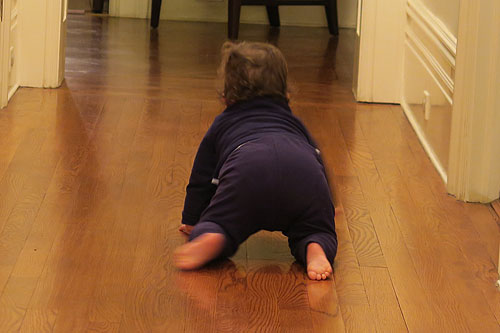
Pretty impressive?

Re leaking tires…weather also affects tire air pressure. My low tire light comes on twice each year, spring and winter with the changes in air temperature. Fortunately I buy my Michelin tires from Discount Tire who check the air in your tires for free…just drive in.