There are two tenets to successful investing:
1. Run your own thing — typically a business. You control. You manage. The angst is 100% yours. Which is very different to:
2. Put money where you don’t control. You suffer from other people’s idiocies. Your frustration is peak. The only weapon against OPI (other peoples’ idiocies) is diversification. Yesterday’s diversification was stocks in different industries, and maybe some bonds. Bonds are dead, for now. Diversification in stocks has been eaten by ETFs, which increasingly force stocks to move lock-step. Worse, in hedge fund redemptions they often throw out the good stuff with the bath water. All this forces us to think “diversification” much more broadly — one huge reason I’m increasingly in residential real estate syndications. I asked Waypoint to send me a few photos so we’d get an eye on typical projects — a picture being worth maybe 800 words and all that. I wrote about Waypoint and another syndicator called Beachwold on Friday:

These properties rent to the middle class of nurses, policemen, firemen, middle managers, retired people, truck drivers, etc. The single biggest category, Beachwold tells me, is teachers. The big hope is that these people will keep their jobs and hold onto their $650-$2,000 a month apartment — the average being $950. And hold on through thick and thin.
Is there going to be some “thin?” Business Insider just published “Wall Street’s brightest minds reveal the most important charts in the world.” There were 70 charts. The first one is this one:
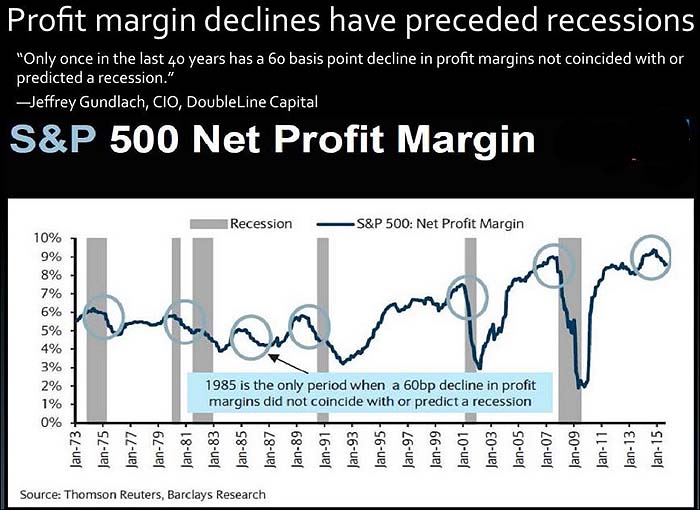
The chart’s guessing we’re in for a recession. Your guess is as good as mine. For the other 69 charts, click here.
And now, to depress you a little further, here’s an article on China from August 25 New York Times. I publish it now because I missed it at the time.
China Falters, and the Global Economy Is Forced to Adapt
With deepening economic fears about China, multinational corporations and countries are having to respond to a new reality as a once sure bet becomes uncertain.
HONG KONG – The commodities giant BHP Billiton spent heavily for years, mining iron ore across Australia, digging for copper in Chile, and pumping oil off the coast of Trinidad. The company could be confident in its direction as commodities orders surged from its biggest and best customer, China.
Now, BHP is pulling back, faced with a slowing Chinese economy that will no longer be the same dominant force in commodities. Profit is falling and the company is cutting its investment spending budget by more than two-thirds.
China’s rapid growth over the last decade reshaped the world economy, creating a powerful driver of corporate strategies, financial markets and geopolitical decisions. China seemed to have a one-way trajectory, momentum that would provide a steady source of profit and capital.
But deepening economic fears about China, which culminated this week in a global market rout, are now forcing a broad rethinking of the conventional wisdom. Even as markets show signs of stabilizing, the resulting shock waves could be lasting, by exposing a new reality that China is no longer a sure bet.
China, while still a large and pervasive presence in the global economy, is now exporting uncertainty around the world with the potential for choppier growth and volatile swings. The tectonic shift is forcing a gut check in industries that have built their strategies and plotted their profits around China’s rise.
Industrial and commodity multinationals face the most pressing concerns, as they scramble to stem the profit slide from weaker consumption. Caterpillar cut back factory production, with industry sales of construction equipment in China dropping by half in the first six months of the year.
Smartphone makers, automobile manufacturers and retailers wonder about the staying power of Chinese buyers, even if it is not shaking their bottom line at this point. General Motors and Ford factories have been shipping fewer cars to Chinese dealerships this summer.
It is not just companies reassessing their assumptions. Russia had been turning to China to fill the financial gap left by low oil prices and Western sanctions. Venezuela, Nigeria and Ukraine have been heavily dependent on investments and low-cost loans from China.
The pain has been particularly acute for Brazil. The country is already faltering, as weaker Chinese imports of minerals and soybeans have jolted all of Latin America. The uncertainty over China could limit the maneuvering room for officials to address the sluggish Brazilian economy at a time when resentment is festering over proposed austerity measures.
The weakness in China is even compelling officials at the United States Federal Reserve to think more globally, as they consider raising interest rates. William C. Dudley, the president of the New York Fed, said on Wednesday that a September rate increase looked less likely than it did a few weeks ago.
“The entire world is focusing now on China, watching this crisis unfold,” Armando Monteiro Neto, Brazil’s minister of development and foreign trade, told reporters on Tuesday in Brasília. “Brazil is already feeling the effects of China’s deceleration. If the situation gets worse, the impact will get bigger.”
The trouble is, the true strength of the Chinese economy – and the policies the leadership will adopt to address any weaknesses – is becoming more difficult to discern.
China’s growth, which the government puts at 7 percent a year, is widely questioned. Large parts of the Chinese service sector, like restaurants and health care, continue to grow, supporting the broader economy. But the signs in industrial sectors, in which other countries and foreign companies have the greatest stake through trade, paint a bleaker picture.
Adding to the worries are recent events like the deadly explosion of a hazardous chemicals warehouse in Tianjin, which has delayed shipments through one of China’s biggest ports. Labor protests, already rising, jumped sharply across coastal China last week over unpaid wages at struggling export factories.
The leadership, concerned with maintaining social stability, has been quick to act, making aggressive moves to prop up the stock market, inject money into the financial system, and generally stimulate the economy. But President Xi Jinping doesn’t have much experience managing a downturn, and some economists worry that the government is making knee-jerk decisions that will do more harm than good.
Many company executives and global economists say that forecasting China’s growth has become so hard that they are hedging their bets for the time being. “This is a complete black art right now,” said Tim Huxley, the chief executive of Wah Kwong Maritime Transport Holdings, a large Hong Kong shipping company. “I can’t make any long-term decisions based on what is happening today, and so I just keep our fleet running until we get a bit of direction.”
The problems have been building for months in areas like commodities and industrials where just modestly slowing growth in China has been having outsize effects.
For more than a decade, prices surged for iron ore, a main ingredient in making steel, as new skyscrapers, rail lines and other infrastructure were built across China. Last year, BHP Billiton shipped enough iron ore each day to China to fill the Empire State Building.
Now, the industry is retrenching in the face of China’s weaker prospects and diving commodity prices.
Vale, the Brazilian mining giant, is racing to unload assets. In Australia, Vale and its Japanese partner, the Sumitomo Corporation, sold a coal mine in July for just $1, after it had been valued at more than $600 million three years ago. In Argentina, Vale is trying to sell a potash mine in which it invested more than $2 billion.
The fallout in commodities has been especially painful for emerging markets that depend on sales of those resources.
With Brazil’s revenues declining sharply this year, President Dilma Rousseff’s government is coming under criticism over the country’s dependence on China, which surpassed the United States as the top trading partner in 2009. Brazil’s exports to China fell 23.6 percent, to $24.7 billion, in the first seven months of the year from the same period in 2014.
In an editorial on Tuesday, the newspaper O Estado de S. Paulo described Brazil’s relationship with China as “semi-colonial,” claiming that the country’s economy “depends in excess on Chinese prosperity.”
Ilan Goldfajn, chief economist at Itaú Unibanco, one of Brazil’s largest banks, said he was already forecasting the economy to contract about 2.3 percent this year, without factoring in the possibility of a hard landing in China. “China is the most important risk factor for Brazil,” Mr. Goldfajn said.
China was supposed to be the financial savior for Russia.
Last year, Russia signed a $400 billion natural gas deal with China. China would help finance a nearly 2,500-mile pipeline to ship fuel from Siberia. Russia trumpeted that it would eventually sell more natural gas to China than Germany, now its biggest customer.
But the prices that China is willing to pay for the gas are dropping so low that it may no longer be worthwhile to build a pipeline. The Russian energy giant Gazprom has cut its planned capital outlays this year for the first leg of the pipeline by half, Dozhd television reported.
Some of the latest pressures reflect a belated recognition by businesses and politicians that China had been slowing down.
Automobile manufacturers cut their shipments of new cars to dealers by 7 percent in July, compared with a year earlier. Retail sales had not suddenly tanked, said Cui Dongshu, the secretary-general of China’s Passenger Car Association, which represents manufacturers.
Rather, too many cars had been sent to dealers’ lots in previous months, he said. In other words, manufacturers were slow to see the economy’s deceleration and waited too long to throttle back their factories.
“What manufacturers are doing is adjusting inventory levels to the `new normal,’ ” said Bill Russo, a former chief executive of Chrysler China, using a favorite phrase of President Xi Jinping of China in recent months to describe an economy that is expanding at a slower pace.
Similar adjustments are taking place around the globe.
For years, Germany has been well positioned to profit from Chinese growth because it specializes in machine tools and other factory equipment. Most important, China acted as a counterweight to the chronically slow-growing markets in Europe.
Now, major German exporters are seeing signs of pressure.
Trumpf says that sales of its signature product, machines that automakers use to cut sheet metal that sell for about 500,000 euros ($566,000) each, have continued to grow in China. But in May and June, sales of less-expensive cutting machines flattened and began to decline. At the bottom of Trumpf’s product line, sales have fallen sharply since November for machines often purchased by start-up companies.
How industries and economies ultimately fare will depend on how long the slowdown and how deep the economic woes.
Demand remains strong at Boeing for its 777-300ER and 787 jets, models that are capable of flights lasting 10 hours or longer, to Europe or North America. Long-haul international travel from mainland China soared nearly 30 percent in the first half of this year compared with the same period last year, Randy Tinseth, the vice president for marketing at Boeing’s commercial aircraft division, said during a visit to Beijing on Tuesday.
So far, it has been mixed for technology players. Timothy D. Cook, the Apple chief executive, said on Monday that business had stayed strong in China in July and August. But Meg Whitman, the chief executive of Hewlett-Packard, said in an earnings call last week that China’s consumer market for printers and computers was “pretty soft,” although demand from businesses was holding up better.
In the end, much of the China story will come down to whether the expectations meet the reality. Andrew Mackenzie, the chief executive of BHP, captured a broader corporate view on Tuesday when he spoke glowingly about China’s potential in the decade to come and predicted continued profitability. But he conceded that the country’s steel production would most likely “grow a little more slowly,” citing a forecast that works out to just 1.4 percent annually – a figure that sounds more like Europe than the formerly go-go economy of China.
A similar realization is taking place in various corners. “We had five fabulous years in China, of course, where we grew strong double-digit, and it has been gradually slowing down,” Frans van Houten, chief executive of Royal Philips, the Dutch conglomerate, said on July 27. “I think, going forward, we need to be much more modest on expectations with regard to China growth: That’s just being realistic.”
The entire China article has some neat graphics. You can read the entire China piece here.
Wondering about Valeant? Here’s a piece from Gretchen Morgenson which sums it all up.
Valeant Shows the Perils of Fantasy Numbers
Investors often say they learn more from investment losers than from winners. That suggests that Valeant, the beleaguered pharmaceutical company whose market value has fallen by almost $60 billion since August, offers a bounty of teaching moments.
Let’s start with the perils of relying on earnings forecasts and stock valuations based on fantasy rather than reality. Such a reliance may have lulled some recent investors into believing they were paying a small premium to own Valeant shares when in actuality it was costing them the moon. (The stock is still a winner for those who bought shares before the autumn of 2013.)
Valeant is among a growing number of companies that regularly present two types of financial results: those that adhere to generally accepted accounting principles, and those that help executives put the best spin on their operations.
In accounting parlance, such adjusted figures – which exclude certain costs from calculations of a company’s earnings – are known as pro forma or non-GAAP numbers. But let’s call them what they really are: a false construct.
Part of the problem with these adjustments lies in the freedom companies have to choose which costs they want to strip out. One company may exclude stock compensation costs from its earnings calculations while another in the same industry does not. That makes it difficult to compare the two companies’ operations.
The tide of companies making up their own earnings calculations is rising, said Jack Ciesielski, publisher of The Analyst’s Accounting Observer. In a recent report, he noted that 334 companies in the Standard & Poor’s 500-stock index reported non-GAAP earnings last year, up from 232 such companies in 2009. The dollar amount of cost adjustments made to those companies’ profits totaled $132 billion last year, more than double the amount in 2009.
“There is a lot more of this going on,” Mr. Ciesielski said in an interview. “The companies are really pushing it.”
This creativity is common practice in the pharmaceutical industry, so Valeant is certainly not atypical. But the difference between the company’s real earnings and its adjusted numbers is far greater than it is for its large competitors, making Valeant a prime example of this problem.
In news releases, Valeant executives are careful to include their results under accounting rules. But these communications tend to focus more on the company’s primary hand-tailored figure – what it calls “cash E.P.S.” When providing forecasts, for example, the company supplies only pro forma numbers.
Valeant strips out a laundry list of expenses from its revenue, including those related to stock-based compensation, legal settlements and costs associated with restructuring and acquisitions.
Most significant, perhaps, for Valeant are costs related to acquisitions. Generally accepted accounting principles require companies to recognize over time the diminishing value of intangible assets they acquire when buying another company – or amortization. Valeant excludes those costs.
At Valeant, an acquisitive company, this is a big number. This year alone, Valeant has paid $15 billion for six deals in which terms were disclosed.
Excluding acquisition-related costs from its pro forma figures, including amortization, makes the company look far more profitable than it is.
The company says it publishes pro forma figures to provide investors with “a meaningful, consistent comparison of the company’s core operating results and trends for the periods presented.” Valeant goes into detail on the expenses it is excluding, so diligent investors can do their own analyses.
A spokeswoman for the company declined to comment further.
Valeant took another blow on Thursday when the nation’s three largest drug benefit managers said they would stop doing business with a pharmacy that sold Valeant products. The hedge fund manager William A. Ackman, who is one of Valeant’s biggest stockholders, defended the company in a marathon three-hour conference call on Friday, yet its stock continued to plummet.
Looking at Valeant’s real earnings compared with its make-believe ones exposes an enormous gulf. Under generally accepted accounting principles, the company earned $912.2 million in 2014. But Valeant’s preferred calculation showed “cash” earnings of $2.85 billion last year. That gap is far wider than at other pharmaceutical companies presenting adjusted figures.
It’s easier to justify paying up for a stock when you’re relying on ersatz results. Valeant’s shares, at their peak of $262, were trading at 98 times 2014 earnings. Set against the fantasy figures, though, the stock carried a multiple of just 31 times. Not a bargain, perhaps, but also not insane.
Given that the Securities and Exchange Commission requires companies reporting pro forma figures to publish GAAP numbers in tandem, you might assume investors would stay focused on the facts. But academic research appears to show that adjusted numbers drive stock prices.
Consider a 2002 study on non-GAAP numbers by Mark T. Bradshaw, an associate professor of accounting at Boston College, and Richard G. Sloan, a professor of accounting at the University of California, Berkeley. The fantasy numbers had “displaced GAAP earnings as a primary determinant of stock prices,” its authors wrote.
In an interview, Mr. Sloan said he was concerned about the proliferation of companies reporting non-GAAP figures and the challenges that posed to investors.
“I can see the advantages of letting a company with a good management team do its own voluntary disclosure to help investors understand over and above what’s in the GAAP filings,” Mr. Sloan said. “But what goes along with that is companies that use their own numbers to put them in a better light and to mislead investors.”
Helping perpetuate these kinds of earnings myths, Mr. Sloan said, are Wall Street analysts who use companies’ invented figures in reports and stock price forecasts.
“You’d hope that Wall Street analysts would recognize you can’t really value a company like Valeant whose business model is to pay cash to make acquisitions by ignoring the amount of cash it is using in those acquisitions,” Mr. Sloan said.
Recent Wall Street research on Valeant highlights this problem. In an Oct. 1 report from Morgan Stanley, Valeant’s pro forma earnings are identified as “E.P.S.,” leading many readers to assume a GAAP number. A figure identified in a table as net income is actually Valeant’s adjusted number, which is far larger than the GAAP version.
Two recent UBS reports are also confusing. On Page 1 of both reports, the analyst cited Valeant’s pro forma figure as “E.P.S.” Later in the report, the analyst identified the figures as “cash E.P.S.”
At Merrill Lynch, the Valeant analyst does a better job, presenting both GAAP and pro forma figures so investors can see the vast differences between the two.
Analysts may feel compelled to use a company’s adjusted numbers when they reflect standard industry practice. At the same time, however, going along with a numbers game may also be a way to stay on good terms with a company’s executives. Analysts who exert independence can find that managers may refuse to answer their questions or otherwise turn off the crucial information spigot.
Back in 2003, after pro forma earnings had begun to gain traction, the S.E.C. wrote a new rule to try to help investors. Known as Regulation G, it requires companies using fantasy figures in regulatory filings to present “with equal or greater prominence,” comparable financial measures calculated under GAAP. The regulation does not cover news releases.
Mr. Sloan thinks it may be time for a new rule. “When they did Reg G, things calmed down for a little bit,” he said. “Now things are getting out of control again.”
The entire Valeant piece has some graphics. Click here.
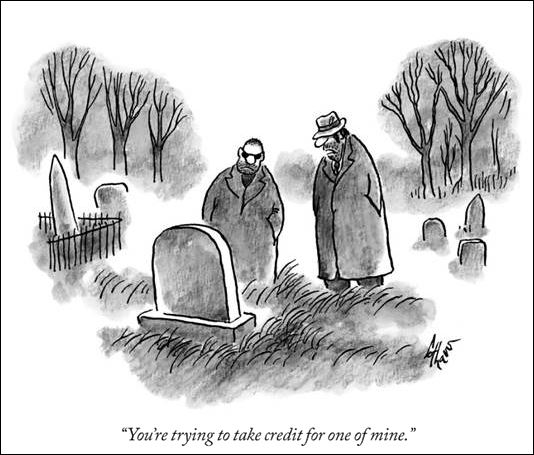
Favorite recent New Yorker cartoons



Harry Newton who spent much of the last week helping baby-sit happy granddaughter, Sophie Newton Maloney. If Kodak still made film, I would have made them rich. Instead I made SanDisk (SNDK) semi-rich.