Yesterday I published a note from the Royal Bank of Scotland that said “sell everything.”
Half the world trashed me, saying the market had already fallen 10%…
By the end of the day, the market was solidly up.
Was I an idiot?
First, as a reader you should understand the nature of this column, and its “recommendations.”
I can’t recommend what you should do. Your portfolio is different to mine, and different to the next guy.
The point of articles likes yesterday’s is to get you thinking.
Here are the basics: The world has changed dramatically. You need to think through each of your holdings — not be wedded to any of them.
For example, Casey Daily Dispatch reported yesterday:
Arch is the fourth major coal miner to declare bankruptcy since the beginning of 2015. The others are Patriot Coal, Walter Energy, and Alpha Natural Resources. Yesterday, Reuters reported that companies responsible for 25% of U.S. coal production are currently in bankruptcy.
A friend has a huge position in Exxon (XOM). It’s done well for him over the years as it has split and split and split again.
But in the past year, though he has written covered calls against his position, he’s down significantly:
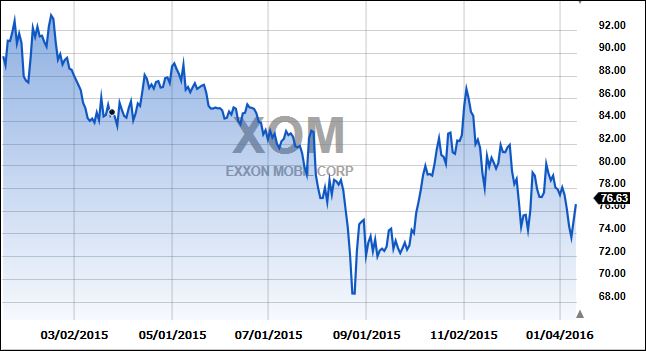
He doesn’t want to sell his XOM because he believes it has taken its lumps and the future looks brighter. I’m dubious. I spent last night trying to figure Exxon’s exposure to the price of oil. You’d figure it would be great. But that’s not easy to figure from their investment presentations… I’m still investigating.
Fact is: The world has changed. You need to put a magnifying glass over everything you own.
Owning something today is the same as a decision to buy it today.
Some of Vanguard’s low cost index funds look appealing, for now.
El Chapo Speaks.
Sean Penn, the actor, wrote a widely-quoted piece in Rolling Stone. Best part of his writing were these three insightful paragraphs — all ignored by the mainstream media:
As an American citizen, I’m drawn to explore what may be inconsistent with the portrayals our government and media brand upon their declared enemies. Not since Osama bin Laden has the pursuit of a fugitive so occupied the public imagination. But unlike bin Laden, who had posed the ludicrous premise that a country’s entire population is defined by – and therefore complicit in – its leadership’s policies, with the world’s most wanted drug lord, are we, the American public, not indeed complicit in what we demonize? We are the consumers, and as such, we are complicit in every murder, and in every corruption of an institution’s ability to protect the quality of life for citizens of Mexico and the United States that comes as a result of our insatiable appetite for illicit narcotics.
As much as anything, it’s a question of relative morality. What of the tens of thousands of sick and suffering chemically addicted Americans, barbarically imprisoned for the crime of their illness? Locked down in facilities where unspeakable acts of dehumanization and violence are inescapable, and murder a looming threat. Are we saying that what’s systemic in our culture, and out of our direct hands and view, shares no moral equivalency to those abominations that may rival narco assassinations in Juarez? Or, is that a distinction for the passive self-righteous?
There is little dispute that the War on Drugs has failed: as many as 27,000 drug-related homicides in Mexico alone in a single year, and opiate addiction on the rise in the U.S. Working in the emergency and development field in Haiti, I have countless times been proposed theoretical solutions to that country’s ailments by bureaucratic agencies unfamiliar with the culture and incongruities on the ground. Perhaps in the tunnel vision of our puritanical and prosecutorial culture that has designed the War on Drugs, we have similarly lost sight of practice, and given over our souls to theory. At an American taxpayer cost of $25 billion per year, this war’s policies have significantly served to kill our children, drain our economies, overwhelm our cops and courts, pick our pockets, crowd our prisons and punch the clock. Another day’s fight is lost. And lost with it, any possible vision of reform, or recognition of the proven benefits in so many other countries achieved through the regulated legalization of recreational drugs.
Read the full article here:
An education on Inversion. It’s the latest piece by James Surowiecki in New Yorker:
Why firms are fleeing.
The biggest corporate deal of 2015 was also, in the view of many, the shadiest: Pfizer’s $160-billion merger with the Irish drug company Allergan. It’s a “tax inversion”—Pfizer will in effect be reconstituting itself as an Irish company, in order to lower its taxes—and that’s why so many people found it so offensive. Hillary Clinton said that ending inversions wasn’t just about fairness but about “patriotism”; Donald Trump called the deal “disgusting.” It’s got to make you wonder when even Trump finds your moneymaking schemes repugnant.
Meanwhile, the inversion train seems only to be picking up speed. Such deals were once exceedingly rare—according to the Congressional Research Service, there was just one in the nineteen-eighties—but there have been more than fifty in the past decade, most since 2009. Although in the past couple of years both the Treasury Department and the I.R.S. have issued new rules designed to make inversions more difficult, the trend continued apace in 2015. It’s a predictable, if dismaying response both to the current U.S. tax code and to the changing nature of big corporations.
Two features of American tax policy make inversions attractive: a relatively high corporate tax rate and what’s called a worldwide tax system—American corporations have to pay that tax rate on all their global income. That makes the U.S. unusual; every other country in the G-8, and eighty per cent of the countries in the O.E.C.D. (the club of industrialized democracies), has adopted some form of what’s known as a territorial tax system, in which companies largely pay taxes only on the income they earn in a country.
To be sure, the U.S. system has an important provision called deferral—American companies don’t have to pay taxes on their foreign profits until they bring them back to the U.S. But that just means they hold their money overseas rather than bring it home; American companies are estimated to be keeping more than two trillion dollars abroad. This so-called “lockout effect” means that companies invest less in the U.S. and distribute less cash to shareholders. In some ways, we’ve ended up with the worst of both worlds. Since so much of what companies earn remains abroad and untaxable, we raise only a small amount of revenue from our global system. At the same time, the fact that those foreign earnings are in exile encourages inversions, so companies can get access to all that locked-up cash and a lower tax rate thereafter.
One answer to this problem, endorsed by Bernie Sanders, is simply to do away with deferral—make corporations pay taxes on their foreign profits as soon as they’re earned. This would increase tax revenue in the short term. But it would make inversions all the more alluring and, in the long run, would likely reduce the number of new companies incorporating themselves in the U.S.
A more plausible alternative is to follow the lead of countries like Germany and Japan and adopt a hybrid territorial system. Although the details are complicated, you’d start with the “territorial” principle that profits would be taxed where they’re earned. But since any territorial system is vulnerable to tax-avoidance schemes—like shifting income abroad to make it look as if profits were being earned abroad—you’d also need tough anti-abuse provisions, like taxing at least a fixed percentage of foreign earnings and limiting companies’ ability to channel income to subsidiaries in low-tax countries. And, as part of any such change, companies should be required to pay taxes on all the cash they’re currently holding abroad. In theory, such a system could keep companies (and more of their workers) at home and bring foreign earnings back, without putting a real dent in U.S. tax revenue. This strategy also has some bipartisan appeal; versions of this type of reform have been offered by both the Obama Administration and Republicans in Congress.
But why give corporations any sort of tax break at all? The reality is that America’s global taxation system is a legacy of a bygone era. In the past, the fact that our tax system was “worldwide” mattered less, both because the U.S. was such a huge part of the world economy and because being incorporated in the U.S. made companies more appealing to stockholders. But those advantages are diminishing. Investing abroad is more attractive and easier than ever before, and capital is more mobile. “As the economic differences between the United States and other countries narrow,” a 2015 study of tax systems concluded, “the ability of the United States to sustain US tax exceptionalism will also decline.”
And then companies are far less tied to their country of origin than they once were. Look at Pfizer. Its C.E.O. was born in Scotland and raised in Rhodesia. More than sixty per cent of its revenue comes from overseas, and most of its employees work abroad as well. It’s hard to know what makes a company like that genuinely “American.” True, many U.S. companies, including big pharma, have drawn heavily on government-funded research, but foreign companies have been able to profit from that research just as easily—without the extra taxes.
Corporations certainly play the patriotism card when it suits their purposes. But their real loyalty is to the bottom line. And while Congress could take measures to curb inversions in the short run—Hillary Clinton, for instance, has proposed a steep “exit tax” on any company that inverts—those measures merely postpone a necessary reckoning. The world economy has changed. The U.S. tax system needs to change, too.
Australia’s beaches.
Australia has more than 30,000 miles of spectacular coastline, and 10,685 beaches. Which are the best. Conde Nast picked the top ten. Here’s their number one pick. It’s Whitehaven Beach in Queensland:

For the other nine, which includes Bondi, click here.
Leo Rosen’s favorite Jewish joke. It’s old, but still funny.
Moishe was sitting at the bar staring at his drink when a large, trouble-making biker steps up next to him, grabs his drink, gulps itand menacingly says, ´Thanks Jew Boy, whatcha going to do about it?”
Moshe burst into tears.
“Come on, man,” the biker says, “I didn’t think you’d CRY. I can’t stand to see a man crying What’s your problem?”
“This is the worst day of my life,” Moshe says. “I’m a complete failure. I was late to a meeting and my boss fired me. When I went to the parking lot, I found my car had been stolen and I don’t have any insurance. I left my wallet in the cab I took home. I found my wife in bed with the postman and then my dog bit me.”
“So I came to this bar to work up the courage to put an end to it all. I buy a drink; drop a capsule in and sit here watching the poison dissolve; then you show up and drink the whole thing!
“But enough about me, how’s your day going?”

Harry Newton, who is final;y getting over jet lag. Sydney and Melbourne are 16 hours ahead of New York. That’s a lot of jet lag. I think melatonin works, or at least helps. Sad about the bombing in Istanbul. Write off another place you can’t visit.

Please follow the money. All business taxes, fees, regulation requirements, etc. are costs that increase prices and are passed onto the next buyer until paid by the final consumer. Thus it is us, the final consumer, including the 47 percenters that are paying these business taxes in the form of a hidden/embedded regressive sales tax. And most of you don’t even know it. The U.S.A. has the highest business taxes in the world thus raising the prices for U.S.A. goods, but imported goods do not carry that high tax burden. Nothing in our nation today impedes our ability to compete globally as much as the income tax and the regressive payroll taxes. Stop taxing jobs and production (income, savings and investments) that grow the standard of living. Instead tax consumption with a progressive tax system that helps most the impoverished. America’s Big Solution is the FAIRtax® bill HR25/S155. Learn more, join the cause and contribute at FAIRtax.org.
Unfortunately Chapo has left Mexico a consumer nation also.