Go figure.
+ Chesapeake Energy Corp. shares surged 8% in premarket trade Friday, after the company said it is suspending its quarterly preferred stock dividends in an effort to save cash.
+ General Electric’s shares fell 2%, despite growth in its core earnings and revenue for the fourth quarter, Overall for the period ended Dec. 31, GE reported a profit of $6.28 billion, or 64 cents a share, compared with a profit of $5.15 billion, or 51 cents a share, a year earlier.
It’s common for bear markets to enjoy occasional bounces, as it’s likely to do today.
It’s also common for stocks to react in weird ways to earnings. Which is the mantra of diversification.
So, where are we going and what should we do?
My recommendation: Hang on for another volatile ride for what we have left.
Meantime, I looked at what they’re writing:
From the New Yorker magazine
Are We Already in a Bear Market? By John Cassidy
With the stock market falling again on Wednesday-the Dow Jones Industrial Average closed down about two hundred and fifty points-we’ll be seeing a lot of talk about whether we have entered a bear market. Such discussions rarely yield much insight. On Wall Street, the conventional definition of a bear market is a fall in stock prices of more than twenty per cent from the previous peak: anything less is referred to as a “correction.” But this definition can be misleading.
To most people, a bear market means an extended period of falling stock prices. And the fact is that we have been in one of those periods for quite a while now. The Dow and the Standard & Poor’s 500 indices both peaked last May, and the Nasdaq 100 index peaked in July. For the past seven or eight months, the stock market has generally been either stalled or falling. To be sure, the fall has accelerated dramatically since the start of 2016, but if you look at individual companies you will find that many of their stock prices have been dropping for much longer than that.
The standard way to think about bear markets is to follow the indices. The Dow, which consists of thirty leading companies, is down about fourteen per cent from its peak. This means, according to the standard definition, that it isn’t near bear territory. Neither is the Nasdaq, which is also down fourteen per cent, or the S. & P. 500, which is off about thirteen per cent.
Just looking at these numbers doesn’t necessarily give the full picture, however. Because of the way the indices are constructed, they sometimes conceal almost as much as they reveal. If you look at the Dow stocks individually, as I did after the market closed on Wednesday, you will find that seventeen of the thirty are down more than twenty per cent from their peaks, seven of which are down at least thirty per cent. According to my back-of-the-envelope calculations, the average price drop is about twenty-two per cent.
Some of the biggest corporate names in America have seen even bigger falls. Caterpillar is down almost fifty per cent; IBM is down forty-three per cent; Chevron is down forty-one per cent. Even the mighty Apple is down twenty-seven per cent. Doesn’t that sound bearlike?
How, you may ask, can the average Dow stock be more than twenty per cent below its peak when the over-all average is down just fourteen per cent? Part of the answer is that the individual stocks and the index peaked at different times. Part of it may be that the Dow is a price-weighted index, which means that stocks with high prices (such as McDonald’s and Disney) count for more than stocks with low prices (such as Cisco and Intel). If stocks with high prices tend to do better than stocks with low prices, the index can go up even if the majority of stocks go down.
There are issues, too, with the Nasdaq, which consists of a hundred stocks, many of them in the tech sector. Because the Nasdaq is a capitalization-weighted index, the stocks of the most highly valued companies, such as Amazon, Facebook, and Netflix, count for more than the stocks of smaller companies, such as TripAdvisor and Liberty Media. Normally, that might not matter much. But, in 2015, the stocks of some of the biggies went gangbusters, which helped to disguise some weakness elsewhere in the market.
Strength was concentrated in the so-called FANGS: Facebook, Amazon, Netflix, Google, and Salesforce. Last year, Netflix’s stock rose 134.4 per cent, and Amazon’s stock jumped 118.1 per cent, while Google’s stock jumped about forty-five per cent, and the stocks of Facebook nd Salesforce both rose about thirty-two per cent. The narrowness of the market advance was so pronounced that some commentators with a sense of history compared the FANGS to the “nifty fifty” growth stocks of the early seventies, which suffered badly in a subsequent bear market. But to people who were simply looking at the Nasdaq, things seemed sort of okay. Now they don’t. Since the start of the month, Amazon’s stock has fallen more than fifteen per cent, and Facebook is down about ten per cent. Netflix’s stock, which started sliding late last year, is down another six per cent.
Another indicator that the market may be even weaker than it seems is the dismal performance of the Russell 2000 index, which is made up of small-cap and medium-cap stocks. Since it peaked last July, the index has fallen about twenty-three per cent. Even going by the standard definition, it is in a bear market. Since small companies tend to be riskier investments than large companies, and are more vulnerable to economic downturns, that is hardly surprising. But it is worth noting, nonetheless.
So, what does all this mean? I can think of two possible interpretations.
The bearish suggestion is that, even before the falls of the past few weeks, stocks were weaker than they looked. The rallies were getting narrower and narrower, many big stocks were well off their peaks, and, with earnings falling in a number of sectors, such as energy and finance, the bull market was fast running out of steam. Bad economic news from China and a rout in commodities prices, notably oil, hastened the inevitable: a broad-scale sell-off, which may well have some way to go. On the basis of earnings, especially cyclically adjusted earnings, stocks still look pretty expensive.
The bullish counter-argument is that much of the bad news is already baked into the market. For instance, the fact that China’s economy is slowing down is hardly news to investors in Caterpillar, the heavy-equipment manufacturer, which does a lot of business there-the company’s stock has been slumping since 2012. Energy stocks, for their part, have been falling since 2014, and many bank and consumer stocks, which tend to reflect the health of the U.S. economy, peaked early last year.
If the market has already accounted for a lot of doom and gloom about the global economy, as well as the possible repercussions here at home, there may be room for it to rally from here. That appears to have been the hopeful thinking investors were applying on Wednesday, anyway, when the Dow fell more than five hundred points only to recoup more than half of its losses by close.
That was just one day’s trading, of course. To get a real read on where the market might be headed, we’ll need to see if the oil price stabilizes, what happens in China, and how the Federal Reserve reacts to the recent sell-offs. Until then, we can expect more turbulence.
From the Economist:
The Economist explains Why stockmarkets are falling
SHARE prices have been falling persistently since the start of 2016 with markets in Europe and Japan falling more than 20% from their recent highs, the technical definition of a bear market. Bear phases are reasonably common; the S&P 500 index has suffered at least 15 of them since 1929, although it has yet to meet the definition this time round.
It is never possible to be definitive about the reasons for a stockmarket fall. Investors don’t have to fill in a form explaining their reasons for selling shares. The popular explanations for the current decline involve worries about the health of the Chinese (and thus the global) economy; concerns that corporate profits may be falling; and fears that the Federal Reserve may have tightened monetary policy too soon when it raised interest rates in December. And a survey of fund managers by Bank of America Merrill Lynch indicates these explanations are roughly right; optimism about the global economy has declined, more than half think profits will fall over the next 12 months and a Chinese recession is perceived to be the biggest risk.
Another way of understanding the decline is to focus on the theoretical basis for share valuations; a share represents the future cashflows the investor will receive, discounted at the appropriate rate (the higher the discount rate, the lower the current price). So falling share prices either indicate that investors have become more pessimistic about future cashflows (they fear falling profits) or that they have raised the discount rate they apply (a sign they have become more cautious, and demand a higher return for the risk of owning shares). The plunge in oil prices and other commodity prices may explain that caution; perhaps they are telling us something about the health of the global economy. Another sign of caution is the rise in the yields paid by junk bonds (those issued by the riskiest companies); investors are demanding a higher return for the risk of lending.
Does a bear market inevitably mean recession? No. The 23% one-day decline in American equities in October 1987 (Black Monday) was not followed by an economic downturn. The dotcom boom, and the surge in house prices in America and elsewhere, showed that prices can lose track with fundamentals. The recent decline may merely indicate that share prices were overvalued, and are now coming back to earth, or even a sign that investors have become too pessimistic. More economic news, and more company results, will be needed to tell whether this market signal is the real thing, or just a fake.
From Howard Marks at OakTree Capital
My buddy Sandy was an airline pilot. When asked to describe his job, he always answers, “hours of boredom punctuated by moments of terror.” The same can be true for investment managers, for whom the last few weeks have been an example of the latter. We’ve seen bad news and prices cascading downward. Investors who thought stocks were priced right 20% ago and oil $70 ago now wonder if they aren’t risky at their new reduced prices.
In Thursday’s memo, “On the Couch,” I mentioned the two questions I’d been getting most often: “What are the implications for the U.S. and the rest of the world of China’s weakness, and are we moving toward a new crisis of the magnitude of what we saw in 2008?” Bloomberg invited me on the air Friday morning to discuss the memo, and the anchors mostly asked one version or another of a third question: “does the market’s decline worry you?” That prompted this memo in response.
The answer lies in a question: “what does the market know?” Is the market smart, meaning you should take your lead from it? Or is it dumb, meaning you should ignore it? Here’s what I wrote in “It’s Not Easy” in September and included in “On the Couch”:
Especially during downdrafts, many investors impute intelligence to the market and look to it to tell them what’s going on and what to do about it. This is one of the biggest mistakes you can make. As Ben Graham pointed out, the day-to-day market isn’t a fundamental analyst; it’s a barometer of investor sentiment. You just can’t take it too seriously. Market participants have limited insight into what’s really happening in terms of fundamentals, and any intelligence that could be behind their buys and sells is obscured by their emotional swings. It would be wrong to interpret the recent worldwide drop as meaning the market “knows” tough times lay ahead.
The rest of this memo will be about fleshing out this theme (meaning you can stop reading here if you’ve had enough or are short on time).
I based the above reference to Ben Graham on his famous observation that in the long run the market’s a weighing machine, but in the short run it’s a voting machine. In other words, in the long term the consensus of investors figures out what things are really worth and moves the price there. But in the short term, the market merely reflects consensus opinion regarding an asset’s future popularity, something that’s highly susceptible to the ups and downs of psychology.
So, what does the market know? First it’s important to understand for this purpose that there really isn’t such a thing as “the market.” There’s just a bunch of people who participate in a market. The market isn’t more than the sum of the participants, and it doesn’t “know” any more than their collective knowledge.
This is a very important point. If you believe the market has some special insight that exceeds the collective insight of its participants, then you and I have a fundamental disagreement. The thinking of the crowd isn’t synergistic. In my view, the investment IQ of the market isn’t any higher than the average IQ of the participants. And everyone who transacts gets a volume-weighted vote in setting an asset’s price at a given point in time.
People of all different levels of ability act together to set the price. They vary all over the lot in terms of knowledge, experience, insight and emotionalism. The market doesn’t give the ones who are superior in these regards any more influence than the others, especially in the short run. My bottom line on this subject is that the market price merely reflects the average insight of the market participants. That’s point number one.
If anything, I think it’s emotion that’s synergistic. It builds into herd behavior or mass hysteria. When 10,000 people panic, the emotion seems to snowball. People influence each other, and their emotions compound, so that the overall level of panic in the market can be higher than the panic of any participant in isolation. That’s something I’ll return to later.
Now let’s think about the first goal of investing: to buy low. We want to buy things whose price underestimates the value of the underlying assets or earnings (value investing) or the future potential (growth investing). In either case, we’re looking for instances when the market is wrong. If we thought the market was always right – the efficient market hypothesis – we wouldn’t spend our lives as active investors. Since we do, we’d better believe we know more than the consensus. So by definition we must not think the market – that is, the sum of all other investors – knows everything, or knows more than we do, or is always right. That’s point number two.
And that leads logically to point number three: why take instruction from a group of people who know less than you do? In “On the Couch,” I wrote that it all seems obvious: investors rarely maintain objective, rational, neutral and stable positions. Do you agree with that or not? Is the market a clinical and rational fundamental analyst, or a barometer of investor sentiment? Does the market’s behavior these days look like something a mature adult should emulate?
It seems clear to me: the market does not have above average insight, but it often is above average in emotionality. Thus we shouldn’t follow its dictates. In fact, contrarianism is built on the premise that we generally should do the opposite of what the crowd is doing, especially at the extremes, and I prefer it.
A Case in Point – The Crash of 2008
The year 2008 culminated in the greatest panic I’ve ever seen. The events that built up to it included:
+ massive subprime mortgage defaults and the failure of mortgage backed vehicles,
+ meltdowns at funds that had invested in those vehicles, notably two Bear Stearns funds,
+ the collapse of Bear Stearns, necessitating its purchase by JPMorgan for almost no consideration,
+ rescues of Merrill Lynch by Bank of America; Wachovia by Wells Fargo; and Washington Mutual by JPMorgan (after it was first seized by the Office of Thrift Supervision),
+ decisions on the part of BofA and Barclays not to acquire Lehman Brothers, and on the part of the U.S. Treasury not to bail it out, leading to Lehman’s bankruptcy filing,
+ the appearance that Morgan Stanley would be next if it couldn’t secure additional capital, and
+ widespread speculation regarding other firms that might follow.
A massive downward spiral ensued. Among the contributing factors were:
+ precipitous declines in the prices of bank stocks,
+ large-scale short selling of the stocks (the “uptick rule” previously mandated that a stock could only be sold short at a price above the last trade, meaning short selling couldn’t force the price down.But the rule was repealed in 2007, so there ceased to be limits on when stocks could be shorted.Thus short sellers could force stock prices down – whether intentionally, in what in the 1920s were called “bear raids,” or just because they thought the stocks were right to sell),
+ dramatic increases in the cost to insure the debt of banks through credit default swaps.
In the environment described above, the downward spiral in bank stocks was intensified by the following factors (whether they were intentionally manipulated, I can’t say for sure):
+ It was easy to bet against the banks by buying credit default swaps (CDS) on their debt.
+ It was easy to depress bank stocks by selling them short.
+ The declining stock prices were taken as a sign that the banks were weakening, causing the cost of buying CDS protection to rise.
+ The rising cost of CDS protection was taken as an additional negative sign, causing the stocks to fall further.
I can tell you, it had the feel of an unstoppable vicious circle. Some compared it to the “China Syndrome”: a 1979 movie with Jane Fonda and Michael Douglas in which an out-of-control nuclear reaction threatens to propel reactor components through the earth’s core, from the U.S. to China. Thus the stock of panic-ridden Morgan Stanley (for example) fell 82%, to less than $10.
But it’s important to note that the negative feedback loop described above was able to continue without reference to – and not necessarily in reasonable relationship to – actual developments at the banks or changes in their intrinsic value. Eventually, however, the Treasury restricted short selling in the stocks of 19 financial institutions deemed “systemically important.” Morgan Stanley secured a $9 billion injection of convertible equity from Mitsubishi UFJ Financial Group. The panic subsided. The economy and capital markets recovered. And Morgan Stanley’s stock traded at $33 a year later.
Do you wish you had taken the market’s instruction in 2008 and sold bank stocks? Or do you wish you had rejected its advice and bought instead? In short, did the market know anything?
There are three possible answers:
+ The market was flat wrong in 2008 when it took Morgan Stanley’s stock so low.
+ The market was right; it properly reflected the possibility of a meltdown that could have happened but didn’t.
+ The market was wrong in the case of Morgan Stanley in 2008, but most of the time it isn’t.
I like the first, and the second is appealing as well. But while a meltdown certainly was possible, the below-$10 price probably assigned it too high a likelihood. And, of course, I’m not persuaded by the third.
…My bottom line is that markets don’t assess intrinsic value from day to day, and certainly they don’t do a good job during crises. Thus market price movements don’t say much about fundamentals. Even in the best of times, when investors are driven by fundamentals rather than psychology, markets show what the participants think value is, rather than what value really is. Value is something the market doesn’t know any more about than the average investor. And advice from the average investor obviously can’t help you be an above average investor.
What Does a Falling Market Say About Psychology?
Fundamentals – the outlook for an economy, company or asset – don’t change much from day to day. As a result, daily price changes are mostly about (a) changes in market psychology and thus (b) changes in who wants to own something or un-own something. These two statements become increasingly valid the more daily prices fluctuate. Big fluctuations show that psychology is changing radically.
And, I said on page two, emotional fluctuations – swings in market sentiment or psychology – do seem to be synergistic. That is, in crowd psychology, 2 + 2 = 5. While I don’t think the price of an asset reflects more wisdom than is possessed by the average of its market’s members, I do believe mass psychology will make a group swing to reach greater emotional extremes than its members would separately. In short, people make each other crazy. And when times are bad – like now – they depress each other. That was a factor in the edge enjoyed by our distressed debt team in 2008: they were able to buy at the market’s lows because they weren’t in New York, where everyone was trading scary stories and getting each other down.
Again, we can gain insight through logic. We all know we want to buy (not sell) at the lows, and sell (not buy) at the highs. So then how can it be right to sell because of a decline or buy because of a rise? Advocates of this latter approach must think (a) declines and rises tend to continue more than they reverse and/or (b) they can tell which declines mean “buy” and which mean “sell.” Some savants may have that latter ability, but not many. In general, I think it’s ridiculous to sell something because it’s down (just as it is to buy because it’s up).
As prices fall, there are some very genuine reasons to sell:
+ Some people feel rising fear and have to lighten their positions in order to retain their composure.
+ Some, having lost a lot of money, sell to be sure they won’t experience losses they can’t survive.
+ Some have to sell to repay demanding creditors or satisfy investor withdrawals.
These reasons are not “invalid.” It’s just that none of them has anything to do with making money.
Most mature investors know intellectually that short-term price fluctuations are low in fundamental significance, and that the best results will be achieved if they hold on to their positions and ride out the volatility. But sometimes people sell anyway, perhaps for the above reasons. Doing so has the potential to convert a short-term fluctuation into a permanent loss by causing any subsequent recovery to be missed. I consider this the cardinal sin in investing.
What Do the Media Know?
I’m usually able to find something in the print or broadcast media that helps me make my point. Here’s how The New York Times led the business section on Saturday:
Concern Grows That Market Sell-off is an Early Warning of a U.S. Slowdown
It may be time for everyone to take the markets seriously again.
As stock prices started tumbling in the first trading days of the year, many Wall Street professionals were tempted to describe the declines as the sort of adjustment that the market has gone through in recent years before moving higher.
But that opinion evaporated this week as the selling intensified. Concerns are now growing that the markets are signaling that the United States economy, despite its recent bright spots, is on the verge of a slowdown.
The fear is that economic problems in China have set off negative reactions around the world that could ultimately weigh on American households and corporations.
So the bottom-line question is simple: does the market reflect what people know, or should people base their actions on what the market knows? And if the latter, where does “the market” get its information, other than from people? For me it’s simple: if people follow the market’s dictates, they’re taking advice from . . . themselves!
I set a trap at the beginning of this memo, and I want to spring it now. In the first paragraph, I wrote, “We’ve seen bad news and prices cascading downward.” You probably glossed over it. But is it true? Leaving aside China and the markets’ gyrations, have we really been seeing negative news on balance? Isn’t it just that people are fixating on bad news, ignoring good news, and tending to interpret things negatively?
There are ways in which psychology can become “real,” feeding back to influence fundamentals. One is that declining asset prices produce a negative “wealth effect,” making people feel poorer and causing them to spend and invest less. And there are others. But despite the feedback influences of the market declines, I still would say U.S. and European economic fundamentals aren’t negative on balance.
On Friday, in the midst of the declines, I participated in a small lunch attended by investment professionals and current and former senior government economic and financial leaders. I’ll spare you the details: there was a lot of “on one hand” and “on the other hand,” but no one thought there would be a recession this year. So then who are the people creating price signals to which others should accord significance?
I want to end by making one thing completely clear. I’m not saying the market is never right when prices go down (or up). I’m merely saying the market has no special insight and conveys no consistently helpful message. It’s not that it’s always wrong; it’s that there’s no reason to presume it’s right.
It is the goal of some investors to sell on declines when the subsequent movements will be down, but “buy the dips” when the subsequent movements will be up. If you think you can tell which is which from watching the market movements themselves, then we – again – have a fundamental disagreement. Future price movements can only be predicted on the basis of the relationship between price and fundamentals. And, given the market’s short-term volatility and irrationality, this can only be done in the long-term sense. The market has nothing useful to contribute on this subject.
Read Howard’s entire piece here.
Two really useful recommendations:
+ Scannable is an iPhone app that photographs something, scans it and OCRs it (optical character recognition). It can photograph a business card and convert it into a VCF file which you can drop into your contact manager, e.g. Outlook. This is a huge time saver.
+ Automatic is a $100 dongle that fits into your car’s diagnostic port, talks to your cell phone, gives you stats on your driving (or your kids’ driving) and does a million other useful things.

From writeup: Automatic comes with a free app for iPhone and Android phones that pairs with the car adapter when you drive to provide many useful features like diagnosing the check engine light, improve your driving with real-time feedback, remembering where you parked, and even free emergency crash response.
I love remembering where I parked. To do that, it pinpoints your car’s location on Apple Maps. From Amazon. click here.
Sarah Palin defies categorization. Most of the time, I have no idea what’s talking about. But she has a way with words, which make her fun.
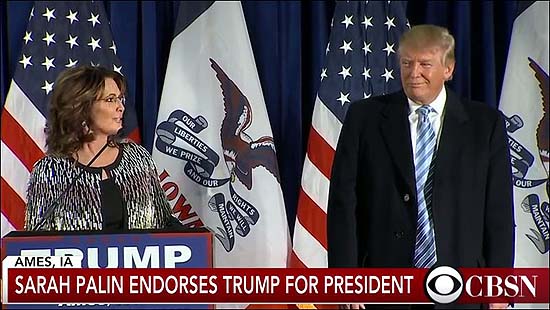
To watch her full speech endorsing Trump, click here.
The New York Times writeup on her speech began:
Sarah Palin’s meandering, fiery, sarcastic, patriotic and blustery speech endorsing Donald J. Trump for president on Tuesday in Ames, Iowa, does not easily submit to categorization.
It has been described as performance art, a filibuster, even slam poetry.
Mrs. Palin has always been a singular force on the campaign trail. But in her years away from politics, the former Alaska governor and Senator John McCain’s Republican vice-presidential pick in 2008 seems to have spawned a whole new series of idiosyncratic expressions and unusual locutions — to the point where even Mr. Trump seemed occasionally mystified as he tried to follow along.
Below, a list of 10 of the most memorable lines of the speech, and an attempt to translate them:
Read the list here.
I found this coat hanger at my local dry cleaner. it’s funny.

In Columbia County, New York.
You need a Building Permit to demolish a house.

Harry Newton, who sadly retained a big position in GE. Dumb.

Harry, how;s the shorting the market stuff you wrote about yesterday working out? You were quoting Bloomberg, which is hardly ever smart. The market is up 2 percent, and you were writing on and on about shorting. I feel sorry for your gullible readers
“But in her years away from politics” .. and right there this NYT writer demonstrates that he/she knows nothing and that the reader need go no further. I know it is beneath a NYT writer to check any sources other than JournoList 2.0, but even the WaPo knows better.
Political analyst Ron Bonjean told WaPo: “Palin’s endorsement adds a boost of nitroglycerin with most Republican primary candidates that are looking for help with tea party grassroots support and contributions, especially in places where Obama is extremely unpopular,” Bonjean told the Washington Post in 2014. “Her backing isn’t as impactful to candidates in the Northeast, where candidates looking to win will have to be prepared to court independents and conservative Democrats in the general [election].”
In 2015 Palin successfully endorsed and campaigned for several winning candidates in the Mid West. But, since the NYT is not AWARE of the existence of the Mid West (except perhaps as a source of Ethanol) their writer would think Palin has spent “years away from politics.”