If you love the product and the stock is cheap, buy the stock.
Look at this five-year chart of Tesla:

At $20 to $40, it was a bargain. At $230 I’m not sure. I wasn’t overly impressed with the car (I’ve never driven one) — until I read a Quora post, “Why do people like Tesla cars?“
It’s written by a Tesla owner who’s been through every Tesla “experience,” including crashing his Tesla:

I can’t do his incredible review justice. Read it. You’ll want to rush out and buy a Tesla today. (I want to.) Read it here.
The point of all this is when new companies introduce new revolutionary products, we, as investors, really need to spend the time to check out the products. (My emphasis.)
Had I checked the Tesla car out, I would have owned Tesla stock at $20. And I’d be rich.
Today, three years, later it’s $228!
And I don’t own any Tesla. I’m an idiot.
Active managers don’t work.
Yesterday I published the Economist’s piece on money fleeing pricey, non-performing money managers. A reader drew my attention to a piece published in the Financial Times a few days ago. It focused on the European experience:
86% of active equity funds underperform
by Madison Marriage
Almost every actively managed equity fund in Europe investing in global, emerging and US markets has failed to beat its benchmark over the past decade, raising more questions about the value stockpicking managers add.
The findings pile further pressure on active fund managers, who have come under repeated attack from academics and consumer groups for charging high fees for poor performance.
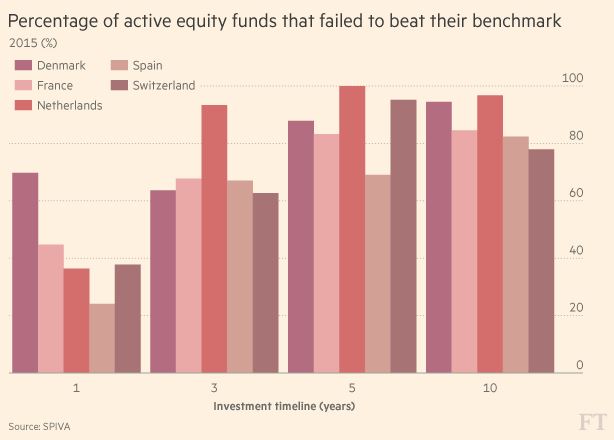
An in-depth study by S&P Dow Jones Indices also found that 100 per cent of actively managed equity funds sold in the Netherlands have failed to beat their benchmark over the past five years.
Ninety-five per cent of funds sold in Switzerland and 88 per cent of those on offer in Denmark also underperformed.
Daniel Ung, director of research at S&P Dow Jones Indices, said: “The 100 per cent figure is very shocking. The other statistics are not much better. We are not saying active management is dead, but active managers need to justify what they are doing.”
Overall in Europe, four out of five active equity funds failed to beat their benchmark over the past five years, rising to 86 per cent over the past decade, according to S&P’s analysis of the performance after fees of 25,000 active funds.
Within that sample, 98.9 per cent of US equity funds underperformed over the past 10 years, 97 per cent of emerging market funds and 97.8 per cent of global equity funds.
“There are some good managers out there but they are not easy to find. At a regional level, at a global level, in emerging markets, you name it, they are not performing well. On a one-year basis it is still possible to outperform, but it is very difficult on a consistent basis over the long run,” Mr Ung said.
Asset management experts said the findings will exacerbate investor concerns about overpriced, underperforming active funds.
These fears have fuelled demand for cheap index-tracking funds, enabling the low-cost exchange traded fund market to grow more than sixfold over the past decade, to $2.9tn.
David Blake, director of the pensions institute at London’s Cass Business School, said: “The average equity fund manager is unable to deliver outperformance from stock selection or market timing. This means a typical investor would be almost 1.44 per cent better off per annum by switching to a UK equity tracker.
“A small group of star fund managers are able to generate superior performance, but they extract the whole of this outperformance for themselves via fees, leaving nothing for investors. All but the most sophisticated investors should invest in index funds.”
Andrew Clare, who holds the chair in asset management at Cass Business School, added: “Finding a good active manager of developed-economy equities is very difficult, which is why many institutional investors don’t bother looking.”
Equity funds domiciled in the UK – one of Europe’s largest asset management markets – performed relatively well, by contrast. The majority of UK large and mid-cap funds beat their benchmark over one, three and five years. Over 10 years, however, all UK fund categories underperformed.
A spokesperson for the Investment Association, which represents the interests of UK asset managers, said: “British actively managed funds are highly competitive and the average fund has beaten the UK, global emerging markets and European markets in the past five years.
“There are no guarantees with active management, but there is clear evidence that the UK investment industry offers a range of compelling active products that add value for investors.”
Net sales of European ETFs jumped 55 per cent last year, to Euro 74bn, but sales of actively managed funds dropped 15 per cent to Euro 274bn, according Lipper, the research company.
Jake Moeller, head of UK research at Lipper, said active managers needed to do more to combat intense competition from the passive industry.
He said: “Styles fall out of favour, fund managers make mistakes and markets are wholly unpredictable. Nobody denies that investing in active funds requires considerably more due diligence. But the rewards for selecting a good active fund remain considerable.
“If this [research] encourages some retail investors to question their financial advisers and fund groups, then that is a good thing. I would, however, like active fund groups to get on the front foot [and] sing out [their] benefits more loudly. The passive voice is getting louder and louder.”
Living with a toddler. Granddaughter Eleanor is 2 1/3. She’s with us until she’s back at Toddler College next Monday. She’s a treat. She’s a challenge. I am learning about toddlers:

John Oliver is funny and getting funnier. He’s on HBO at 11 PM Sunday nights. Sometimes he takes a break. So he records a funny short YouTube video. Here’s one for April 1. Watch the others as they come up. They’re really funny.

For the John Oliver YouTube video, click here.
Travel stuff — terrorism
1. If you don’t have to to go, don’t.
2. Don’t linger in the public area of any airport. Pass through the security as fast as possible. Some airports now do screening a mile or so from terminal buildings. The number is few, but makes huge sense.
3. Stay away from crowds.
4. Go to safe places like Australia or New Zealand. Want a list of places to see? Email me.
Donald Trump and the bible
Donald Trump was asked if he could quote any Bible verses.
He answered: Trump 20:16, “Give a man a fish and he will eat for a day.
Deport him and you won’t have to feed him again, ever.”
This is obviously apocryphal, but funny nevertheless.

Harry Newton, who buys more VZ when it falls a little. It’s still yielding a mouth-watering 4.2% yield.

Harry, regarding market based ETFs. Have you given any thought to what would happen if everyone moved into the S&P500 ETF? Everything would look great as long as you have those 500 stocks. In a broad sense the move to Market based ETFs could be why statistically the market is narrowing. The indexes that go up the most only seem to be the most well known ones, Dow, s&p500 and Naz. I am not arguing against market ETF investing. But trying to think ahead to when their popularity has maxed out. How would we know? Perhaps by watching fund flows? The whole thing with market ETFs is starting to sound like the logic of the Nifty Fifty in the 1970s. Have found anyone writing about this possibility?
Ron
Stop throwing your money away on stocks and buy a Tesla…you deserve it…you have the money…what are you waiting for? At your age you should enjoy anything and everything you want and can afford, which you can. I fell in love with the first Tesla I ever saw…I too was too cheap to buy one. I am running out of excuses.