Yesterday I ran five charts of stocks over the past ten years. Two things amazed:
1. The differences between the returns over the ten years.
2. How all of them did better than the S&5 500.
Here are the results:
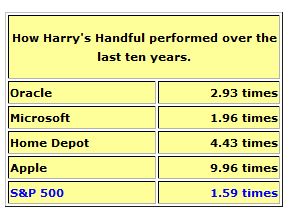
What we all did (i.e. how we messed up) was to not stick with them. We got panicked out of them when they fell, got busy with something else, then forgot to get back in when stocks turned (like lately).
I could expand this list to include companies like Tesla (11.45 times appreciation over the past ten years) and Facebook (2.53 times). But history is not relevant — unless you pluck a lesson from it:
You love the stock if the management and their technology impresses.
Tesla is the classic double whammy. Great management. Great technology. Facebook is pretty good. And now Microsoft, with its new boss, looks pretty good.
Harry’s thought is simple: Let’s all buy a portfolio of Great Technology, Great Management Stocks and lock them away for ten years.
Which ones? I had this “brilliant” idea to google “The Most Innovative Companies.“
Bingo, lists appeared from Forbes, Fortune, BCG Global Insights, and Fast Company.
I scanned the lists (added my own and my friends’ ideas) and came up with this list:
Adobe ADBE
Amazon AMZN
Apple AAPL
Autodesk ADSK
Baidu BIDU
Box BOX
Cisco CSCO
Expedia EXPE
Express Scripts ESRX
Facebook FB
Fitbit FIT
GE GE
Gilead GILD
GoPro GPRO
Google — Alphabet GOOGL
Microsoft MSFT
Mobileye MBLY
Netflix NFLX
Oracle ORCL
Palo Alto Networks PANW
Priceline PCLN
Salesforce CRM
Tesla TSLA
Verizon VZ
I went through their price charts of the last ten years (or less, if they were younger), and learned:
+ Most go down sharply at some point — usually during a recession. But they usually bounce back.
+ Some go down for a long time and may or may not bounce back, e.g.Fitbit or GoPro.
+ Some sit down for a long time and then skyrocket, e.g. Tesla.
+ Some suddenly get with innovation and transform themselves — like Verizon — and pay a handsome dividend — like Verizon.
I don’t profess to have discovered a new investment approach.
But brilliant management and brilliant technology has a good chance of making it over time.
Hence I am asking you, my readers, to check out my list and let me have your additions or deletions.
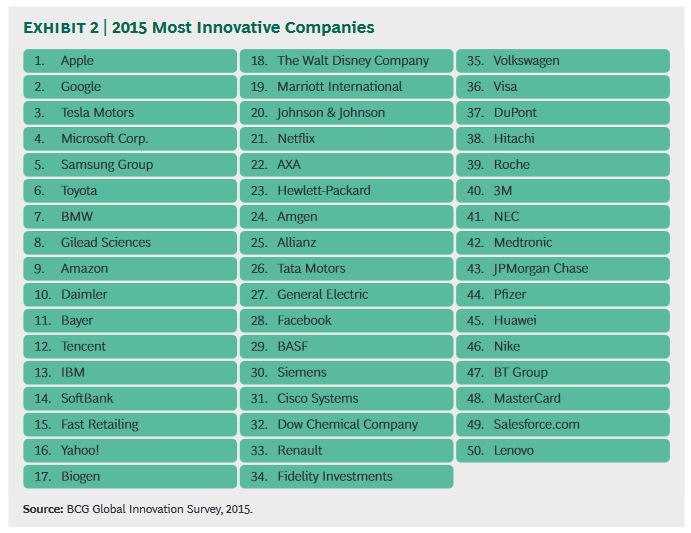
FYI, here’s a nice chart I found when googling most innovative companies. These tend to be very large companies. Most won’t become ten-baggers over the next ten years. We’re looking for smaller ones with great technology and great leaders. Fitbit, Mobileye and GoPro fit that criteria. Google Forbes, Fortune, and Fast Company and see what you find.
Apple’s new tiny SE phone. It’s impressed the reviewers. Here’s one. Click here.
A Jewish Divorce
A New York City judge is presiding over the divorce proceedings of a Jewish couple.
When the final papers have been signed and the divorce is completed, the woman thanks the judge and says, “OK. Now I have to arrange for a Ghet.”
The judge inquires what she means by a ‘Ghet’.
The woman explains that a Ghet is a religious ceremony which is required under the Jewish religion in order to receive a divorce that is recognized by the Jewish faith.
The Judge says, “You mean it’s a religious ceremony like a Bris?”
“Well,” she replies, “Yes, it’s sort of similar to a Bris, only in this case you get rid of the entire prick.”

Harry Newton, who got to take Rosie to the Doggie Park. See you tomorrow. Send me your additions and deletions, please.

So Harry – are you actually saying buy and hold ! I’s not sure how this fits in with your 8% stop loss rule – because , as you mentioned, even good companies sell off. The problem is you buy, sell after an 8% loss and they either run back up (so you then wait for the correction which never seems to come to buy back in) or you forget about buying back in until you see an article about them and how well they have done and you do the old head slap – “why didn’t I stick with them!”.
Seems like the best long term plan is to buy quality (both mgmt. and company products) and add on the dips that will eventually come.