The Dow fell 3.3% last week, snapping a three-week winning streak. I am not overly optimistic for the rest of the year.
How do you predict the market? Of course, you can’t, and you don’t.
But.. This piece posted on Friday by Mark Gomes, a consultant, and writing in Seeking Alpha offers some useful insights — my bolding.
Why the Market Will Keep Falling.
Economic indicators have been on the decline for several weeks now. However, it took until this week for investors to flee from equities. To understand why the market took so long to respond to the souring data you have to understand that a Catalyst is usually required for stocks to begin moving in unison with reality. You also have to understand that a Catalyst is the fourth, but most important, of four keys key to successfully timing a move in the market (or individual stocks for that matter):
1. Understand the environment — Observing what’s happening in your neighborhood can help, but it isn’t enough. You need a broad view of what’s going on with business and economics, in the U.S. and worldwide. Several objective sources can be found on the Internet.
2. Understand when the government and/or Fed will intervene and if the intervention will help — When the economy is in danger, the government and/or Fed will inevitably intervene to save the day. If you short the market and an intervention occurs the next day, you’re probably going to lose money.
In this case, my feeling has been that the government wouldn’t do much, because “stimulus” has become a dirty word with the public. With elections looming, nobody in Washington can afford to risk angering the electorate. Thus far, that has proven half-right. Unemployment benefits were on death’s door, but were eventually reinstated. That was a good way of pumping money into the economy without making too many people angry. In addition to this, the Fed has been making some minor moves of its own. This is also a savvy political move, because the public doesn’t generally associate the Fed with a political party.
The bottom line is that intervention remains possible. Keep in mind, almost any intervention will hurt the value of the dollar, but the government and Fed seem perfectly willing to sacrifice the dollar to keep GDP from falling (the definition of “recession”). Also keep in mind that a falling dollar almost always generates higher stock prices.
3. Understand if the market reflects reality — Most of the time, this is pretty easy. If reality looks bleak and the market hasn’t dropped, something has to give. Either stimulus is on the way or the market is due to roll over. In this case, the government and Fed have both made some moves (as I discussed above), but I don’t think it’s enough. Based on the market’s reaction over the past couple of days, investors seem to agree with my view.
4. Understand the Catalyst — The market doesn’t always respond to reality in real-time. In fact, experience has shown that it almost never does. Back in November of 1999, there were clear signs that the Internet bubble was bursting. Despite this, the market didn’t peak until March of 2000. If you shorted the market in November of 1999, you could have gone bankrupt — a harsh reward for being right about what was coming. Similarly, in May of 2007, it was clear to me that the real estate bubble was coming to an end. However, the market churned higher until October, some 5-months later.
Knowing what’s going to happen next is great, but knowing what will make investors act on that reality is what will make you rich.
Most recently, I published a SeekingAlpha article entitled “Which Way Is the Market Going Next?”. In that article, I wrote that the economy was starting to turn south again. I also stated my opinion that the market would start reflecting this reality “very soon”. Over the next week or so, the NASDAQ slid from 2,242 to 2,160…but almost as quickly rebounded, shooting above 2,300. Only in the past couple of days has the market fallen back below 2,242.
Assuming we are now in the midst of a correction, my call took a month to be proven correct. The reason my timing so far off was a misinterpretation of the Catalyst — the event(s) that would make investors believe (and more importantly, act on) my interpretation of reality. In this case, I felt that investors would simply see the writing on the wall and start selling stocks, despite what I felt was going to be a relatively healthy Q2 earnings season.
That was my mistake. As good earnings rolled in, investors ignored signs of a bleaker future in favor of reports of a brighter past. Then, as earnings season wound down, investors refocused on the economy, but believed that the Fed would come to the rescue at this week’s FOMC meeting.
It was a valid argument, but as it turns out, the Fed’s stated plan-of-action proved disappointing. Worse yet, with elections coming in November, the Fed is likely to honor its tradition of maintaining its status quo in the months leading to an election (for fear of being seen as politically biased).
With no more positive Catalysts upon which to cling, investors are left with no choice but to face reality. Thus, the Catalyst for a market decline was born.
In the coming weeks, I believe we’ll see more signs of economic degradation. With earnings season winding down and the Fed meeting behind us, positive Catalysts appear to be exhausted for now. Barring a surprise government or Fed intervention (unless, barring a full fledged crisis), the near-term Catalysts are likely to be negative, lighting the way to further stock market declines.
Afghanistan drags on and on. Over 1,200 American military personnel have died there. Another 40,000 plus have serious mental and physical injuries. Our new commander there predictably wants to keep this war going so he’s on a PR campaign (think military lobbyist) to extend it — in direct contravention to what our president has said is American policy. This is getting sadder by the moment. From today’s New York Times:
Petraeus Opposes a Rapid Pullout in Afghanistan
KABUL, Afghanistan — Gen. David H. Petraeus, the commander of American and NATO forces, began a campaign on Sunday to convince an increasingly skeptical public that the American-led coalition can still succeed here despite months of setbacks, saying he had not come to Afghanistan to preside over a “graceful exit.”
In an hourlong interview with The New York Times, the general argued against any precipitous withdrawal of forces in July 2011, the date set by President Obama to begin at least a gradual reduction of the 100,000 troops on the ground. General Petraeus said that it was only in the last few weeks that the war plan had been fine-tuned and given the resources that it required. “For the first time,” he said, “we will have what we have been working to put in place for the last year and a half.”
In another in a series of interviews, on NBC’s “Meet the Press,” General Petraeus even appeared to leave open the possibility that he would recommend against any withdrawal of American forces next summer.
“Certainly, yes,” he said when the show’s host, David Gregory, asked him if, depending on how the war was proceeding, he might tell the president that a drawdown should be delayed. “The president and I sat down in the Oval Office, and he expressed very clearly that what he wants from me is my best professional military advice.”
This chart comes from E. Bumiller, “The War: A Trillion Can be Cheap”, NYT, July 25, 2010
|
U.S. Wars
|
||
|
|
Costs (billion)
|
% GDP
|
|
WWII
|
$4,100
|
35.8%
|
|
Iraq
|
784
|
5.5%
|
|
Vietnam
|
738
|
2.3%
|
|
Korea
|
341
|
4.2%
|
|
WWI
|
334
|
13.6%
|
|
Afghanistan
|
321
|
2.3%
|
|
Gulf
|
102
|
0.3%
|
|
Civil
|
80
|
11.3%
|
You’ll find more on the economics of wars and how our defense conractors are fairing (excellent) here.
For more on what I personally think of the war in Afghanistan, see my blog, www.StopAfghanistan.org.
How to be more charming. Such was a headline in the August Esquire. The article has some pretty good advice.

It doesn’t matter what you do for a living; it’s all sales. It’s making people feel good about doing business with you, whether business means a cup of coffee, a bite to eat, and a half hour of talk or a night of stolen, steamy bliss. Calling it charm just makes it sound sexy; hell, talking about it at all makes it sound dishonest. It’s not. It’s human nature at its most natural.
You meet me. My voice is firm and sunny. I’m smiling. A smile is a primal thing, mighty past words. What it comes down to is simple: You have to trust your stuff. I have my flaws — plenty of ’em. But just take a gander at the dark sea of mopery that passes for competition: I’m a godling by comparison, and so are you.
The first thing I’m going to say is, “Thanks for making time for me.” Doesn’t matter if you’re Sean Penn or a taxi driver, you don’t owe me squat. We’re going to share a few moments; the only lives we’re ever going to live have joined right here and now. You made that happen; I owe you. Let’s have some fun. The next thing I’m going to do is ask about you. I’m going to learn about you, and I’m going to learn from you. I’m going to make you feel important; because we’re together, you are important. Then comes the coup de grâce: I’m going to make you laugh. I don’t know how to tell you to do this; you must trust your instincts. Genuine laughter is no less than a social orgasm. Provoke it and the world will drop its drawers for you.
These aren’t tricks. The only trick is that there are no tricks, just a planet full of folks — rich and poor alike — all hoping to get treated better than dirt. I can give them that gift. You can, too.
You better start now, times a wasting!!
Two old guys, one 80 and one 87, were sitting on their usual park bench one morning.
The 87 year old had just finished his morning jog and wasn’t even short of breath.
The 80 year old was amazed at his friend’s stamina and asked him what he did to have so much energy.
The 87 year old said, “Well, I eat Italian bread every day. It keeps your energy level high and you’ll have great stamina with the ladies.”
So, on the way home, the 80 year old stops at the bakery. As he was looking around, the lady asked if he needed any help.
He said, “Do you have any Italian bread?”
She said, “Yes, there’s a whole shelf of it. Would you like some?”
He said, “I want 5 loaves.”
She said, “Mama mia, 5 loaves? By the time you get to the 5th loaf, it’ll be hard.”
He replied, “I can’t believe it! Everybody knows about this stuff but me.”

Harry Newton,who’s finally got it all cleared up. One reader thought Friday’s picture of my partner, Gerry Friesen, could only have been taken in my reader’s home state Colorado.
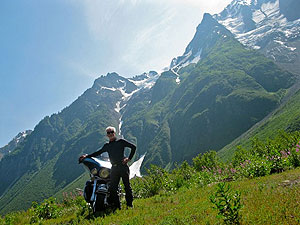
In fact it was taken in On the Kitimat-Stikine road, Highway 37 into Hyder, Alaska from the Cassiar Highway in British Columbia. (Gerry likes biking to Alaska.)
Gerry also emailed me:
Harry,
I read your blog thing… I’m afraid I must correct you. A Chinese Vespa is not a bike. It is a roller skate. And you need one on each foot to go anywhere.
This is a bike. And, as you can see by my attire, I’m just riding home from the golf course in my golf shoes and pants. A good cigar on the bike is always an added bonus… Of course, I just happened to be playing at Bandon Dunes, OR, just two days up PCH (Pacific Coast Highway) by bike from San Diego, CA. On a Vespa, even one on each foot, that would take you all summer. GERRY


Hi, I have read recently, in different articles as if it was NOT related, that Bernake is buying back his own treasuries and that China has switched part of its treasury purchases from US to Euro.
Does Bernake think there will be trouble as China reduces its purchases of US treasuries? How much can Bernake simply buy if China does not? Why don't we just buy all our own treasuries?
I enjoyed the item on your partner, Gerry Friesen. What a guy! I wondered how long it would take some busybody to comment on the lack of helmet and cigar. Get over it. I also ride a Harley and have 5 grandkids. I'm enjoying life like Gerry. Leaving for Soldotna, AK on Sat. to fish the Kenai River. I retired from the Telecommunications industry a few years ago after 37 years. I had the pleasure of hearing Harry Newton speak at an industry meeting in NC around 1983. It's refreshing to hear about positive, successful people like Harry and Gerry. Live life to the fullest–we're only hear in this beautiful place for a few years. Take care of yourselves, your family and friends. If Gerry will send me 6 of the cigars he is smoking, I will not turn him in to law enforcement since he is riding in CA without a helmet. I'll check the mail.
I'd hate to see the injuries your friend would suffer if he fell off. No helmet, boots gloves or reinforced pants. Even in a minor spill he would say goodbye to a lot of skin.
It amazes me how bikers think that an accident could never happen to them. Definitely a poor example to set.
Don't get me started on the cigar. I was riding years ago and a car driver flicked a cigarette…which came right at me and down the front of my jacket. I damn near crashed trying to stop in a hurry. I had a nice little hole in my t-shirt and a burn to show for that one.
Gen. P. is good guy – I met him when he was the Commding General at Ft Leavenworth but he is still a General with stars looking for the next war or make the one he as into a longer one – Go see the movie 'Restrepo' and you have to come to the conclusion-our guys are dying for nothing-why lose our youth in a fight for a hilltop only to withdraw in amtter of weeks or months – no wonder the soldiers ask is it worth it?