Your allocation determines your investment success. They wrote books on this idea. They were right. Then.
So much bonds. So much equities.
Change your allocation as you grow older. You need more income. Hence more bonds.
But allocation no longer works.
Bonds no longer provide old people (like me) income.
Stocks have run a six-year boom — since March 2009. It’s hard to see them providing tasty income in the foreseeable future.
Hence, you’re forced to look elsewhere. You can try venture investing — through funds or startups.
But the chances of an early (or any) return from your non-professional attempts at venture investing are slim to none.
Been there, done that. Lost gobs of money in everything from biotech to software, from distress hedge funds to distress real estate, from on-shore to off-shore. The fault is not entirely mine. The professionals in Silicon Valley see the good stuff. I see the bones after they’ve been picked dry.
I thought, for a moment, that my 50-year obsession with computer, networking and telecom technology might allow me to pick the real winners. I’ve had some. But they often hit speed bumps. Now I’m thinking that the present speed bumps may suggest growth has peaked — especially for the biggies. Time to get out. Examples include Google, Microsoft, Intel, Apple, Amazon. Growth remains but the shares languish. Yuch.
The key is to start another business, run it myself. Then I’ll succeed, again, keep myself amused and earn real money I can’t spend, (but can give away).
The 73-year old brain says it’s really hard to start and grow a new business versus playing tennis, writing this fun blog and visiting the kids. (Why, oh why do they live so far away?)
Which brings to me to real estate syndications. They’re why I just spent two days in Savannah, Georgia and Jacksonville, Florida. I’ve been eyeing multi-family properties. I saw seven of them.
It works like this: A team buys a property of say three hundred one, two and three bedroom units. The bank finances say 65% of the deal, leaving 35% for the team (typically a family) and outside investors, like me.
The tenants pay rent. The bank gets paid interest on its loan — and sometimes its principal. The remaining monies pay the expenses of running the place, making some improvements (granite countertops and stainless steel appliances are popular) and paying something to the investors, i.e. me.
Two views of one the seven apartment/townhouse complexes I visited yesterday. There were many buildings like this:
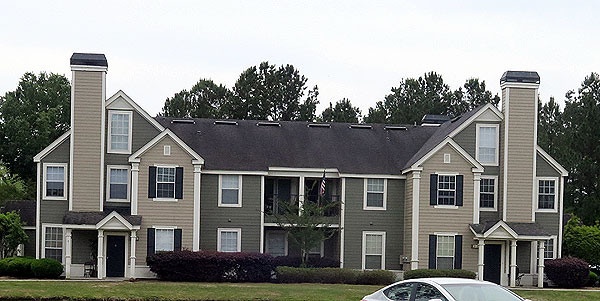
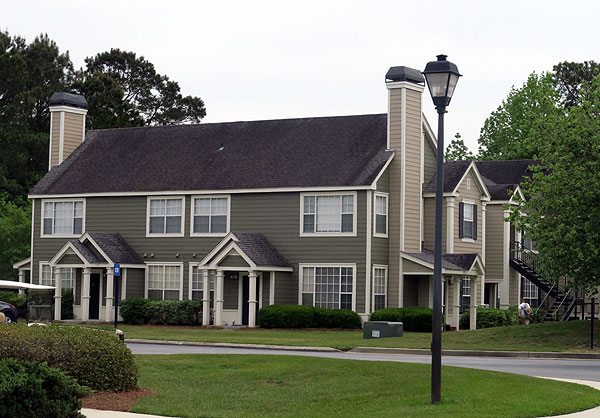
The “team” is called the syndicator. The deal is called a syndication. The syndication can succeed in several ways:
1. The syndicator is intelligent, capable and honest. It knows what’s its doing. It doesn’t waste money on pricey unnecessary improvements. It can make decisions. It doesn’t hold multiple, endless committee meetings to choose the color scheme to paint the lobby or the building. (Don’t laugh.)
2. There’s a real plan, also called a strategy. The goal is typically to improve the project’s value (otherwise why buy it?). Make it more valuable. One day, at a higher value, there’ll be a sale or a refinancing. The plan should make sense to you as a normal home-living person. This is not Moore’s Law and figuring out what the heck is happening with nano-micromillimeter microprocessor chips and the future of the Internet Of Things.
3. The mechanics of the deal should make sense. Don’t pay too much for the property. Don’t pay too much for the financing. Don’t burden yourself with insane restrictions on the loan. Some bank restrictions (like theoretical value) can put a loan into default even though the the loan is paid up. Make sure your earnings cover your debt by a nice margin, say 40% to 50%. Manage the cash flow intelligently.
That’s it for good deals.
There are a multitude of ways to mess up a deal:
1. Your property could have BIG physical problems you didn’t discover until AFTER you owned it. Roof problems are classic. You didn’t do proper due diligence — like checking everything.
2. Your community collapses. The biggest employer in town moves to China, or worse, Mexico. (Thank you Donald.)
3. Your plan to improve the property with granite countertops, better marketing, fancy management, and upgraded tenants may simply not take.
4. Your loan comes due. Your bank won’t refinance you. It’s not longer doing “whatever” your thing is or where it is — e.g. Podunk, Iowa, wherever that is.
A serious downturn in the economy (like 2008) could mess up a deal. But it’s hard to see how. You’re renting apartmets for $750 to $1,500 a month (mostly around $1,000 to $1,200), which are not New York City rents And people got to live somewhere. You could lose your bigger, pricier apartments to a job recession (like 2008). But those tenants might also take on a roommate or move into your smaller apartments — most are unlikely to pitch a tent in a public park, live in their cars, or God forbid, move in with their parents. You can also reduce your rents. But, OK. Rental residential real estate doesn’t carry the risk of owning a single tenant commercial building and waking up one morning to the news that your tenant has just gone bankrupt. Oih!
I met a bunch of tenants and saw the way they live. These are not rich people. There are students sharing the rent with a boyfriend. They graduate and move away. There are military people. (Jacksonville is home to Navy stuff.) There are people with local jobs who stay a year or two, then move on to a better job in another place. If that option closes we might actually see a longer-term, more stable rent roll.
Interestingly, in the greater course of events, it won’t be the price you paid, though it’s nice to pay less. As the years chug on, a few percentage points here or there in the price you paid won’t be huge in the deal’s ultimate outcome.
The part of syndications I love is that I can study them, learn if the syndicator is intelligent, if there’s a sensible plan, if the mechanics make sense, etc. It’s handle-able by my tiny brain.
Microsoft, Intel, Apple, Amazon, Verizon Google, etc. are not handle able by anyone’s brain. Moreover, I see them all making mistakes I wouldn’t make. For Intel, I would push speed, not battery life. For Verizon, I would push telecommunications, not whatever strange businesses Yahoo and AOL are presently in.
I can’t get my brain around the CEOs of these giant companies, nor what Wall Street often pushes them into. Look at yesterday’s piece on Valeant. But I can speak to the syndicator’s CEO, participate in one project, and if it goes well, go into another. I’m looking at early payouts of 7% and 8%. But much higher 15% IRR when the project is improved, re-financed or sold. I just had a commercial one that returned 30% IRR. And I have one residential one that is about to more than triple my money.
Jacksonville is booming. I’m told it’s physically the biggest city in the country. I toured a new shopping mall called St Johns Center. I have never seen a mall this big. You cannot walk it — unless you have a couple of days. Here’s a map. Click here. Here are a bunch of photos. Click here.
Presently, I’m in 61 syndications, some commercial, commercial residential. I don’t think syndications are for everyone. You’re typically in them for the life of the project. And some of the commercial ones did horribly in the 2008 downturn. But the residential ones have held in nicely. A lot depends on the syndicator and his skills. (I’m learning.) With stocks, you have daily agita and you can sell them from one day to the next. With syndications, you don’t have daily agita. With syndications you have annual agita.
I’m not a broker. I’m not a financial adviser. I’m one investor who’s trying to muddle through. If you’re interested in residential projects in Jacksonville — the ones I saw in the last two days, send me an email. I can get them to send you the docs. They’re still open. I don’t make anything on this. In fact, I didn’t even get a free dinner out of this. I paid for the three of us at dinner one night. They’d paid my hotel room and I owed them one, I thought. In fact my hotel room was less than a third the price of dinner. Keep reading, You’ll see why.
The best travel tip
Walk in off the street, the price for the night was $149. On Hot Wire, it was $52.
My guru explained that if the hotel can get a few more bucks than it costs to clean the room and power the lights and the AC, they’ll do it.
The two best hotel sites are Hot Wire and Priceline.
Here’s my $52 a night hotel:

My room had a nice desk, free Wi-Fi and eight pillows. I was in Heaven.
.
Hot Wire and Priceline differ from booking on the hotel’s site. The hotel’s web site is how you get the hotel you want. But, you can pick the hotel you want on Hot Wire and Priceline by simply narrowing the location and specifying how many stars. If your hotel is the only one in that location with that many stars, you’ll get the hotel you want, at huge saving. And anyway, what difference does it make if you get the hotel next door. Heck you just saved 65% on the room and there are zillions of nice, new hotels everywhere.
Prilosec and dementia (aka Alzheimers)
My doctor told me to take one Prilosec pill every day for the rest of my life. He clearly hadn’t read this:
Heartburn Drugs Tied to Dementia Risks
By Nicholas Bakalar February 17, 2016 New York Times
The popular heartburn drugs known as proton pump inhibitors have been linked to a range of ills: bone fractures, kidney problems, infections and more. Now a large new study has found that they are associated with an increased risk for dementia as well.
Proton pump inhibitors, or P.P.I.s, are widely available both by prescription and over the counter under various brand names, including Prevacid, Prilosec and Nexium.
German researchers, using a database of drug prescriptions, studied P.P.I. use in 73,679 men and women older than 75 who were free of dementia at the start of the study. Over an average follow-up period of more than five years, about 29,000 developed Alzheimer’s disease or other dementias. The study is in JAMA Neurology.
After controlling for age, sex, depression, diabetes, stroke, heart disease and the use of other medicines, they found that regular use of P.P.I.s increased the risk for dementia in men by 52 percent and in women by 42 percent, compared with nonusers.
“Our study does not prove that P.P.I.s cause dementia,” said the senior author, Britta Haenisch of the German Center for Neurodegenerative Diseases. “It can only provide a statistical association. This is just a small part of the puzzle.
“Clinicians, pharmacists and patients have to weigh the benefits against the potential side effects,” she continued, “and future studies will help to better inform these decisions.”
That’s it. I’m off Prilosec.
Passover begins tonight.
Passover celebrates Moses taking the Israelites out of Egypt.
As they move closer to the Promised Land, they hit the Red Sea.
Moses calls for his VP Engineering. “Build me a bridge.”
The VP Engineering: “Sorry Moses. No bridge. We’re in the desert. No wood. No steel.”
Moses calls for his VP Sales. “Go back. Work a deal with the Egyptians.”
The VP sales beetles off and returns an hour later: “Sorry, boss. No deal. They want us dead.”
In desperation, Moses calls for his VP Public Relations. “Yankele, what do we do?”
Yankele, VP Public Relations, “Moses, see that rock. Stand on it. Lift your arms. Ask God to open the Red Sea. He will. Take your Israelites through the gap. When you get to the other side you’ll notice another rock. Stand on it. Wait for the Egyptians, their chariots and their war machinery to fill the gap. Raise your hands. Ask God to close the gap. ‘Make the Red Sea waters to flow.’ He will. Your enemies will be destroyed and you can pass on safely to The Promised Land.”
Moses, skeptically: “This stuff gonna work?”
Yankele, “I don’t know. But if it does, I’ll get you three pages in the Old Testament.”

Harry Newton who loved Jacksonville, with its $1.97 gas and wonderful signs, like these:


They call Florida “God’s Waiting Room.” I didn’t see a single old person. But I did meet some of our tenants:

She’s a marketing manager who was managing her company’s Internet advertising from the pool in our apartment complex. She did admit to going into her company’s office, occasionally. I talked to her about Internet advertising. She really understood that stuff. More about what I learned from her next time.
This nice lady was polishing her car’s wheels, dressed appropriately in bright red high heels. Note her dog. Some of the apartment syndications charge a little extra for dogs.


‘Your community collapses. The biggest employer in town moves to China, or worse, Mexico. (Thank you Donald.)’..please dont tell me you are blaming Trump for jobs leaving the country. That would be the biggest load of horseshit you’ve ever written, and you’ve written ALOT.
My tenants in Sun City really are in God’s waiting room…not one of them look like your Blond tenant…maybe 50 years ago!
The Town Center Mall here in Boca isn’t exactly small either… 🙂
Harry- Are you saying that you like Jacksonville as a city are just the mall?
Harry -what is the advantage of private deals over publically traded apmt reits. I tend to like the liquidity and less tax work / paperwork with a publically traded company
In a publicly traded apt REIT, you can’t vet them deal by deal.
And you can’t write-off all the “business trips” checking them out 😉