Oil, gold, iron ore and copper have rebounded this year.
We need to check these year-to-date charts out. I bet they’ve got a little more to run.
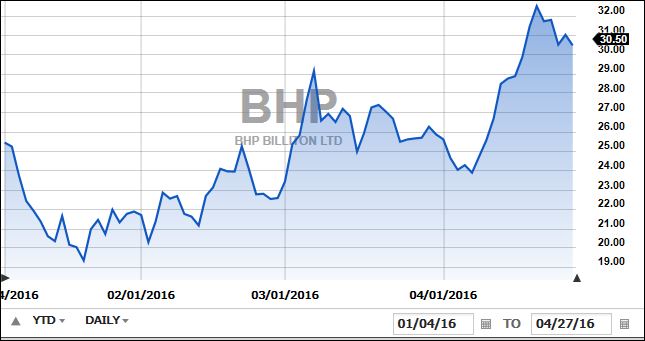


Something good is happening in China. Perhaps China is coming back from the brink and lots of China bears are wrong? Totally wrong?
Meanwhile Apple disappointed and its stock is down. I think we all waste far too much intellectual energy on Apple. Everyone has an iPhone and the new ones are simply not enticing enough. There are more rewarding things in the world than Apple.
Some crazy is on CNBC this moment predicting AAPL to hit $125 one day. (Who knows or cares?) Here’s Apple now:

I have no idea where Apple is going. I no longer care. I haven’t owned AAPL for a while.
My iPhone 6 works fine — especially now I’ve enabled WiFi Calling — the great invention since sliced bread. If you haven’t turned it on your iPhone or Android, please do. It works fine on Verizon and AT&T. And T-Mobile, of course has had it for years. WiFi Calling improves your cell phone reception a million percent.
Not good for my present obsession — pills.
Last night we saw Eugene O’Neill’s famous play Long Day’s Journey into Night. It’s a brilliant play (his best). It’s about a totally dysfunctional family racked by drug addiction — the mother on morphine, the father on alcohol. Not a good play for me currently obsessing on all those years I spent on Prilosec. To make matters worse, my readers bombarding me with “miracle”dietary supplements that replace real drugs with mashed up twigs and weeds.
Give up pills, dietary supplements. Live a healthy life with exercise and sleep, etc.
The Dietary Guidelines for Americans (according to the Federal Government) describes a healthy eating pattern as one that:
Includes a variety of vegetables, fruits, whole grains, fat-free or low-fat milk and milk products, and oils. Whole grain products and certain fruits and vegetables like broccoli, potatoes, grape juice, and oranges are sources of chromium (an important chemical for the body). Ready-to-eat bran cereals can also be a relatively good source of chromium.
Includes a variety of protein foods, including seafood, lean meats and poultry, eggs, legumes (beans and peas), nuts, seeds, and soy products. Lean beef, oysters, eggs, and turkey are sources of chromium.
Limits saturated and trans fats, added sugars, and sodium and Stays within your daily calorie needs.
To bore you even further, here’s an important “Personal Health” piece from yesterday’s New York Times. It describes our pill-popping society. If you don’t want to read it all, skip to the parts I bolded:
The Dangers of `Polypharmacy,’ the Ever-Mounting Pile of Pills
Dr. Caleb Alexander knows how easily older people can fall into so-called polypharmacy. Perhaps a patient, like most seniors, sees several specialists who write or renew prescriptions.
“A cardiologist puts someone on good, evidence-based medications for his heart,” said Dr. Alexander, co-director of the Johns Hopkins Center for Drug Safety and Effectiveness. “An endocrinologist does the same for his bones.”
And let’s say the patient, like many older adults, also uses an over-the-counter reflux drug and takes a daily aspirin or a zinc supplement and fish oil capsules.
“Pretty soon, you have an 82-year-old man who’s on 14 medications,” Dr. Alexander said, barely exaggerating.
Geriatricians and researchers have warned for years about the potential hazards of polypharmacy, usually defined as taking five or more drugs concurrently. Yet it continues to rise in all age groups, reaching disturbingly high levels among older adults.
“It’s as perennial as the grass,” Dr. Alexander said. “The average senior is taking more medicines than ever before.”
Tracking prescription drug use from 1999 to 2012 through a large national survey, Harvard researchers reported in November that 39 percent of those over age 65 now use five or more medications — a 70 percent increase in polypharmacy over 12 years.
Lots of factors probably contributed, including the introduction of Medicare Part D drug coverage in 2006 and treatment guidelines that (controversially) call for greater use of statins.
But older people don’t take just prescription drugs. An article published in JAMA Internal Medicine , using a longitudinal national survey of people 62 to 85, may have revealed the fuller picture.
More than a third were taking at least five prescription medications, and almost two-thirds were using dietary supplements, including herbs and vitamins. Nearly 40 percent took over-the-counter drugs.
Not all are imperiled by polypharmacy, of course. But some of those products, even those that sound natural and are available at health food stores, interact with others and can cause dangerous side effects.
How often does that happen? The researchers, analyzing the drugs and supplements taken, calculated that more than 8 percent of older adults in 2005 and 2006 were at risk for a major drug interaction. Five years later, the proportion exceeded 15 percent.
“We’re not paying attention to the interactions and safety of multiple medications,” said Dima Qato, the lead author of the JAMA Internal Medicine article (Dr. Alexander was a co-author) and a pharmacist and epidemiologist at the University of Illinois at Chicago. “This is a major public health problem.”
She was stunned to discover, for instance, that the use of omega-3 fish oil supplements had quadrupled over five years. Her research suggests that almost one in five older adults now takes them.
Users probably believe fish oil helps their hearts. But Dr. Qato pointed out fish oil capsules lacked regulation and evidence of effectiveness, and can cause bleeding in patients taking blood thinners like warfarin (brand name: Coumadin).
Though drug interactions can occur in any age group, older people are more vulnerable, said Dr. Michael A. Steinman, a geriatrician at the University of California, San Francisco, who wrote an accompanying commentary.
Most have multiple chronic diseases, so they take more drugs, putting them at higher risk for threatening interactions.
The consequences can also be more threatening. Say a drug makes older patients dizzy.
“They’re more prone to fall, because they don’t have the same reserves of balance and strength” as the young or middle-aged, Dr. Steinman said. “And if they do fall because they’re dizzy, they’re more likely to get hurt.”
Some common combinations that cropped up in the study and could spell trouble: aspirin and the anti-clotting drug clopidogrel (Plavix), both blood thinners that together increase the risk of bleeding with long-term use; aspirin and naproxen (Aleve), over-the-counter drugs that when combined can cause bleeding, ulceration or perforation of the stomach lining.
Dr. Qato recalled reviewing the medications of a 67-year-old man taking both the cholesterol drug simvastatin (Zocor) and the blood pressure medication amlodipine (Norvasc) — the most common combination of interacting drugs that emerged in her study.
Statins, along with their cholesterol-lowering properties, can cause muscle pain and weakness; Norvasc heightens that risk. A different blood pressure drug — there are many alternatives — would be a safer choice, Dr. Qato said. Yet almost 4 percent of the older adults in her study took both drugs.
Moreover, though her patient wasn’t experiencing problems, he was also taking garlic and omega-3 supplements, which can interact with prescription medications.
“Did you tell your doctor you were on them?’” Dr. Qato recalled asking. “He said, ‘No, why should I? If it was important, why didn’t he ask me?’”
A reasonable question. A recent study in JAMA Internal Medicine, however, found that more than 42 percent of adults didn’t tell their primary care doctors about their most commonly used complementary and alternative medicines, including a quarter of those who relied most on herbs and supplements.
Usually, that was because the physicians didn’t ask and the patients didn’t think they needed to know; in a few cases, doctors had previously discouraged alternative therapies, or patients thought they would.
And they might, especially for older patients with complex regimens. “I’m not a big fan of supplements,” Dr. Alexander tells patients taking lots of vitamins, supplements and herbal remedies.
“I think the vast majority of evidence raises serious questions about their effectiveness or, in some cases, their safety. They’re less well regulated than prescription medications. I think you’d be better off stopping them.”
Patients often resist, he said, and “they’re the captain of their own ship.” So he explains the risks and benefits, and negotiations ensue.
Often, though, patients don’t know that a daily aspirin, Prilosec OTC or fish oil can interact with other drugs. Or they’re confused about what they’re actually taking.
Dr. Steinman recalled asking a patient to bring in every pill he took for a so-called brown bag review. He learned that the man had accumulated four or five bottles of the same drug without realizing it, and was ingesting several times the recommended dose.
Ultimately, the best way to reduce polypharmacy is to overhaul our fragmented approach to health care. “The system is not geared to look at a person as a whole, to see how the patterns fit together,” Dr. Steinman said.
In the meantime, though, patients and families can ask their physicians for brown bag reviews, including every supplement, and discuss whether to continue or change their regimens. Pharmacists, often underused as information sources, can help coordinate medications, and some patients qualify for medication reviews through Medicare.
“We spend an awful lot of money and effort trying to figure out when to start medications,” Dr. Alexander said, “and shockingly little on when to stop.”
Favorite (?) bank, standard idiocy. How can one bank be SO stupid?

Favorite cartoons


No. I’m not. I’m riding my bicycle and playing tennis.

Harry Newton, who finds eating less and in small helpings is curing his heartburn. Maybe.
We had April showers. Predictably they brought May flowers. Now, what do May flowers bring? And the answer your seven-old granddaughter will tell you is pilgrims. Have a nice day!

Harry, you said, ” Dietary Guidelines for Americans (according to the Federal Government) ” Good grief! What a reference. These are the SAME people who gave us all THIS food pyramid in 1992… 6 – 11 Servings of “Bread, Cereal, Rice & Pasta” Power and money… that’s what they recognize. As it happens, I don’t have much of a problem with their CURRENT recommendations, but that is probably happenchance. Perhaps the power of the Internet has made them swing in the current direction.
even worse, they forgot to include the chocolate group and the alcohol group.
Harry, can you expand on the Prilosec comment. I assume you are not using it any longer. What are you doing that you don’t need it any longer?
I lost 20 lbs and went off Prilosec. No problems. I’ve also cut pills in halve with good results. Unfortunately the 20 lbs came back and the heartburn returned. 90% of the 20 lbs was in my belly region.
Harry, are you still shorting Apple – I think you shorted it a few months ago around 99? Not only do their new phones not entice anyone but now that you have to purchase the phone at full cost with no more contract pricing available who is going to purchase a new model right when they come out. Seems like a good short to me…
I am not long or short Apple. I can’t predict it. And I’m bored with it. Better pickings elsewhere.