When I first got into telecom, 95% of businesses were paying the phone company for equipment and lines they didn’t have and paying far too much for their long distance calling. They were due huge refunds and big drops in their monthly bills.
Things have changed. In the 1970s, it cost 35 cents plus a minute to make a coast-to-coast long distance call. These days coast-to-coast calls are basically free.
I bet most of us are still overpaying on our phone bills. Here are some simple tips:
1. If you’re a business, do a phone audit. Check your bills against what you really have — lines and equipment. You may get a big refund. You’ll cut your monthly bill. If you need a consultant, I have a good one.
2. Do you need a landline at home? About 30% of U.S. households given them up in favor of only cell phones. The landline business is going the way of print media.
3. Does your office really need so many (or any) fax lines? I just killed my home office fax line. No one sends me faxes any more. They send PDF attachments via email. I put this little $10.50 gadget in.
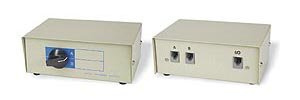
Now I share one of my two landlines with my fax machine. If I ever want to send a fax, I turn the switch. It’s mechanical. It can’t go bust. Unlike Susan’s Mercedes. But that’s another story. Check out Cyberguys.
4. How are you paying for your long distance calls? No more than a penny a minute. There are a zillion ways around this — from MagicJack to Vonage, from Skype to simply telling your phone company to put you on a better plan.
5. Video calls are super for business and for eyeing the grandkids. Skype-to-Skype video calls are free anywhere in the world. Facetime on the iPhone 4 will blow you away with its quality.
A pool sensor. What a great idea.A friend lost his 2-year old when he fell in. When I was in France recently, I noticed this thing. It’s an ultra-sensitive sensor. One morning a seagull drank from our pool. The sensor woke the neighborhood. Had my friend had one, his boy would be alive today.
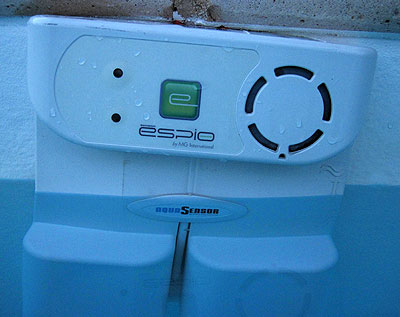
I believe these things are mandatory in France. They should be here, too.
Stunning progress in photography. I started taking photos for a living when I was 16. One summer in Australia, I photographed 83 weddings. I had every generation of Nikons — the ones with film. Nothing prepared me for the digital revolution.
As I organized for this weekend’s wedding, I experimented with three generations of my digital cameras. On the left is a Nikon D100, introduced in 2002, in the center the Canon G10 introduced in 2008 and the iPhone 4 introduced in recent months.
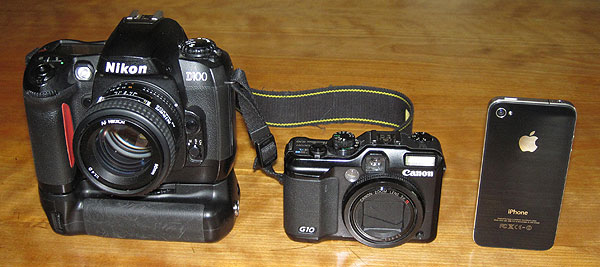
Noting prepared me for the result. This is unscientific. But iPhone 4’s photos are on a par with the G10 and far better than D100. Lessons:
+ New digital cameras do better without the flash — no matter how little light there is.
+ Most of us shoot to share our images on Picassa. Virtually any of today’s cameras — even the cheapest and smallest — will do a great job on Picassa and make perfectly fine prints to 8″ x 10″.
+ Today’s cheap digital cameras do better than last year’s digital cameras. Don’t buy last year’s model. And don’t spend a lot.
+ I am awed by the quality of the camera inside the iPhone 4. The thing also does high-def movies in lousy light.
How Harry was to harvest his capital gains. When I sold the company in 1997, asset managers pitching my business, told me my portfolio would rise at least 10% a year. (I don’t make this stuff up.) They would sell say half the gains. I would live on those gains. The best part? Those gains would be capital gains — at a much lower tax rate.
The first year they tried this brilliant strategy, they made lots of money. The next couple of years, they lost what they had made, and more. So much for that brilliant strategy. I took the money back (and promptly lost even more of it).
The amazing statistic: If you had been in equities from end-1999 to end-2009, and invested in a broad array of equities, you would have lost about 10% of your money.
The last ten years have been full of agita. There have been three major booms and busts. And virtually every area of investing — from stockmarkets to private equity, from startups to distress real estate — has suddenly become ultra-difficult. You can see that in the number of very succcessful hedge fund managers who have recently announced heir retirement (e.g. Druckenmiller).
You know what I’m doing now — muni bonds, cash, high yielders, selling covered calls, and tight stops. Conservative. Conservative. I don’t think anything is cheap any longer.
What estimate of future portfolio growth (if any) should I make going forward? Personally I figure maybe 5%. The Aatlantic magazine just did a piece called, The Great Stock Myth. Here are some excepts:
In 1985, Rajnish Mehra and Edward C. Prescott, economists then at Columbia University and the University of Minnesota, published a paper pointing out a strange anomaly they dubbed “the equity premium puzzle.” Since the late 19th century, stock investments in America had generated returns that were 6 percent higher than what economists call “the risk-free rate—the yield on an investment for which there is virtually no risk of losing your principal. The low-risk investments, such as short-term U.S. government debt, had yielded less than 1 percent.Those “excess” stock-market returns, which include both price appreciation and dividends, are much higher than you would expect if they simply reflected the risk of losing your investment (don’t even get me started on the arcane procedures by which economists arrived at this conclusion). Moreover, this premium cannot simply be attributed to an underestimation of future corporate growth by investors. Even when expected dividend or corporate-earnings growth is taken into account, stock returns are higher than one would predict.
Mehra and Prescott’s paper coincided with the early stages of a long boom in equities that lasted from 1982 to 2000. In the years after its publication, people like Wharton’s Jeremy Siegel (and many less careful or measured imitators) wrote books touting the benefits of long-term stock investing. Americans jumped into the stock market, first tentatively, then eagerly, and finally almost hysterically. Convinced that equities offered an attractive risk-reward ratio, they began bidding up the price of stocks. Stock-price increases fueled expectations of further growth, until by 1999, a Securities Industry Association survey showed that investors expected to earn an annual rate of return of 30 percent. In other words, they expected that by 2010, stock prices would have skyrocketed.
Their actual return, of course, has mostly been negative. Over the past decade, equity investing hasn’t offered much of a premium. The market went up (the Dow hit another record high in the middle of the decade). But then it went down again. In finance terminology, we experienced a lot of volatility—the major indexes have fluctuated a lot—but not much real growth.
One possible explanation for this pattern is that the equity premium has eroded. Markets have grown more efficient over time, as more and better information—and the computer tools to analyze it—has become available. Meanwhile, the stock market has democratized. Modern diversified portfolios have reduced some of the risk of holding stocks, because even if a few companies fail, they won’t take your entire nest egg with them. Rather, the failures average out with the successes to produce a relatively steady rate of return. As defined-benefit plans—what your grandfather called a pension—have died off, people have poured their retirement savings into mutual funds that offer this sort of diversification. The deeper pool of money flowing into equity markets means that equities no longer need to offer a higher yield in order to attract money from bond and other securities markets.
The equity premium’s shrinkage may have another reason. Financial markets have an interesting feature that has undone many a trading strategy: once everyone starts believing something, it often stops being true. If you discover an arbitrage opportunity—otherwise known as a “price anomaly” or “free money”—it will be profitable only as long as few people know about it. Once it is widely known, bidders will rush into the market until the discrepancy is traded away. After that happens, future returns will be lower.
In other words, once everyone believes that the stock market offers high returns for relatively little risk, that notion stops being true. And everyone apparently does believe just that—even after the 2008 crisis, the price-to- earnings ratio of the S&P 500 remains near the top of its average historical range. Paradoxically, the current high price may be supported in part by a belief that the old equity premium still obtains. A survey done by ING Direct in March of this year found that, even after a decade of lousy returns and a spectacular market crash, more than a quarter of Americans expect annual returns in the stock market to average 10 to 20 percent.
Click here to find out more!
If the return on equities really has fallen, this decline poses a big problem for the average investor who planned to stick 5 to 10 percent of his or her annual income into stock funds and retire comfortably. At an annual inflation-adjusted growth rate of 8 percent, savings of just 5 percent of your income for 30 years will leave you with a nest egg big enough to replace almost half your income when you retire. Saving 10 percent will make you really comfortable.
But if the return is 2 to 3 percent, you’ll need to save close to 40 percent to replace almost half of your income. And a 2 percent return seems to be a real possibility—in fact, it’s a hair above the 1.8 percent that Smithers & Co., an asset-allocation consultancy, forecast for U.S. equities over the next decade.
Felix Salmon, a finance blogger, argues that with stocks showing both lackluster prospects and whiplash-inducing price swings, investors might want to get out of the market entirely. That conclusion is tempting: if a quarter of Americans are expecting bubble-grade growth in stock prices, mightn’t another correction be in the offing? …
You can read the entire piece here.
The old sailor saga.

An old retired sailor puts on his old uniform and heads for the docks once more, for old time’s sake.
He engages a prostitute and takes her up to a room.
He’s soon going at it as well as he can for a guy his age. Needing a little reassurance, he asks, “How am I doing?”
The prostitute replies, “Well, old Timer, you’re doing about three knots.”
“Three knots?” he asks. “What’s that mean?”
She says, “You’re knot hard, you’re knot in, and you’re knot getting your money back.”

Harry Newton once gave speeches for a living. He commanded $15,000 for 90 minutes as far back as the 1980s. But this weekend, the wedding organizers — his son and future daughter-in-law — have cut him to two minutes. Meanwhile, Susan, his PC-sensitive wife, is insisting on reading the speech, pre-delivery. OMG, how many offensive jokes do they expect I can make in 120 seconds! This presents a serious challenge. I have until Saturday evening.

For low light conditions, such as at night / indoors, I've had good luck with a Nikon D40 and Nikon's 35 mm, 1.8 lens and no flash (much better than trying to crank up the ISO on a pocket camera).
The D40 is the bottom line DSLR, but it has only 6 megapixels, which means that each pixel is a little larger than the 10 megapixel sensors (same size sensor as the D60, D80, etc. consumer grade stuff, but not as big a sensor as the professional stuff). Larger pixel = more sensitivity. I can't imagine that the iPhone can come close under low-light conditions, particularly with respect to motion blur. Good luck and congrats.
Congratualtions on the upcoming wedding. I wouldn't be surprised if you are able to extent that 2 minute window. One point I would make about the Atalntic article is that large cao stocks did not have real returns from 99 -09, but small and mid caps were up over 50% during that period. Having sadi that it is hard to believe they can continue this streak fro the next several years. Felix Zuluaf recently was quoted as saying he thinks the S&P 500 will retest its lows in the next several year. I hope he is wrong, but with the continued leverage problems (US and globlally) it is hard to be really optimistic.
3 knots … Ha!
Harry – Why on earth would you want an old A/B box with your fax machine? Most fax machines have in/out RJ11 plugs, assuming you need to plug your phone into the fax. But better than that fax machines can listen in on the call and handle a receiving fax without the need for a dedicated line. BTW – You should take your paragraph under your picture and incorporate it into your speech. A faithful reader – Gary
I have an old reliable fax machine, which doesn't have an RJ11 port. Most people are like me. Old fax machines. the advantage of this box is you only use it when you want to send a fax. I don't want my callers suffered to a fax machine “listening” and wasting their time while it figures if it's a voice or fax call. This works easily.
OK but fyi there is no perceived delay on the listening side, I've had this setup for years with a couple of different printer/fax machines and it works well. Enjoy the weekend.
I attended several of those speeches in the 80s. It is likely you were overpaid. HOWEVER, I think that since you are probably paying for at least the rehearsal dinner, and possibly much more… you should get a lot more time! The rehearsal dinner is the right place. Use your best shots there.
I am still waiting for the right opportunity to tell the story of how you walked into the Pentagon in Washington DC carrying several bombs and corrupting subversive material! Rescuing you when you were up against the wall in the hands of the 5 foot tall 200 pound female security guard was still one of the times of my life when I wonder if I really did the right thing.