Today is my 74th birthday. I’m celebrating by telling you everything I’ve learned about investing.
I was never an investor. And I don’t like being one now because it’s become so hard.
So, here goes. Indulge me.
Once I had a full-time job. I got paid. To get more money, I moonlighted at other jobs. I never earned enough to save.
My father generously paid for me to go to Harvard Business School (HBS). He did that because he thought it might be good for me, but primarily because he wanted a family member in the U.S. when they had pogroms in Australia and he needed to move him, mother, my sister and his money to America. He grew up with Germany’s hyper-inflation in the 1930s. He went to college there. He was there when they started with the “Dirty Jew” thing. Later he moved money to Mexico, which was paying 13%. He lost most of it when they devalued. Fear is not a good investment motivation.
When I graduated from HBS, I took a job. The company was small, poorly managed, but had great potential. After three months, I tried to buy it, but the price was ridiculous. I quit with no idea of what I was going to do next. And I mean NO IDEA.
I set myself up as a “consultant.” I’d ask them what their problem was, say I was an expert in the problem and fix it. One of my first clients was a new company called MCI Communications. It had six employees. It was trying to compete against AT&T with over a million employees. MCI’s CEO Bill McGowan turned me onto the potential of competitive telecommunications — an industry the FCC had just opened up with landmark decisions in 1968 and 1969.. By the time, Bill died several years later, MCI has 30,000 employees and AT&t had been dismembered by the 1984 Consent Decree. It was satisfying. The old AT&T was so stupid.
I started the first magazine in competitive telecom, the first magazine in LANs (local area networks), then the first magazine on computer telephony — which is really what the Apple Store now does.
It was wonderful. I started magazines, held trade shows, published books and never had a web site. It was a luxurious life. I thought up the new businesses and got them going. My partner, Gerry Friesen, was a brilliant salesman, sales manager, marketing whiz and later spreadsheet maven.He never understood why a HBS graduate wasn’t interested in money, only ideas for new products and new businesses.
In the heady days of the late 1990s, he came to me, said he had “stress” and would like to sell. If we got a low price, I could buy him out. If we got a high price, we’d sell. In the end, by putting the business up for auction, we got a ridiculous price — which I insisted be paid in cash, not stock — even though the stock option was 30% higher. That was my first investment decision. I was right. The buyer’s stock didn’t do well.
One Friday in September 1997, I ended up with a huge pile of money. About $130 million of it. My banker said if I bought government bonds and held them for the weekend I’d earn mega-interest. I did. Monday’s Wall Street Journal reported that interest rates were on their way up since they had spiked strongly late Friday afternoon. That was my first introduction to the financial press in America. It was not reassuring. Their published story was total nonsense.
Our company sale was reported in the Journal. The phones started ringing. There were two main pitches: 1. Buy muni bonds. 2. Invest in a fund of funds. “We pick the best ones. Every year we harvest 10% return. You live on that. We re-invest the rest of the returns in the best funds. We always keep moving into the best funds.”
I fell for both the bonds (which did well). And the fund of funds. We never did earn 10%. The harvesting was minimal. But the fees weren’t.
Lesson number one. Anyone who manages your money in anything — from stocks to real estate, from timber forests to precious metals, from options to FX trading — is interested only in fees and what little they can do to keep you and your money from bolting.
It isn’t difficult to compare your managed returns to those of the S&P 500.
Lesson two: Very few managers of anything can consistently beat (or even match) the S&P 500. Warren Buffett is right: For the 99% of us unwashed, the best investment is an index fund — which Vanguard has the best. Fidelity (and others) claim to be cheaper than Vanguard but my researches show Vanguard does better for you the investor. I don’t know how one S&P 500 index fund can do better than another. But there are lots of mysterious investment things you’ll never get to the bottom of.
Lesson three: If you don’t understand it, don’t go near it.
For your children, get them into a simple S&P 500 index fund and tell them to put money into every month — no matter what the price of the fund is. This is called Dollar Cost Averaging. It won’t make your kids as rich as Bill Gates but it will give them enough to retire on and pay some of the medical bills our government won’t.
The country has run up huge debt, printing money, selling bonds to the Chinese and generally being fiscally irresponsible. There’s lots of stuff on the Internet about how all this is going to come crashing down soon. Like it did in 1929, 2008 and all the other times shown in this Business Insider chart.
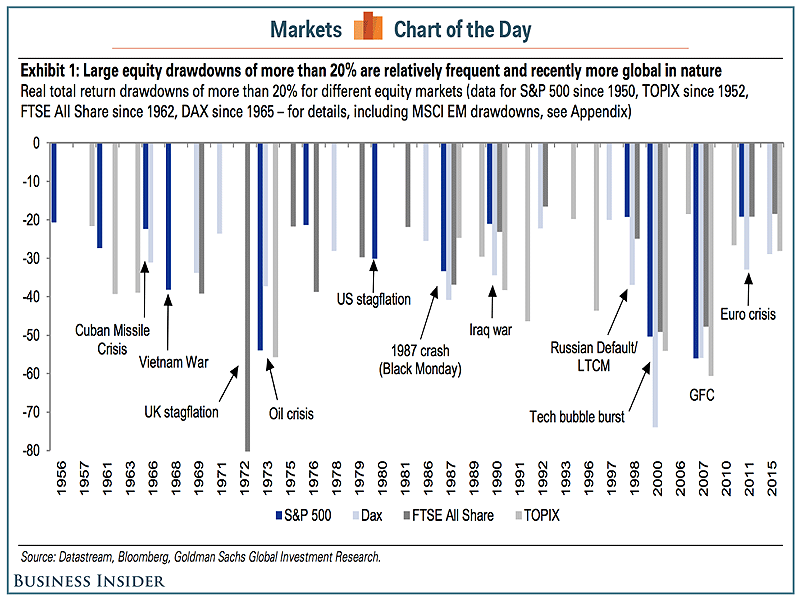
TOPIX is Japan.
Business Insider writes about this chart:
Stock market crashes are sudden, scary, and surprisingly common.
According to Christian Mueller-Glissmann, a strategist at Goldman Sachs, crashes of at least 20% are incredibly painful because of their rapid pace and long recovery times, but they’re also more frequent than you may expect.
Since 1950, there have been 57 such crashes in four of the world’s major indexes (the US’ S&P 500, the UK’s FTSE All Share, Germany’s DAX, and Japan’s TOPIX).
Mueller-Glissmann also notes that the drawdowns are beginning to happen in concert. Crashes in the 1960s, 1970s, and early 1980s were relatively disconnected. In recent instances, such as the tech bubble burst and the financial crisis, the precipitous drops have been more coordinated.
Everyone lost money as a result of 2008 (the last mess). The financial press talked about trillions of dollars of wiped out wealth that year. What you don’t see is how much has been lost since 2008 as a result of 2008. It’s a lot more.
My case is not untypical. Instead of putting all my money into index funds or triple tax-free muni bonds (which were paying the equivalent of 8% tax-free), I got seduced by all manner of ventures that sounded great, like Goldman Sachs funds. One fund invested in distress hedge funds. One buy-out equity fund. To Goldman’s credit, ten years late they’re above water. But the returns have been miserable — under 5%. They were pitched as being over 20%.
2008 was caused by a bust in sub-prime mortgages. But it hurt companies as disparate a biotech drug companies to simple bottled water companies, from commercial real estate to land development schemes in California’s once-booming Coachella Valley.
One thing I didn’t know was that all these various startups would need a continuing flow of money to finance whatever they had to do to ultimately get to cash flow positive, and showing a profit.
The money all dried up in 2008, 2009 and 2010. Share prices were depressed. All the rich investors (like me) were suddenly facing 100% write-offs in many of their “best” investments. The pain was excruciating. No one had warned us you could actually lose 100% of your investment by investing in biotech or real estate, or even bottled water.
I’ve learned to say NO with meaning. I’ve learned that due diligence (Lesson four) is NOT to figure what’s good about the investment. It’s to figure what’s BAD about the investment. What could go wrong. And why. and then say NO.
Capitalism is not easy. Ultimately I learned (Lesson five) that you can stack your chances better if you spread your investments, which Wall Street now calls bets. That’s a better word because it tells you your investments are bets, like they have in Vegas. Nothing in life is certain, except falling down stairs.
The successful investors are not investors, they’re businessmen who own 51% or more of the investment. This way they control it.
I’ve always done better with businesses I control. I made millions with my publishing venture. The IRR was infinite, since we didn’t start with anything other than my powers to persuade our printer to give us credit for 120 days. “What do you know about publishing a magazine?” my printer asked. I answered, “Nothing.” He still gave us the credit. We stayed with him for over 20 years. Though he wasn’t the cheapest, he was the best. Thank you Rich Kubik.
There are many successful businessmen who own little outside their own business. Maybe a few houses. Some art they love. And some bonds (when they were worth owning). But owning your own business is a lot better than owning Amazon, Netflix, Microsoft or Google.
When you own your own business (Lesson six), you get a double whammy. First, you pay yourself a salary. Second, you get ten times the profits when you sell out.
In my lifetime, the world of investing has turned completely upside down. When my father started an investment bank in the 1950s in Australia, there were far more opportunities than there was money to finance them. Much of what he financed was the first in Australia — from lolly factories, to gelato bars, to nylon manufacturing to commercial high-rise real estate, to strip housing with outhouses. (My summer job was playing call center for outhouse malfunctions. Call me for tasteless stories.) Father’s investment banking business was so successful, he was able to pay 24% interest a year on money deposited with him. At that time, muni bonds were paying 17% a year in the U.S.
Fast forward to now. We have too much of everything. Too many retail stores. Too many car companies. Too many airlines. Too many makers of tennis balls. Too much of everything.
Interest rates are zero. The ten-year German bond is now yielding zero. In many places interest rates are negative. You have to pay the bank to keep your money.
This has turned the world on its head. Lesson seven. Think about the poor insurance companies. They sold you policies by guaranteeing you a 7% annual return. But most are not earning anything like that. One day the chickens will come up to roost. Many dead people won’t be able to pay their heirs what your heirs expect on your life insurance. Insurance companies will be bankrupt and your heirs will be disappointed, or broke.Lesson next: Don’t buy insurance companies. Cash your large life insurance policies out NOW, before they become valueless tomorrow.
There are many bubbling disaster scenarios today on my birthday. You can see the headlines everywhere. George Soros — whose name means disaster in Yiddish — is alleged to be especially pessimistic and taking “doom and gloom” negative bets. Below is the Wall Street Journal article reporting on Soros’ negativity.
Thing about “doom and gloom” negative bets — like shorting the insurance companies, or the S&P 500 or the Australian dollar. You’re dealing with two variables– your logic and your timing. You can be right about the logic and years wrong on timing — when it happens. Stocks, for example, are way overpriced according to many measures, like P/E ratios. But they’re still going up (except today). Why? Because there’s nothing left for the ordinary man to invest in. For the 1%, they still have the luxury of buying over-priced contemporary art, over-priced Manhattan or London real estate, or putting the money into their own business. But their choices are also narrowing.
Wall Street pooh poohs cash. You should “put your money to work.” Buy stocks, funds, ETFs, real estate, anything and everything that will generate it fees.
This is no longer my father’s investment landscape. It’s much harder, and much scarier. Don’t borrow. Keep two years of family’s living expenses in cash. One friend has six years. He’s not a worrier. He sees six years as “conservative.” He sees a potential Donald Trump election as causing a huge sell-off in treasuries. Donald has said publicly he’ll short change owners of government debt.
My phone still rings with 25-year old kids trying to sell me something hot. I know how young they are when they repeating my name. I’ll hear Harry thirty times in a short conversation. They’re seeking my permission to send me a PowerPoint slide presentation (called “a deck.”)
An acquaintance with 40 visits to China under his belt says their economy is “tilting over a cliff.” Reasons: Too much debt, too few exports, too much building of apartments currently empty, too much corruption. The usual suspects.
For now I’m sticking with my few listed stocks, some gold (SGOL), some day-trading, my growing real estate syndications, my cash, selling dictionaries and writing several more books. I’m not involved in the management of any of the companies I stupidly invested in recent years.. Lesson seven. No one listens. They’ll say anything until they have your money. Then you and your advice can go pound sand. And they’ll mess up while you cringe.
At 74, I’m alive and healthy. I take no medications, except an occasional TUMS. This afternoon I’ll play tennis with a fellow half my age. I’m not taking any short bets.
Here’s the article on Soros from yesterday’s Wall Street Journal:
A Bearish George Soros Is Trading Again
After a long hiatus, George Soros has returned to trading, lured by opportunities to profit from what he sees as coming economic troubles.
Worried about the outlook for the global economy and concerned that large market shifts may be at hand, the billionaire hedge-fund founder and philanthropist recently directed a series of big, bearish investments, according to people close to the matter.
Soros Fund Management LLC, which manages $30 billion for Mr. Soros and his family, sold stocks and bought gold and shares of gold miners, anticipating weakness in various markets. Investors often view gold as a haven during times of turmoil.
The moves are a significant shift for Mr. Soros, who earned fame with a bet against the British pound in 1992, a trade that led to $1 billion of profits. In recent years, the 85-year-old billionaire has focused on public policy and philanthropy. He is also a large contributor to the super PAC backing presumptive Democratic nominee Hillary Clinton and has donated to other groups supporting Democrats.
Mr. Soros has always closely monitored his firm’s investments. In the past, some senior executives bristled at how he sometimes inserted himself into the firm’s operations, usually after the fund suffered losses, according to people familiar with the matter. But in recent years, he hasn’t done much investing of his own. That changed earlier this year when Mr. Soros began spending more time in the office directing trades. He has also been in more frequent contact with the executives, the people said.
In some ways, Mr. Soros is stepping into a void at his firm. Last year, Scott Bessent, who served as Soros’s top investor and has a background in macro investing, or anticipating macroeconomic moves around the globe, left the firm to start his own hedge fund. Soros has invested $2 billion with Mr. Bessent’s firm, Key Square Group.
Later in 2015, Mr. Soros tapped Ted Burdick as his chief investment officer. Mr. Burdick has a background in distressed debt, arbitrage and other types of trading, rather than macro investing, Mr. Soros’s lifelong specialty. That is why Mr. Soros felt comfortable stepping back in, the people said.
Mr. Soros’s recent hands-on approach reflects a gloomier outlook than many others on Wall Street. His worldview darkened over the past six months as economic and political issues in China, Europe and elsewhere have become more intractable, in his view. While the U.S. stock market has inched back toward record levels after troubles early this year and Chinese markets have stabilized, Mr. Soros remains skeptical of the Chinese economy, which is slowing.
The fallout from any unwinding of Chinese investments likely will have global implications, Mr. Soros said in an email.
“China continues to suffer from capital flight and has been depleting its foreign currency reserves while other Asian countries have been accumulating foreign currency,” Mr. Soros said. “China is facing internal conflict within its political leadership, and over the coming year this will complicate its ability to deal with financial issues.”
Mr. Soros worries that new troubles will arise in China partly because he said the nation doesn’t seem willing to embrace a transparent political system that he contends is necessary to enact lasting economic overhauls. Beijing has embarked on overhauls in the past year but has backtracked on some efforts amid turbulent markets.
Some investors are beginning to anticipate rising inflation amid recent wage gains in the U.S., but Mr. Soros said he is more concerned that continued weakness in China will exert deflationary pressure-a damaging spiral of falling wages and prices-on the U.S. and global economies.
Mr. Soros also argues that there remains a good chance the European Union will collapse under the weight of the migration crisis, continuing challenges in Greece and a potential exit by the United Kingdom from the EU.
“If Britain leaves, it could unleash a general exodus, and the disintegration of the European Union will become practically unavoidable,” he said. Still, Mr. Soros said recent strength in the British pound is a sign that a vote to exit the EU is less likely.
“I’m confident that as we get closer to the Brexit vote, the `remain’ camp is getting stronger,” Mr. Soros said. “Markets are not always right, but in this case I agree with them.”
Other big investors also have become concerned about markets. Last month, billionaire trader Stanley Druckenmiller warned that “the bull market is exhausting itself” and hedge-fund manager Leon Cooperman said “the bubble is in fixed income,” though he was sanguine on stocks.
Mr. Soros’s bearish investments have had mixed success. His firm bought over 19 million shares of Barrick Gold Corp. in the first quarter, according to securities filings, making it the firm’s largest stockholding at the end of the quarter. That position has gained more than $90 million since the end of the first quarter. Soros Fund Management also bought a million shares of miner Silver Wheaton Corp. in the first quarter, a position that has increased 28% so far in the second quarter.
Meanwhile, gold has climbed 19% this year.
But Mr. Soros also adopted bearish derivative positions that serve as wagers against U.S. stocks. It isn’t clear when those positions were placed and at what levels during the first quarter, but the S&P 500 index has climbed 3% since the beginning of the second period, suggesting Mr. Soros could be facing losses on some of those moves.
Overall, the Soros fund is up a bit this year, in line with most macro hedge funds, according to people close to the matter. The investments by the firm were previously disclosed in filings, but it wasn’t clear how involved Mr. Soros was in the decisions spurring the moves.
The last time Mr. Soros became closely involved in his firm’s trading: 2007, when he became worried about housing and placed bearish wagers over two years that netted more than $1 billion of gains.
Traveling this summer with your laptop? Tips, courtesy Travel and Leisure magazine and me:
1. Remove all sensitive files. Copy them to an external hard drive or flash drive and leave them home.
2. Change your laptop’s password to something longer, preferably 12 random letters and digits.
3. Perhaps it’s time to encrypt everything on your hard drive? Mac users can activate File Vault 2. Windows users can use Microsoft’s BitLocker.
4. Stay off public Wi-Fi. Alternatives include renting Wi-Fi hotspots. I’ve used ones from Xcomglobal with success. Click here. But there are millions. Google “international Wi-Fi hotspots.”
5. Photograph everything in your checked suitcase.
6. Make sure your suitcase has two external labels and three of your business cards inside. When it gets lost, you’ll have a shot at getting it back.
7. Before you leave the check-in counter, always check your baggage claim stub to see your bag is actually going to the right place.
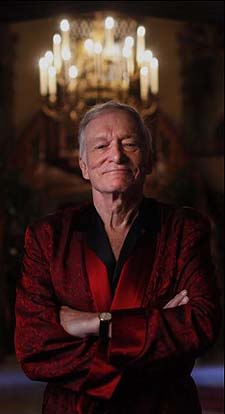
Hugh Hefner turned 90 in April.
He married Cyrstal Harris, who was 26, in 2012. Has Hef discovered the secret of long life? He is a World War II vet. He recently sold his $200 million 29-room Playboy mansion. Could it be he’s downsizing? Something Susan would like to do.
George Burns lived until 100.
He was once asked what his doctors thought of his lifestyle: smoking cigars, chasing young women, and drinking boooze?
He replied, “My doctors? They’re all dead.”

Harry Newton, who’s 74 . Only 24 years to go. I’ll get to my granddaughters’ weddings in a wheelchair sporting a bottle of oxygen. Just think 24 more years of ultra-low interest rates.Really good for retired people. Thank you Congress. Haven’t you figured out that low interest rates don’t create jobs? They create asset bubbles.
I bought myself a birthday present – a new ThinkPad X260 laptop. But I’m typing this column on my old, reliable, wonderful ThinkPad X230. The X260’s sole plus is a hugely long battery life – all day and then some. It isn’t faster than my three-year old X230. But making faster computers doesn’t seem to be Intel’s obsession these days. Which may be why PC and laptop sales are falling. Lenovo changed the X260’s keyboard and how you get to many commands like F1, F2, etc. All this reinforces my old aphorism: If it works, don’t fu*k with it. (Stay away from “upgrading” to Windows 10.) My recommendation: Go on eBay and buy yourself a ThinkPad X230 with an SSD drive. Then go on Amazon and buy 16 gigs of memory for your new, old machine. You’ll pick the machine up on eBay up for under $500. Worth every penny. Not worth spending $1,500 or more on a new ThinkPad X260. Trust me.

Happy Birthday. I was a reader of your mags when I was a beginning investor, and later applied what I learned when I was a partner in a hedge fund. Everything you said above is doubly true from the other side. We bought companies that were managed by idiots and often simply replaced them with new idiots – not always as smart as we thought we were. The 5% rule applies everywhere. Thanks for the great post.
Harry Happy Birthday Harry you could have had 7 years of slow boring investment with VWINX like you said no one listens.
Jan
Happy birthday Harry,
Wishing you the best!
I didn’t realize but I am with you reading you since 1998 nearly 20 years! I should say hi soon in NYC
Rob Ivanoff
Happy Birthday Harry…writing from Branson, MO where we are stopping off a couple days rest from driving a U-Haul truck from Nova Scotia to Payson, AZ moving some of our belongings from one summer cottage to another…could have bought all new cheaper!! We have aged pretty well together…friends from the early 70s, however now at 78 my 37th drive across our beautiful country is not as easy as it was 25 years ago. I enjoyed many of your ICA and TCA presentations and all your early tele-comm books. I am still pulling arrows out my back from our pioneer days when AT&T, Pacific Telephone and Mountain Bell tried to get me fired and all failed…while the companies I worked for saved more and more money. The computer PABX switches I helped to design and install were later sold to MCI to be used as nodal switches in their networks.
Keep it going Harry…buy a new Tesla for your next birthday!!
Lucky, Sounds like you also go back to my early days building MCI Try me at 415-902-8016.
Harry, in your blog you discuss many of the things I love most: money, computers, gadgets, tennis and humor. And you do it with honesty, intelligence, logic, jest, and common sense…..except in the area of politics and health. Although to your credit, with respect to health you’re starting to realize that drugs are not necessarily the best answer. I do notice recently that the humor has become repetitious, the investment advice resigned, and your postings rather erratic. Perhaps the world isn’t giving you much to work with these days given the minuscule interest rates, stagnated computer progress, a dearth of worthwhile gadgets and a general sad state of world affairs that lends itself more to crying than laughing. Moreover, it seems you have resolved the issue of the “perfect investment,” the main thrust of your journal. I hope this doesn’t mean you’re going to abandon us, Harry. I’ll keep reading, even if you only write about your family and tennis! You’ve become part of my family and I don’t want to see you go. Please keep sharing yourself with us. We love you.
Happy Birthday Harry and many, many more to come!
I remember you well from our early MCI days, 1972-75 era, a character riding a motorcycle in NYC. Those were the days as Bill McGowan changed the world like few others have ever done, cheap/free communications and a billion devices. Great forgotten man. And Hugh Hefner buying his “palace’ in 1971 for $1M, now being bought for $200M with Hugh living there till he passes. $1M in 1971 is equal to $200M today. Called inflation and one result of our gov’t printing money faster than a whore’s dropping draws, as Harry might say.
after inflation, $1 million in 1971 would be $5.9 million today.
Lowell, that may be true if you use gov’t statistics on inflation, a huge daily lie. Real inflation, food, etc., is reflected in Hugh’s house increase, perhaps with a few other factors. But key is inflation including the difficulty of building new homes..
so you want to use the value of beverly hills real estate as a foundation foe calculating the inflation rate. i suppose that makes sense if your primary consumables consist of 21,000 square foot 29 room mansions. why not arbitrarily compare the prices of other goods between then and now to arrive at the inflation rate.
average price of gasoline in 1971 cost about 30 cents a gallon. today its $2.50 – inflation 15% per year. color televisions in 1971 were $600, today $100 – inflation -1.8% per year. milk was 36 cents a gallon in 1971 and now you can get a gallon in costco for less than $2.50. so let’s say it’s gone up 7 times.
so, if you want to argue that the inflation rate is understated for daily use staples, fine. other things have gone up slower and some, like consumer electronics, have come down in price. but it’s a far cry from your original claim of 20,000% over 46 years or 434% per year. now that is just plain stupid.
Harry,
Wishing you the happiest of birthdays, my friend! For years, your blog has started my day and I’m grateful to you for taking the time to share your thoughts. Thanks for the knowledge over the years. “An investment in knowledge pays the best interest.” – Benjamin Franklin
Rhett
I wish a HAPPY HAPPY Birthday Harry!!! is a real pleasure read you..
Greetings from Chile
Harry,
A Happy Birthday wish to you. I have also enjoyed reading your column for many years. I was first “introduced” to you when I came across your Telecom Dictionary. I was in the radio engineering field at the time and felt your definitions were accurate and easy to understand, so I purchased a copy. That was the 18th edition of the book and I still have it on my bookshelf. I also was a subscriber to the Technology Investor magazine and the real estate magazine and enjoyed the subject matter.
Good wishes to you and your family.
Keep writing and publishing !
Warm Regards.
HBD2U! I became 70 in April. I was a millionaire for three years before the crash. What I’ve learned so far is in this book. “Do As I Say, Not As I Did. Learn From My Lifetime of Mistakes.” http://www.DoAsISay.xyz
This guy is a lying sack of pulp. He harasses people online and makes his “millions” selling fake reviews to self-publishers who think readers are so stupid, we won’t know the difference. You know that guy that claims the best way to make a million bucks is to write book called “How to make a Million bucks?” This is that asshole. http://www.rentabookreviewer.com/
Happy Birthday Harry! I have been a loyal reader of your column for many years, back since the Technology Investor Magazine Days. I even met you once at the NY Traders Expo. I thank you for sharing your thoughts, successes, and heartaches, while on your investment quest. Although I have had some successes and failures in my investments, as does everyone, some of the things I learned from you along the way helped steer me away from true disaster. Your jokes have brightened my day, and your other tidbits of wisdom, likes, and dislikes, have enriched me greatly. I have shared the wisdom of many of your columns with friends and family, who enjoyed them as well. I appreciate all you do, and you have taught me a lot as you have shared the details of your journey. Thank you for the past years, thank you for sharing your knowledge, and I look forward to reading your writing for many more. Enjoy your birthday!
“Could it be he’s downsizing? Something Susan would like to do.”
Listen to Susan…
Think “Tiny Houses” (700 sq. ft. minimum)
Pay no attention to Jerry (another Donald Trump).
I am amazed not to hear endless comparison of Trump to P.T. Barnum. Would you vote for P.T. to be Pres? The country would quickly become the “Greatest Show on Earth”. Not what I want…
I was in the Financial Sector with a license and my own (small) company. I had to sit by while good person after good person became overwhelmed by their egos and lost all their money. When I did not tell them what they wanted to hear they dropped me and found someone who would.
I learned the hard way the I was good at analyzing but not good at spotting good investments.
Thank you for sharing, Harry..a great honest narrative. I wish you could charge fees to the psychic vampires. They are the people whose life blood is negativity- spreading it while sucking positive energy where they find it, like your column.
Happy Birthday!
And here is another good read you may appreciate-
http://www.thenation.com/article/why-is-american-democracy-so-broken-and-can-it-be-fixed/
Don’t thank Congress for low interest rates. It’s the nutty Fed. Happy B-day;
Ugh. 74 years old and you have not learned a damn thing about investing nor about Americans.
Yeah, well where’s your blog Jerry? Unless you’re laying your investing life bare for us all to see, I think you should STFU.
I’ve shared my investing tips on here a number of times, Tom. Perhaps most notably when I encouraged readers of this blog to buy the Facebook IPO. Harry disagreed and so I’m sure nobody listened to me. The price at the time, only a couple years ago, was $38. Now it’s about $120.
So, what’s your latest idea? By the way I did reverse myself later and recommended buying Facebook. You’re allowed to do that.
so, what’s your latest idea?
I’m investing mostly in start ups and private equity these days. As a value investor I don’t see a lot of public stocks I want to own. If there’s a 10-15 percent pullback in the market that will change.
Happy Birthday, Harry! Loved your words of wisdom for today and I hope you have a nice birthday with family and friends.