At 8:00 AM last Saturday, Warren Buffett’s 2017 shareholder letter and annual report appeared. I downloaded it and jumped a six-hour plane trip to California.
Having six hours of peace and quiet to read and digest Buffett’s thoughts is a great pleasure. I’ll try for a few highlights below. But you owe yourself the favor of reading his letter in its entirety. Click here.
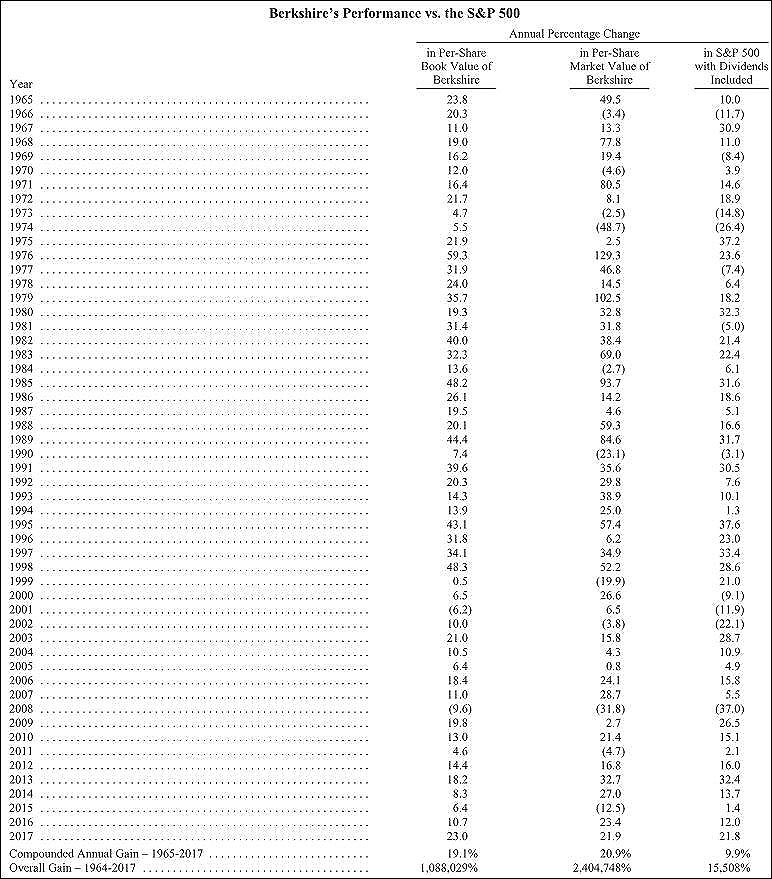
The first highlight is Berkshire’s results. They trounce bonds, hedge funds, most real estate, and S&P index funds. Look at the last line. That will blow you away. If you can’t see all of this chart on your screen, click on it:
There are a million other nuggets in his 16-page letter to shareholders.
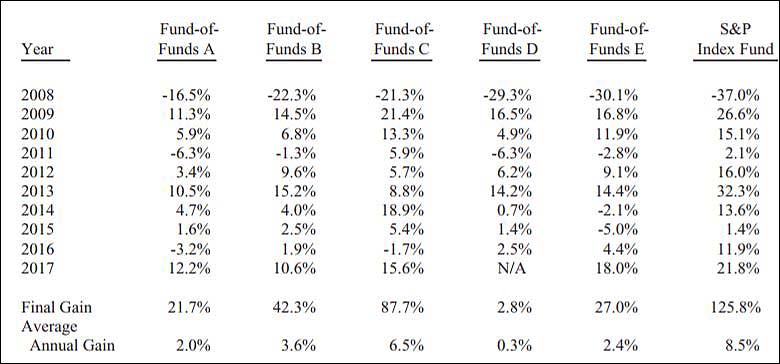
To me, one was the bet he made: The best hedge funds versus the S&P500 over ten years. Here are the results:
Here are Buffett’s words:
Last year, at the 90% mark, I gave you a detailed report on a ten-year bet I had made on December 19, 2007. (The full discussion from last year’s annual report is reprinted on pages 24 – 26.) Now I have the final tally — and, in several respects, it’s an eye-opener.
I made the bet for two reasons: (1) to leverage my outlay of $318,250 into a disproportionately larger sum that – if things turned out as I expected – would be distributed in early 2018 to Girls Inc. of Omaha; and (2) to publicize my conviction that my pick – a virtually cost-free investment in an unmanaged S&P 500 index fund — would, over time, deliver better results than those achieved by most investment professionals, however well-regarded and incentivized those “helpers” may be.
Addressing this question is of enormous importance. American investors pay staggering sums annually to advisors, often incurring several layers of consequential costs. In the aggregate, do these investors get their money’s worth? Indeed, again in the aggregate, do investors get anything for their outlays? Protégé Partners, my counterparty to the bet, picked five “funds-of-funds” that it expected to overperform the S&P 500. That was not a small sample. Those five funds-of-funds in turn owned interests in more than 200 hedge funds.
Essentially, Protégé, an advisory firm that knew its way around Wall Street, selected five investment experts who, in turn, employed several hundred other investment experts, each managing his or her own hedge fund. This assemblage was an elite crew, loaded with brains, adrenaline and confidence.
The managers of the five funds-of-funds possessed a further advantage: They could – and did – rearrange their portfolios of hedge funds during the ten years, investing with new “stars” while exiting their positions in hedge funds whose managers had lost their touch.
Every actor on Protégé’s side was highly incentivized: Both the fund-of-funds managers and the hedge-fund managers they selected significantly shared in gains, even those achieved simply because the market generally moves upwards. (In 100% of the 43 ten-year periods since we took control of Berkshire, years with gains by the S&P 500 exceeded loss years.)
Those performance incentives, it should be emphasized, were frosting on a huge and tasty cake: Even if the funds lost money for their investors during the decade, their managers could grow very rich. That would occur because fixed fees averaging a staggering 21/2% of assets or so were paid every year by the fund-of-funds’ investors, with part of these fees going to the managers at the five funds-of-funds and the balance going to the 200-plus managers of the underlying hedge funds.
The five funds-of-funds got off to a fast start, each beating the index fund in 2008. Then the roof fell in. In every one of the nine years that followed, the funds-of-funds as a whole trailed the index fund.
Let me emphasize that there was nothing aberrational about stock-market behavior over the ten-year stretch. If a poll of investment “experts” had been asked late in 2007 for a forecast of long-term common-stock returns, their guesses would have likely averaged close to the 8.5% actually delivered by the S&P 500. Making money in that environment should have been easy. Indeed, Wall Street “helpers” earned staggering sums. While this group prospered, however, many of their investors experienced a lost decade.
Performance comes, performance goes. Fees never falter.
Buffett’s complete 148-page annual report, which contains his letter (and his charming humor) to shareholders is here.
I wish I owned more Berkshire Hathaway shares. It used to be my largest holding but Amazon achieved that honor, by dint of its recent incredible run. Today AMZN is $1519. There is talk of it going to $2,000. Berkshire’s A stock is up $8,900 today to $313,000. Not shabby.
Great news. Our newest edition is out.
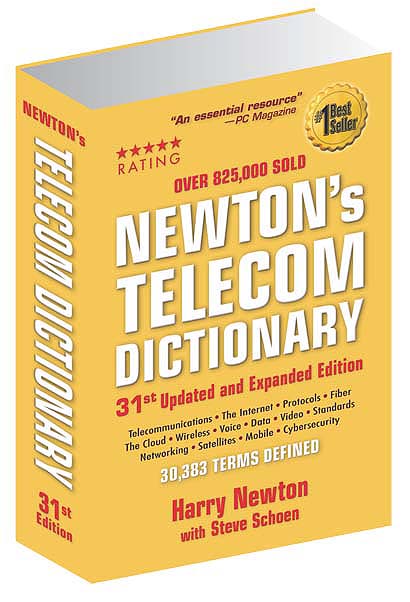
If you or your people need to understand technology, this is your book. Here’s a writeup, courtesy Amazon:
This is a business dictionary of 30,383 defined technology terms — covering the latest in telecommunications, computing, the Internet, the Internet of Things, networking and social media. It’s a complete dictionary/encyclopedia of today’s information technology. It is used by everyone from salesmen to lawyers, from corporate trainers to college educators, from corporate users to engineers. It is set as a required textbook in colleges teaching telecommunications and information technology. As the cover says, this massive 1440-page book covers everything in voice, data, images, mobile apps and video. The book is written for businesspeople in non-technical language.
Newton and his team expand and update the dictionary every day of the year, which makes it about as up to date as you can get. No other dictionary/encyclopedia is updated as regularly as this one is. This is the 31st edition. No other dictionary in the entire history of publishing has gone through this many editions — each one improved, expanded and updated. There are 4.4% more definitions (1,214 more) in this 31st edition.
Several reviewers (and customers) refer to Newton’s Telecom Dictionary as the industry “bible.” Originally just telecommunications, it now covers computing, networking, and all the newer allied technology fields.
A feature of the dictionary is that many of the definitions are not just an explanation of the technology, but also a primer on how the technology is used. Do’s and don’ts about using the technology. Tips from personal experience. What works and what doesn’t. What to watch out for. Warnings.
Buy it here. Please.
Highlight from Las Vegas. National Geographic has a gallery inside The Forum Shops at Caesars. They’re selling gigantic prints of gorgeous photos for hanging on your walls. Here are two Susan and I liked:


You can see other NatGeo prints here. Make sure you visit the NatGeo store next time you’re in Vegas.
Susan and I went to Vegas to see Elton John. He’s fantastic. He’s also announced his upcoming retirement. Catch him if you can. My photos of his concert don’t do his music justice. Suffice, go see him.
This is a total scam.
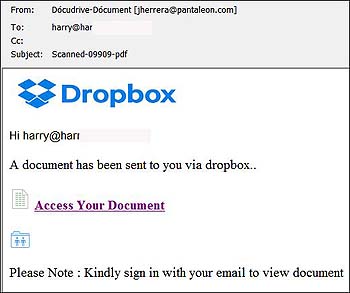
It’s very impressive. Looks like the real thing. You can tell it’s a scam. Look at the address from which the email came. Looks fishy.
Chased by the police
I was upset but not too surprised when I saw flashing lights in my rear view mirror.
“I’m terribly sorry officer. I was trying to make it to a meeting on time.”
” That’s a shame” the officer said upon handing me my ticket, “what time is the meeting called for?”
“Three o’clock” I said.
The officer looked at his watch, “you could probably still make it if you hurry up!”

Harry Newton, who got a flu shot and a cold — about one day apart. Go figure.

I got a flu shot and a cold one day apart. Is there a connection?