It’s called quantitative easing. He buys bonds, pumps money into the economy. It will do nothing for full employment or for housing. But it will help the stockmarket.
Don’t fight the Fed.
The Shingles Shortage. Some older Americans get shingles. It’s a horrible disease. You’re at risk if you had chicken pox when you were young. Who didn’t?
You can avoid shingles by getting the shingles vaccine made by Merck.
But you can’t get the vaccine because it’s on “backorder.” It’s been backorder for eons. I’ve personally been waiting for months and months.
I’ve called Merck investor relations several times. I was told endless BS stories and promised callbacks.
The whole shingles vaccine affair is a total disgrace.
Should I start a public campaign to bring pressure on Merck?
Have you had your shingles vaccine?
A cure for diabetes II? Brendan is my wonderful accountant. This morning he’s going in for a gastric bypass operation. That operation reduces his stomach to the size of an egg. The operation will will do three things, according to Brendan’s doctors:
1. It will reduce his weight. He’s currently 232 lbs. He believes he should be 160 lbs. He’s 5′ 8″.
2. It will change the way his body absorbs nutrients.
3. It will cure his diabetes II.
If all goes well, he’ll be out of the hospital on Friday and looking forward to his new life.
Brendan, we’re rooting for you. We love you.
And you thought we had bureaucracy in the U.S. You haven’t seen Germany. Susan and I just signed a “Completeness Statement“ for our German tax preparer.
I think that means our brains are complete. I wish it were that simple.
How bad is Washington? Don’t ask. Don’t tell. Congress’s inability to get rid of that insane policy was, to me, emblematic of its inability to get anything done. Fortunately a Federal judge solved Washington’s hopelessness and killed the policy.
On Tuesday, U.S. District Judge Virginia A. Phillips issued a permanent injunction, ordering the government “immediately to suspend and discontinue any investigation, or discharge, separation, or other proceeding, that may have been commenced under the ‘Don’t Ask, Don’t Tell’ Act.”
You would not believe the cost to our military of this insane policy — including losing a huge number of soldiers with critical foreign language skills.
What happens when you ignore technology? You get clobbered by it. Read this and tell me if you think Netflix is worth $153, with a P/E ratio of 61.
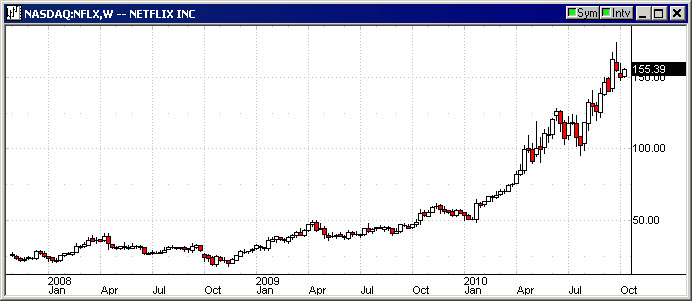
The Next Level by James Surowiecki, New Yorker October 18, 2010
In the nineteen-eighties, a new kind of chain store came to dominate American shopping: the “category killer.” These stores killed off all competition in a category by stocking a near-endless variety of products at prices that small retailers couldn’t match. Across America, independent stores went out of business, and the suburban landscape became freckled with Toys R Us, CompUSA, and Home Depot superstores. But the category killers’ reign turned out to be more fragile than expected. In the past decade, CompUSA and Circuit City have disappeared. Toys R Us has struggled to stay afloat, and Barnes & Noble is in the midst of a boardroom battle prompted by financial woes. And, last month, Blockbuster finally admitted the inevitable and declared Chapter 11.
The obvious reason for all this is the Internet; Blockbuster’s demise, for one, was inextricably linked to the success of Netflix. But this raises a deeper question: why didn’t the category killers colonize the Web the way they colonized suburbia? That was what pundits expected. Companies like Blockbuster, the argument went, had customer expertise, sophisticated inventory management, and strong brands. And, unlike the new Internet companies, they’d be able to offer customers both e-commerce and physical stores—“clicks and mortar.” It seemed like the perfect combination.
The problem—in Blockbuster’s case, at least—was that the very features that people thought were strengths turned out to be weaknesses. Blockbuster’s huge investment, both literally and psychologically, in traditional stores made it slow to recognize the Web’s importance: in 2002, it was still calling the Net a “niche” market. And it wasn’t just the Net. Blockbuster was late on everything—online rentals, Redbox-style kiosks, streaming video. There was a time when customers had few alternatives, so they tolerated the chain’s limited stock, exorbitant late fees (Blockbuster collected about half a billion dollars a year in late fees), and absence of good advice about what to watch. But, once Netflix came along, it became clear that you could have tremendous variety, keep movies as long as you liked, and, thanks to the Netflix recommendation engine, actually get some serviceable advice. (Places like Netflix and Amazon have demonstrated the great irony that computer algorithms can provide a more personalized and engaging customer experience than many physical stores.) Then Redbox delivered the coup de grâce, offering new Hollywood releases for just a dollar.
Why didn’t Blockbuster evolve more quickly? In part, it was because of what you could call the “internal constituency” problem: the company was full of people who had been there when bricks-and-mortar stores were hugely profitable, and who couldn’t believe that those days were gone for good. Blockbuster treated its thousands of stores as if they were a protective moat, when in fact they were the business equivalent of the Maginot Line. The familiar sunk-cost fallacy made things worse. Myriad studies have shown that, once decision-makers invest in a project, they’re likely to keep doing so, because of the money already at stake. Rather than dramatically shrinking both the size and the number of its stores, Blockbuster just kept throwing good money after bad.
As for “clicks and mortar,” it’s a nice catchphrase, but there’s not much evidence that consumers really need a company to offer both: Blockbuster tried to make a selling point of the fact that you could rent a movie online and then return it to a store, instead of popping it in the mail, but the allure of this was lost on most people. In practice, “clicks and mortar” just meant that Blockbuster had to spend lots of money and time integrating an entirely new information-technology system into the one its stores already had. Meanwhile, Netflix could focus on making its distribution system bigger and more efficient, in large part because it was starting from scratch. Similarly, in the late nineteenth century, department stores like Macy’s tried to enter the mail-order business that Sears had pioneered, but, since Sears had been designed around the mail-order business, its competitors were unable to catch up.
Unlike Sears, though, Netflix isn’t going to have decades in which to bask in its success. Its domination of the DVD-rental market comes just as people are moving toward streaming and downloadable video. As has already happened with music, the business of renting and selling movies will soon be about moving digital files rather than physical objects. Streaming is already a big part of Netflix’s business, and it has signed up partnerships to let consumers get movies via video-game machines, Blu-Ray players, and so on. But this is a market in which Netflix’s expertise in shipping red envelopes as quickly and efficiently as possible will no longer be a competitive advantage. It’s a market that’s already quite crowded—with Amazon, Apple, the cable companies, and now Google (which just rolled out its own TV product) all competing. And it’s a market that remains wide open technologically—no one really knows how, or on what devices, most people will watch movies in the future. In this environment, it would be easy for Netflix to fall back on its safety cushion, milk the existing DVD business for all it’s worth, and try to slow down customers’ migration into streaming, particularly since a customer who streams movies is less lucrative than one who rents three DVDs a month. But then, a decade from now, we’d be writing Netflix obituaries that sounded just like the ones for Blockbuster. Sometimes you have to destroy your business in order to save it. ♦
Riches in a bottle. Following my theme that the key to instant riches is something in a bottle.
New York is suddenly obsessed with bedbugs. They’ve been many articles in the local press. Even the most ritzy buildings on Park Avenue have them.
Bed bugs often arrive in luggage checked on planes.When we arrive back from a trip, we spray our luggage with a solution of 91% hydrogen peroxide. Says my daughter, Claire, the family’s designated expert on bed bugs, “But anything that can go in the dryer should be dried on high heat. That works just as well.”
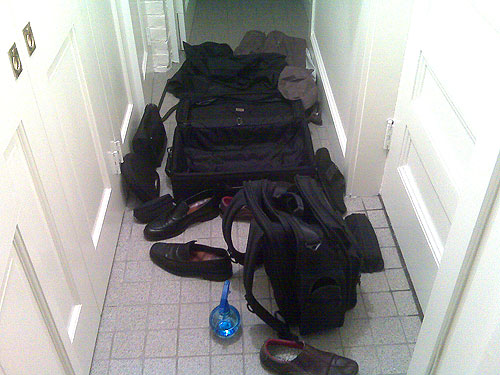
When her suffering husband, Ted, arrived home from a 234-country (or thereabouts) 12-day trip, she wouldn’t let him into the house until he’d dropped everything, including his clothes. This is his pile. Poor Ted.
In every “disaster” is a great opportunity. Spied yesterday on the back of a New York City bus:
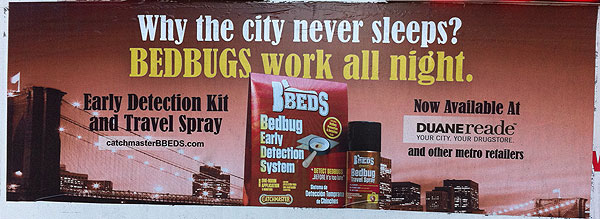
Taken with my iPhone 4.
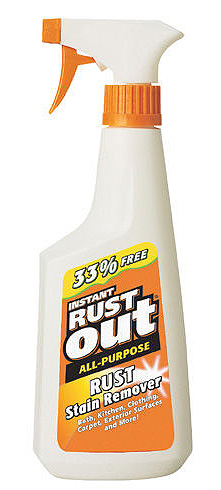 |
Our country palace has rusty water.
This means it puts This stuff is magic . Spray it on. Wait Bingo. It’s like new. Costs a fortune. Just like NewSkin, another great (and also expensive) idea:
|

TheWest Bank settlement.
An Israeli housebuyer is asking a local broker, “Why would anyone in their right mind buy an apartment in the new settlements?”
“Stand on your terrace, you’ll be shot. Stand at your window, you’ll be bombed. Explain why this is a great investment?”
The broker ponders for a moment and replies, “Have you seen the gorgeous parquet flooring.”

Harry Newton who’s proud it was American technology that got the Chilean miners out. Maybe there’s a future in technology? I do smell that the solar stocks are beginning to heat up. Meantime, you want “hot,” look at gold. GLD and SGOL and even SLV.

The Winn-Dixie pharmacy in Florida gave me the back log story.
Got the shot 2 years ago,but my wife just got the shingles,although it will be a mild case.
You just need something to reduce (opposite of oxidize) the rust, which precipitates, into an ionic form that will dissolve. Something like Sodium metabisulfite or sodium pyrosulfite will work. Home Depot. Stump remover. Cheap.
Want the Singles vaccine, then shop around. The Winn-Dixie pharmacy in Florida gave me the back log story. I called the Baptist Hospital pharmacy, where my wife got her shot. They had it in stock. Cost me $40 with my Humana Gold Plus Medicare supplement. The foam cooler and dry ice to keep the vaccine cold and injection service were free.
Since you talked about it before, I noticed our local Grocery Store in Plano, Texas had a sign out for Shingles immunization. I think it was in the $20 range. No idea what brand. Is there only one?
Harry…my wife and I got our Shingles Shots a couple years ago from our HMO CIGNA for Seniors, Maricopa, County, Arizona. Cost $30.00. We walked a prescription from our doctor across the hall to where they kept the serum and received our shots. Shelf life is very limited. Maybe other HMOs have the serum available as well.