Tariff wars make no sense, do no one any good. Never have. Never will.
News of escalating tariff wars will hurt stocks prices in coming months. I’m guessing the Wars will ease just in time for the November elections. Now is a good time to go on vacation to somewhere it’s not raining.
Investopedia wrote an excellent tutorial:
What are Tariffs and How do They Affect You
The Basics
Put simply, a tariff is a tax on an imported good at the border. Tariffs have been a tool for governments to collect revenues, but they are also a way to protect domestic industry and products. The theory is that with an increase in the price of imports, American consumers would choose to buy American goods instead. In today’s global economy, many products we buy in the United States have parts from other countries, or were assembled in other countries, or were manufactured entirely overseas.
In today’s free market economy, tariffs have something of a bad reputation. Many economists blame the Smoot-Hawley Tariff for worsening the Great Depression in the 1930s. In an attempt to strengthen the U.S. economy during the Great Depression, Congress passed the Smoot-Hawley Tariff Act which increased tariffs on farm products and manufactured goods. In response, other nations, also suffering, raised tariffs on American goods bringing global trade to a standstill. Since then, most policymakers, on both sides of the aisle, have turned away from trade barriers like tariffs towards free-market policies that allow nations to specialize in certain industries and incentivize optimal efficiency..
Trump First Tariffs
It may feel like we’re talking about tariffs more now than we were under President Obama, and that’s because we probably are. A large part of President Trump’s economic policy revolves around American protectionism, which typically means more tariffs. Putting American businesses and manufacturing first means taxing our global competitors in those industries.
The first tariffs imposed by the Trump Administration were on solar panels and washing machines. Robert Lighthizer, the U.S. Trade Representative announced that, after consulting with the Trade Policy Committee and the U.S. International Trade Commission, president Trump decided that, “increased foreign imports of washers and solar cells and modules are a substantial cause of serious injury to domestic manufacturers.” The first 1.2 million imported washing machines would be taxed at 20% and the subsequently imported washers would be taxed at 50% in the following 2 years. For imported solar panel components, they would now be taxed at 30% with the rate declining over four years.
Soon after the tariffs on washing machines and solar panels were imposed, the Trump administration slapped tariffs on imported aluminum. By June 1, a 25% tariff on all imported steel was imposed and a 10% tariff on aluminum from the European Union, Canada and Mexico was also imposed. What is notable here is that these were our top trading partners and allies, and they were not happy with these additional tariffs. In response, the EU issued a 10-page list of tariffs on U.S. goods ranging from Harley-Davidson motorcycles to bourbon. Similarly, Canada and Mexico are planning retaliatory moves against the tariffs.
At this point in mid-June, only a small fraction of the overall U.S. economy was impacted by these tariffs. In March of this year, Morgan Stanly estimated that Trump’s tariffs on washing machines, solar panels, steel, aluminum, have covered only 4.1% of U.S. imports. In terms of global trade, they cover just 0.6%, the bank calculated.
In a survey of economists conducted by Reuters, the Trump administration’s new tariff was very poorly received. Almost 80% of the 60 economists surveyed believed that the tariffs on steel and aluminum imports would actually harm the U.S. economy, with the rest believing that the tariffs would have little to no effect. All in all, none of the economists surveyed thought that the tariffs would benefit the economy.
Trump and China
But, only a few weeks later, on July 6, fears of an all-out U.S. trade war seemed to be validated as the Trump administration imposed even more tariffs, this time on China. These tariffs came after the Office of the United States Trade Representative (USTR) released the results of its Section 301 investigation into China’s unfair trade practices. The 200-page report calls out China’s use of preferential industrial policy to unfairly support Chinese firms, the country’s discrimination against foreign firms, and disregard for intellectual property.
In response to what Trump says are China’s unfair trading practices, the U.S. president imposed sweeping tariffs on $34 billion worth of Chinese goods. The tariffs target manufactured tech products from flat-screen televisions, aircraft parts, and medical devices to nuclear reactor parts, and self-propelled machinery. These tariffs, Trump hopes, will impact mostly Chinese businesses and not the American consumer, at least not immediately.
China promptly retaliated by imposing their own tariffs that target American agricultural products like pork, soybeans, and sorghum and warnings of “the largest trade war in economic history to date,” as reported by NPR’s Colin Dwyer. The Chinese tariffs target American farmers and big industrial-agriculture operations in the mid-west. The same political groups that voted for Donald Trump in 2016 and, in theory, have the most influence on his policies. As the 2018 midterm elections approach, if President Trump’s own constituency and the powerful agro-farm sector are hit hardest by these tariffs, then perhaps they will pressure him to lower the barriers.
Impact on us
This looming trade war has many worried that American consumers will see price increases on American products. Companies affected by tariffs essentially have three options: they can absorb the extra expense, increase prices, or move production to another country. While the impact on consumer goods appears to be low at the moment, the Trump administration’s 25% tariffs on Chinese goods will inevitably hit products sold to American companies.
“Prices would likely rise in the near term as tariffs increase the cost of imports, and some firms would be forced to pass rising costs along to consumers or shutter,” Wells Fargo investment strategy analyst Peter Donisanu wrote in a July 6 note to investors.
While the effects may be limited for now, if the U.S. and China, the worlds largest economies, commit to an all-out trade war, we could be looking at a complete shake-up of the global economy.
Investopedia’s piece is here. The bolding is mine.
Don’t do stupid
+ Don’t leave your washing machine or dryer open. A three-year climbed inside. Her young brother closed the door and started the machine. They rescued the girl.
+ All new cars feature “safety.” They’ve hardened the passenger cage with more steel. Which means they’ve reduced driver visibility. Watch out at intersections for cars coming from the right. They’re now impossible to see.
What last week’s lightning storm destroyed
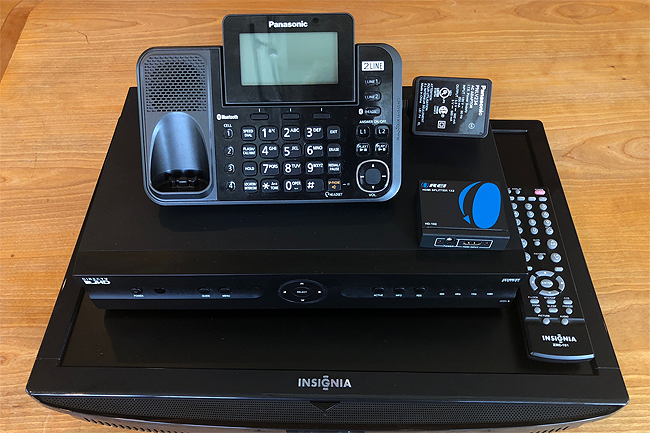
Destroyed by lightning: One phone system, one DirecTV box, one Insignia TV and one HDMI splitter.
On Saturday I went shopping to replace the TV. I went to a mall, my first time in years.
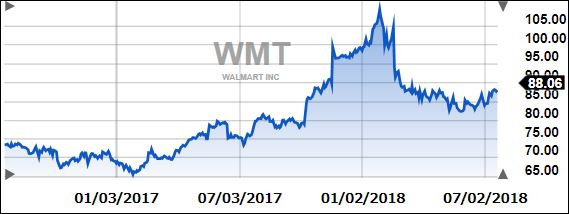
+ Walmart is remarkable. They have everything at prices that can’t be beat. I bought a Philips 24″ HD LED TV for $98. They have oodles of inventory. I have no idea who buys it all. It wasn’t mobbed. The building’s enormous size was impressive. Their salespeople were helpful. Walmart will suffer with tariffs on Chinese stuff. I think they buy more Chinese stuff than anyone else on the planet. Not impressive stock chart:
+ Lowe’s is unremarkable. They didn’t have what I wanted. It was hard to find a salesperson. My visit confirmed my standing recommendation: Buy Home Depot. Stay away from Lowe’s.
+ Dairy Queen (now called DQ) is owned by Berhkshire Hathaway. I had lunch there. Their cheeseburgers are great. Their people are sweet. They deliver your combo (fries, hamburger and Coke) to your table. Like in real restaurants. The good news for DQ is all their customers are overweight. Which means DQ sells them a lot of huge hamburgers and even bigger ice cream cones. One young man told me he weighed 450 lbs, “originally 520 and on the way down.” He was proud of his progress. DQ doesn’t have WiFi for its customers. I worked offline — a new experience.
Gleeful nonsenses
+ My 60 year kindergarten reunion is coming up soon and I’m worried about the 175 pounds I’ve gained since then.
+ I always wondered what the job application is like at Hooters. Do they just give you a bra and say, “Here, fill this out?”
+ Denny’s has a slogan, “If it’s your birthday, the meal is on us.” If you’re in Denny’s and it’s your birthday, your life needs re-thinking.
+ If I make you breakfast in bed, a simple “Thank you” is all I need … not all this, “How did you get into my house?” business!
+ I think it’s pretty cool how Chinese people made a language entirely out of tattoos.
+ Money can’t buy happiness, but it sure keeps the kids in touch.

Harry Newton, who is living an exciting life in his country mansion — babying all the lightning damaged equipment back. How bad was it? He’s the DSL splitter’s cover. Note the burn marks from the lightning getting up the phone line. …
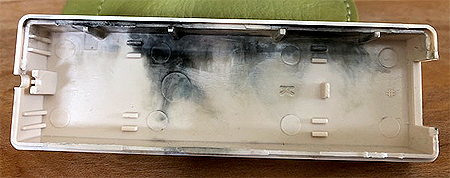
Storms are getting worse. Please protect every piece of equipment you have. And I mean every piece. It’s not the cost of replacing it all that’s a pain. It’s figuring out what’s busted and why. Takes hours and hours.

How nice, living in a beautiful house in the country, without a lighting rod. Did you know the Ernst Hemingway, while talking on the phone one night, once lit up like both St. Elmo and Wile E. Coyote in his Florida Key West house across the street from the lighthouse while his kids watched. Where’s your divining Lightening Rod grandpa? Don’t need to scare the kids twice and be picking yourself up from off the floor. But say hey, it’s in your dictionary right? I like the ones with the glass color bulbs.
Actually we have about ten lightning rods on the roof. But the main surge came up the phone and the electricity lines.
Now I understand. Your house is acting like the local grounding rod for your neighborhood. Good on you. You be doing great green. You save trees. You limit the chance of wildfires. Sure glad you don’t have a private tennis court and be waving an aluminum tennis racket. Sure would miss you posting here. Never know the purity.
(most people know lightening can travel two ways but you are the master gathering best of tech shock info into a simple blog.)
I was hoping you’d reply to Mark’s posted comments. You know the difference between Keynesian (badguys) and Austrian (goodguys) economics. By the way, what happened to Marks post on your site? Don’t tell us you’re now censoring comments. Kinda reminds me of our corporate/government policy. Truth can be a dangerous thing for ones health. Huh Harry?
I didn’t censor Mark. Promise.
huh?