We’ve gone ten years without a crash. Hence the pundits are predicting “It’s about time.”
It’s not. But they’re pundits and I’m not.
One pundit writes:
Rosy-looking stats conceal the same two related problems as 10 years ago: excessive
consumer debt (relative to income) and unaffordable housing.
The New York Times did a weekend piece “Lessons From 2008” which included:
In the mid-2000s, the nation experienced a housing bubble. A combination of stupidity, negligence and malfeasance led a bunch of Wall Street firms to make excessively risky bets that the bubble would go on forever. Through mortgage-backed securities and related instruments, they extended credit to home buyers of dubious credit quality. (They were called “sub-prime mortgages” and “liar loans.”)
For a while, this credit expansion fueled the bubble. But when the bubble burst, these new homeowners defaulted in record numbers, and the Wall Street firms headed toward insolvency. The whole financial system teetered on the edge of collapse, leading to a deep recession.
What also happened is that everyone and their uncle borrowed money to buy houses which they could quickly flip as prices rose. But then the steam ran out, the bubble burst — as it has done with housing bubbles through the years.
Too much debt is usually the trigger to a recession.
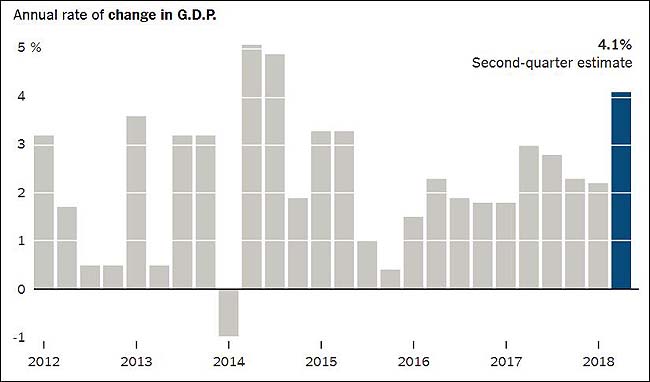
Today? The big debt is non-mortgage household debt — student loans and credit cards. It’s now 41% higher than the previous peak in 2008. Could high household debt bring down the economy? It’s hard to see it happening when the economy is performing so well and so broadly (as reflected in the low unemployment rate) and the GDP numbers:.
Let’s turn to the stockmarket which has been lopsided — i.e. tech stocks doing fantastic (until recently) and other stocks doing so-so. My favorite money manager Chris Radici, emailed me (with results to end June):
+ FAANG + Microsoft account for more cap weighting than the bottom 270+ stocks combined in the S&P 500
+ Apple alone accounts for more than the bottom 100+ stocks
+ Amazon, Netflix and Microsoft together this year are responsible for 71% of the S&P 500 returns and 78% of the NASDAQ 100 returns
+ These three stocks make up 35%, 21%, and 15% of the S&P 500 returns, respectively, while making up 41%, 21%, and 15% of the NASDAQ 100 returns
+ Apple also makes up a large portion of both indexes, contributing 12% of both S&P 500 and NASDAQ 100 returns, while Alphabet and Facebook contributing 8% to each
In summary, this is a very narrow market, driven almost entirely from a handful of stocks. The S&P 500 has again become concentrated in the FAANG stocks and technology sector.
To my brain, this is entirely justified since so few non-technology stocks are growing at the rate the FAANG and Microsoft are growing.
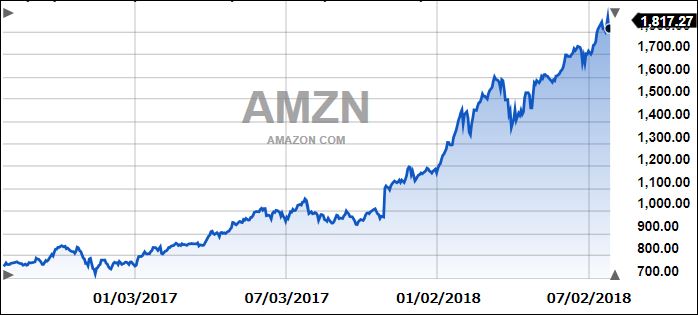
Amazon, my largest position, just reported 49% in its AWS cloud business in Q1 to $5.44B. Microsoft reported an 89% growth for its Azure cloud segment — though it’s starting from a lower base.
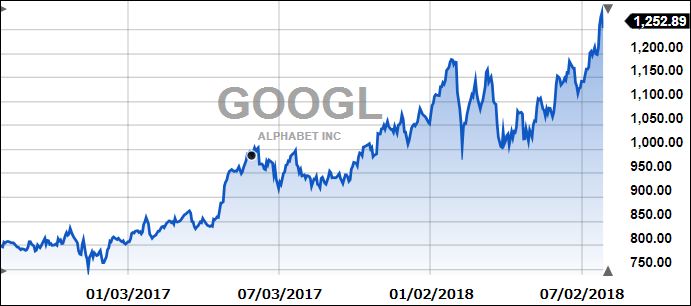
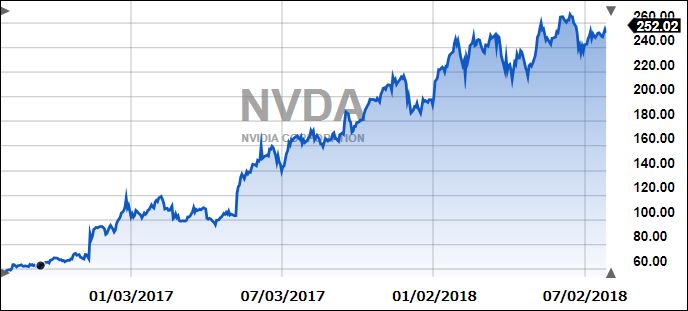
Let’s look at the last two years (to Friday). The growth has been nothing short of amazing.
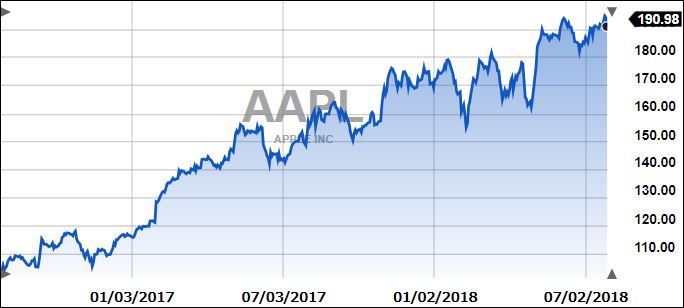
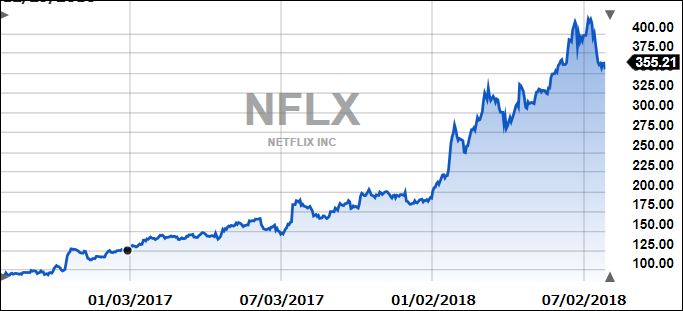
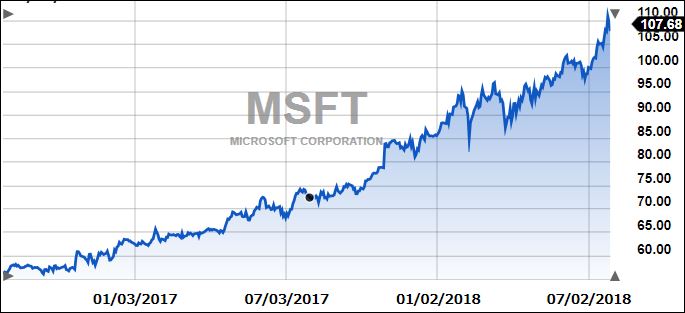
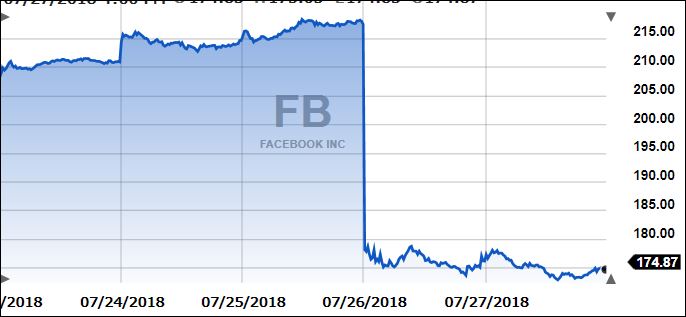
Facebook took a big 20% hit last week, but it’s still growing and dominating:
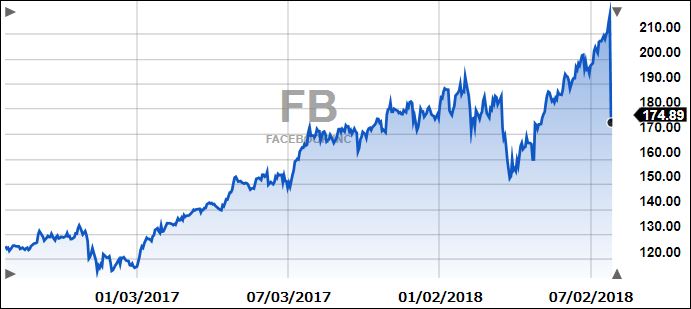
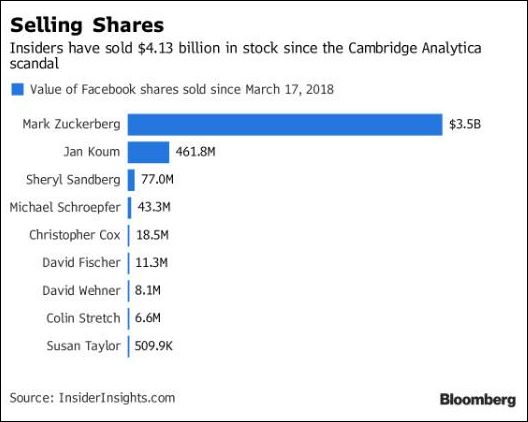
Facebook is under a cloud — what with government snooping, bad press, selling info to the Russians and all the stuff you read about, including:
This was Facebook for last week. There seems to be some sort of “floor.” I think it’s too early for dip-buying. I could be wrong. Right now I own 9.5 times more Amazon. That’s after Facebook’s dive.
Don’t forget one of my favorites, also doing well:
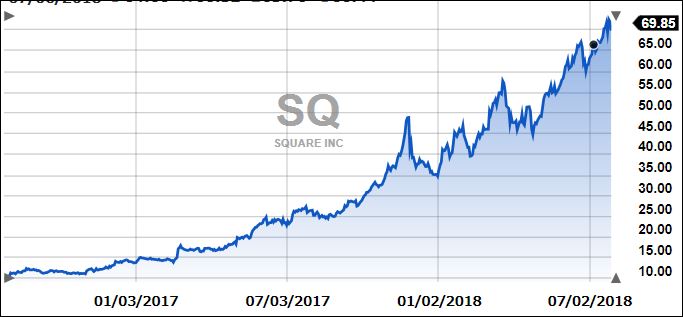
I don’t know how much further these favorite tech stocks will grow. But all of them have learned analysts predicting much higher stock prices. And they’re growing strongly. Much faster than companies selling toilet tissue, laundry detergent and soda.
All about tariffs
The latest Dines Letter has this really good explanation:
Trump has shaken the world’s economic order to its roots, lately with tariffs. For those who are not yet fully aware of their meaning, let’s start with what they are. Tariffs have been used since 1757, and derive from the Italian tariffa, meaning “price.” The Medieval Latin tarifa was defined as a “list of prices and rates.” Simply stated, the right to sell goods in another country is treated as a “thing” that could have a price. That price could vary widely, depending on the specific goods being sold, and is a crucial factor to those who wish to sell those goods in other countries. Take for example, a Jeep Wrangler that costs $40,530 in America, but sells in China for $70,000 because of taxes Beijing charges on imported cars. In comparison, a Tesla car typically costs one and a half times more in China, after adding 25% duty and a 17% value-added tax, which is more than the 73% markup for Jeep Wranglers.
Tariffs are higher than average for goods bought and sold between China and the US. China pays an average tariff of 3.54% when it sells goods in America, but if America wants to sell its goods in China the average tariff is around 10%. The disparity between those two rates means that one country is gaining more on average from the trade than the other.
China has also been encouraging local production and discouraging the import of foreign goods and services, stealing foreigners’ technological secrets, and building what it calls “national champions” (Alibaba, Tencent). As a result, the disparity between the goods China and America exchange was a mind-blowing $376 billion last year, which President Trump repeatedly growls is “unsustainable.” Indeed, the entire range of tariffs between America and the world is being upended by President Trump and the shocks are understandable, as some countries had been enjoying a foreign-exchange (“forex”) disparity for many years. China, for example, has used its huge forex holdings to buy large chunks of real estate and finance trade development worldwide, possibly disrupting the basis of the commercial world. Might President Trump reverse course? There’s an election in around 100 days, and we expect that everything he does will be with the intent of adding to his list of accomplishments, possibly even a reduction in nuclear weapons in an extension of an agreement about nuclear weapons between the world’s two largest owners of them: America and Russia. The impact of that might be seen as a lessening of war dangers. Furthermore, by election day tariffs should begin to revive some of the ghost towns in America’s midwest, and Trump could actually have labor on his side in this November’s elections.
Which brings us to more on China..
Joel Ross’ take on China. From his weekend’s Ross Rant
To understand the trade war with China, you need to understand that China at the moment is having a major slowdown economically. The stock market is down 25%. Many banks are being bailed out by the government. Everything and everyone in China is way over levered, and the economy is therefore in a high risk position which the government was trying to fix. The trade war got in the way, forcing the government to subsidize the smaller banks. China is loaning tens of billions to countries like Pakistan to build ports and railroads and infrastructure. Problem is, these countries have zero possible way to ever repay these loans. So now they are faced with stopping the projects or asking the IMF to bail them out. It is a mess for China and the countries who took the loans. There is starting to be pushback against China for this. So, Trump’s timing to go after China is exactly right. They are in a weakened position right now. Ignore all the hype about how they could sell their $1.4 trillion of US Treasuries -to who??? Not going to happen. The whole world agrees China violates every rule on trade and steals IP. Trump is just the only one who is willing to take them on with the rest of the world cheering him on from the sidelines. Now it appears the EU is willing to cooperate with Trump and revise the WTO and to push China on IP and other trade violations. Something they were never willing to do before.
Verizon’s bills
They’re high and creeping higher. However, if you have the patience — and that’s a huge IF — get your paper bill in front of you and call them on 1-800-837-4966. Eye your bill. There’ll be charges for things you don’t understand and things you don’t use.
Then pick the biggest monthly charges — those over $100 — and ask them if they have a newer, cheaper plan. Like one with more data. They will.
Spectrum is blitzing the countryside
Spectrum has arrived in Columbia County NY. Friends are signing up to cheaper, faster bundled — voice, TV and Internet — service. My local provider Consolidated Communications, is running scared and is talking fiber. I love competition.
Rules with Contractors
+ They know nothing about business. Like being reliable, doing what they agreed to, showing up on time and getting the job done when they said they would.
+ They can’t manage money. Period. Don’t give them money up front. They’ll use it to pay off the supplies on someone else’s job.
+ Don’t believe their references. That was last week. Or last year. Or last decade. References mean nothing.
+ You can tell how hopeless a contractor is by how few employees he has.
+ If he complains he’s “very busy,” run the other way.
+ If he talks to you about his recent divorce, his family, his children and what a good family man he is, run the other way even faster.
+ If you think I’m being too cynical, that’s your opinion. Not mine. I have evidence.
The room was full of pregnant women with their husbands.
The instructor said, “Ladies, remember that exercise is good for you. Walking is especially beneficial. It strengthens the pelvic muscles and will make delivery that much easier. Just pace yourself, make plenty of stops and try to stay on a soft surface like grass.”
“Gentlemen, remember — you’re in this together. It wouldn’t hurt you to go walking with her. In fact, that shared experience would be good for you both.”
The room suddenly became very quiet as the men absorbed this information.
After a few moments a man at the back of the room, slowly raised his hand.
“Yes?” said the Instructor.
“Would it be all right if she carries a golf bag while we walk?”
Brings a tear to your eye, doesn’t it? This level of sensitivity cannot be taught.

Harry Newton. I’m not big on government policy by Tweets, but this one does have a point — especially after you’ve read the China stuff above.
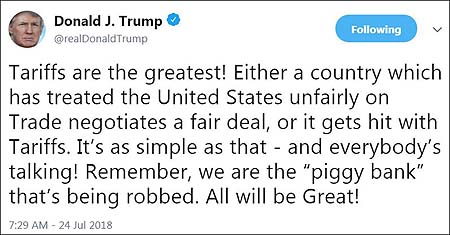
Can you imagine what our stockmarkets will do when China announces some concessions? And our president declares Victory.

Mr. Newton,
Just why would you think residential contractors would behave any better than stock market makers? To me it seems they have learned from the best. Do you go to Church with them or what?
No reason.
Hey Harry, I agree with Hugh, I also have T-mobile: their bill is all inclusive fixed rate. You also get Netflix for free, up to $16.00 membership. The only thing you may miss is a slightly better coverage with Verizon.
As for trade explanations, I yet to see a good “whole circle” explanation of the trades among the countries. I am skeptical trade escalation will help any side, I mean no side will be better off than before. I listen “Market Place” on our Public radio station: they have been interviewing small business owners who voted for Trump but hurting badly from tariffs, especially steel tariffs.
Cell phones charge what they deliver — like most products. This morning I played tennis with a fellow who desperately needed to call someone. He used AT&T. He had no service. I have Verizon. I had perfect service. It all depends on where you are and what you need. T-Mobile apparently has worse service than AT&T. So it wouldn’t work for me. However, if I only used WiFi Calling, it would work fine for me.
Doug Kass, the president of Seabreeze Partners Management Inc., had this to say today: Downside Risk Dwarfs Upside Reward. I base my expected market view on the probabilities associated with five separate (from pessimistic to optimistic) projected outcomes that seize on a forecast of economic and corporate profit growth, inflation, interest rates and valuation.
* Global Growth Is Less Synchronized . The trajectory of worldwide growth is becoming more ambiguous. I have chronicled extensively the erosion in soft and hard high-frequency data in the U.S., Europe, China and elsewhere, so I won’t clutter this missive with too many charts. But needless to say (and as shown by these charts here and here), with economic surprises moderating from a year ago and in the case of Europe falling to two-year lows, we are likely at “Peak Global Growth” now. (The data are even worse in South Korea, Taiwan, Indonesia and Thailand.)
* FAANG’s Dominance Represents an Ever-Present Risk. Last Monday I warned that earnings disappointments in the FANG stocks represents an immediate risk to this league-leading sector, and to the markets FANG has become GA!
* Market Structure Is One-Sided and Worrisome. Machines and algos rule the day; they, too, are momentum-based on the same side of the boat. The reality that “buyers live higher and sellers live lower” represents the potentially dangerous condition that investors face in a market dominated by passive investors.
* Higher Interest Rates Not Only Produce a More Attractive Risk-Free Rate of Return, They Also Make It Hard for the Private and Public Sectors to Service Debt
* Trade Tensions With China Are Intensifying and Mr. Market Is Improperly Looking Past Marginal Risks. From Goldman Sachs’ David Kostin (h/t Zero Hedge). Remember, as discussed within this column, the dispute has buoyed second-quarter U.S. GDP. The “benefit” soon will be over and a second-quarter economic cliff is possible.
* Any Semblance of Fiscal Responsibility Has Been Thrown Out the Window by Both Political Parties. This has very adverse ramifications (which shortly may be discounted in lower stock prices), especially as it relates to the servicing of debt — a subject I have written about often. Not only are our legislators acting irresponsibly and recklessly, but the Republican Party is now considering more permanent tax cuts. Should economic growth moderate, tax receipts diminish and undisciplined spending continue, stock valuations will likely continue to contract.
* Peak Buybacks. Buybacks continue apace, but look who’s selling. As Grandma Koufax used to say, “Dougie, that’s quite a racket!” If I am correct about the peaking in corporate profits, higher interest rates and slowing economic growth, we shortly will have another rate of change — negative in buybacks.
* China, Europe and the Emerging Market Economic Data All Signal a Slowdown. It’s in the early innings of such a slowdown based on any real-time analysis of the economic data. The rate-of-change slowdown on a trending basis is as clear as day. A rising U.S. dollar and weakening emerging-market economic growth sow the seeds of a possible U.S. dollar funding crisis.
* The Orange Swan Has Returned. Again, hastily crafted policy delivered by Twitter that conflates politics is dangerous in a flat and networked world. The return of an untethered Orange Swan is market-unfriendly… brace yourselves as the Supreme Tweeter will likely “Make Economic Uncertainty and Market Volatility Great Again” (#MUVGA)
* We Are Moving Closer to the November Elections, With Their Uncertainty of Outcome and the Potential For a “Blue Wave.” The current 40% approval rating for the president is historically a losing proposition for the incumbents. We also may be moving toward some conclusion of the Mueller investigation — is the Summer of 2018 the Summer of 1974?
Bottom Line
“Confronted with a challenge to distill the secret of sound investment into three words, we venture the motto, Margin of Safety.”
–Benjamin Graham
The search for value and comparing it to risk taken is, at its core, the marriage of a contrarian streak and a calculator.
While it is important to gauge the possibility that the market may be making an important top, it is even more important to distill, based on reasonable fundamental input, what the market’s reward vs. risk is. This calculus trumps everything else that I do in determining market value.
On that front, I continue to believe that downside risk dwarfs upside reward.
Moreover, there is a growing fundamental and technical list of signposts that may suggest that the market is starting to look like it is in the process of making a possible (and important) top.
Doug Kass is a perma-bear who’s been calling for the market to tank for years. If you’d listened to him in 2011 and taken all your $$ out of the market (maybe you did?) you’d have missed out on huge gains.
Harry dump Verizon. Like you I have an MBA from Harvard Business School yet was never smart enought to understand their outrageious bills. I switched to T Mobile which charges $50 per month (if yoo prepay each month) including U.S. Mexico and Canada (where I am now for a few months. Unlimited phone, text, data.
As I wrote above: Cell phones charge what they deliver — like most products. This morning I played tennis with a fellow who desperately needed to call someone. He used AT&T. He had no service. I have Verizon. I had perfect service. It all depends on where you are and what you need. T-Mobile apparently has worse service than AT&T. So it wouldn’t work for me. However, if I only used WiFi Calling, it would work fine for me. I do think T-Mobile is getting better, however.