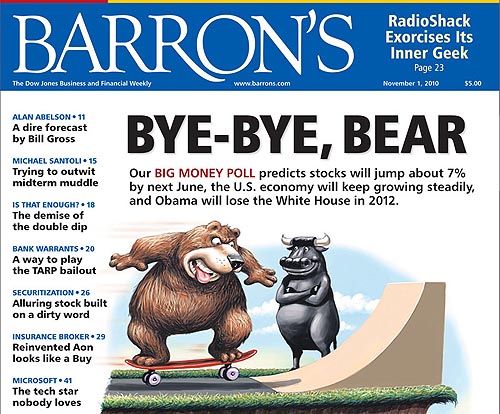
Tomorrow’s election will throw some rascals out and usher in strong stock gains, at least for the next year or so. That prediction has some basis in history. Apparently, there is optimism in the land. Or so Barron’s believes.
Barron’s weekend cover.
From the weekend’s Economist:
The mid-terms
Angry America
Barack Obama and the United States are both doing a little better than Americans seem to believe.
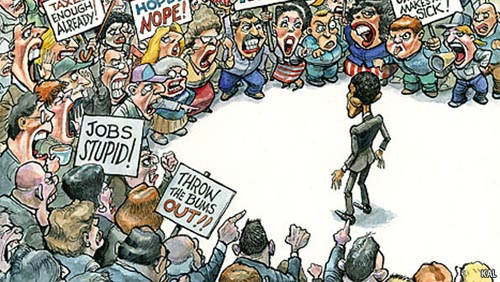
IT TAKES an effort these days to recall the thrill that surged through the world when Barack Obama was elected America’s president. It was not only that he was the first black person to assume the globe’s greatest office. He seemed to be preternaturally thoughtful, dignified and decent; a man who could heal America’s wounds at home and restore its reputation abroad. Though too many were swept away in a collective longing to see hope triumph over experience, none of it seemed wholly unreasonable at the time. Yes, many thought, he can.
Two years later, the magnitude of the let-down is palpable everywhere; and at home the president is caught in a vice. To many on the left, he is a cowardly compromiser, whose half-baked plans to get America back to work have done little to help those who voted for him, and whose health-care and financial reforms were gutted at the behest of special interests. To many on the right, he seems a doctrinaire spendthrift who has squandered trillions of dollars on wasteful bureaucracy, mortgaging the future while failing to grapple with the present. To centrists who backed him, including this newspaper, he has been a disappointment, his skills as a president falling far short of his genius as a campaigner.
It looks as though an angry America is about to exact its revenge, giving Mr Obama’s Democrats a painful kicking in the mid-terms on November 2nd. The likeliest outcome (see article) is that the Republicans will take back the House of Representatives and make solid gains in the Senate, where, though falling short of majority control, they will effortlessly be able to block any bill they wish. But, in our view, the rage directed at Mr Obama is overdone.
Consider the main reason why Americans are angry: the economy. The slow pace of job re-creation is primarily the result of consumers and companies trying to rebuild their finances. Balance-sheet recessions always take time to recover from. Mr Obama is guilty of promising that the pain would be over sooner than was ever likely. But he did not cause the bust, and he deserves more credit than he is getting for steering America clear of a much worse fate, especially considering the constraints of a political system designed to make big changes difficult. He was right to go for a big, bold and immediate stimulus plan. He has been right to resist, with minor exceptions, calls for a wave of protectionism. He is guilty of having no credible medium-term plan to reduce the deficit. But then nor do the Republicans; and it was they, after all, who oversaw the tax cuts, the entry into two wars and the financial collapse that are the source of most of America’s gigantic deficit.
In other policy areas, too, Mr Obama has got some big things right. He was correct to try to deal with a dreadful system that leaves tens of millions of Americans without access to health cover, though he should probably have postponed doing so until the economy had recovered. In foreign policy, he has made generally sensible decisions about Iraq and Afghanistan. Many of the people he has retained or put in place have done well, including his ex-rival, Hillary Clinton.
So what went wrong? The answer is a series of smaller things—rhetoric, details, execution, even an aloof vagueness—that have cumulatively undermined his presidency. He has made enemies of the businessmen who are needed to drive forward America’s recovery, haranguing them as fat cats and speculators. He has even, as we report here, forfeited the goodwill of America’s most dynamic and entrepreneurial asset. Silicon Valley, which once saw Mr Obama as a promising start-up, now sees him as a bad investment.
His decision to leave details to others has also cost him dearly. By choosing to subcontract the stimulus, health reform and finance reform to the Democratic leadership, he ended up with shoddy bills that Republicans could safely vote against and that many Democrats are now anxious to distance themselves from. A more accomplished president would have controlled that process better, and found ways to make the Republicans offers that they could not refuse. Mr Obama’s macroeconomic soundness has been undermined by the Democrats’ tendency to meddle with microeconomics, leading to a health bill that imposes onerous requirements on business and a stimulus bill larded with pro-union giveaways.
America is now an uncharacteristically uncertain place. Abroad it seems unsure of who its friends and enemies are. At home there are too many imponderables: over how the health bill will play out in practice; over what might happen to energy prices if carbon-pricing is resurrected via executive action; most of all, over what Mr Obama can do about those yawning deficits. People do not like uncertainty; so if Americans are angry, it is hardly surprising.
Mr Obama seems curiously unable to perceive, let alone respond to, the grievances of middle America, and has a dangerous habit of dismissing tea-partiers and others who disagree with him as deluded, evil or just bitter. The silver tongue that charmed America during the campaign has been replaced by a tin ear. Some blame this on an emotional detachment his difficult upbringing forced on him, others on the fact that he has lived all his life among tribal Democrats. Whatever the reason, he does not seem to feel America’s pain, and looks unable either to capitalise on his administration’s achievements or to project an optimistic vision for the future.
Which ought not to be so hard. Despite its problems, America has far more going for it than its current mood suggests. It is still the most innovative economy on earth, the place where the world’s greatest universities meet the world’s deepest pockets. Its demography is favourable, with a high birth rate and limitless space into which to expand. It has a flexible and hard-working labour force. Its ultra-low bond yields are a sign that the world’s investors still think it a good long-term bet. The most enterprising individuals on earth still clamour to come to America. And it still has a talented president who can surely do better than he has thus far.
So where does Obama stand? The New York Times interviewed presidential historian, Professor Garry Mills. I found Mills comments enlightening:
As a presidential historian and emeritus professor at Northwestern, you’re well aware that the Democrats are facing the likelihood of an electoral setback this Tuesday. Yet President Obama continues to be the object of scathing criticism among Democrats, including yourself. Why won’t you give him credit for getting things done?
He gets things done in a very crippled way. The health care plan and the finance plan – he made so many bargains along the way.
You’ve accused him of excessive ingratiation, or “omnidirectional placation,” as you wrote in a blog post for The New York Review of Books.
As a black man with an odd name, he often had to ingratiate himself in the companies that he kept, and he does. Beyond that, I think he may have a principle of trying to compromise, but that has proved to be a big mistake.
You were invited to the White House for an off-the-record dinner during Obama’s first year in office, along with some other presidential historians. Can you tell us what advice you gave him?
I said, “Don’t go into Afghanistan.”
We were already there, so I assume you’re referring to the deployment of additional troops. How did he respond?
He was very prickly. He said: “I’m not a naïve optimist. I know of the difficulties. They’re all being considered and taken care of.” He really cut off this conversation.
That’s surprising, especially since you describe him as a placater.
He’s kept a pretty tight little circle around him. By the way, that meeting with us was supposed to be the first of many. There have been none after.
And now for the great tax Tsuami. Courtesy InvestmentNews:
Tax tsunami on the way
Americans are facing a wave of increases if Congress doesn’t act soon
If you want to believe that the lame-duck Congress will come to the rescue after Election Day and renew the Bush-era tax cuts, return the estate tax to its more palatable 2009 levels and increase the exemptions from the alternative-minimum tax, go ahead.
The rest of us will get ready for the worst — a tsunami of tax increases that will make most Americans miserable.
Recent history is on our side.
Consider the estate tax. Congress had nine years to figure out what a new estate tax should look like. Instead, it let the estate tax lapse for 2010, something no one expected and few thought made sense — except those wealthy families such as the Steinbrenners, whose tax bill was reduced substantially when their patriarch passed away this year.
Attorney Joshua S. Rubenstein, national chairman of trusts and estates at Katten Muchin Rosenman LLP, said it was an “incredible irresponsibility” on the part of Congress to let the estate tax expire at the end of 2009.
“Nobody expected that Congress would never touch the law, and it’s staggering to see what the elimination of the estate tax has done to the economy,” said Mr. Rubenstein. “At least five billionaires have died this year in the U.S. The revenues Congress lost from their estates — billions and billions of dollars — are just huge!”
Other billionaires besides George Steinbrenner who passed away include Mary Janet Cargill ($1.7 billion), Dan Duncan ($9 billion), Walter Shorenstein ($1.1 billion), and John Kluge ($6.5 billion.) At the top 45% rate in place last year for estates exceeding $3.5 million, those five families alone would have paid $8.7 billion in estate taxes this year if Congress had not allowed the tax to expire.
With so little time left before the year ends, tax professionals agree it is unlikely Congress will enact any retroactive legislation. Attempting to recoup some of those lost billions in estate taxes, for example, would only generate legal challenges by heirs who can afford the litigation.
By doing nothing, Congress will let the estate tax revert to pre-2001 levels, with a top rate of 55% and a $1 million exemption.
Congressional inaction will also affect income tax rates, which would return to where they were before the Economic Growth and Tax Relief Reconciliation Act of 2001 — 15%, 28%, 31%, 36%, and 39.6%.
However, the president may prevail in his proposal to retain the current lower bracket rates of 10%, 15%, 25% and 28% but allow the two top rates of 33% and 35% to go back up to 36% and 39.6%.
There is also the possibility that the Republicans will score victories in the midterm elections this week and successfully extend the Bush-era tax rates for everyone.
Let’s assume that at the very least, upper-income Americans — defined as individuals with adjusted gross income of $200,000 or more and couples making $250,000 or more — get socked with higher taxes. What would the effect on those taxpayers be?
Mark Luscombe, principal analyst for CCH Inc., a global provider of tax and accounting information to professionals specializing in the field, provided InvestmentNews with this illustration:
Assume a married couple with no children, who file a joint return and take the standard deduction. They have $300,000 in wage income, $50,000 in net capital gains and $5,000 in dividend income (for this illustration, no inflation adjustments were made for 2011 from 2010 bracket amounts). Their tax liability will go up $12,929, to $91,789, from $78,860, if the Bush-era tax cuts expire. If Mr. Obama’s proposal is adopted, the couple will see their tax liability rise $5,151 to $84,011.
Another result of the expiration of the Bush-era tax cuts would be a revival of the so-called marriage penalty. Under the 2001 tax bill, the standard deduction for a married couple filing a joint return gradually increased to twice that of an unmarried single filer. If the law is allowed to expire, the $11,400 deduction applicable in 2010 will drop to somewhere between $9,500 and $10,000 in 2011.
Unless Congress takes action before year-end, alternative-minimum-tax exemptions will expire, returning qualifying amounts back to 2001 levels. This has been the first year since 2005 that Congress has failed to enact a patch adjusting these figures, meaning that exemption amounts for 2010 and 2011 will fall to $33,750, from $46,700 for unmarried single filers, and to $45,000, from $70,950, for married couples filing a joint return.
“It would be a political disaster not to increase even slightly the exemption from the AMT,” said Julian Block, an attorney who conducts continuing-education courses for financial planners and the author of several books on taxes.
Should nothing be done, he estimates that 30 million individuals would become subject to the AMT.
“That’s not going to happen,” he said. “We’ll see a one-year patch, but there won’t be a substantial overhaul. Changing the AMT [by a significant amount] would exponentially increase the deficit.”
In terms of the percentage change, the largest tax hike is the rate on dividends, which — along with capital gains — have been taxed at 15% since the Jobs and Growth Tax Relief Reconciliation Act of 2003. A return to pre-Bush tax cut rules means that dividends will be taxed as ordinary income, with rates as high as 39.6% — close to a 250% increase. While the same fate awaits short-term capital gains — rates are currently capped at 35% — rates on long-term capital gains are expected to climb only to 20%.
But even that small increase could affect estate taxes, which this year — to offset losses from the 2010 suspension — underwent a change from step-up to carry-over basis. While it would take new legislation to retain the carryover rule to 2011 and beyond, an extension would hit heirs of large estates hard, while burdening executors.
Mr. Rubenstein explains: “Carry-over basis will be very hard to figure out and be subject to income tax. It will be even harder to track then, because income tax returns are audited more rarely than estate tax returns.”
Neither Congress nor President Barack Obama has addressed the basis question.
Gail Cohen, vice chairman and general trust counsel at Fiduciary Trust Company International, said: “We could end up with no estate tax in 2010 and a return to step-up in 2011, which many people think might be too good to be true.”
It’s that kind of anomaly that concerns certified financial planner Eric Seff of Seff Investments LLC, a fee-based firm that manages up to $30 million in assets.
He has been trying to identify the worst-case scenario for his clients. “Assuming the cuts are all repealed or repealed for those with incomes above a certain level, it’s not a happy situation. And if the taxes on dividends and capital gains go up, it won’t be happy for anyone,” he said.
“On the other hand,” he said, “if you look at the finances of the federal government, we need the money.”
Goldman Sachs put out an excellent presentation on the upcoming tax changes…Goldman highlights how the BIG tax increase will fall on dividends. Here’s Goldman’s sumary:
In 2011, barring new legislation, the marginal tax rates for taxpayers in the top tax bracket ($373,651 and above) will likely increase.
—Ordinary income rate goes from 35% to 39.6% (a 13.1% increase)
—Long-term capital gains rate goes from 15% to 20% (a 33.3% increase)
—Qualified dividends rate goes from 15% to 39.6% (a 164% increase).
•The tax rule reducing a taxpayer’s itemized deductions by a specified percentage of the amount by which adjusted gross income (AGI) exceeds a threshold does not apply in 2010 but returns in 2011. The limitation occurs on Schedule A, Form 1040.
—In 2011, the reduction will equal the lesser of (i) 3% of that excess income or (ii) 80% of the itemized deductions (such as charitable contributions) subject to this rule.
—For a taxpayer with $5 million of AGI in 2011, deductions will be reduced by about $144,700.
—This rule is often referred to as a ―stealth tax‖ because reducing deductions by 3% of the excess AGI potentially increases the 2011 marginal tax rate thereon from 39.6% to 40.8%.
•The health care reform law enacted this year includes a new 3.8% surtax on investment income (including long-term capital gains) for individuals with AGI in excess of $200,000 and married couples with AGI in excess of $250,000. This surtax begins in 2013.
—Surtax increases top marginal rate on investment income other than long-term capital gains (and possibly qualified dividends) to 43.4%.
—Surtax increases top long-term capital gains rate to 23.8%.
We have identified 10 areas that you may wish to review with your own tax and legal advisors in order that you might prepare for these potential changes:
1) Accelerating the Sale of a Business Interest
2) Realizing Capital Gains from Investment Transactions on an Accelerated Basis at Current Tax Rates
3) Accelerating Exercise of Nonqualified Stock Options
4) Realizing Capital Losses from Investment Transactions on a Deferred Basis
5) Charitable Gift Timing
6) Making Investments with Reduced Tax Costs
7) Converting a Traditional IRA to a Roth IRA
8) Managing the Alternative Minimum Tax (AMT)
9) Managing State Taxes
10) Foreign Investments
Goldman’s presentation is worth reading and showing your accountant. Click here.
Curing cancer. I apologize for quoting other people’s stuff this morning. But the stuff is good. There is a long piece by Siddhartha Mukherjee, an assistant professor of medicine in the division of medical oncology at Columbia University. This article in the weekend’s New York Times Magazine, is adapted from his book “Emperor of All Maladies: A Biography of Cancer,” which will be published by Scribner next month. I found these few paragraphs especially engrossing:
The Cancer Sleeper Cell
The hope to cure cancer rests on finding the right kind of drug. But what if we have to first find the right kind of cell?
When 19th-century pathologists trained their lenses at tumors, they found not black bile in overabundance but cells in excess — sheet upon sheet of them that had divided with near-hyperactive frenzy, distorting normal anatomy, breaking boundaries and invading other tissues. The crucial abnormality of cancer was unbridled cellular proliferation, cell growth without control.
We now have a vastly enriched understanding of how this runaway growth begins. Cancer results from alterations to cellular genes. In normal cells, powerful genetic signals regulate cell division with exquisite control. Some genes activate cellular proliferation, behaving like minuscule accelerators of growth. Others inactivate growth, acting like molecular brakes. Genes tell a limb to grow out of an embryo, for example, and then instruct the limb to stop growing. A cut prompts the skin to heal itself, but heaps of skin do not continue to grow in excess. In a cancer cell, in contrast, the accelerators of growth are jammed permanently on, the brakes permanently off. The result is a cell that does not know how to stop growing.
Uncontrolled cell division imbues cancer cells not just with the capacity to grow but also with a crucial property that often accompanies growth: the capacity to evolve. Cancer is not merely a glum cellular copying machine, begetting clone after clone. Every generation of cancer cells produces cells that in turn bear additional mutations, changes beyond those already present in the accelerator and brake genes. And when a selective pressure like chemotherapy is applied to a cancer, resistant mutants escape that pressure. Just as antibiotics can give rise to resistant strains of bacteria, anticancer drugs can produce resistant cancer cells.
This process — evolution’s slippery hand driving cancer’s adaptation and survival — provided biologists with an explanation for cancer’s recurrence after treatment. Relapse occurs because cancer cells that are genetically resistant to a drug outgrow all the nonresistant cells. Chemotherapy unleashes a ruthless Darwinian battle in every tumor. A relapsed cancer is the ultimate survivor of that battle, the direct descendant of the fittest cell.
Crowding in Heaven.
It got crowded in heaven so, for one day and one day only, it was decided to only accept people who had really bad day on the day they died.
St. Peter was standing at the pearly gates and said to the first man, “Tell me about the day you died.” The man said, “Oh, it was awful. I was sure my wife was having an affair, so I came home early to catch her with him. I searched all over the apartment but couldn’t find him anywhere. So I went out onto the balcony, we live on the 25th floor, and found this man hanging over the edge by his fingertips. I went inside, got a hammer, and started hitting his hands. He fell, but landed in some bushes. So, I got the refrigerator and pushed it over the balcony and it crushed him. The strain of the act gave me a heart attack, from which I died.”
St. Peter couldn’t deny that this was a pretty bad day, and since it was a crime of passion, he let the man in. He then asked the next man in line about the day he died. “Well, sir, it was awful,” said the second man. “I was doing aerobics on the balcony of my 26th floor apartment when I twisted my ankle and slipped over the edge. I managed to grab the balcony of the apartment below, but some maniac came out and started pounding on my fingers with a hammer. Luckily I landed in some bushes. But, then the guy dropped a refrigerator on me!”
St. Peter chuckled, let him into heaven and decided he could really start to enjoy this job. “Tell me about the day you died?” he said to the third man in line.
“OK, picture this; I’m naked, hiding inside a refrigerator….”

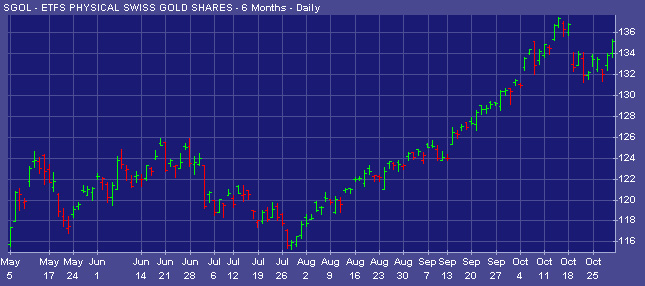
Harry Newton who continues to like gold in today’s confusing times. I especially like the little pullback. Gold is not exactly “on sale.” But it’s a little cheaper than what it was a few weeks ago.

The mid-term elections promise only continuing political gridlock domestically. The Dems have already lost their super majority, and even if by some miracle they should hang on to both houses after mid-term elections, they will still be unable to pass any meaningful domestic legislation. Their only hope for the 2012 congressional elections lays in continuing improvement in the feeble economic recovery.
The economy has been showing a few faint rays of hope. A slide back into recession would mean ‘Game Over’.
The Republicans, even if they have a huge victory and win back both houses, will not have a veto proof majority. The GOP will be unable to reverse any of the major legislation passed during the Obama Administration, or pass anything of its own without negotiating with Obama. Do you think he will cooperate with the GOP after being bashed for the past two years?
On Nov 3, the 2012 Presidential campaign begins.
Gridlock is good! I want the government out of my life. I do not want Congress passing yet more intrusive laws. Let liberty rule! Live free or die.
The “live free or die” point of view – the motto of the State of New Hampshire – is oftentimes steeped in hypocrisy. This is clearly illustrated by the past history of state of New Hampshire itself. In 1971, the New Hampshire state legislature mandated that the phrase appear on all non-commercial license plates (replacing “Scenic”), effectively making it compulsory. Then, when one of its citizens (George Maynard, a Jehovah's Witness) covered up “or die” from his plate, the State hauled him into court. He was convicted of breaking a state law against altering license plates.
The matter went to the U.S. Supreme Court, which ruled 6–3 in Maynard's favor. In ruling that the state’s interests paled in comparison to individuals’ free-expression rights, the Court majority stated as follows: “We begin with the proposition that the right of freedom of thought protected by the First Amendment against state action includes both the right to speak freely and the right to refrain from speaking at all.”
Many of today's “libertarians” and “states rightists” are screaming about President Obama taking away their freedoms and rights and guns and SUVs and indoctrinating their kids and sending the government into their lives. However, when George W. Bush enacted the Patriot Act, which severely impacted personal freedoms and civil liberties, as well as allowed direct government surveillance and intervention into all American lives (not just supposed terrorist…of the thousands of times it has been used, only in 3 cases was it against suspected terrorist), Libertarians and States Rightists were silent.
When the war in Iraq was pursued with phony intelligence and cockeyed rationalizations (Iraq = Al Qaeda), the libertarians and the states rightists supported Bush, and were silent when anyone who questioned the justification of the Iraq fiasco was tarred with “not supporting the troops” – or worse. Under Bush, the Dept. of Justice was politicized, and attorneys lost their jobs because of lack of political purity – but these actions were met by yawns from the libertarian crowd.
Yet now, with a different party in the White House (together with a President with a funny name and a different color), the libertarians and states rightists are up in arms over “wanting their country back.”
Libertarian hypocrisy is perhaps best epitomized by that libertarian poster child, soon-to-be-Kentucky-senator Rand Paul. As Time magazine has noted: “Paul has lately said he would not leave abortion to the states, he doesn't believe in legalizing drugs like marijuana and cocaine, he'd support federal drug laws, he'd vote to support Kentucky's coal interests and he'd be tough on national security. “ Paul is willing to bend the issue of pure personal freedom for drug laws, abortion, and even coal subsidies … on the other hand, he thinks telling a restaurant it cannot discriminate is an affront to personal freedom.
Whose???
All too often, the “live free or die” attitude is held by those who are all for freedom – so long as it is by their definition and on their terms – and they are likely to jam those terms down your throat, if that's what it takes.
It is VERY difficult to know where to draw these lines. BUT we have to try!