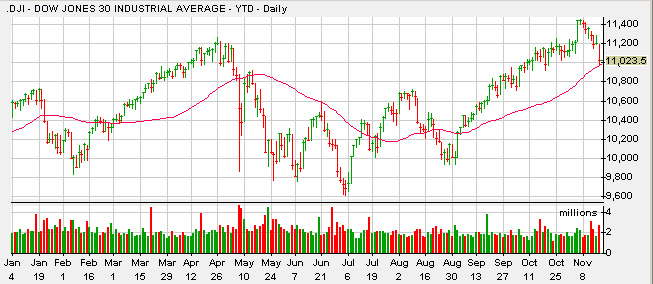
I’d paid ultra-close attention. I’d built my “gains” to $76,000 in the last several months. I was a genius. Then all of a sudden, within a few days, my gains started evaporating. By yesterday I was down to $30,000. Look at the nice runup in the Dow from end-August and the ugly rundown since the beginning of November.
I’ve sold stuff in the last week. Stuff that “wasn’t working.” Criteria I used (I’m still finehoning this).
1. Inviolate trailing stop loss. Now down to 4%.
2. Gut feel. The news media has been negative lately. Much discussion about European disasters. China, etc. You can “feel” things getting ugly.
3. Things changed. Suddenly muni bonds got hit with bad publicity — most of which they didn’t deserve. But they got hit and my muni bonds funds (stupid me) got really hit.
4. Market technicals. Notice my 200-day moving average line on the chart above. If you favorite stock drops below it, sell.
5. Too fast a runup. Gold rose quickly. I should have taken some of my profits off the table. But it’s hard when things go nicely to anticipate when they’ll go badly. You don’t think they’ll turn on a dime. They did.
Being in cash is a strategy. It allows you to jump in the next time an “August” appears.
My faith in “Wall Street” — coming back? Remember how I bitched yesterday about my private equity fund, oriiginally from Citigroup and now being managed by StepStone? It turns out there are many StepStones. Dan Good, intelligent reader, sent me their address. I called and actually got to speak to two live, polite, helpful StepStone people. As to my fund:
1. My statement shows it’s down 26%. But their next statement will show an improvement.
2. StepStone has more people managing my fund than Citigroup did.
3. StepStone people believe I will ultimately get my money back and then some.
But it will be a long-haul. My fund did its investing in 2006-2008. Those were the days when leverage was king. And high P/Es, like housing prices, were never going down.
The human brain is by nature optimistic. As the stockmarket zoomed from August through October this year, we thought our troubles were over. We thought we’d put the disasters of 2005-2007 behind us. No way. It’ll take years and years to overcome the problems caused by the excessive debt — in everything from sub-prime mortgages to leveraged buyouts in private equity funds, from commercial real estate to countries like Ireland, Spain, Portugal and Greece with too much sovereign debt.
That’s why The New Normal is all about de-leveraging. I figure it it will take ten years. Along the way, there’ll be a lot of pain.
Meantime, The New Investing will be be super-hard. The best investment going forward is to buy Distress and turn it around yourself. See the interview below.
Yet another reason to buy Apple (AAPL).
The iPad stands alone, lacking real competition
I predicted that Linux-based tablets would quickly give the iPad a run for its money. I was wrong.
by Steven J. Vaughan-Nichols
Where is the iPad’s competition?
By this time, I’d expected to see some real comers gunning for Apple’s iPad tablet. Hasn’t happened.
You want to talk about HP’s just-released Slate 500? It has a starting list price of $799. An iPad can cost that much, but the price starts at $499, and people have demonstrated that they’re willing to pay that much and more. Are people going to feel the same way about the Slate 500? Highly doubtful.
The Slate has an 8.9-in. screen, compared to iPad’s 9.7 in., and it runs Windows 7. Now, tell me, how many Windows 7 apps are there for a pure touch-screen tablet? … And get this: For your 800 bucks, you get a Wi-Fi-only device. Makes you wonder whether HP’s goal is to see whether it can ship a product that can die even faster than Microsoft’s Kin did.
Some people would tell you that since Windows is under the hood, the Slate is going to get snapped up by business users who wouldn’t touch an Apple product. Really? Thousands of people are already buying iPads for business use.
It’s not just HP, though. HP just stands out for having the dumbest iPad-rival launch to date. Anyone paying attention knows that iPads are selling faster than hotcakes on a cold Vermont morning. So, where are the iPad’s rivals?
The first problem was that everyone underestimated just how popular the iPad would be. There was a sense it was going to be big, but who knew that almost 7.5 million iPads would be sold in the device’s first two quarters of existence? Suddenly, tablets went from being a niche market for companies like Fujitsu to being big, big business.
The result? Almost no one had their manufacturing ducks in a row. Even now you can see OEMs struggling with basic design issues. Will tablets with 7-in. displays sell? Maybe. Maybe not.
When it first became apparent that the iPad was going to turn the tablet PC from a niche product into a best-seller, I predicted that Linux-based tablets would quickly give the iPad a run for its money. I was wrong. I still think it will happen, just not as soon as I thought.
Linux-powered tablets like the Dell Streak, which is due to get upgraded to Android 2.2, are finally making their way into the marketplace, but there won’t be a flood of them out by the holidays.
It turns out that while Android 2.0 and 2.2 make killer smartphone operating systems, they’re not quite ready for tablets. The problem that many would-be Android tablet builders, such as Archos, Toshiba and ViewSonic, have encountered is that the current generations of Android don’t do such a great job with a tablet’s larger interface.
The other Linux contenders, such as MeeGo — the embedded Linux with the best chance to rival Android — won’t be rolling out until 2011. The Google Chrome operating system, due out real soon now, is well, still due out real soon now.
I predicted that Linux-based tablets would quickly give the iPad a run for its money. I was wrong.
Windows 7? Oh, I guess it could be a competitor, but historically Microsoft has always flopped with mobile phones and other embedded devices. The folks in Redmond have also done a lousy job of competing head-to-head with Apple in this arena. I can make my point with one word: Zune.
So, for the time being, or at least through the 2010 holiday season, the iPad rules. Sometime in 2011, we’ll start seeing real competition, but not this year. I still think that the Android Linux models will be the first to give the iPad a real race. Unlike the other possible contenders, the Android Linux community already has a large group of application programmers ready and able to develop tablet apps, just as Apple does. But for now, it’s still an iPad world.
A really neat interview with an obviously talented, intelligent man.
Secrets Of The Self-Made 2010
Ten Questions For Gerald J. Ford, 66. Net worth: $1.4 billion
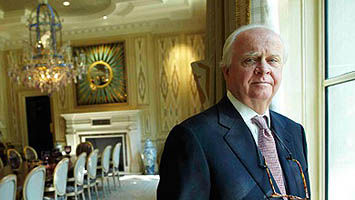
Farm-boy-turned-thrift-trader Ford bought his first bank for $1.2 million in 1975 and later sold it for $80 million. He turned around California’s struggling Golden State Bancorp and, with fellow billionaire Ron Perelman, sold it to Citigroup in 2002 for $6 billion in stock. Here he shares his entrepreneurial secrets.
1) What personality trait was the key to your success?
Persistence.
2) What financial advice do you have for someone who is newly rich?
Things change.
3) How do you choose a money manager or investment advisor?
Don’t use one.
4) Talk about the most offbeat advice you followed.
I went to Bolivia for two months when I was 27, on the advice of a friend.
5) What do you think are the biggest obstacles to job creation in America?
Politics.
6) Who is your hero, and why?
My mother and father.
7) What are the unforeseen downsides to success?
Responsibility for others.
8) What books should every entrepreneur read?
The Great Gatsby by F. Scott Fitzgerald
The Financier by Theodore Dreiser
The Bonfire of the Vanities by Tom Wolfe
Too Big to Fail by Andrew Ross Sorkin
The Big Short by Michael Lewis
9) You have $100,000–where do you put it?
In a bank account.
10) Name one experience every entrepreneur-to-be must have.
Failure.
Isn’t this wonderful? The big thing I learned in business was that you are your own worst enemy. No competition could wreck your business as fast as you yourself can wreck it.
DisplayLink makes super software that helps your PC or Mac run multiple external monitors (like you see all those traders on Wall Street with). If you ask DisplayLink’s Support a question, this is the insane response you get:
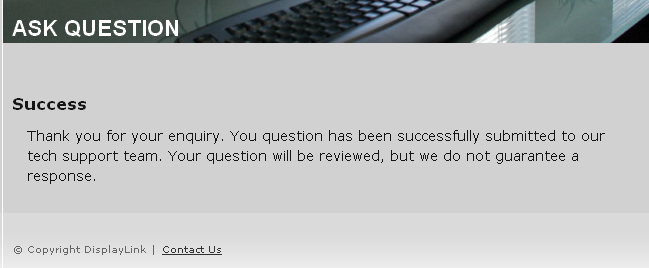
I asked them a question yesterday. I haven’t received a response, yet.
An 86-year-old man went to his doctor for his quarterly check-up...
The doctor asked him how he was feeling, and the 86-year-old said , ‘Things are great and I’ve never felt better.’
I now have a 20 year-old bride who is pregnant with my child. ‘So what do you think about that Doc ?’
The doctor considered his question for a minute and then began to tell a story.
‘I have an older friend, much like you, who is an avid hunter and never misses a season.’
One day he was setting off to go hunting.
In a bit of a hurry, he accidentally picked up his walking cane instead of his gun.’
‘As he neared a lake, he came across a very large male beaver sitting at the water’s edge.
He realized he’d left his gun at home and so he couldn’t shoot the magnificent creature.
Out of habit he raised his cane, aimed it at the animal as if it were his favorite hunting rifle and went ‘bang, bang’. ‘Miraculously, two shots rang out and the beaver fell over dead..
Now, what do you think of that?’ asked the doctor.
The 86-year-old said, ‘Logic would strongly suggest that somebody else pumped a couple of rounds into that beaver.’
The doctor replied, ‘My point exactly.’

Harry Newton who returns this morning to his dentist for more painful work. Last week’s adventure still hurts. I’m now more than obsessed with dental hygiene. My “researches” into dental cleaning techniques and gadgetry show that dentists do a totally miserable job teaching us mere humans how to take care of our teeth. But then why should I expect otherwise? Our doctors do an equally miserable job teaching us how to stay well. Both dentists and doctors make a living fixing us when we’re sick. Why should I expect them to cut their income, also called cutting off their nose to spite themselves. I’ll return to dental hygiene shortly. Get excited.

What a great resource!
I really thought my previous comments related to your dental concerns were aimed at the preventive aspect of oral care. Speaking for myself, my practice is busy DESPITE the emphasis and time spent on patient education, not due to any definciency of instruction. The reason for this, and for the “annuity” situation you descibed previously, is simple: lack of compliance. Just as you lament that the principals of the many start-ups that approach you for advice/money just don't listen and therefore are doomed to fail, so it is with dental hygiene. As I told you previously, my profession has tried harder than most to work itself out of a job, and as such I resent the implication that it's not in our interest to properly educate our patients. Anthony Onofreo, DMD
I had a dentist fill 5 cavities that didn't exist. I made the mistake of thinking that medical professionals were just that “professionals”. Check Check Check(thanks Harry)! I do not believe that this is standard operating procedure for many dentists, but i'm sure that that dentist didn't have my best interests in mind. Anthony, maybe you know, is there anyone I can complain to? any recourse at all? ADA? I feel pretty helpless/stupid about the situation. THX
Joe, I am very sorry to hear of your experience. You may contact your state's dental association to find out how to file a complaint, but perhaps you should seek a second opinion first?
thanks, already did(second opinion that is).
THE COMING WARS…
Alan Phan, Paris, 11 November 2010
After years of pressuring China to increase the Yuan value, the US government gave up the effort and devalued its dollar instead. The $600 billion QE2 of money printing was just the first step; others to follow. Many currency traders expect the USD will lose at least 12% of its value by June 2011. However, we should not expect China and other export economies to sit quietly. Counter measures or outright retaliations are coming and the start of a series of trade wars and currency skirmishes are not too far off.
Obama has little choice. He is trying to copy the successful business model of China, Japan and Germany by making the US companies more competitive in the global market. He hopes American exports will cure some of the unemployment problem; he thinks the devalued currency will bring the deficit down and reduce the debt load of the USA. It might be feasible if he operates in a vacuum of a lab test; but in reality, there are actions and reactions, and the complication of internal politics and economics in each country ensures that nobody could predict the outcome.
One thing is certain: with the continuous de-leveraging of major economies, including China, the go-go days of global free trade and WTO agreements are over. Countries, big or small, powerful or weak, will start defending their turf and throw all sorts of defensive mechanism to frustrate competitors. Disputes, lawsuits, unofficial barriers, currency manipulation will be the new normal. Free trade is not dead, but it will take a few steps back. Only actual shooting wars or major technology break-through will prevent or alter this coming challenge.
The new reality will not help the US or Europe to reclaim their crown of economic superpowers. The inherent weakness in their societal structure is too big to resolve (mature development of economy, consumer-oriented demands, government spending, entitlement and welfare programs…). However, the result of the coming wars will also slow down the BRICs, especially China and will cause them to turn inward for alternatives.
Meanwhile, there are huge sums of money accumulated during the boom time looking for a decent return. Which direction would they head to? Gold and precious metals will benefit, given the tradition of being used as a hedge in uncertain times. Bargain prices of real estate in stable, developed countries with positive cash flow could be a good bet. While stock and bond returns will be mediocre, there are always gems in those companies with promising technology and marketing savvy. Commodities and agriculture products are expected to be stable: demand is slower but the growth of world income and population will continue. Emerging market equities could be attractive in short term, but the ride will end with the burst of the bubble.
In short, there won’t be any seismic change across the landscape. However, economies will take a time-out to adjust and invent. This process might take from 5 years to 10 years. Meanwhile, with the slow- down in the growth rate and global changes, people will have more time for themselves, for each other, for little finer things that require patience and devotion. After the party and the orgy, we will all need the solitude and introspection of a quiet Sunday morning to enjoy the sunshine and the smell of a good cup of coffee; or maybe the laughter of a child and the singing of a bird. Is life wonderful?
Dr. Alan Phan is Chairman of Viasa Fund since 2001. He worked for many multi-nationals before founding his own firm in 1990. His latest book, Hedge Funds and China’s Stock Market, was translated into 3 languages. Dr. Phan received his Doctor of Business Administration from Southern Cross University (Australia), his MBA from American Intercontinental (USA) and his BS from Pennsylvania State University (USA).His Email address is aphan@asiamail.com.