First Greece bailout, now Ireland. Who next ? Italy, Portugal? When does it end and what kind of precedent is it setting for the future (mainly our states)?
That’s the big imponderable.
On other other hand, we are entering the usual sweet spot for equity investing. Thanksgiving through New Years is historically a very strong market time.
Leading hot stocks (NFLX, CRM, AAPL, BIDU, etc.) still look and are acting great.
My guru writes, “Until they roll over, this market will hold up and probably go higher. Overvalued (some may be so, or not on the fundamentals), the leaders lead and until they stop, the market remains in a strong uptrend.
I’m hanging in, but watching like a hawk and keeping my stops tight.
Coal stocks have interest — PCX, ICO and BTU. Gold and silver are down, but not out. They could easily pop from here.
Toxie’s dead.
In January of 2010, four reporters spent $1,000 and bought a small piece of the financial crisis. Listeners ultimately dubbed that asset “Toxie.” The story of what happened ended up being called “Toxie’s Dead.” The brilliant video — you must watch it — is a Planet Money production — a collaboration of This American Life and NPR News.
To watch the video, click here.
Then thank my daughter Claire for finding the video. She’s even more brilliant. That’s an objective statement from an ultra-proud father.
Ireland accepted a bailout to fix its financial mess. Writing about ithe affect on the Irish, the New York Times reported:
The wildest urban legends are readily believed. There is said to be a two-month backlog at the abattoirs, as families abandon the expensive pets, including Thoroughbred racehorses, that they bought in the fat years and now can no longer afford to feed. One hears stories of the return of bartering: a yacht swapped for a mobile phone, a Harley-Davidson exchanged for a bicycle. There are moments of giddiness and breathless panic when it feels as it must have in the last days of the Weimar Republic.
The joys of rebooting. Everything can be fixed by turning it off, unplugging it, counting to 20 and plugging it back in. This works for everything electronic today, including computers, cell phones, cable TV set top boxes, cable and DSL modems.
Banking in the modern era. Read the big type. It says FREE CHECKING. Now read the service fees. I got charged an inactive account fee of 6.53% of what was in my inactive account.
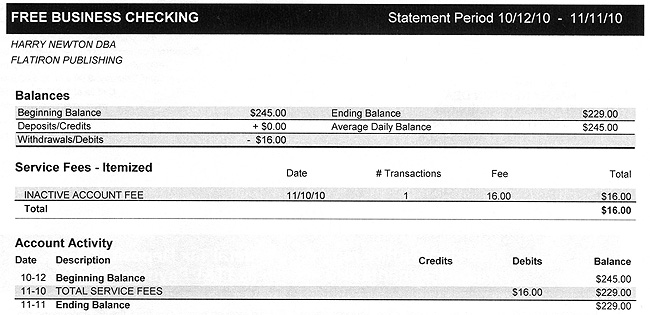
The bank removed the charge when I called. They suggested that I write a check once a month to get some “activity.”
The wonderful Kingston solid state drive kit. There are faster solid state drives, but none are cheaper than Kingston and none come in what Kingston calls a “notebook upgrade kit.”
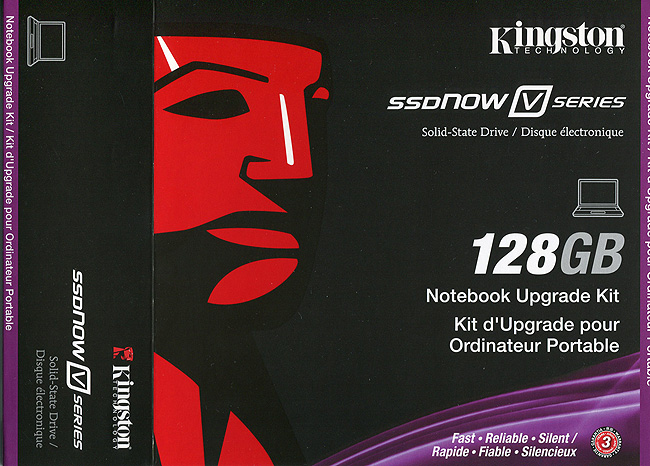
In the kit, you get a 128 gig SSD (solid state drive), you get a metal case to put the drive in, a USB cable and most importantly, a CD containing the latest version of the Acronis disk cloning software, which alone is worth $50.
Go overseas. It takes a special skill to invest successfully abroad. The BIG problem is exchange rate risk — very hard to predict. Finally, after many years, my Australian investments are nicely above water. This piece from today’s New York Times explains all:
Buy American? Upscale Investors Look Abroad
Well-heeled American investors have been doing something lately that they resisted for decades — becoming more like their European, Asian and Latin American counterparts and substantially diversifying their portfolios outside their home country.
There are two reasons for this. The financial crisis and the slow recovery showed them that the United States was not immune to devastating crashes of the kind that wealthy people in emerging markets have tried to hedge against by investing abroad. And second, American investors are worried that their portfolios are going to suffer for the foreseeable future, given the size of the United States’ budget deficit, the weakness of the dollar and the uncertainty over the stock market.
“I’ve never seen a period in which clients have expressed such an interest in nondollar investments,” said Kent Lucken, managing director at Citi Private Bank. “People are spreading their chips around more prudently and I think more wisely.”
What is different is how directly these investors are going into non-American markets. They are not content with buying international equities or going into an international bond fund. They are looking to invest directly in Chinese private equity, Indian real estate, Brazilian equities denominated in reals and Australian government bonds. They are also opening cash accounts in multiple currencies.
“International clients understand the need to diversify currencies, but this is something new to U.S. clients,” said David Frame, global head of alternative investment at J. P. Morgan Private Bank.
The people putting as much as 40 percent of their portfolios into nondollar investments are quite wealthy. But consider it this way: What can investors of more modest means learn from what the wealthiest people in the country — with the best research and advice at their disposal — are doing with large portions of their fortunes?
UPSIDE Investors who lived through the 1990s will remember the crises in Asia, Mexico and Russia that shook global capital markets. Investing internationally has always carried risks and it is by no means without perils today.
But many investors see a different trade-off, one based as much on a stagnant or declining United States as on certain international markets that are growing, if not booming.
“When you make an investment in nondollar currencies, you’re making two investments at once,” said Tony Roth, head of investment strategies at UBS Wealth Management. “You’re betting the dollar will go down, but you’re also buying another investment. You need to be compensated for that source of risk.”
He cited the example of buying a one-year Australian government bond, yielding 5.25 percent. He said he believed that the American dollar was going to lose value and the Australian dollar was going to gain it. That’s Part 1. Part 2 is that the Australian government is stable, so an investor can count on receiving that 5 percent annual return. The alternative is less than half of a percent if invested in United States Treasuries.
“I’m going to receive a return,” he said, “that more than compensates me for the marginal risk I’m taking.”
But there are far more risky investments. And the ones that are less liquid — infrastructure in China, say, or a private equity fund in Brazil — carry more uncertainty. But like their equivalents in the United States, they provide a higher return, in theory.
Mr. Frame said clients were investing in Asian infrastructure and Asian private equity by pooling their money with other investors. “There is a lot going on when a country is growing and developing that is hard to address through the public markets,” he said.
While there’s an obvious “pull” to international investments, there is also a bit of a “push” out of the United States: investors who are making their portfolios more international are doing so because they believe that the role of the United States in the global economy is shrinking.
Mr. Roth said the United States contributed 40 percent of global gross domestic product 15 years ago and now contributed 21 percent. He predicted that that figure would fall to 12 percent in another 15 years. Going along with this is the shrinking market capitalization of American stocks compared with global stocks.
“We have the U.S. experiencing flat to 2 percent G.D.P. growth, but you have Brazil, India and China with substantially higher rates,” Mr. Lucken said. “Equity investors are investing abroad to capture higher returns and invest ahead of higher growth rates.”
DOWNSIDE The biggest risk is uncertainty, followed by a lack of knowledge. No one knows exactly what is going to happen, and there are always investors who rush in too quickly without fully understanding the risks.
Those risks run the gamut from income inequality that could create unrest, to legal systems that have not been tested by foreign investors, to managers abroad without established track records.
There is also the unforeseen. “I witnessed firsthand the collapse of the Soviet Union,” said Mr. Lucken, a former foreign service officer. “That speaks to the unique political risks in smaller developing countries.”
Also, South Korea and Brazil, which are now darlings of investors, were shaken by crises in the 1990s. “The history of success has been relatively short — the past 10, 12 years,” said Christopher J. Wolfe, chief investment officer for the private banking and investment group at Merrill Lynch.
But Mr. Wolfe said clients were investing across all asset classes when they invested internationally and that gave them greater diversification. It is also a big change from the time when “it used to be U.S. stocks and non-U.S. stocks,” he said.
Like all big changes, there are going to be fits and starts. But after what investors lived through over the last three years at home, some are willing to chance it.
The rabbi takes confession.
A priest was called away for an emergency. Not wanting to leave the confessional unattended, he called his rabbi friend from across the street and asked him to cover for him. The rabbi told him he wouldn’t know what to say, but the priest told him to come on over and he’d stay with him for a little bit and show him what to do. The rabbi comes and he and the priest are in the confessional.

A few minutes later, a woman comes in and says, “Father forgive me for I have sinned.” The priest asks “What did you do?” The woman says, “I committed adultery.”
Priest: “How many times?”
Woman: “Three times.”
Priest: “Say two Hail Marys, put five dollars in the box and go and sin no more.” A few minutes later a man enters the confessional. He says, “Father forgive me for I have sinned.”
Priest: “What did you do?”
Man: “I committed adultery.”
Priest:”How many times?”
Man: “Three times.”
Priest: “Say two Hail Marys, put five dollars in the box and go and sin no more.”
The rabbi tells the priest that he thinks he’s got it so the priest leaves.
A few minutes later another woman enters and says, “Father forgive me for I have sinned.”
Rabbi:”What did you do?”
Woman: “I committed adultery.”
Rabbi: “How many times?”
Woman: “Once.”
Rabbi: “Go do it two more times. We have a special this week, three for five dollars.”
Drunk and speeding.
An elderly man speeding is stopped by the police around 1 a.m. and is asked where he is going in a hurry at this time of night.
The man replies,
“I am going to a lecture about alcohol abuse and the horrible effects it has on the human body”.
The officer then asks, “Really? Who is giving that lecture at this time of night?”
The man replies, “My wife.”

Harry Newton who wonders why we worry about TSA pat-downs, “don’t ask, don’t tell” and other irrelevancies when we face massive budget deficits, state insolvencies, and heavy unemployment.

Brilliant solution.
Hey Harry, send me a check for the $245 to close the account and that will end your worry about future months 🙂
Brilliant solution.
I was on the fence about airport security, thinking it was necessary but annoying. I saw this clip today showing the TSA stripping the shirt off a little boy, and I wondered what I would do if it was my 15 month old daughter. Really, take a look and tell me it's not time to adopt the Israeli method of pre-screening and profiling.
Unless they are not telling us (which I don't think the PR people could avoid) the TSA has yet to catch a single terrorist.
Security is essential, but even growing up through the real troubles caused by the IRA in England, we relied on vigilance and the security services. Never did we get subjected to the hassle the TSA inflict upon us. 33,000 odd people a year are killed on the roads, but we'd never put up with road blocks and random police stops.
Harry, I agree that there are serious matters to be considered, but I think this is a bit more than “damn, they took my toothpaste” Irrelevant it isn't.