Make a list of your favorite and ultra-sturdy stocks — let’s say 3M, Caterpillar, IBM, Apple, Google, Chevron, Coca Cola, Exxon Mobil, Johnson & Johnson, McDonalds, Verizon. Next put in BUY orders at 25%, 50%, and 75% of today’s prices. Make the orders good till canceled, i.e. good forever.
Remember the Flash Crash of May 6, 2010? I’m convinced it will happen again.
If your orders are in NOW, you might actually fluke a cheap buy the next time a flash crash happens and make yourself some instant money. I’m guessing the exchanges won’t void all the trades, just like they didn’t do last time.
First some background. the bulk of today’s daily trading on ALL stock exchanges is done by high frequency trading houses. These places have four “assets.” They’re headed by a successful stock trader. Second, they have a bunch of quants. These are maths and physics Ph.Ds who can program computers with trading algorithms they and their traders figure out. And they have powerful computers and ultra-high speed communications lines. They locate their computers and lines as close as possible to the center of the trading action — e.g. a big exchange.
Te name of the game in this business is to gain knowledge a milli-second sooner than anyone else. With that knowledge your computers can trade and make a fraction of a penny on the trade. For example, your computer finds one exchange is selling IBM at a penny higher than another. Quickly grab some cheap IBM and quickly sell it on the expensive exchange. That trading strategy is called “latency arbitrage.” Another strategy might to be watch the order books. For example, let’s say I place an order to buy 10,000 IBM. Their computers see my order, check the sell orders around the world (there are few). So it quickly buys IBM, figuring that my order, when it’s executed, will drive the price up a penny or so. That’s a form of front-running, which is illegal. But it’s not illegal, I guess, if your computers and communications links are faster than mine.
There are millions of other strategies. That’s why you have the quants and the traders. Their job is to identify trading strategies as they change. And change they do.. Their main strategy is to be completely out of the markets by the end of day.
The business of being a high frequency trading house is immensely profitable. That’s why all the major investment banks have internal high frequency trading shops. The one at Goldman Sachs is one of the biggest. It is not uncommon for these houses to go for months without a single losing day. I repeat: They make money every single day. That is a lot better than you and I.
All this explains why there has apparently been an explosion of high frequency trading houses. Heck, it’s a lot cheaper and faster to open one of these houses than to build a new steel plant or a car making factory. And you don’t have to worry about consumers’ and their fickle changing tastes.
You’d think what these guys do would be illegal. Heck, buying in front of my IBM order is called — in some circles — front running. That’s illegal. But doing what the high frequency trading houses do is called “creating liquidity.” And curiously, that’s precisely what many exchanges want for their customers. There’s about 16 exchanges to trade IBM in the U.S. They’re all in competition with each other. Many will actually reward these high frequency trading houses with real cash money for providing that liquidity. So, for example, a high frequency trading house can buy IBM for $144.55 and sell it for $144.55 and actually make a profit. I don’t exactly know how this works. But I’m jealous.
The problem with high fequency trading houses is that we know so little about them. You and I can see the volumes and transactions on the public exchanges. But there are also non-public exchanges, called variously “dark pools” by the industry. These may be larger than the public exchanges.
The problem (and the opportunity) in all this is that computers are doing all the trading. And computers screw up. Look what happened to me this morning, when this column blew up.
There will be another Flash-Crash. The computers belonging to the high frequency trading houses will simply stop. They won’t know what to do. They will be faced with a situation they were trained to deal with. They will freeze and stock prices will plummet. It won’t be long — perhaps a few minutes — just long enough for the humans to jump in and start buying or reboot their computers. But for those few minutes, there will be genuine bargains.
Yes, but Harry, won’t the exchanges reverse some of the trades in the flash crash?
Maybe yes, maybe no.
I love Nicholas Taleb. His latest book (which I haven’t read, but plan to) is called.
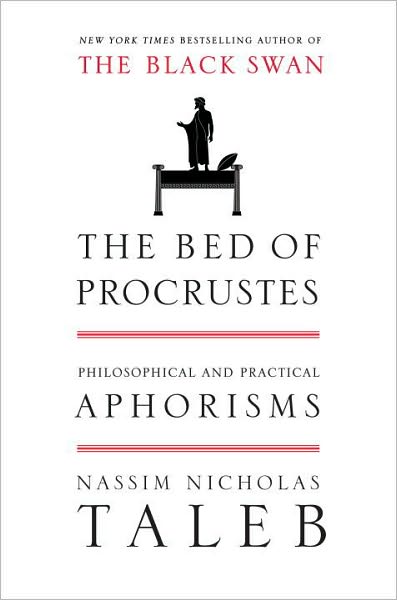
Procrustes was an Italian “tailor” who would solve your “too large” problems by amputating one of your limbs, or solve your “too small” problems by stretching your body. He addressed the right problem with the wrong solution. Once I played consultant and boy is Taleb right. Think of how the government has handled our economy recently — by saving the people (e.g. the bankers) that caused the problem. And forcing suffering on the poor people who didn’t cause it, like the retirees trying to survive on their savings, which are diminishing thanks to low interest rates and high inflation. (Yes, we have it. Just the government doesn’t measure it.) I ordered his book today.
A young Arab asks his father:
What is this weird hat that we are wearing ?
It’s a “chechia” because in the desert it protects our heads from the sun.
And what is this type of clothing that we are wearing?
It’s a “djbellah” because in the desert it is very hot and it protects your body.
And what are these ugly shoes that we have on our feet.
These are “babouches”, which keep us from burning our feet when in the desert.
Tell me, papa…
Yes, my son ?
We live in Canada. Why are we still wearing all this stuff?

Harry Newton who is looking forward to the weekend. Get some exercise and kiss the family.

Harry, if you can put in a buy order good til cancelled on some stocks at 25 or 75% of current prices, the flash traders have done this a zillion times over, how could you possibly front run them?
Vincent
I don't know. But the good news of my “strategy” is that it can't lose. Maybe it can't win also. But there's always a little chance. Better odds than most places.
If a latency arb algo sees a sequence of abnormal buys in a stock, expects more buys to come and decided to buy, that is not front running because you don't know whether there will be more buys or not. One the other hand, if I have an order in hand to execute for a customer and buy before or in tandem with it, then it is front running. The first is a statistical inference, the second is treating your customer badly. You have to know how your broker gets paid that's for sure!. You might discuss rebate trading – that's one way you can buy and sell at the same price and get paid for providing liquidity.
This high frequency trading stuff is fascinating. I doubt that a single guy, like me, can game it or play it. I think one of the key things I didn't mention is what happens to your trailing stop losses in a flash crash. You could then be really hurt. You have to be on top of this 24/7. Complex stuff. I keep thinking this new world is stacked against us little guys.
I believe that knowledge of your stops can be used by traders because they tend to drive prices when activated. Also, I think stops are layered by people at even price levels – clustered. Also, they tend to be activated when the price gets near through randomness. You don't always want them to be activated in this case. When I started working in this area, a trader once told me that anything other than a limit order is for amateurs 🙂
I tend to think you're right. Better play your stops manually. But put some cheap buy orders. When the next Flash Crash comes, many of the high frequency trading houses will have pulled out for those few minutes. Maybe you'll get lucky.
Harry, as I recall, Procrustes came from Greek mythology. The gentleman measured hapless passersby against a bed and either stretched them or lopped off appendages to fit. Pretty sure this came from the set of myths featuring Theseus.
I know there are variations of these, but Italian tailor?? that seems a stretch. 😉
You're right. Hence the picture of the bed on the cover. As I said, I haven't read the book. But I do like the “logic.”