There are endless opportunities to start a new business.
New businesses are the most likely way you’ll make a small fortune (other than starting with a large one).
The Internet, the unemployeds, cheap rent and low prices for just about everything have made it much easier and cheaper to start your own new business.
You will find opportunities “in your own backyard.” Search your job, and your life for opportunities.
The Tarzan Theory of Opportunity Finding has worked for me. Swing from one vine to the next.
There are plenty of vines out there.
There are three BIG advantages in working for yourself:
1. You’re in charge. Control is a wonderful. Not having a boss who always says NO is a a BIG plus.
2. You get a salary, which you figure. It’s called profits.
3. When you sell the company, they give you eight to 12 times last year’s profits. That’s a double whammy, which you don’t get as a salary man.
Please make 2011 the year you established something new.
Investors are finally piling into equities. Well maybe not piling. Note the inflow in the week to December 21. Interestingly ten times as much money flowed into funds investing overseas than domestically. It’s the first time since the Flash Crash in May.
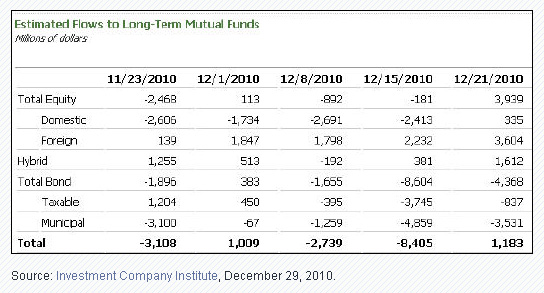
The comments I read on the InvestmentPostcards site are:
As usual with retail investors, it would seem that the change in strategy comes rather late in the cycle, with Treasury yields having bottomed in December 2008 and U.S. equities in March 2009. But the thinking is perhaps rather late than never, especially as the economy is growing again and the equity bull market, in the assessment of the masses, has not even been running for a full two years, whereas all 10 bull markets of the past 60 years made it into a third year (via MarketWatch). Additionally, there could be the hope that the third year of the presidential cycle will again be positive for stock markets.
There’s a clip on Bloomberg TV about this. Click here.
How the media favors gloom and doom.This came from the December 27 New York Times.
Economic Optimism? Yes, I’ll Take That Bet
By JOHN TIERNEY
Five years ago, Matthew R. Simmons and I bet $5,000. It was a wager about the future of energy supplies — a Malthusian pessimist versus a Cornucopian optimist — and now the day of reckoning is nigh: Jan. 1, 2011.
The bet was occasioned by a cover article in August 2005 in The New York Times Magazine titled “The Breaking Point.” It featured predictions of soaring oil prices from Mr. Simmons, who was a member of the Council on Foreign Relations, the head of a Houston investment bank specializing in the energy industry, and the author of “Twilight in the Desert: The Coming Saudi Oil Shock and the World Economy.”
What a wonderful waste resources. According to CNBC, China in 2010 closed down 60,000
I called Mr. Simmons to discuss a bet. To his credit — and unlike some other Malthusians — he was eager to back his predictions with cash. He expected the price of oil, then about $65 a barrel, to more than triple in the next five years, even after adjusting for inflation. He offered to bet $5,000 that the average price of oil over the course of 2010 would be at least $200 a barrel in 2005 dollars.
I took him up on it, not because I knew much about Saudi oil production or the other “peak oil” arguments that global production was headed downward. I was just following a rule learned from a mentor and a friend, the economist Julian L. Simon.
As the leader of the Cornucopians, the optimists who believed there would always be abundant supplies of energy and other resources, Julian figured that betting was the best way to make his argument. Optimism, he found, didn’t make for cover stories and front-page headlines.
No matter how many cheery long-term statistics he produced, he couldn’t get as much attention as the gloomy Malthusians like Paul Ehrlich, the best-selling ecologist. Their forecasts of energy crises and resource shortages seemed not only newsier but also more intuitively correct. In a finite world with a growing population, wasn’t it logical to expect resources to become scarcer and more expensive?
As an alternative to arguing, Julian offered to bet that the price of any natural resource chosen by a Malthusian wouldn’t rise in the future. Dr. Ehrlich accepted and formed a consortium with two colleagues at Berkeley, John P. Holdren and John Harte, who were supposed to be experts in natural resources. In 1980, they picked five metals and bet that the prices would rise during the next 10 years.
By 1990, the prices were lower, and the Malthusians paid up, although they didn’t seem to suffer any professional consequences. Dr. Ehrlich and Dr. Holdren both won MacArthur “genius awards” (Julian never did). Dr. Holdren went on to lead the American Association for the Advancement of Science, and today he serves as President Obama’s science adviser.
Julian, who died in 1998, never managed to persuade Dr. Ehrlich or Dr. Holdren or other prominent doomsayers to take his bets again.
When I found a new bettor in 2005, the first person I told was Julian’s widow, Rita Simon, a public affairs professor at American University. She was so happy to see Julian’s tradition continue that she wanted to share the bet with me, so we each ended up each putting $2,500 against Mr. Simmons’s $5,000.
Just as Mr. Simmons predicted, oil prices did soar well beyond $65. With the global economy booming in the summer of 2008, the price of a barrel of oil reached $145. American foreign-policy experts called for policies to secure access to this increasingly scarce resource; environmentalists advocated crash programs to reduce dependence on fossil fuels; companies producing power from wind and other alternative energies rushed to expand capacity.
When the global recession hit in the fall of 2008, the price plummeted below $50, but at the end of that year Mr. Simmons was quoted in The Baltimore Sun sounding confident. When Jay Hancock, a Sun financial columnist, asked if he was having any second thoughts about the wager, Mr. Simmons replied: “God, no. We bet on the average price in 2010. That’s an eternity from now.”
The past year the price has rebounded, but the average for 2010 has been just under $80, which is the equivalent of about $71 in 2005 dollars — a little higher than the $65 at the time of our bet, but far below the $200 threshold set by Mr. Simmons.
What lesson do we draw from this? I’d hoped to let Mr. Simmons give his view, but I’m very sorry to report that he died in August, at the age of 67. The colleagues handling his affairs reviewed the numbers last week and declared that Mr. Simmons’s $5,000 should be awarded to me and to Rita Simon on Jan. 1, but Mr. Simmons still had his defenders.
One of his friends and fellow peak-oil theorists, Steve Andrews, said that while Mr. Simmons had made “a bet too far,” he was still correct in foreseeing more expensive oil. “The era of cheap oil has ended,” Mr. Andrews said, and predicted problems ahead as production levels off.
It’s true that the real price of oil is slightly higher now than it was in 2005, and it’s always possible that oil prices will spike again in the future. But the overall energy situation today looks a lot like a Cornucopian feast, as my colleagues Matt Wald and Cliff Krauss have recently reported. Giant new oil fields have been discovered off the coasts of Africa and Brazil. The new oil sands projects in Canada now supply more oil to the United States than Saudi Arabia does. Oil production in the United States increased last year, and the Department of Energy projects further increases over the next two decades.
The really good news is the discovery of vast quantities of natural gas. It’s now selling for less than half of what it was five years ago. There’s so much available that the Energy Department is predicting low prices for gas and electricity for the next quarter-century. Lobbyists for wind farms, once again, have been telling Washington that the “sustainable energy” industry can’t sustain itself without further subsidies.
As gas replaces dirtier fossil fuels, the rise in greenhouse gas emissions will be tempered, according to the Department of Energy. It projects that no new coal power plants will be built, and that the level of carbon dioxide emissions in the United States will remain below the rate of 2005 for the next 15 years even if no new restrictions are imposed.
Maybe something unexpected will change these happy trends, but for now I’d say that Julian Simon’s advice remains as good as ever. You can always make news with doomsday predictions, but you can usually make money betting against them.
Neat book recommendations. Readers responded to yesterday’s column. Books they like:
“More Money Than God: Hedge Funds and the Making of a New Elite” by Sebastian Mallaby
“Fault Lines : How Hidden Fractures Still Threaten the World Economy” by Raghuram Rajan
“More Mortgage Meltdown” by Whitney Tilson. Really 2 books, one on the crisis, one a look at a hedge fund’s strategies.
“Unconventional Success” by David Swensen. Yale endowment guy demolishes mutual funds, makes a sensible case for asset allocations, which 5 years on can easily be done with ETFs.
“F Wall Street” by Joe Ponzio. Value investing 101. Especially recommended to Harry as the antidote to his current love affair with momentum “investing,” aka the greater fool approach.
“The Paleo Solution” and “The 4-Hour Body”. Change your life in 2011..
“Crisis Economics” by Roubini and Mihm
The Obvious: All You Need To Know In Business. Period. by James Dale Hyperion Press
What a wonderful waste of money and resources. According to CNBC, China in 2010 closed down 60,000 porn web sites in 2010.’
Endless airline nightmares. Yesterday I wrote, “My friend’s Singapore Airlines flight, scheduled for 9:00 PM on Tuesday finally left New York this morning at 7:00 AM — 34 hours late. He had to wait. There was nothing else.” I was wrong. It actually took off at 10:45 AM — 37 3/4 hours late. Across the Atlantic, it lost an engine and emergency landed in Frankfurt, where they put him up in a hotel. Next morning at 9:00 AM the airline tells its passengers that the plane is busted and not flying. All passengers will go on the next Singapore Airlines flight to Singapore. On that plane, there are only 5 open seats for 165 people. The rest will presumably pound sand in Frankfurt, or get drunk — at their own expense. Singapore Airlines is reputed to be one of the world’s best airlines.
Here in New York and the north-east, it’s above freezing. The snow is melting.
Everything should be back to normal (whatever that is) in a week or so.
The best New Year’s Story.
Moskowitz had bought a parrot and one morning found the bird at the eastern side of the cage, with a small prayer shawl over its head, rocking to and fro, and mumbling. Bending low to listen, Moskowitz was thunderstruck to discover the parrot was intoning prayers in the finest Hebrew.
“You’re Jewish?” asked Moskowitz.
“Not only Jewish,” said the parrot, “but Orthodox. So will you take me to the synagogue on Rosh Hashonah?”
Rosh Hashonah, the Jewish New Year, was indeed only 2 days away, and it would as always usher in the high-holiday season which would end with Yom Kippur, the Day of Atonement, ten days later. Moskowitz said “Of course I’ll take you, but can I tell my friends about you? This isn’t a secret is it?”
“No secret at all. Tell anyone you want to.” And the parrot returned to his praying.
Moskowitz went to all his friends to tell them about his Jewish parrot. Of course no one believed him, and in no time at all Moskowitz was taking bets. By Rosh Hashonah he had $1,000 in bets riding on the parrot.
Grinning, Moskowitz brought the parrot to the synagog in its cage. He put him in a prominent place and everyone turned to watch the parrot do his prayers. Even the rabbi watched, as he had $7 that said the parrot would not pray.
Moskowitz waited. Everyone waited. The parrot did not pray.
Moskowitz put the prayer shawl over the parrot’s head, but the bird ducked and shawl fell off. After the services all of Moskowitz’s friends laughed, and collected their money.
Utterly humiliated, Moskowitz returned home, turned viciously on the bird, screaming, “Prepare to die you little monster, for I’m going to wring your neck! If you can pray, now’s the time!”
The parrot’s voice rang out clear, “Hold it, you idiot. In 10 days it’s Yom Kippur, when all the Jews will sing the tragic, haunting Kol Nidre. Why don’t you bet everyone that I can sing Kol Nidre.”
“Why? You didn’t do anything today!”
“Exactly,” replied the bird. “So for Yom Kippur, just think of the odds you’ll get!”
The best New Year’s Resolution
A couple is lying in bed. The man says, “I am going to make you the happiest woman in the world.”
The woman replies, “I’ll miss you…”

Harry Newton who asked a bunch of his friends for their New Year’s Resolutions. They all included:
+ Losing weight.
+ Giving up sugar.
+ Getting exercise.
+ Being nice to the family.
BORING. But mine, too. Do something fun this evening.

bigger penis
penis enlargement pills
vimax
penis enlargement
Vimax EWEXR72011, Vimax EWE00Tai90 7567676, vimax, 5345454, penis enlargement, 0843098 penis enlargement pills, -04947365 bigger penis, 098267 penis enlargement pills work or not? 893397, penis enlargement, 873139 download youtube videos, 897926 penis enlargement pills, 90077092
Can you go into more detail about how to search for opportunities? In other words, how does a person come up with business ideas; how did you go about it?
Thanks
I agree with all of your comments regarding starting a business,with the exception of item #3. “When you sell the company, they give you eight to 12 times last year’s profits.” This is simply inaccurate and grossly misleading for folks who maybe uninformed and looking to you for guidance. Business valuation is very complex, and industry and company specific. Multiples vary widely depending, on the specifics of the business you are selling. To state that a seller can anticipate a 8 to 12 times multiple of profits on ALL business sales is wrong. It would have been more accurate to state that a seller may anticipate a reasonable multiple of business profits.
On the news recently, ex head of Shell ( I think it was Shell ) is forecasting that gas prices will
cost $5.00 /gal in US within a few years. Would you make your $5,000 bet with him?
Thank you Harry for another year of your fantastic insight!
Looking forward to more in 2011!
Book to read recommendation and new year resolution to make.
The FairTax Book by Neal Boorzt and John Linder
The resolution: learn about and join the effort to pass the tax reform offered in the FairTax bill, HR 25, 133 pages of tax code to replace over 67,000 pages of tax code to raise the same dollar amount. Take power from politicians that use the tax code to reward and punish, divide and conquer and hide and disguise new taxes. Stop punishing good behavior with taxes on income, profits, investment, savings and jobs…and rewarding bad behavior with tax deductions for more debt. The FairTax will bring jobs and over 12 trillion of offshore capital to our economy with no stimulus cost…just a change in our tax code. There is a tipping point that will over come the resistance of politicians and lobbyists and enable them to do what is best for our country. Visit http://www.fairtax.org to learn more and add your name (your vote) for the FairTax. And a more prosperous New Year to you and your family.
Sorry I just read yesterdays column. Monsanto is a classic Cockroach stock. Most profits derive from Roundup(glyphosate) and Roundup ready seeds. After a decade of using it farmers are finding glyphosate resistant weeds. As a response farmers dump extra glyphosate on their fields and Monsanto is adding another herbicides to the mix. Monsanto also has lots of competition in Dow Chemical, Syngenta and BASF. I see two final cockroach scenarios. One. At some point in the near future, farmers are going to figure out that by farming using herbicides is not sustainable or profitable and will return to older methods of farming. Right now their seeds, herbicides, pesticides and fertilizer are expensive and all locked into one expensive company. They know they are trapped, as soon as the system doesn't work for them anymore(resistant weeds) they will look to jump ship. Scenario two. The government realizes that dumping ever increasing amounts of glyphosate and amonium nitrate(fertilizer) into the streams, rivers, peoples bodies through food and contact, then oceans and drinking water isn't the best idea for a healthy environment, or healthy population(see growing organic revolution). The government will then regulate it heavily or ban it completely. My vote is to short Monsanto stock.
Thank you Harry for another year of your fantastic insight!
Looking forward to more in 2011!