The weekend: Away with the kids and the grandkids. All are healthy.
Joy is when a six-year old grandkid reads to you — hard words and all.
Back at our own home now, I see the keys to my life: Moving, thinking, resting, writing and being ultra-careful with the menacing outside world.
I played tennis this morning — first time in four days. It felt good. Tennis is moving, running and … elation when I hit a (infrequent) winner.
This year was remarkable: Huge gains in our hot stocks… And then a couple of surprises. One apartment syndication got refinanced. And a lagging office syndication got sold. A couple of nice surprises that, once again, proves that predictions (and angst) are worthless, pointless and counter-productive. Worse, bad predictions bring angst. And angst translates into stress. You know the rest of the story.
When you write a blog like this one, you’re laying your life out for everyone and their uncle to criticize (and/or suggest improvements to).
You get hurt when it’s obvious you’re wrong and others know better, and have done better.
Today I made a list of stocks I have avoided, but which you have probably done better with. (I know you’re smarter.)
Here’s my beginning list of ‘No-Buys.”
+ I don’t buy Chinese stocks. I’m not a moralist. But Xi is nuts and does things that don’t always make sense for business — viz Hong Kong and Alibaba. Worse, he does things that de-stabilize the quiet assuredness that business requires to grow.
+ I don’t buy stocks I’ve had bad experiences with — as a customer or an observer. I tried to buy a company from Intel. Dealing with them was agonizing. I’ve watched Intel screw up on virtually every new business they tried in the past 40 years — from video conferencing to cell phones.
+ I don’t buy stocks whose businesses I don’t understand. I should not have to spend hours their web site and then still scratch my head. Want a
+ I don’t buy stocks whose businesses are not scaleable quickly and cheaply, preferably through the cloud. I don’t like factories. They’re not scaleable. You have to keep building more of them. And they’re pricey. Amazon, Microsoft and Google clouds let me grow and contract quickly — without the penalty of shuttering a factory and firing all the union employees.
+ I don’t buy stocks whose businesses just don’t seem to make sense. I thought Facebook initially stupid, but .. well you know the rest of the story. I still don’t post on Facebook. But I now understand it’s among the best places to run advertising. Maybe the best.
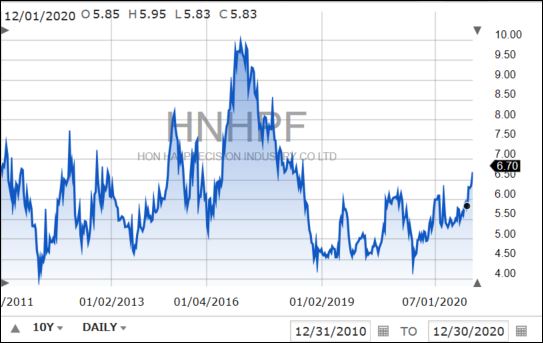
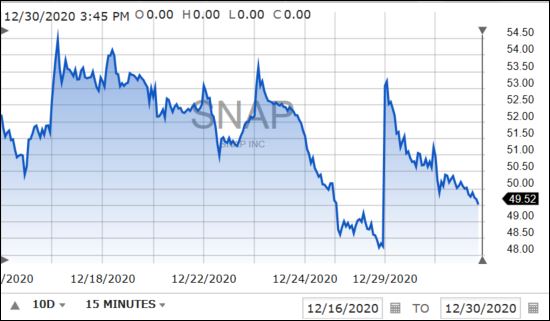
+ I don’t buy stocks whose charts look weird. e.g. Snap and HNHPF. Snap chart is over 10 days, but just got upgraded by an investment banker looking for (I’m guessing) Snap’s business. HNHPF assembles thing for others — the lowest margin business in the world.
+ I don’t buy funds. The reasons are for another blog.
+ I don’t buy technologies which have a bright future, but a long, long path to nirvana. Think 5G.
+ I don’t trade. I’m not good at it. Most people aren’t. Most people lose money trading.
+ I don’t buy things like gold or bitcoin – just because they’re going up.
Smarter people have made money in these areas. Go for it. Be aware that the key to making money and living a peaceful life is to do what you’re good at and what excites you.
Once upon a time we got vaccinations done…
Quickly, efficiently and we saved lives. Here’s a feel-good story:
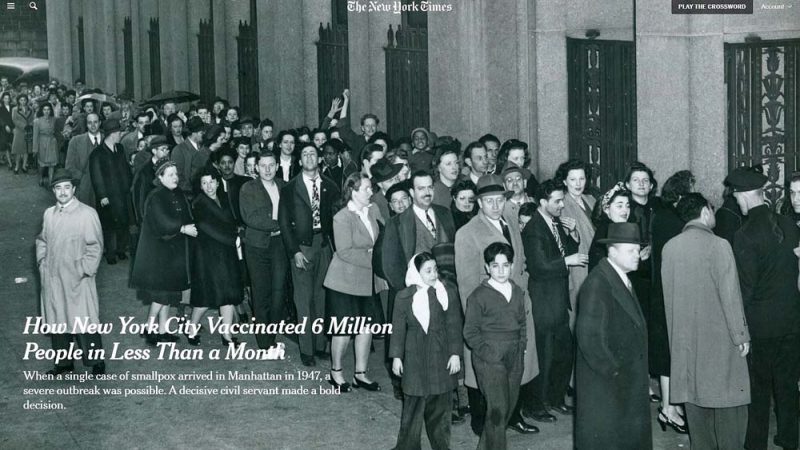
The article ends with these words:
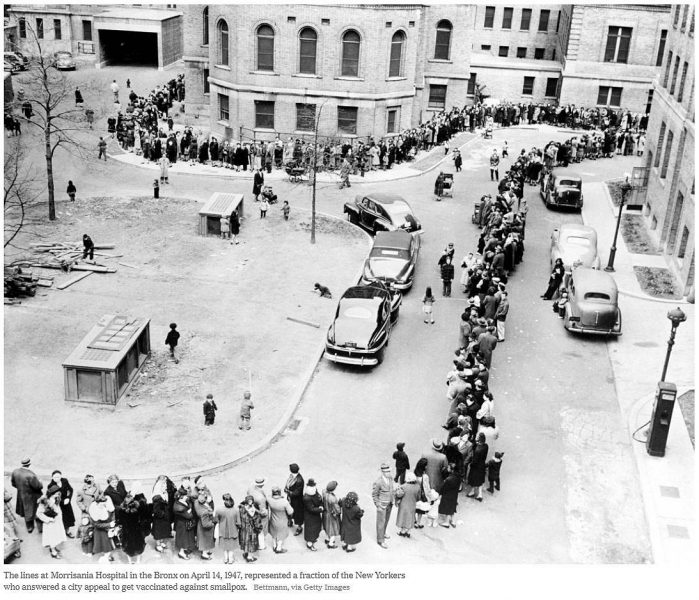
Later that year, he summed up the case in The American Journal of Public Health. “In a period of less than a month, 6,350,000 people were vaccinated in New York City,” he wrote. “Never before had so many people been vaccinated in such a city and on such short notice.”
The final tally was 12 infections and two deaths.
“What Dr. Weinstein did in 1947 is something we’re still studying and referring to,” Dr. Markel said. “The fact that they developed the logistics – the delivery of vaccine, the large public spaces where people could line up to get vaccines, the manpower in the form of nurses and doctors who would give the vaccine – is pretty incredible. Weinstein is to be credited.”
“It stands out as a remarkable achievement by any measure,” Dr. DiMaggio said. “It was a public health triumph.”
Dr. Weinstein resigned from his post in November 1947, seven months after the smallpox outbreak. He left behind a blueprint for containing an infectious disease in a large, dense city.
But this time, with the coronavirus pandemic, New York faces a logistical hurdle. Experts in infectious disease point to a hollowing out of the public health infrastructure – not just in the city, but across the country. Yet, they believe the biggest obstacle is not distribution but the public’s distrust of government, science and the media.
“We’re coming out of a train wreck of messaging,” Dr. Redlener said. “We’ve learned that politics is poison to a public health initiative, especially during a crisis. Honesty and straightforward, clear messaging are absolutely critical.”
In 1947, Dr. Weinstein was the only voice with a megaphone. He spoke and people listened.
“Back then, there was a much simpler media landscape,” Ms. Sherman said as she laid out the Ad Council’s campaign, which is due to kick off early next year. “In today’s environment, we’re dealing with a highly, highly fragmented media. We’ll be relying on micro-influencers who are the trusted voices.”
So, as the Covid-19 vaccine rollout in New York City began this past week, a major question remains: Can the city come close to what it accomplished 73 years ago?
Dr. Redlener, who serves as an adviser to Mayor Bill de Blasio on emergency response, said he believes that New York will meet the challenge again. But he added, “It’s almost inconceivable that we’re going to be able to do something similar as rapidly and as effectively.”
You can read the full New York Times piece here. Send it to your congressperson.
Meantime, if you can’t get Covid-19 vaccine, at least get the Flu vaccine. You don’t want to get sick from both.
Stay healthy and removed. Covid can kill you — even if you’re healthy.
See you tomorrow. — Harry Newton
