Big yielders NLY, AGNC and ANH have taken a hit in recent days. Grab some. Two other interesting ideas below:
Playing this short-term carefully. My friend, money manager, Scott Udine, emails me:
Patience! Decrease position sizes if trying new longs and tighten up all stops.
Yesterday was the first time in months that we did not bounce off the lows and in fact we closed at or near the lows. Then after the close FFIV reported earnings and got smacked to the tune of over 20% in the after hours, wiping out months worth of gains in 10 minutes. Remember they take the stairs higher and the elevator on the way down.
Market tops don’t happen in a day, they take time to form and happen when everything looks great and there is tons of complacency. Let’s see what the next few days/weeks bring and then we can decide how we want to position our precious capital.
We raised some cash yesterday (got stopped out of a few positions), added some index short hedges (small) and tightened up our remaining stops. If we do roll over here, we will be in cash rather quickly and will not give back much of our recent nice gains. If this is just an ordinary pullback, then we will reposition in the best risk/reward scenarios. We shall see and will be patient until we see some further signs.
Mosaic, the big phosphate and potash maker. Now might be a good time to edge in.
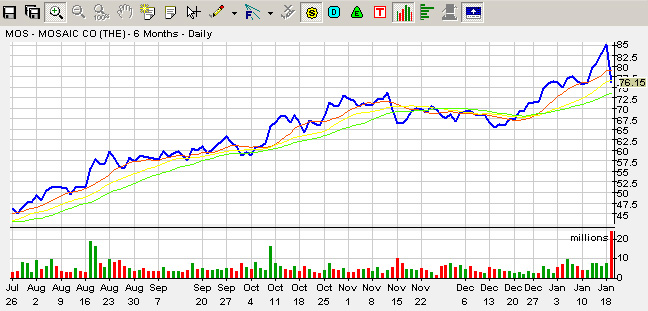
I like their recent quarterly earnings, nicely edging up. Joseph L. Shaefer wrote this piece on Seeking Alfpha. (Click here.)
I have written a number of articles extolling agriculture in general, and potash and nitrogen plays in particular, but because I am in the middle of year-end client statements it took a nudge from a recent article by my friend and competitor in the financial business, Bob Howard, to get me to take a few moments to discuss Mosaic (MOS).
Bob, who publishes Positive Patterns, has also long been an enthusiastic supporter of “ag” for the same reasons I’ve discussed so many times:
* The world’s population is growing, not shrinking.
* The amount of arable land on which to produce crops is shrinking, not expanding.
* As people move up the Maslovian scale from mere subsistence to healthier and more diverse/robust food sources, they will pay to eat higher on the protein ladder.
That’s where Mosaic comes in.
As the company states in its mission statement: “Our mission is to help the world grow the food it needs.” Between Canada’s Potash Corp. (POT) and Minnesota’s Mosaic, they produce roughly half the world’s supply of phosphates and potash. Every farmer and, indeed, every gardener knows that a little food for the plants’ roots and structure goes a long way toward producing more food for the table.
I believe today is a great time to buy Mosaic, the largest agricultural fertilizer producer in the U.S.
The company’s stock has sold off 10% because privately-held Cargill Corp, one of the world’s behemoth ag companies, has decided to sell most of its 64% stake in MOS. This has the investing public panicked: If Cargill doesn’t have confidence in Mosaic, it must be a bad investment, right?
Wrong. There are many reasons for you, I, or Cargill to sell a company; it isn’t always because we have lost confidence in its prospects. In Cargill’s case, it has a legal obligation to fund the late Cargill heiress Margaret Cargill’s charitable trusts. To do so, Cargill would either have to go public or sell off some assets. By raising some $24 billion in this manner, it can fund all its obligations to the charitable trusts. The tax-free transaction calls for 110 million shares of Mosaic (38% of Cargill’s stake in MOS) to be distributed to Margaret Cargill’s charitable trusts. Another 69 million shares will go to other Cargill shareholders.
In addition, Cargill can reduce long-term debt by some $9 billion as well, since the third tranche of Cargill-owned Mosaic stock — 107 million shares — will go to Cargill debt holders, significantly improving Cargill’s credit profile.
So there will be an “overhang” of stock for sale, since most of the debt holders are likely to sell their holdings within a year or so after the deal closes – and to fund operations, Margaret Cargill’s trusts are likely to sell about 50 million shares during that period.
But my guess is that overhang may not even have time to affect the shares. BHP’s rejected offer to buy Potash Corp. left it still hungering for a big supplier of potash and phosphates. With Potash off the table by Canadian government fiat, and BHP’s dumb lowball offer, #2 may be looking awfully good to BHP and other firms and nations desperate for the product. If it happens, I would imagine the bidding would begin well above $100 a share.
China? Richard Russell writes:
January 18, 2011 — Does anyone know what China really wants and in which direction China is going?
The Russell answer: China wants to be the most powerful financial power on the planet. Note that I said China wants to be a “financial power,” not a military power. Militarily, China simply wants to neutralize the US, and be on a military level with the US. China knows that nobody can win the next major war between super-powers (both sides would be utterly destroyed).
China’s initial financial strategy — to make the yuan (renminbi) the world’s leading currency. China wants the yuan to take the place of the US dollar in world trade and they want the yuan to be the world’s reserve currency. China is going about this in slow, deliberate steps.
First, China is making strategic alliances with a long list of nations. This means that they will trade, using currency swaps in China’s currency, the yuan. This will result in eliminating trade in US dollars. The Chinese alliances include Malaysia, Belarus, Hong Kong, Indonesia and more recently Brazil and Argentina.
China is also moving to create currency swaps with the Arab nations. More ominously, this means that China ideally wants oil quoted and traded in yuan rather than as it is currently quoted and traded — in dollars.
What’s behind China’s new strategies? The fact is that China has been smarting under many decades of bad-mouthing and disrespect. China is a nation of 1.3 billion hard-working people, a nation pulling itself out of deadening poverty and fast-becoming the leading economy of the world. Today, no trend or major deal is transacted without considering it’s affect on China or China’s affect on the transaction.
It’s obvious that China wants the yuan to be the world’s new reserve currency. Ask yourself this — if you are dealing with a currency, would you rather deal with the currency of a nation with a huge hard-working population, a nation with the largest reserves on the planet — or would you rather deal with the currency of a nation drowning in debt, a nation who’s currency is in a multi-decade decline, and a nation which is steadily losing its productive and manufacturing capabilities?
The next step in the progression is for China to make its yuan convertible. China wants the yuan to take the place of the dollar. It wants the yuan to be the world’s leading trading and safe-haven currency. More than that, China is in a headlong rush to build its reserves of gold. Recently, China asked the IMF to create a new reserve currency, a mix of three or four leading currencies with the yuan and gold as two of its components.
China quietly has become the world’s largest producer of gold. Furthermore, China’s leaders have been urging their people to accumulate gold.
Unlike the US, China sees gold as a symbol of power and prestige. I believe that China is thinking that in due time, it will back the yuan with part-gold, thereby making the yuan far preferable to the US dollar, which is backed by nothing tangible. Today. the dollar is backed only by the “full faith and credit” of the US government.
So it’s interesting and rather frightening, while the US creates billions (trillions) of dollars out of computer transactions, all in an effort to save its banking system, China is spending part of it giant dollar hoard to buy up the resources of the earth. China already has a near-monopoly in rare earths. China is buying mining companies whereever it’s feasible. China is buying arable land in South America and Africa. If it’s a valuable resource, if it’s for sale, China wants to buy it.
All this is happening while the US debates the suitability of gays being in its armed forces.
Item, River Court City, Goldman Sachs’ headquarters in London, has just been bought by China through a company called “Chinese estates.”
Item, Tim Geithner and Hillary Clinton continue to berate China and tell China what it should be doing. China is doing exactly what it wants and what serves its own interests, and surprisingly, China is not interested in the plans that the US has for it.
Housing: China’s leaders are worried about the housing bubble that has formed in China. In an effort to let the air of the bubble, China has increased its bank reserves and raised its benchmark interest rates. Thus has resulted in a sharp drop in its stock market (below, a chart of the Shanghai Composite Index as of Friday’s close).
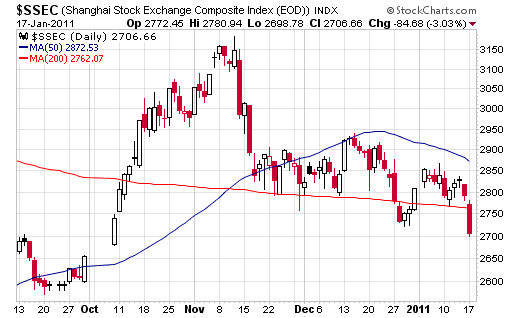
Harry’s note: The Shanghai Stock Exchange is edging down again today.
Favorite New Yorker photo.

The caption reads, “In Camden, New Jersey, one per cent of patients account for a third of the city’s medical costs.”
It’s hard to get people to take care of themselves.too many people are eating too much, and exercising too little. The article shows if you focus on on the unhealthiest (i.e. most expensive) people n your community, you can dramatically bring down your community’s total health costs. the unhealthiest spend vast, expensive time in your hospitals.
Item: I’ve never seen a fat old person. I’m guessing they’re all dead, or confined somewhere.
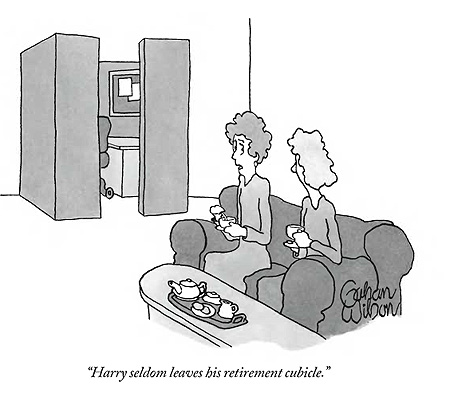
Favorite recent New Yorker cartoons:
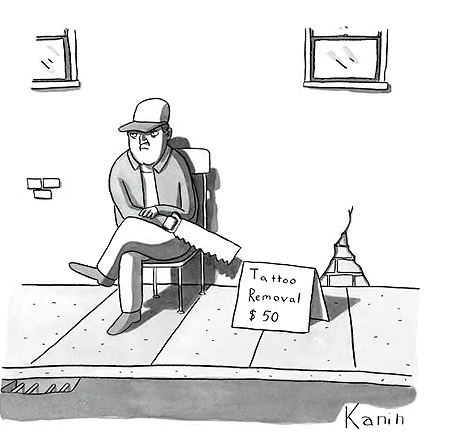
This is my wife’s favorite:

Harry Newton who wonders why transferring a few miserable stocks out of Vanguard is so bloody difficult. First, I didn’t fill the form out correctly. Now they want a “Medallion” signature — whatever that is. I’ve given up on Vanguard. Their prices are good. But their web site layout and reporting is just plain awful. Today, I much prefer Fidelity. Ask Fidelity for their Active Trader Pro free software platform. It’s more complex and has more features than their normal platform. You may not like it. But you won’t lose their normal platform. You can actaully use the two simultaneously. Some things are more comfortable on one platform.
Keep an eye on SWZ — could be a very nice long-term hold.
