There are two types of tennis players. Those who focus on the next point. And those who focus on the score. I focus on the score. That’s bad. How many times have I lead 40-0, only to lose the game. Too many to count.
Samuel Goldwyn (of MGM fame) was born Shmuel Gelbfisz in Warsaw, Poland. He made great movies and great aphorisms, known affectionately as Goldwynisms:
“A verbal contract isn’t worth the paper it’s written on.”
“A hospital is no place to be sick in.”
“Anyone who goes to a psychiatrist ought to have his head examined.”
“Gentlemen, include me out.”
“I can give you a definite maybe.”
“I can tell you in two words: im possible.”
“If I could drop dead right now, I’d be the happiest man alive.”
“Pictures are for entertainment. Messages should be delivered by Western Union.”
“I don’t want yes-men around me. I want everyone to tell me the truth, even if it costs them their jobs.”
“If I look confused, it’s because I’m thinking.”
“You fail to overlook the crucial point.”
My favorite Goldwynism is: “Never make forecasts, especially about the future.”
This week is the annual World Economic Forum in Davos, to which I was, once again, not invited. Each year they publish a Global Risks Report. This year’s identified 37 major things to lose sleep over, one more than last year. The list included obvious risks like climate change, geopolitical conflict and government debt, and a few less obvious ones, including migration and new technologies.

But just last year, for all the talk of crisis prevention, commented the New York Times DealBook, participants at the forum missed what proved to be the big economic story of 2010 — Europe’s sovereign debt crisis. While Greece’s fiscal problems were already becoming clear, Prime Minister George A. Papandreou assured one session last January that the government would get its debt under control.
Yup, under control!
I have charts that show “No way.” Greece’s debts are way beyond working out with more debt. Unless Germany bails them out, again and again — with money it doesn’t expect to be returned.
You can now buy one Euro for $1.36.
The Euro looks doomed. That’s a “forecast.” The weekend’s “thought” was to buy cheap, long-term, out-of-the money put options against the Euro. Nassim Taleb would probably approve of this strategy. Keep funding the options “as a cost of doing business” until they become ultra-valuable and you’ve 20-times your money.
A more conservative approach is simply to buy SWZ, an ETF which buys only Swiss companies. Switzerland has its own currency. It’s called the Swiss Franc.
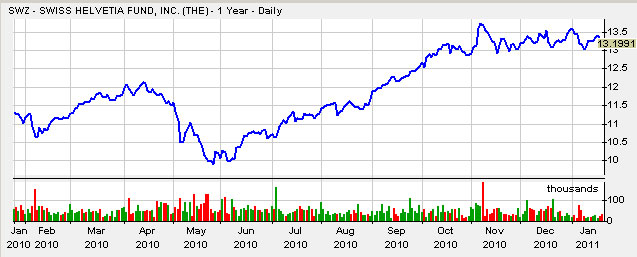
NAV per share is $15, higher than the market price. That’s good, and solid. So are Swiss mountains.
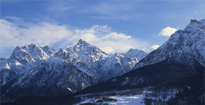
I like mountains.
The weekend’s economist did a 14-page cover on the Rich.
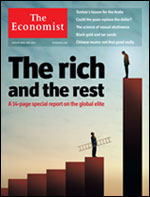
My favorite excerpt:
You do not have to be a genius to build a million-dollar business, but it helps if you are intelligent and extremely hard-working. In their book “The Millionaire Next Door”, Thomas Stanley and William Danko observed that a typical American millionaire is surprisingly ordinary. He has spent his life patiently saving and ploughing his money into a business he founded. He does not live in the fanciest part of town—why waste money that you can invest? And his tastes are so plain that you can barely tell him apart from his neighbours. He buys $40 shoes, and his car of choice is a Ford.
I prefer a Subaru. My wife hates my cheap shoes.

Harry Newton who wonders how he can play four hours of spectacular tennis (singles, of course) on Saturday, killing all three opponents and then come back on Sunday and lose 6-0, 6-1, 6-0. That gives miserable a whole new meaning. Still, I’m happy to be alive.

Harry Harry Harry – There's a country & western song a couple years ago that had the answer…
I'm not as good as I once was – but – I'm as good once as I ever was
foolish me I thought they were talking about something more fun than tennis… Stay Young
capt.bill
I haven't picked up a tennis racket in over a year. Too much of a perfectionist: our master bedroom overlooks the tennis courts of the townhome complex where we live, and I was able to observe the skill level of the folks that, as a player, I was no better than. That cold, hard reality was a source of embarrassment for me and took the fun out of the game; I admire you for your ability to derive pure enjoyment from the playing, not necessarily how you look compared to Nadal and Federer.
Millionaires aren't what they used to be – that's the difference in this day & age. I don't mind saying that I'm one, and I regard it as no big deal. As I've said to others, to say that you have a 7-figure net worth, today, is to say that you're doing OK … and that's all. I don't think that one can “kvell” about wealth unless/until one's wealth is now in 8 figures – not 7. That's what inflation and the erosion of the dollar does – and it's ongoing.
Ten years ago I took over my wife's then-10-year-old Subaru. They do go on forever! I admit that I did turn it in a couple of months ago, for a leased '11 Altima. I will use the cash value from my whole-life insurance as a source of the lease payments … thus monetizing the cash surrender value of the policy, while I'm still around, and at no tax consequence.
I've thought about SWZ but I have a feeling the Swiss wouldn't like the Swiss franc to appreciate any more than it already has. I don't see a currency play there unless the dollar falls through a hole in the floor – and how on earth could that possibly happen? Over the past several years I've been fortunate enough to have bought lots of Canadian stocks – a win-win, as the stocks have appreciated while the loonie has gone from 65 cents to parity. But here too, I think the currency game (loonie vs. dollar) is about done.
That's the big problem with today's market: where does one go from here. For the time being, I've been trying to raise cash. One possible alternative, not unlike SWZ: BRXX??? Cheers.
Yes, “The Inner Game of Tennis” is a must read for tennis players. The principles can also be applied to any athletic participation.
And Harry, even the pros…you know younger people …prefer at least a days rest between matches. 🙂
The Inner Game of Tennis: The Classic Guide to the Mental Side of Peak Performance
In this month's Tennis Magazine Nick B. said that club players who have specific strengths should not play the score but play their strengths. He goes on: if you have the best serve of your peers but an average baseline game do not take something off your serve at 30-40 to avoid a double fault. He said if your serve is your strength you must trust it and he even said hit two first serves (risking the DF) rather than give your opponent the upper hand!