My friends in real estate are wearing a happier face. To them it seems as if prices have stabilized (i.e. stopped falling) in commercial real estate and retail stores. Their perspective is clouded by a Manhattan-bias. They live and invest heavily here. But they’re also invested in Canada and Australia. And there, things are also picking up. They’ve seen new tenants coming out the woodwork to rent vacant retail space. They’ve seen multiple offers on properties they’ve recently put up for sale.
Individual experiences don’t make an economic trend. But it’s heartwarming. A little good news (and few smiling faces) is heartwarming.
The “big” discussion in Manhattan real estate is Stuvesant Town — the $5 billion plus disaster whose owners just handed the project back to the lenders. Turns out that the assumptions under which the original purchase was made were just completely out of whack. Example: A big percentage of the apartments are rent controlled or rent stabilized — renting for far less than the market. As tenants leave or die, a certain number of apartments become available for the owners to bump up the rents to market rents. The industry experience is around 3% a year. The buyers assumed 30%. I kid you not. There were other assumptions that caused them to bid $5.3 billion, when other bidders thought $2 to $2.5 billion represented the real value. Today the properties according to the New York Times are worth maybe $1.9 billion. The reality is no one knows.
One of the insanities of the $5.3 billion deal is that it was allegedly financed with 11 levels of mezzanine debt below the mortgage. That mezz debt is probably now worthless.
As real estate comes back, so “deals” are coming back. And they’re popping on my desk, once again.
From my limited sampling, the “industry” that promotes deals to investors still has some way to go in learning. To wit: they’re being offered with mortgages showing high loan to value — some as high as 75%. That means if the property drops 25% in value, the owner (theoretically me) is wiped out. Second, the theoretical returns to investors have now moved up from 8%, 9% and 10% to 11%, 12% and 13%. That’s still too low. And it only got up there based on the high level of borrowing — also called risky leverage. And finally the fees on properties presented to investors remain way too high. There are fees for acquisition. There are fees for running the property. And there are hefty fees after the investors have been paid their “guaranteed” return.
Which brings me to one of the biggest (maybe the biggest) investment lessons of this past decade: Don’t buy a structured investment product. Structure your own. That way you’ll have control and avoid the fees. In the simplest example, buy the stocks, not the fund. Buy the properties, not the fund. Being in a fund means you get access to deals you’d never get as an investor. Balderdash. Stay out. Go play tennis.
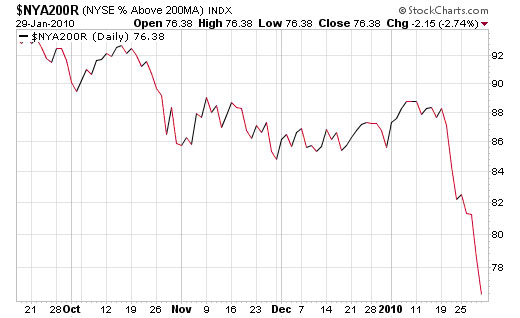
Richard Russell remains a bear. He writes “Below a chart showing the percentage of NYSE stocks trading above their 200-day moving averages. With the Dow hovering near its highs, the percentage of stocks holding above their 200-day MA is plunging. An ominous picture.”
Favorite sign.

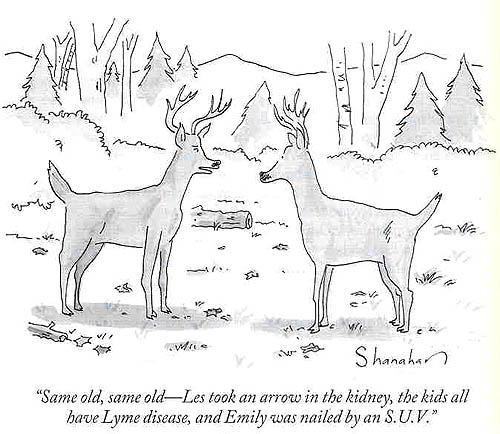
Favorite New Yorker cartoon.

Harry Newton, who’s figured the only way to beat his 35-year old tennis opponent is to attack every ball — hence giving new meaning to “he who hesitates is lost.” So far, this brilliant new strategy is not working. I suspect it’s also why Murray lost to Federer on Sunday.

Yes, attack the ball. Even in a defensive mode, show an attitude of dominance. Boxers often win backing up. Aggressive defense is better than a weak offense.
RE: the percentage of NYSE stocks trading above their 200-day moving averages. ….
Correct me if I'm wrong (I'm neither a huge investor nor a particularly experienced one…) but wouldn't the drop in % stocks ABOVE their 200-day average be merely a mathematical fluke of the passing of last years (horrible) dip out of the 200-day average. Seems to me to indicate a more normal trading range after the horror of Jan/Feb last year… Doesn't seem as foreboding to me.
Federer is also a better player.
A huge part of the real estate enthusiasm is based on decent valuations, even bargains based on historical data. And certainly compared to the crazinest of 3 years ago. Out here in parts of California a newer house for $650,000 two years ago can now frequently be had for 1/2 that, even $250,000 in some cases. So the bargains are there for the brave.