I will admit. I have been ripped off by a bogus China investment.
Being ripped off is part of one’s investment education.
I’m not proud of being ripped off. Warning people of my idiocies is a key reason I write this column.
I don’t believe there is any way of using due diligence to pick a good investment from a bad investment. You will always make mistakes. But saying “NO” is a good exercise. There are far more bad investments out there than good ones. Maybe in the ratio of 99 bad-to-1 good.
Emerging countries are often sinkholes. They lack much of what we take for granted — the rule of law, the rule of disclosure, the concept of fiduciary relationship to your stockholders, etc.
China is ultra-seductive, because it’s so BIG and growing so FAST.
But it also has its share of crooks. Read this from the latest issue of New Yorker:
Don’t Enter the Dragon
by James Surowiecki January 31, 2011
The pomp and circumstance of Hu Jintao’s state visit last week was a testament to just how integrated the Chinese and American economies have become. China, it seems, has an inexhaustible capacity for making stuff, and Americans, even now, have an inexhaustible capacity for buying it: sneakers, TVs, pet food, and, more recently, investments. American investors keen to cash in on the China boom have poured money not just into well-established giants like China Telecom and C.N.O.O.C. but also into more speculative “small-cap” companies, hundreds of which now trade on U.S. stock exchanges. The problem is that, while some of these firms are indeed thriving enterprises, more than a few seem to be specialists in a less savory business: ripping off investors.
Take, for instance, two of the hottest Chinese stocks of 2009: RINO International, a maker of “environmental-protection equipment,” and the jewelry maker Fuqi. At one point in 2009, these companies were Nos. 1 and 2 on the Investor’s Business Daily 100. But last March Fuqi announced that it had overstated earnings for the first three quarters of 2009 and would have to re-state its earnings. Ten months later, the company hasn’t filed a single new earnings statement, so no one knows how much it has made (or lost) in the past two years. The stock is down more than eighty per cent from its peak. As for RINO, last November a short seller issued a report that blasted its accounting as fraudulent and effectively suggested that the entire company was a house of cards. After initially saying nothing, RINO admitted in an S.E.C. filing that two of its manufacturing contracts didn’t actually exist, and that its financial statements couldn’t be relied on. When the company failed to disclose more information, it was delisted from Nasdaq. Its stock has fallen ninety per cent from its all-time high.
A lack of transparency and a disregard for accounting regulations are all too common among U.S.-listed Chinese firms, and the S.E.C. is reportedly conducting, belatedly, an investigation into such stocks. Companies have been known to report one set of revenue numbers to the S.E.C. and another to Chinese authorities (perhaps to minimize tax bills). A company’s suppliers or partners often turn out to be owned or controlled by the company’s own managers, a practice that lends itself to “tunnelling”—using outside businesses to milk the corporation. Another problem is executives who treat their companies as personal A.T.M.s: RINO lent its C.E.O. and its chairwoman (a married couple) $3.5 million, and didn’t even ask for a signed loan document in exchange.
The U.S. has an entire regulatory apparatus designed to protect the interests of investors, but Chinese companies have been adept at exploiting its loopholes. Using a tactic known as a reverse merger, hundreds of Chinese companies have bought American shell companies, which have a stock-exchange listing but few actual assets. A quick name change, and, presto, the Chinese company is traded on Nasdaq or the Amex. This gives Chinese firms the credibility of being listed on a major exchange without any of the vetting from investors that companies get when they go public. And once you’re on an exchange it takes a lot to be kicked off. Even though Fuqi hasn’t filed financial statements for almost a year, a Nasdaq panel recently gave it until March to do so.
As for the audits of these companies, it’s hard to know what they’re worth. According to a report by the Public Company Accounting Oversight Board, some U.S. auditors outsource their work to unsupervised Chinese auditors, or sign off on audits without ever sending anyone to China. In many cases, “auditing” probably amounts to little more than rubber-stamping a company’s reported results. It’s often assumed that concern for reputation will make auditors sniff out fraud and chicanery. But, as the Enron scandal demonstrated, reputation often matters less than short-term gain, and it also cuts both ways: turning a blind eye to questionable numbers can be a good way to get new business. It’s no surprise that a number of the companies tarred by allegations of dubious accounting share the same auditors.
Given all these problems, you might think that small Chinese companies would be having a hard time raising money. But though bad publicity has made investors more skittish, the number of reverse mergers actually rose last year, by twenty-five per cent, and small-cap Chinese stocks are still collectively worth billions. The reason is simple enough: nowhere else seems to offer the hopes of getting rich quickly that China does. This is a familiar pattern, and, indeed, investors in small Chinese stocks today are very much like the foreigners who poured money into U.S. railroads in the nineteenth century. Then investors anxious to cash in on the railway boom proved to be easy targets for self-dealers and outright swindlers, and foreigners in particular struggled to get good information about what was happening to their investments. A British emissary to a U.S. company in the eighteen-nineties, describing his futile effort to glean information from the company’s directors, used terms that sound painfully familiar: “It has been most demoralizing.” Yet, because the railways offered—and sometimes delivered—the prospect of enormous wealth, the money kept flowing. Today, the same is true. China’s boom is real enough, and so it’s possible for investors in small Chinese stocks to believe that they’re heeding Deng Xiaoping’s famous admonition “To get rich is glorious.” Unfortunately, many of them are just proving the truth of another famous adage: “There’s a sucker born every minute.” ♦
A brand-new publishing opportunity.
The founding principle of the Journal of Universal Rejection (JofUR) is rejection. Universal rejection. That is to say, all submissions, regardless of quality, will be rejected. Despite that apparent drawback, here are a number of reasons you may choose to submit to the JofUR:
+ You can send your manuscript here without suffering waves of anxiety regarding the eventual fate of your submission. You know with 100% certainty that it will not be accepted for publication.
+ There are no page-fees.
+ You may claim to have submitted to the most prestigious journal (judged by acceptance rate).
+ The JofUR is one-of-a-kind. Merely submitting work to it may be considered a badge of honor.
+You retain complete rights to your work, and are free to resubmit to other journals even before our review process is complete.
+ Decisions are often (though not always) rendered within hours of submission.
Just because I know readers of this site would expect no less, I went ahead and submitted a pre-submission to the journal tonight. Here is the response:
Harry,
Thank you for your titleless pre-textual submission to the Journal of Universal Rejection. I have imagined what your submission might have been and found it unworthy of publication in our prestigious journal. Try not to feel too sad about this rejection.
Best regards,
Caleb Emmons, PhD
Editor-in-Chief
Journal of Universal Rejection
Favorite recent New Yorker cartoons:
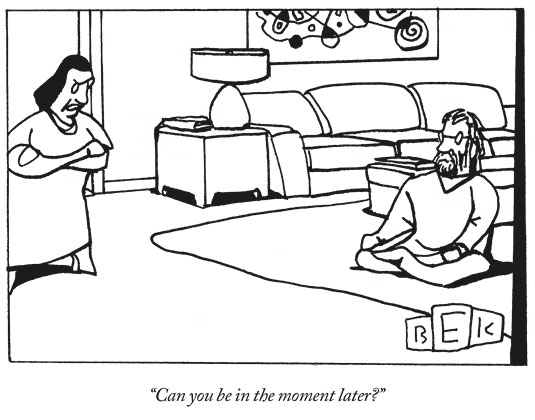
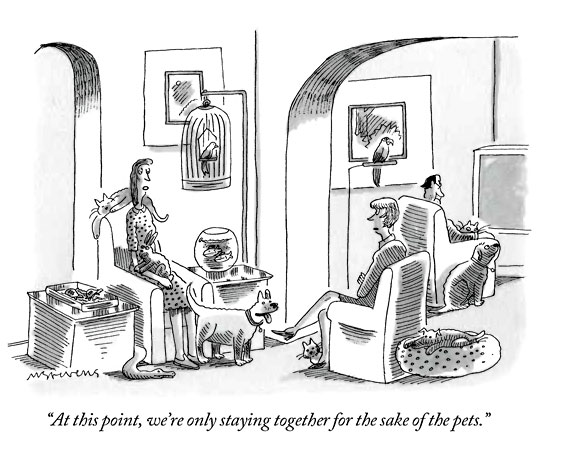
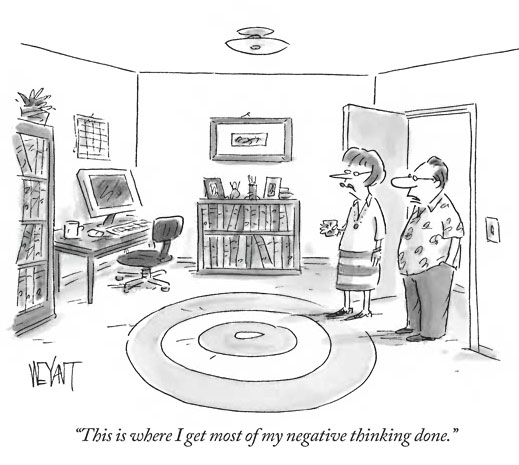

Harry Newton who listened to Obama last night while he watched the tennis. Once — a long time ago — Harry earned a good living giving motivational talks. You can smell these talks a mile off — nice words, no substance. Lots of feel-good stories. You can make it. We can all make it. Decisions in the Obama Administration have been “emergency” ones, made in the moment under threat of some imminent, existing or created disaster. What I hoped for last night was a plan — energy, high-tech, manufacturing. Get us to the moon sort of Vision. No such luck. What we got was a Harry Newton feel-good speech. I felt good last night. This morning, I’m depressed at the lack of Vision. Cutting corporate taxes (good idea), attacking malpractice insurance rates (good) and freezing the federal budget is not Vision. It’s knee-jerk desperation, pandering to the Republicans for political purposes, as well as thoroughly depressing for government employees doing a good job. (There actually are many.) Yuch.

RE: It’s so hard to get backlinks these days, honestly i need a backlink by comments on your blog / forums or guestbook to make my website appear in search engine. I am getting desperate Now! I know you’ll laugh while reading this comment !!! Here is my website penis enlargement I know my comments do not relate to the topic, but PLEASE HELP ME!! APPROVING MY COMMENT!
Regards: PoormanBH2011
So what is the problem my friends, I’m collecting backlinks to make my website penis enlargement appear in the search engines!! whether are the comments look like a crap!
HahayBH2011
That the Chinese are CHEATS is something we Indians are totally aware of. Not that Indians don't cheat (at least a substantial number). But, for the Chinese, winning at all costs, is an obsession. The Chinese Government aids and promotes cheating. Good thing, you Westerners are finally figuring out what the Chinese are really like. Amazing that a rationalist like Charlie Munger is still in awe of the Chinese 🙂
Harry,
I had a major bad experience with Chinese counterfeiting for a VERY large consulting client within the last few years. It involved a medical device and the fraud was the most unbelievable I had ever seen (I am old). Nothing's changed there. They do not see it as wrong. If it promotes business, which they see as the ultimate good, it is justifiable.
Oh, regarding the speech: Best short descriptor: “1000 Points of Trite”.
That's good — a thousand points of trite. At least I got to watch the tennis while listening to the trite.
Cutting corporate taxes is pushing on a string – there's no demand in America, because there are no jobs. Ross Perot told us about that giant sucking sound and he was right – NAFTA, CAFTA etc. have taken their toll, and our corporations have offshored jobs while benefiting from the U.S. tax code. The working middle class has been gutted, and what's good for corporations will be good for the bottom line and for investors (like me) – but not for our economy.
We are faced with stagnation, at best – both political and economic. As a survivalist-liberal (I invest to survive – if I go down, I'm taking Warren Buffett with me), I didn't bother with the state of the union speech last night. Such presentations, by all Presidents in recent times, have become as hackneyed as they are predictable and Barack Obama has set his political course on the plodding middle, while making as few waves as possible.
Still don't understand Harry's liberal allegiance and his snide attack on conservatism — when the ideas he likes both arise from conservatisim. IMHO we should all be independents since we have been screwed by both parties.
JofUR is a hoot! Reminds me of many many publishers I've experienced.
Can you blame them, given how unprofitable publkishing has become.
I agree with Danderson 3959—-Liberals still think they are voting for Hubert Humphrey …. So many haven't woke up . They are voting because thats the way they were raised.It's almost like they would vote for Joseph Mengalah if he was a democrat! Wake up Hubert is DEAD!
It's always enlightening to see how someone with a different point of view can define for me, as a Liberal, what I'm thinking when I vote (it's all about Hubert) and what brought me (i.e., parental upbringing) to my present parlous state. But arrogance and self-assuredness have never been character traits in short supply among the Conservative crowd.
It couldn't possibly be rational thought … or a social outlook that focuses on “We” the people and not “Me” … or a perception that Conservatism as a philosophy glorifies selfishness as a trait that magically benefits all and cures social ills … or a cognizance that the purpose and objective of Conservatism is to preserve and enhance the wealth of those who already have it … or a recognition that we are presently in a death spiral of ever-increasing wealth in the hands of an ever-shrinking infinitesimal seqment of the populace … or that “Corporate America” as it pertains to multinational and oligopolistic endeavors is largely an oxymoron, in that our tax code has been twisted to benefit corporate entities that have destroyed, not built, American jobs and have even gone so far as to domicile elsewhere on the globe – while continuing to receive favored tax treatment, to the extent that they pay any taxes at all. No, it had to be some weird psychological process that – according to some – would even steer a Liberal to “Mengalah”, so long as he were a Democrat …