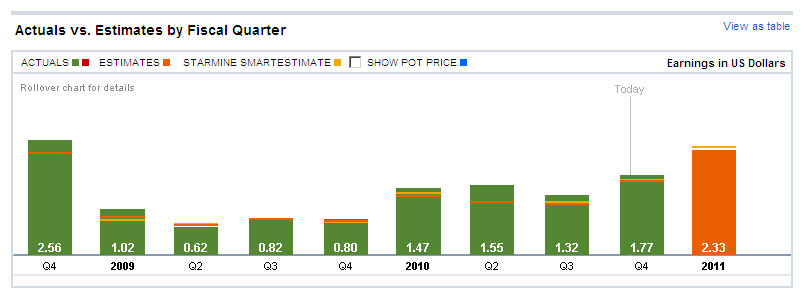
I like Potash. Nice earnings:
Nice price action:
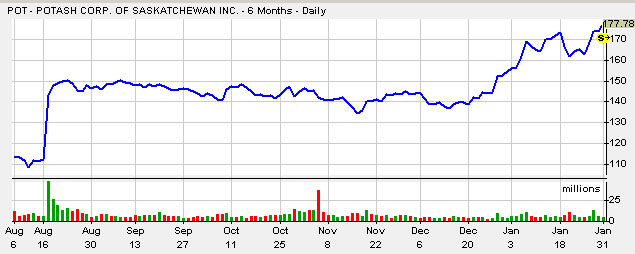
Better yet, the company will split its stock three for one on February 25, 2011. I know that means nothing. But, as they say about enemas, it can’t hurt. See below for the derivation of this vulgarity.
Scott Udine, money manager, emails this morning, “We also own CF, same group and will buy back MOS and MON as well. Group is acting well and should do well this year.”
Of course, the BIG news is food prices are skyrocketing. Farmers are planting like crazy. And fertilizer sales are sailing.
I understand that soaring food prices are behind much of the street unrest overseas. For that I’m sorry. However, fertilizer stocks do look yummy.
The proliferation of crookery
In the good old days I assumed that people I met were honest, and I let them prove me wrong.
Today, I assume that people are dishonest, and I let them prove me wrong.
A remarkable number don’t.
I don’t want to sound like a cranky old man. I recognize that there is a fine line between honesty and competence. What appears as semi-competent could also appear as semi-honest.
What happened? Several events:
1. Around 20 years ago, the world of investing changed dramatically. It reversed itself. There were suddenly fewer opportunities avaiable than the money sloshing around to fund them. This meant that good opportunities and good businesses were suddenly worth substantially more. Valuations went through the roof. The dynamics of business growth changed. Businesses were now meant to be worth more earlier in their growth cycles. There was huge pressure to find early ways of finding value. The dot.com boom found eyeballs.
2. Securitization. When everyone discovered they need no longer live with the consequences of their investments, they no longer did. They simply sold them to someone else who hadn’t the time or inclination to do his own due diligence, and/or relied on the rating agencies, which gave dishonesty in reporting a whole new meaning. Think this column. I write that I love ABC product. Then you notice a whopping big paid ad for ABC product. You wouldn’t believe my “objective” recommendation. Yet people believed the rating agencies, who got paid by the securities they were rating.
3. The explosion of immense wealth on Wall Street and by corporate executives. At one stage wealth was a personal, private affair. But that changed when wealth become widespread. Now comparative wealth defines happiness. Envy causes people to act in strange ways — often short-term and often dishonest. That stretched the definition of dishonesty.
4. The growth of hedge funds. Once there were only mutual funds. Their fees were actually modest and the SEC kept track of them. The managers got paid 1 1/2 percent a year or so. Hedge funds were 2 and 20, and outside the purview of the SEC. Hedge funds were fantastic marketing and even more fantastic money machines for their owners. They could turn an 11% one-year return into $5 billion for their owner, who now walked on water.
5. The growth of ultra-expensive and more important, ultra-visible toys – from MacMansions to MacYachts. Everyone had to have a bigger one. Everyone saw it as their God-given duty to flaunt their toys in the press or on TV. I never made it to The Lives of the Rich and Famous. But many did.
6. Suddently it’s become easier to be a crook. Schemes are more complex. Swaddle yourself in lawyers and you can escape investor wrath. You have to be really dumb and reall eggregious to get caught. Few people do get caught. Steal from your local seven-eleven. You’ll be in jail forever. Steal from accredited investors. Tough. They should have known better. After all they’re “sophisticated.”
The moral of this short essay is simple: Assume they’re crooks, or at the very least incompetent. You won’t be disappointed. “NO” is the hardest word to say in the English language. Practice saying it in the shower. Preserving your meager capital is all that counts. Trust me on this one. I wish I had read these words ten years ago.
Great news from Egypt. The Army said it would no longer shoot at protestors. I have been in two mass marches — Indonesia and India — where the Army did fire on protestors. It’s bloody scary. It keeps people off the street. Today a million people or more will protest in Egypt without fear. This will oust Murbarak. This is a bullish sign for equity markets.
The Economist did a prescient 14-page piece on Egypt last summer. Worth reading. Click here.
Why gold is a bad investment. It’s not. But that’s the headline on a MarketWatch (Wall Stteet Journal) piece. Read the beginning:
Precious metal lures susceptible buyers into a Midas crush
SAN FRANCISCO (MarketWatch) — Gold does not always glitter, but you wouldn’t know that from surging worldwide interest that has turned the yellow metal red-hot.
Gold has become highly prized bling, as anxious and astute buyers alike, from hedge-fund players to central bankers, flock to the “currency of fear.” Gold at around $1,400 an ounce is almost double what it commanded two years ago, and gold’s price is up almost 25% so far this year (2010) alone.
It’s been a great ride. Except gold is a bad investment.
Gold’s feverish run has made a lot of people a lot of money, and though the rally has taken a breather in the last few days, there’s no shortage of flag-waving supporters who claim gold is on a march to $1,600, $1,800, $2,000 and beyond. After all, gold is still well below its 1980 peak, when it was worth around $2,300 an ounce in today’s dollars.
Certainly there are reasons to own gold in a diversified portfolio. Yet gold isn’t like a stock or a bond. It offers no income, no dividend, no earnings. It is considered a store of value, an alternative currency that’s safe beyond reproach, but it is not cash in the bank, or even the mattress. Gold has no untapped intrinsic value; it is worth only what people are willing to pay for it. And lately, many people have been only too willing.
“Gold is going up because people are buying it, and people are buying it because it’s going up,” said Leonard Kaplan, president of Prospector Asset Management in Evanston, Ill., and a longtime gold trader.
Gold will be worth jumping back into it some time in the next few days.
The Great Caruso.
The Great Caruso is to perform at the Metropolitan Opera House. The stage manager appears and announces that “Mr Caruso has had a stroke and has died.”
From the back of the theater comes one voice, “Gib him an enema.”
Stage manager, “Perhaps you didn’t hear me. Mr. Caruso has had a stroke and has died.”
From the back of the theater comes the same voice, “Gib him an enema.”
The stage manager is now flustered. “You don’t understand. Mr. Caruso is dead.”
From the back of the theater comes one voice, “An enema ain’t gonna hoirt him.”

Harry Newton who is in Boston inflicting himself on his daughter and son-in-law’s hospitality. They really are wonderful. Healthy and happy together. He loves her. She loves him. They care for each other. Last night he schlepped her clothes to the dry cleaner, with only a minimal of complaints.
Drat, it’s really snowing in Boston. I’ll probably never get out. Which won’t be all that bad. I’ll spend a few more days with Claire and Ted.
