All about muni bonds: From a Goldman Sachs report on muni bonds:
It is actually surprising that default percentages are not higher historically. Indeed, the $2.9 trillion municipal bond market consists of roughly 50,000 issuers representing 3,000 counties, 36,000 municipalities, 37,400 special districts and 14,600 public school systems.1 As a result, even within the same locale, borrowers and the types of bonds they issue can vary significantly (see Exhibit 2).

Goldman’s investment conclusion:
Although many of the municipal credit concerns may be unwarranted, there is little doubt that the slower pace of economic recovery relative to past recoveries, media headlines about ―impending‖ defaults, and more recent mutual fund outflows have resulted in significant market dislocations. And according to our guest speakers, market volatility will continue. Some of this volatility will be driven by what Bob Kurtter of Moody‘s called ―near-misses‖ like Harrisburg, where the state of Pennsylvania stepped in at the last minute to provide aid; some of it will be driven by supply and demand imbalances; and finally, some of it will be driven by one-off defaults in lower rated or unrated municipal securities. For those clients who can withstand the interim volatility, we recommend staying invested in both the investment grade and high yield municipal markets; for those who have stayed on the sidelines in cash, we recommend taking advantage of the market dislocation to build positions.
For clients who are very concerned about interim downside or a double-dip recession, or who cannot tolerate the volatility, alternative strategies to holding a single-state municipal bond portfolio include diversifying across municipal issuers in both state and national portfolios and diversifying into high quality, taxable fixed income assets (although these strategies have some tax drawbacks relative to a single-state municipal bond portfolio).
For Goldman Sachs’ full muni bond report, click here.
Replacement batteries — beware. All those batteries in your cell phones, cameras and laptops wear out. Do not replace them with cheap, no-name batteries you buy on the Internet. Most are useless. They will not hold their charge. Buy only batteries made by the manufacturer. They’ll cost you a lot more. But they’re worth it. Trust me.
Nice plug for Danaher from Deutsche Bank:
Danaher (DHR.N), Buy, Price Target USD60.00 – Nigel Coe: Tgt $54 to $60. Although numbers remain unchanged at such an early stage of the BEC approval process, we feel sufficiently comfortable to embed upside into DCF. With GAAP 2012e EPS expectations possibly moving as high as $3.50 on deal closure, DHR is trading at an absurdly low multiple of ~13x cash-EPS (ex-intangibles) making DHR one of the most interesting stories in the MI/EE space over the next 12 months. Reiterate BUY. Last close USD49.03. Beckman deal looks strategically coherent…. DHR announced the acquisition of Beckman-Coulter (BEC) for $83.50/share – a transaction valued at $6.8bn (including $0.8bn net debt acquired). As we stated in our 3 Feb update, this is strategically coherent deal – BEC is a life-sciences company with great brands and leading market shares but has been hamstrung by operational and regulatory mis-steps. With margins in the 12-13% range vs. ~20% best in class level, there is certainly upside scope to the $250m synergy target. Moreover, with 23% exposure to EM, we don’t think that BEC’s structural growth rates will be materially lower than DHR’s 5-7% cross-cycle objective. We are more concerned with Med-Tech exposure at 46% pro-forma revenues, but DHR clearly stated this represents a “high water-mark” and set a normalized ceiling of 40%
Don’t mess with The Daily. Rupert Murdoch’s new $60 million iPad “newspaper” is a total waste of time. Nothing to read. Not even a section devoted to business or markets. I waited forever this morning for a new issue to be delivered. Rupert has wasted $60 million.
Sell AOL short. AOL is desperate to save itself. It has just paid an enormous $315 million for The Huffington Post. How desperate?
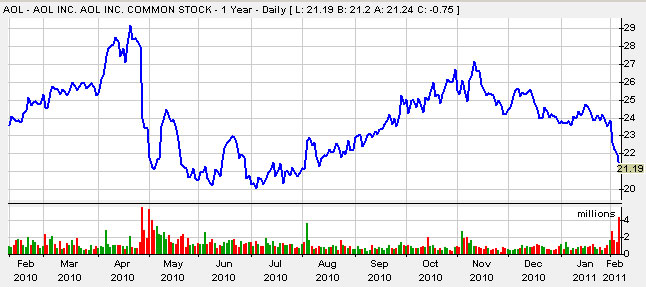
How desperate? It’s buying everything that moves:

Of the $315 million, $300 million was in cash. Arianna took 95% in cash. (When I sold my publishing business, I took 100% in cash.) Neither of us have/had any faith in our acquirer. Which brings to the obvious: Sell AOL short. It has zero idea of what it’s doing. Don’t believe me? Check out AOL’s dismal home page (replete with red eye):

In contrast, look at the Huffington Post’s home page:
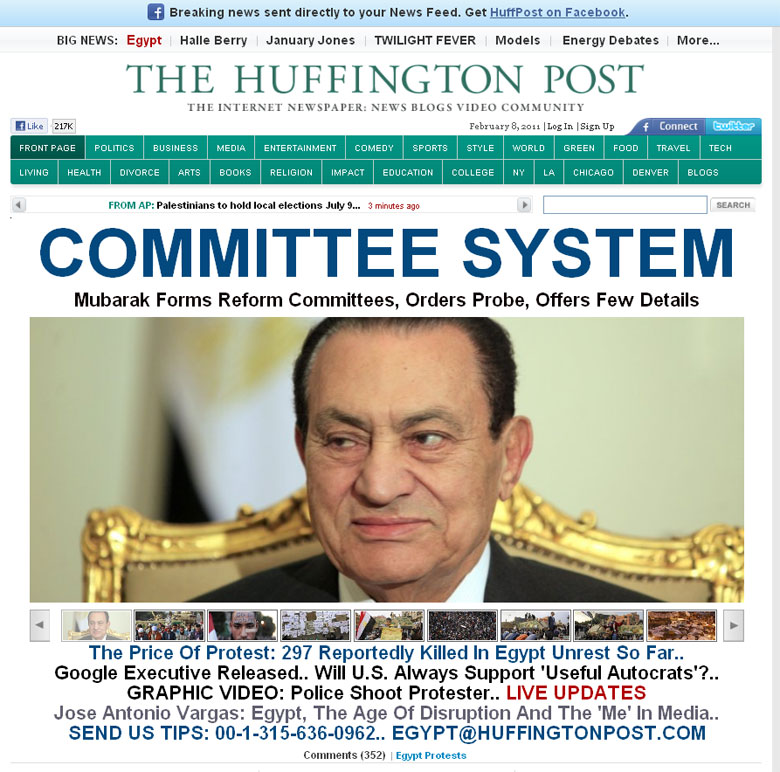
Notice the array of the array of sections across the top. Notice AOL’s collection of dumbed-down, stupid stories. My forecast: Arianna Huffington will be gone from AOL within the year. She’ll “retire” with $100 million in cash to writing books, appearing on TV and generally being a guru . Sell AOL short.
Turns out, according to The Daily, there’s a revolt among the 6,000 unpaid HuffPost editorial contributor/writers. They got nothing from the sale. They didn’t get paid for their work. The “exposure’ was the pay. They won’t stay. They’d be stupid to stay without pay.
Years ago, AOL was the way most Americans got into the Internet. They dialed into AOL. Some still do. Some still pay AOL $10 a month or so. But, now they have broadband, no one needs AOL. Every Internet revolution — from Google to Facebook to Twitter to Picassa to Gmail — passed AOL by. It’s now dying and desperate. Not a good combination.
What are Swaps? My long-time friend and reader, Pete Howley, says this is the best explanation of swaps he’s read. It comes from yesterday’s Wall Street Journal.
‘Swaps’ Add a New Risk
These instruments can fill holes in a fund’s portfolio, but there’s a downside
By ARI I. WEINBERG
Many mutual funds hold a type of financial instrument that most individuals have never heard of—and that in extreme conditions could saddle them with losses due to a risk they didn’t know they were taking.
The instruments in question are known broadly as swaps. They are private agreements between the fund and another financial institution—often a big bank or insurance company—in which the institutions typically promise each other payments linked to the performance of a stock, bond or even an index.
Like any other fund holding, swaps can go up or down in price, depending on market conditions. But there is an added risk: that the institution on the other side may not be able to fulfill its end of the bargain.
That “counterparty” risk was front and center in the financial crisis of 2008. As financial worries swirled around Lehman Brothers Holdings, counterparties pushed for more collateral from Lehman on outstanding swaps, possibly exacerbating the capital crunch that brought down the firm. Meanwhile, the U.S. bailout of American International Group Inc. effectively guaranteed that the company’s struggling AIG Financial Products unit could make good on losing swaps.
In the wake of the crisis, the overall swaps market has shrunk in size. And regulators in Europe and the U.S. for the past year have been hashing out new rules for the trading, reporting and disclosing of swap positions—rules that ultimately could affect funds and fund investors. One idea is to create a central clearing facility that would potentially limit counterparty risk.
In the meantime, “counterparty risk isn’t going away,” says Nathan Rowader, director of investments for Forward Funds in San Francisco. “We manage it by using high-quality counterparties and continuously reviewing their credit quality.”
Uneven Disclosure
Swaps are common in bond funds, but are typically a relatively small percentage of fund assets. In some cases, fund managers use interest-rate swaps to convert a fixed stream of income payments into a floating-rate stream, or vice versa. Bond funds also use credit-default swaps, which are a play on the likelihood of a credit event (bankruptcy, default, etc.) at a specified corporation. They can be used to hedge the risk of a portfolio security—or to mimic the performance of a corporate bond that the manager wants to hold but isn’t able to locate for purchase immediately.
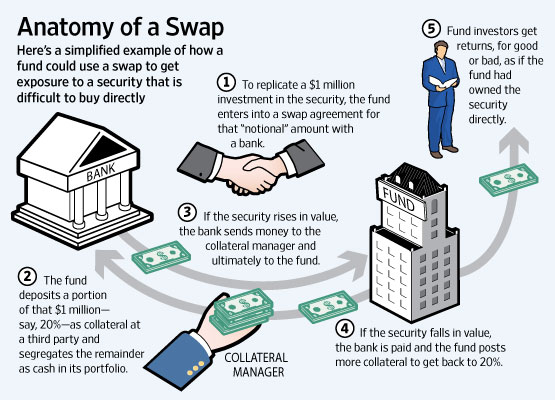
A typical swap transaction between a mutual fund and a counterparty begins with the two sides agreeing on the so-called notional value or asset being exchanged. In the case of a “plain vanilla” interest-rate swap, the parties set a term for the contract, say one year, and the notional dollar amount, say $1 million. They then agree to swap a fixed rate of interest on the notional amount, say 5%, with a floating rate of interest based on a reference rate such as the U.S. federal-funds target rate or the London interbank offered rate (Libor), plus a spread. On a daily, weekly or quarterly basis, the two sides settle up on the difference between the payments.
Regulation that limits to 5% the amount of individual exposure any one fund can have to a particular broker dealer allowed insurance companies such as AIG to become significantly active in swaps. Because they weren’t subject to the same rules, insurance firms were able to step in to fill the void.
A July 2010 paper by Tim Adam, a professor at Berlin’s Humboldt University, estimated that 60% of the 100 largest corporate-bond funds in the U.S. were using credit-default swaps at the end of 2008, with the swaps on average accounting for 14% of fund value. But divining that kind of information from your funds’ annual or semiannual reports can be incredibly difficult.
“There is currently a wide variety of levels of disclosure,” says Rose DiMartino, a fund lawyer at Willkie Farr & Gallagher LLP in New York. The expectation from the U.S. Securities and Exchange Commission is that any material exposure to swaps and counterparties be explained. The SEC is still working on guidance for proper disclosure.
Heavy Users
Other types of funds use swaps even more than bond funds. Swaps are the derivative of choice for many inverse and leveraged exchange-traded funds, which use the instruments to deliver two or three times the daily performance of a referenced index (or its inverse), be it the Standard & Poor’s 500-stock index, a bond index or a commodity.
While these funds have functioned as intended, some investors have been confused by the way the exaggerated daily returns of these leveraged funds compound over longer periods of time. That helped precipitate much of the focus on swaps and derivatives in regulated funds, and the SEC in March 2010 stopped allowing fund managers who didn’t already have regulatory approval to manage derivative- and swap-based ETFs to launch new ones that would make “significant investments” in derivatives.
Some funds use swaps for exposure to hard-to-reach foreign markets that limit access to their exchanges or securities. China, for example, has a rigorous process for certifying foreign banks that can invest in locally traded “A” shares. In October 2010, U.S. mutual-fund firm Van Eck Global introduced the Market Vectors China ETF, which delivers A-share exposure largely by entering into swaps with Credit Suisse.
The Van Eck fund’s single-counterparty structure bears some resemblance to an exchange-traded note. With ETNs, however, the credit risk is explicit since the bank or broker offering the note promises to deliver the outcome. With an ETF such as the Van Eck offering, the fund is managing the counterparty exposure and can limit it to a portion of the fund’s assets.
Last fall, the SEC and the Commodity Futures Trading Commission began issuing proposals aimed at bringing the swaps market under more regulatory control. The undertaking is very complex, in part due to the massive size of the market. The market value of swaps outstanding around the world totals more than $20 trillion; the value of whatever is referenced by the contracts, the so-called notional amount, was more than $400 trillion in mid-2010.
Different Approaches
The SEC and CFTC have each proposed rules for a new type of trading venue known as a swap-execution facility that is designed to increase market transparency. The SEC, which laid out its plan last week for security-based swaps, wants to ensure customers trading on these platforms can request a quote from a single dealer if they so choose, while the CFTC, which oversees the rest of the market, wants to require swap users to receive prices from no fewer than five dealers at a time.
Many fund companies, including BlackRock Inc. and Vanguard Group, have come out in favor of central clearing through an execution facility. But they have concerns about trying to force through “highly customized” contracts. Fund firms also are asking regulators to proceed with caution when it comes to timely exposure for the price and value of swap contracts, another regulatory goal.
The challenge for regulators is to impose more structure on the swaps market without limiting innovation in instruments that funds and other investors have found useful. “It will be very difficult to find the balance between regulate and strangulate,” says David Downey, chief executive officer of equity-futures exchange OneChicago.
One issue specific to funds: “There is still a need for more guidance on the SEC’s restrictions on the use of swaps to create leverage in a regulated fund,” says Mark Perlow, a lawyer at K&L Gates LLP in San Francisco who served on an American Bar Association task force last year on the use of derivatives and leverage by investment companies.
In the meantime, it remains difficult for investors to survey a fund’s exposure to both the market risk and the counterparty risk in a swap. Those calculations currently appear in notes and footnotes in annual and semiannual reports.
“Without this information, it’s difficult to assess the counterparty and collateral risk embedded in an ETF or fund,” says Steve Kole, an investor in Texas.
A significant first step would be getting massive financial institutions to agree on reporting and audit standards.
Favorite latest New Yorker cartoons.
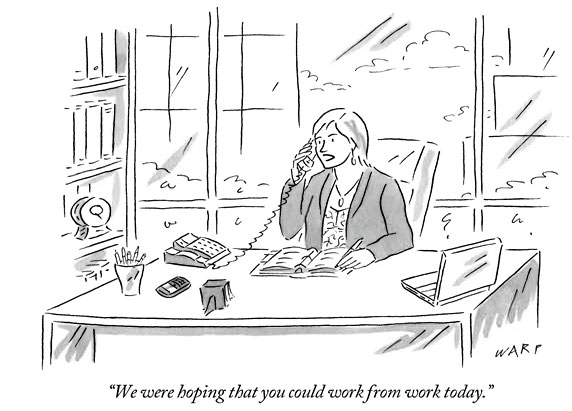
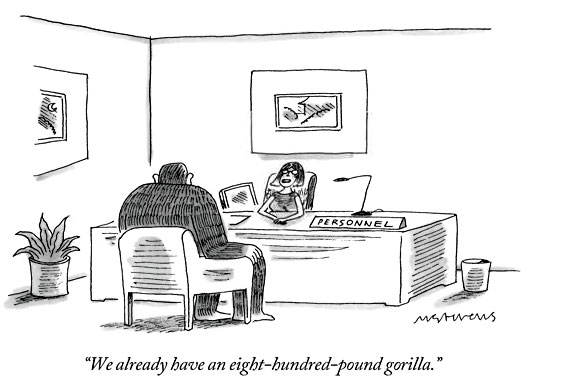
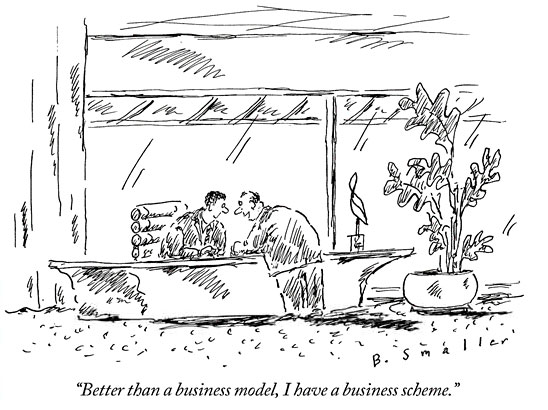

Harry Newton whose 80+ year old friend called. “I’m sick of my Windows machine. I’m going to buy an Apple machine. They have free classes. They’ll teach me how to use it. I hear they’re a lot easier to use.”
Apple is running on all cyclinders: Verizon just sold out of its first batch of iPhone 4s — said it sold the most phones ever on an introduction. Corporations are switching to Macs and iPhone, as Microsoft’s ineptitude is increasingly apparent. My contributing editor on my dictionary, Steven Schoen emails:
Hi Harry,
Microsoft is unbelievable. Its own browser, Internet Explorer, crashed 3 times when I tried to send you this email from Microsoft Outlook.
Now I am using Google’s Chrome browser. Obviously, Google knows more about making Microsoft Outlook work with Microsoft Windows than Microsoft does.
It’s ridiculous.
Meantime, this morning, Canaccord/Genuity upgraded Apple: Technology analyst Michael Walkley raised his target price on AAPL shares to $460 from $432. Mr. Walkley said:
“Our monthly channel checks indicated continued strong sales of the iPhone 4, as it remained by far the top-selling smartphone at AT&T. Further, our checks indicated continued strong sales of the iPad. Finally, our checks indicated Verizon is planning for strong demand for the CDMA iPhone4 launch scheduled for February 10 (this Thursday), and we anticipate strong sales post the launch. As such, we have increased our iPhone unit estimates from 72.9M to 74.8M units for C2011 and raised our pro-forma F2011 EPS estimate from $21.84 to $22.92 and our F2012 estimate from $24.00 to $25.60.”
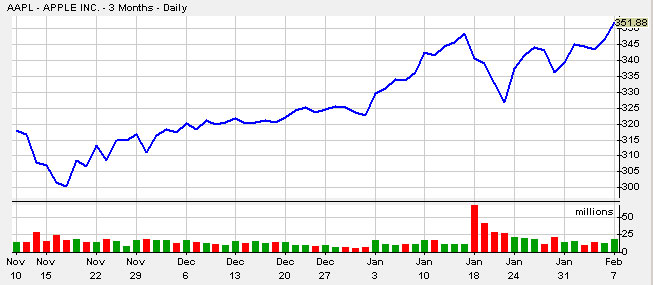
Apple moves ahead:

Harry, you really know how to hurt a guy. I bought AOL stock a few months ago, having read favorable buzz regarding Tim Armstrong and speculating that this could be a “righting the ship” story, with cash flow as a dwindling but still-meaningful kicker. Am now in wait-and-see mode, hoping that Armstrong gives Arianna relatively free rein. A good litmus test might be AOL's home page. I couldn't agree with you more – it is infuriatingly cluttered and – evidently – crafted to the tastes and interests of the terminally stupid. To log onto AOL every day is to submit one's self to a daily dose of cultural drek. But, hey, I guess that's what keeps me on board! (Actually, their “My Portfolios” feature is quite good, and there are a couple of other things I like.)
Isn't it interesting to observe that Apple's channel model is storefront retail? Yes, I bought my iPad from MacMall dot com, but I paid the full retail price and I go to the Apple Store every time I'm dragged to a mall. (The Apple Store and the Sony store… if present.. are the only “guy” places in a mall anymore.) The retail store model… even with the “genius bar”… fits so well for Apple. Why didn't it work for “computer stores”?
Apple Stores : Focused employees who know the products and the products work. Limited number of products sold in high volume. Products made by the the company who's name is on the store.
Computer Stores: Generally poorly trained staff that has to be knowledgable in a wide variety of products. Computers, software, printers, paper, cd's, ink laptops, tv's, DVD's. Can you possibly be everything to everyone in ahighly technical market? They only resell. IMO, the last place one would go for accurate product information. Service problem handled poorly in my expierience.
Amen.
Because,
1. Microsoft lost its Vision when it lost Bill.
2. Dell sold only cheap. That's not Vision.
3. Who else was there? Or is there?