I filled up our propane tank and our two cars with gas. Today I will buy more supplies for the basement, like water and canned food. I took cash money out of the bank. And, for now, I’m in bucolic country, 127 miles north of New York City.
If I were running a company, I’d check what my team is doing about our cybersecurity. I would get my team to give me hard disks with all our corporate information. I want my backups offline. We’ll need those disks to quickly put our IT systems back together — when (not IF) we get hit with Russian cyber attacks.
Putin’s ambitions do not stop with Ukraine. He blames the late 1990s breakup of the Soviet Union on the West generally (as embodied in NATO) and on America specifically. He’s nuts, but he has a big grudge and the resources to wreak havoc.
He’ll do anything to weaken us. For now, it will be cyber. He’s good at that. And we’re not good at protecting ourselves.
Above all, we have no centralized protection against cyberwar — something I’ve been aware of for eons and warning about — and now the subject of a piece today in today’s New York Times:
I’ve Dealt With Foreign Cyberattacks. America Isn’t Ready for What’s Coming.
As Russian missiles rain on Ukraine, there’s another battle brewing — in the cybersphere. Destructive malware has flooded hundreds of Ukrainian websites and computers since Vladimir Putin announced his invasion. It would be a mistake to assume such attacks will remain limited to Ukrainian targets.
Here’s the link: Click here.
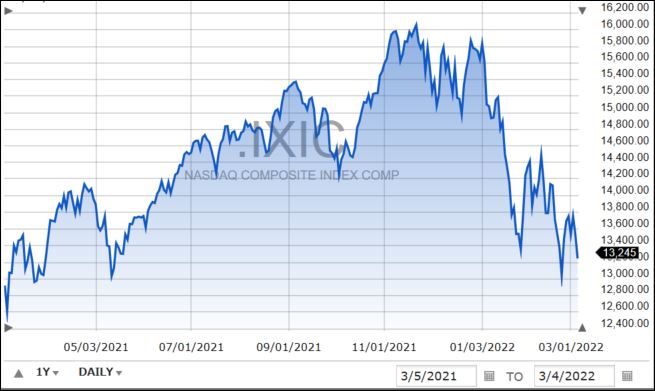
We had a good jobs reports this morning. But the market continues to drop.
I have only two areas that interest me — cyber and energy stocks. They include CrowdStrike (CRWD), Enbridge (ENB) and Chevron (CVX), all of which I own.
Miserable selection, I know. But, buying a little is better than panicking.
I’m looking at stocks with exposure to Europe — like LVMUY (Moët Hennessy Louis Vuitton) and ASML. I sold those two.
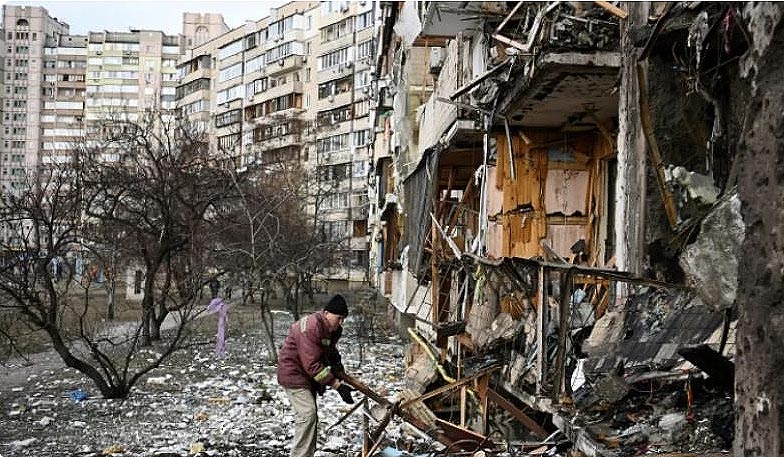
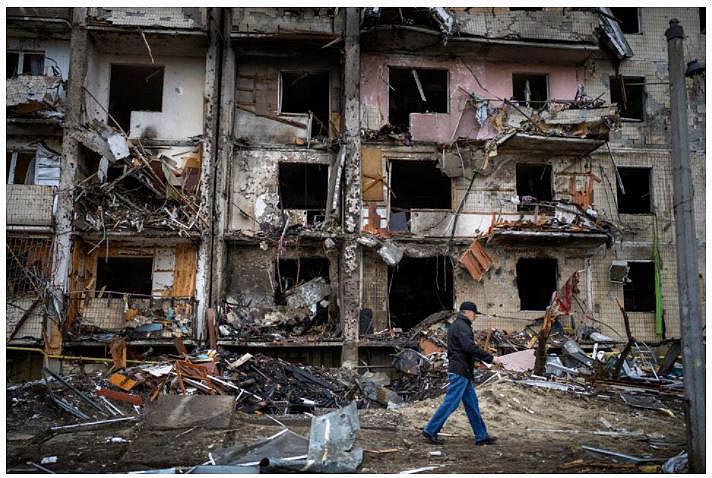
Images of Putin’s Ukraine
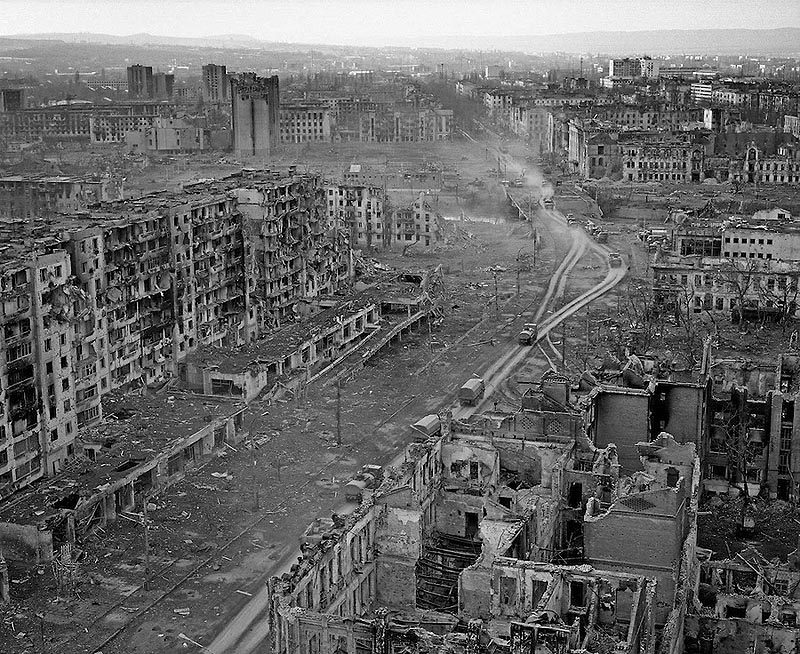
This is what Putin did to Grozny. The 1999–2000 battle of Grozny was the siege and assault of the Chechen capital Grozny by Putin’s forces, lasting from late 1999 to early 2000. The siege and fighting left the capital devastated. In 2003, the United Nations called Grozny the most destroyed city on Earth.
Where do markets go from here?
Where now? Most likely down. The New York Times’s financial reporter, Jeff Sommer, did a piece last weekend:
“The Outlook: Short-Term Rattle, Long Term Rebound.”
Global markets typically rebound from war and disaster, and they are likely to do so this time, too. But Russia’s nuclear arsenal raises the risks beyond calculation.
Here are some excerpts:
Global markets usually weaken as wars approach, strengthen long before wars end and treat human calamity with breathtaking indifference.
That’s been a common historical pattern, anyway. And, with some important caveats, it seems to be playing out with Russia’s latest aggression toward Ukraine. …
Riding out a storm in the stock market has been a good strategy over the long term. One year after the 1941 bombing of Pearl Harbor, the S&P 500 gained 15 percent. A year after the U.S. invasion of Iraq in 2003, it was up 35 percent. History shows that just one year after most stock-market-shattering crises, the S&P 500 stock index has risen.
Russia’s war in Ukraine could be the start of something much bigger: a geopolitical shift that plunges the world into a 21st-century version of the Cold War. But even if that’s the case, the hard numbers suggest that the financial implications for prudent, diversified investors who live far from immediate danger zones may not be all that severe.
The Cold War was destructive and debilitating for vast populations, but it was an excellent period for stock investors. Even during recessions and regional wars, the Dow Jones industrial average turned in an outstanding performance.
Here are the numbers, which I calculated over the long Presidents’ Day weekend:
From President Truman’s March 17, 1948, speech to Congress criticizing what he called the Soviet Union’s expansion of Communism in Eastern Europe, until the end of December, 1991, when the Soviet Union ceased to exist, the Dow returned 10.05 percent, annualized. In the roughly 30 years since then, through Friday, the Dow returned 10.77 percent, annualized, a bit better than during the Cold War, but not by much. …
The Immediate Market Effects
The price of oil is already steep: approaching $100 a barrel, from about $65 a year ago. It is likely to soar higher, especially if Russia mounts a full-scale invasion and, in return, faces harsh financial sanctions by the United States and its allies.
Oil prices are already painful for consumers. They are reflected in the most salient marker of inflation in the United States, the cost of gasoline, which already averages $3.53 a gallon, according to AAA. Inflation is already 7.5 percent, a 40-year high in the United States.
As Caroline Bain, chief commodities economist for the research firm Capital Economics, wrote on Feb. 16: “Much would depend on whether Western sanctions are placed on Russian energy companies and/or Russia decides to withhold energy supply to the West.” In a worst-case outcome, she said, “oil and gas prices could easily double temporarily and the impact on gas prices could last for longer.”
That said, Capital Economics and many other analysts view so severe an outcome as unlikely. Even if energy prices continue to spike — largely because of speculation in financial markets — they are likely to decline quickly, based on fundamental supply and demand, said Edward L. Morse, global head of commodities research at Citigroup and a former deputy assistant secretary of state for international energy policy.
You can read the entire Jeff Somers piece here.
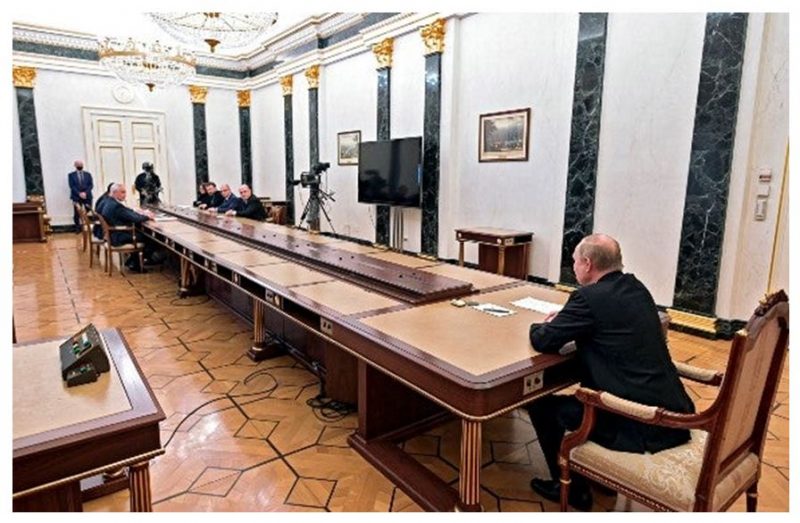
Putin’s 20ft long desk
I originally thought the desk was to protect him from covid. Now I suspect it’s to keep him from being popped off.
I wonder what hearing aids work over that distance?
What country will be next? Moldova? Georgia? Some parts of Georgia are already occupied by Russia, similar to the “breakaway” provinces of Ukraine. This was the old Soviet Union:

Teach the Kids About Puns
+ I have a few jokes about unemployed people, but none of them work.
+ What’s the difference between a hippo and a zippo?
One is really heavy and the other is a little lighter.
+ I went to buy some camouflage trousers yesterday but couldn’t find any.
+ What do you call a bee that can’t make up its mind?
A maybe.
+ When everything is coming your way, you’re in the wrong lane.
+ She had a photographic memory, but she never developed it.
Not enjoyable
I watch the Ukrainian refugees. Over one million of them have now left Ukraine. Many more are leaving. My heart goes out to them. I’m searching for some way to help. Any ideas?
One year in Nasdaq. Who knew?
I could not write this blog in Russia. I’d be in jail for 15 years.
Putin is cracking down. Reporters are fleeing the country. The last independent TV channel has closed. The independent outlets Radio Ekho Moskvy and Dozhd TV, have seen their websites and their ability to broadcast blocked.
And now Putin has taken control of the largest nuclear power plant in Ukraine (and also Europe). It supplies about one-fifth of Ukraine’s electricity.
— Harry Newton
