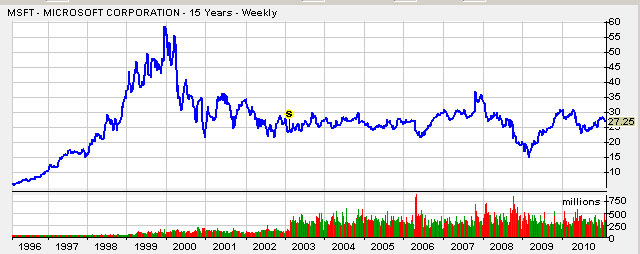
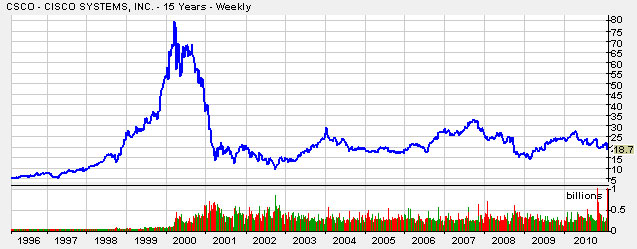
Remember the charts on Friday detailing The Old Technology companies — Cisco, Microsoft, Dell, Intel, Hewlett-Packard and Nokia? Several readers asked why didn’t you run 10 or 15 year charts and show how not one of these companies is anywhere its 1999-2000 peak. Absolutely true. Had you invested in these companies at the end of 1999 / beginning of 2000, you’d be under water today.
More importantly, had you invested any time between 2001 and recently, your investment would have gone nowhere. Zilch. Nada. Nowhere. Here are a couple of 15-year charts.
Google is so important to all of us with web sites. Get more people to our web sites. Get more sales. So thought J.C Penney. By hook or crook, it intended to get those sales. The New York Times investigated and ran this cover story on its Sunday business section. It’s mindblowing. Sorry it’s so long.
February 12, 2011
The Dirty Little Secrets of Search
By DAVID SEGAL
PRETEND for a moment that you are Google’s search engine.
Someone types the word “dresses” and hits enter. What will be the very first result?
There are, of course, a lot of possibilities. Macy’s comes to mind. Maybe a specialty chain, like J. Crew or the Gap. Perhaps a Wikipedia entry on the history of hemlines.
O.K., how about the word “bedding”? Bed Bath & Beyond seems a candidate. Or Wal-Mart, or perhaps the bedding section of Amazon.com.
“Area rugs”? Crate & Barrel is a possibility. Home Depot, too, and Sears, Pier 1 or any of those Web sites with “area rug” in the name, like arearugs.com.
You could imagine a dozen contenders for each of these searches. But in the last several months, one name turned up, with uncanny regularity, in the No. 1 spot for each and every term:
J. C. Penney.
The company bested millions of sites — and not just in searches for dresses, bedding and area rugs. For months, it was consistently at or near the top in searches for “skinny jeans,” “home decor,” “comforter sets,” “furniture” and dozens of other words and phrases, from the blandly generic (“tablecloths”) to the strangely specific (“grommet top curtains”).
This striking performance lasted for months, most crucially through the holiday season, when there is a huge spike in online shopping. J. C. Penney even beat out the sites of manufacturers in searches for the products of those manufacturers. Type in “Samsonite carry on luggage,” for instance, and Penney for months was first on the list, ahead of Samsonite.com.
With more than 1,100 stores and $17.8 billion in total revenue in 2010, Penney is certainly a major player in American retailing. But Google’s stated goal is to sift through every corner of the Internet and find the most important, relevant Web sites.
Does the collective wisdom of the Web really say that Penney has the most essential site when it comes to dresses? And bedding? And area rugs? And dozens of other words and phrases?
The New York Times asked an expert in online search, Doug Pierce of Blue Fountain Media in New York, to study this question, as well as Penney’s astoundingly strong search-term performance in recent months. What he found suggests that the digital age’s most mundane act, the Google search, often represents layer upon layer of intrigue. And the intrigue starts in the sprawling, subterranean world of “black hat” optimization, the dark art of raising the profile of a Web site with methods that Google considers tantamount to cheating.
Despite the cowboy outlaw connotations, black-hat services are not illegal, but trafficking in them risks the wrath of Google. The company draws a pretty thick line between techniques it considers deceptive and “white hat” approaches, which are offered by hundreds of consulting firms and are legitimate ways to increase a site’s visibility. Penney’s results were derived from methods on the wrong side of that line, says Mr. Pierce. He described the optimization as the most ambitious attempt to game Google’s search results that he has ever seen.
“Actually, it’s the most ambitious attempt I’ve ever heard of,” he said. “This whole thing just blew me away. Especially for such a major brand. You’d think they would have people around them that would know better.”
TO understand the strategy that kept J. C. Penney in the pole position for so many searches, you need to know how Web sites rise to the top of Google’s results. We’re talking, to be clear, about the “organic” results — in other words, the ones that are not paid advertisements. In deriving organic results, Google’s algorithm takes into account dozens of criteria, many of which the company will not discuss.
But it has described one crucial factor in detail: links from one site to another.
If you own a Web site, for instance, about Chinese cooking, your site’s Google ranking will improve as other sites link to it. The more links to your site, especially those from other Chinese cooking-related sites, the higher your ranking. In a way, what Google is measuring is your site’s popularity by polling the best-informed online fans of Chinese cooking and counting their links to your site as votes of approval.
But even links that have nothing to do with Chinese cooking can bolster your profile if your site is barnacled with enough of them. And here’s where the strategy that aided Penney comes in. Someone paid to have thousands of links placed on hundreds of sites scattered around the Web, all of which lead directly to JCPenney.com.
Who is that someone? A spokeswoman for J. C. Penney, Darcie Brossart, says it was not Penney.
“J. C. Penney did not authorize, and we were not involved with or aware of, the posting of the links that you sent to us, as it is against our natural search policies,” Ms. Brossart wrote in an e-mail. She added, “We are working to have the links taken down.”
The links do not bear any fingerprints, but nothing else about them was particularly subtle. Using an online tool called Open Site Explorer, Mr. Pierce found 2,015 pages with phrases like “casual dresses,” “evening dresses,” “little black dress” or “cocktail dress.” Click on any of these phrases on any of these 2,015 pages, and you are bounced directly to the main page for dresses on JCPenney.com.
Some of the 2,015 pages are on sites related, at least nominally, to clothing. But most are not. The phrase “black dresses” and a Penney link were tacked to the bottom of a site called nuclear.engineeringaddict.com. “Evening dresses” appeared on a site called casino-focus.com. “Cocktail dresses” showed up on bulgariapropertyportal.com. ”Casual dresses” was on a site called elistofbanks.com. “Semi-formal dresses” was pasted, rather incongruously, on usclettermen.org.
There are links to JCPenney.com’s dresses page on sites about diseases, cameras, cars, dogs, aluminum sheets, travel, snoring, diamond drills, bathroom tiles, hotel furniture, online games, commodities, fishing, Adobe Flash, glass shower doors, jokes and dentists — and the list goes on.
Some of these sites seem all but abandoned, except for the links. The greeting at myflhomebuyer.com sounds like the saddest fortune cookie ever: “Sorry, but you are looking for something that isn’t here.”
When you read the enormous list of sites with Penney links, the landscape of the Internet acquires a whole new topography. It starts to seem like a city with a few familiar, well-kept buildings, surrounded by millions of hovels kept upright for no purpose other than the ads that are painted on their walls.
Exploiting those hovels for links is a Google no-no. The company’s guidelines warn against using tricks to improve search engine rankings, including what it refers to as “link schemes.” The penalty for getting caught is a pair of virtual concrete shoes: the company sinks in Google’s results.
Often drastically. In 2006, Google announced that it had caught BMW using a black-hat strategy to bolster the company’s German Web site, BMW.de. That site was temporarily given what the BBC at the time called “the death penalty,” stating that it was “removed from search results.”
BMW acknowledged that it had set up “doorway pages,” which exist just to attract search engines and then redirect traffic to a different site. The company at the time said it had no intention of deceiving users, adding “if Google says all doorway pages are illegal, we have to take this into consideration.”
J. C. Penney, it seems, will not suffer the same fate. But starting Wednesday, it was the subject of what Google calls “corrective action.”
Last week, The Times sent Google the evidence it had collected about the links to JCPenney.com. Google promptly set up an interview with Matt Cutts, the head of the Webspam team at Google, and a man whose every speech, blog post and Twitter update is parsed like papal encyclicals by players in the search engine world.
“I can confirm that this violates our guidelines,” said Mr. Cutts during an hourlong interview on Wednesday, after looking at a list of paid links to JCPenney.com.
He said Google had detected previous guidelines violations related to JCPenney.com on three occasions, most recently last November. Each time, steps were taken that reduced Penney’s search results — Mr. Cutts avoids the word “punished” — but Google did not later “circle back” to the company to see if it was still breaking the rules, he said.
He and his team had missed this recent campaign of paid links, which he said had been up and running for the last three to four months.
“Do I wish our system had detected things sooner? I do,” he said. “But given the one billion queries that Google handles each day, I think we do an amazing job.”
Mr. Cutts sounded remarkably upbeat and unperturbed during this conversation, which was a surprise given that we were discussing a large, sustained effort to snooker his employer. Asked about his zenlike calm, he said the company strives not to act out of anger. You get the sense that Mr. Cutts and his colleagues are acutely aware of the singular power they wield as judge, jury and appeals panel, and they’re eager to project an air of maturity and judiciousness.
That said, he added, “I don’t think I could do my job well if in some sense I was not offended by things that were bad for Google users.”
“Am I happy this happened?” he later asked. “Absolutely not. Is Google going to take strong corrective action? We absolutely will.”
And the company did. On Wednesday evening, Google began what it calls a “manual action” against Penney, essentially demotions specifically aimed at the company.
At 7 p.m. Eastern time on Wednesday, J. C. Penney was still the No. 1 result for “Samsonite carry on luggage.”
Two hours later, it was at No. 71.
At 7 p.m. on Wednesday, Penney was No. 1 in searches for “living room furniture.”
By 9 p.m., it had sunk to No. 68.
In other words, one moment Penney was the most visible online destination for living room furniture in the country.
The next it was essentially buried.
PENNEY reacted to this instant reversal of fortune by, among other things, firing its search engine consulting firm, SearchDex. Executives there did not return e-mail or phone calls.
Penney also issued a statement: “We are disappointed that Google has reduced our rankings due to this matter,” Ms. Brossart wrote, “but we will continue to work actively to retain our high natural search position.”
She added that while the collection of links surely brought in additional revenue, it was hardly a bonanza. Just 7 percent of JCPenney.com’s traffic comes from clicks on organic search results, she wrote. A far bigger source of profits this holiday season, she stated, came from partnerships with companies like Yahoo and Time Warner, from new mobile applications and from in-store kiosks.
Search experts, however, say Penney likely reaped substantial rewards from the paid links. If you think of Google as the entrance to the planet’s largest shopping center, the links helped Penney appear as though it was the first and most inviting spot in the mall, to millions and millions of online shoppers.
How valuable was that? A study last May by Daniel Ruby of Chitika, an online advertising network of 100,000 sites, found that, on average, 34 percent of Google’s traffic went to the No. 1 result, about twice the percentage that went to No. 2.
The Keyword Estimator at Google puts the number of searches for “dresses” in the United States at 11.1 million a month, an average based on 12 months of data. So for “dresses” alone, Penney may have been attracting roughly 3.8 million visits every month it showed up as No. 1. Exactly how many of those visits translate into sales, and the size of each sale, only Penney would know.
But in January, the company was crowing about its online holiday sales. Kate Coultas, a company spokeswoman, wrote to a reporter in January, “Internet sales through jcp.com posted strong growth in December, with significant increases in traffic and orders for the key holiday shopping periods of the week after Thanksgiving and the week before Christmas.”
There was considerable pressure from investors for Penney to deliver strong holiday results. It has been struggling through one of the more trying times of its century of retailing. The $17.8 billion in revenue it reported last year is the exact same figure it reported in 2001. It announced in January that it would close a handful of underperforming stores, as well as two of its five call centers and 19 outlets that sell excess catalog merchandise.
Adding to the company’s woes is the demise of its catalog business. Penney has phased out what it called its Big Book and poured money into its Web site. But so far, the loss of the catalog has not been offset by the expansion of the Web site. At its peak, the catalog brought in about $4 billion in revenue. In 2009, the site brought in $1.5 billion.
“For the last 35 years, Penney has tried to be accepted as a department store, and during unusually good times, it does very well,” said Bernard Sosnick, an analyst at Gilford Securities. “But in bad times, it gets punished by shoppers who pull back after having spent aspirationally.”
MANY owners of Web sites with Penney links seem to relish their unreachability. But there were exceptions, and they included cocaman.ch. (“Geekness — closer to the world” is the cryptic header atop the site.) It turned out to be owned and run by Corsin Camichel, a chatty 25-year-old I.T. security analyst in Switzerland.
The word “dresses” appears in a small collection of links in the middle of a largely blank Cocaman page. Asked about that link, Mr. Camichel said his records show that it turned up on his site last April, though he said it might have been earlier than that.
The link came through a Web site, TNX.net, which pays Mr. Camichel with TNX points, which he then trades for links that drive traffic to his other sites, like cookingutensils.net. He earns money when people visit that site and click on the ads. He could also, he said, get cash from TNX. Currently, Cocaman is home to 403 links, all of them placed there by TNX on behalf of clients.
“You do pretty well,” he wrote, referring to income from his links trading. “The thing is, the more you invest (time and money) the better results you get. Right now I get enough to buy myself new test devices for my Android apps (like $150/month) with zero effort. I have to do nothing. Ads just sit there and if people click, I make money.”
Efforts to reach TNX itself last week via e-mail were not successful.
Interviewing a purveyor of black-hat services face-to-face was a considerable undertaking. They are a low-profile bunch. But a link-selling specialist named Mark Stevens — who says he had nothing to do with the Penney link effort — agreed to chat. He did so on the condition that his company not be named, a precaution he justified by recounting what happened when the company apparently angered Google a few months ago.
“It was my fault,” Mr. Stevens said. “I posted a job opening on a Stanford Engineering alumni mailing list, and mentioned the name of our company and a brief description of what we do. I think some Google employees saw it.”
In a matter of days, the company could not be found in a Google search.
“Literally, you typed the name of the company into the search box and we did not turn up. Anywhere. You’d find us if you knew our Web address. But in terms of search, we just disappeared.”
The company now operates under a new name and with a profile that is low even in the building where it claims to have an office. The landlord at the building, a gleaming, glassy midrise next to Route 101 in Redwood City, Calif., said she had never heard of the company.
Mr. Stevens agreed to meet in mid-January for a dinner paid for by The Times. Asked to pick a “fine restaurant” in his neighborhood, he rather cheekily selected a modern French bistro in Palo Alto offering an eight-course prix fixe meal for $118. Liquid nitrogen and “fairy tale pumpkin” were two of the featured ingredients.
Mr. Stevens turned out to be a boyish-looking 31-year-old native of Singapore. (Stevens is the name he uses for work; he says he has a Chinese last name, which he did not share.) He speaks with a slight accent and in an animated hush, like a man worried about eavesdroppers. He describes his works with the delighted, mischievous grin of a sophomore who just hid a stink bomb.
“The key is to roll the campaign out slowly,” he said as he nibbled at seared duck foie gras. “A lot of companies are in a rush. They want as many links as we can get them as fast as possible. But Google will spot that. It will flag a Web site that goes from zero links to a few hundred in a week.”
The hardest part about the link-selling business, he explained, is signing up deep-pocketed mainstream clients. Lots of them, it seems, are afraid they’ll get caught. Another difficulty is finding quality sites to post links. Whoever set up the JCPenney.com campaign, he said, relied on some really low-rent, spammy sites — the kind with low PageRanks, as Google calls its patented measure of a site’s quality. The higher the PageRank, the more “Google juice” a site offers others to which it is linked.
“The sites that TNX uses mostly have low PageRanks,” Mr. Stevens said.
Mr. Stevens said that Web site owners, or publishers, as he calls them, get a small fee for each link, and the transaction is handled entirely over the Web.
Publishers can reject certain keywords and links — Mr. Stevens said some balked at a lingerie link — but for the most part the system is on a kind of autopilot. A client pays Mr. Stevens and his colleagues for links, which are then farmed out to Web sites. Payment to publishers is handled via PayPal.
You might expect Mr. Stevens to have a certain amount of contempt for Google, given that he spends his professional life finding ways to subvert it. But through the evening he mentioned a few times that he’s in awe of the company, and the quality of its search engine.
So how does he justify all his efforts to undermine that engine?
“I think we need to make a distinction between two different kinds of searches — informational and commercial,” he said. “If you search ‘cancer,’ that’s an informational search and on those, Google is amazing. But in commercial searches, Google’s results are really polluted. My own personal experience says that the guy with the biggest S.E.O. budget always ranks the highest.”
To Mr. Stevens, S.E.O. is a game, and if you’re not paying black hats, you are losing to rivals with fewer compunctions.
WHY did Google fail to catch a campaign that had been under way for months? One, no less, that benefited a company that Google had already taken action against three times? And one that relied on a collection of Web sites that were not exactly hiding their spamminess?
Mr. Cutts emphasized that there are 200 million domain names and a mere 24,000 employees at Google.
“Spammers never stop,” he said. Battling those spammers is a never-ending job, and one that he believes Google keeps getting better and better at.
Here’s another hypothesis, this one for the conspiracy-minded. Last year, Advertising Age obtained a Google document that listed some of its largest advertisers, including AT&T, eBay and yes, J. C. Penney. The company, this document said, spent $2.46 million a month on paid Google search ads — the kind you see next to organic results.
Is it possible that Google was willing to countenance an extensive black-hat campaign because it helped one of its larger advertisers? It’s the sort of question that European Union officials are now studying in an investigation of possible antitrust abuses by Google.
Investigators have been asking advertisers in Europe questions like this: “Please explain whether and, if yes, to what extent your advertising spending with Google has ever had an influence on your ranking in Google’s natural search.” And: “Has Google ever mentioned to you that increasing your advertising spending could improve your ranking in Google’s natural search?”
Asked if Penney received any breaks because of the money it has spent on ads, Mr. Cutts said, “I’ll give a categorical denial.” He then made an impassioned case for Google’s commitment to separating the money side of the business from the search side. The former has zero influence on the latter, he said.
“If you asked me for the names of five people in advertising engineering, I don’t think I could give you the names,” he said. “There is a very long history at Google of saying ‘We are not going to worry about short-term revenue.’ ” He added: “We rely on the trust of our users. We realize the responsibility that we have to our users.”
He noted, too, that before The Times presented evidence of the paid links to JCPenney.com, Google had just begun to roll out an algorithm change that had a negative effect on Penney’s search results. (The tweak affected “how we trust links,” Mr. Cutts said, declining to elaborate.)
True, JCPenney.com’s showing in Google searches had declined slightly by Feb. 8, as the algorithm change began to take effect. In “comforter sets,” Penney went from No. 1 to No. 7. In “sweater dresses,” from No. 1 to No. 10.
But the real damage to Penney’s results began when Google started that “manual action.” The decline can be charted: On Feb. 1, the average Penney position for 59 search terms was 1.3.
On Feb. 8, when the algorithm was changing, it was 4.
By Feb. 10, it was 52.
MR. CUTTS said he did not plan to write about Penney’s situation, as he did with BMW in 2006. Rarely, he explained, does he single out a company publicly, because Google’s goal is to preserve the integrity of results, not to embarrass people.
“But just because we don’t talk about it,” he said, “doesn’t mean we won’t take strong action.”
I’m very fond of Instapaper.
I love software that does one thing and one thing well. Instapaper does that one thing.
You’re on a web site. It’s interesting. You haven’t time to finish reading it. Bingo, hit “Read Later” — a bar at the top of your browser which Instapaper added. When you have a moment click Instapaper and all your Read Later articles are listed. Click on the desired one and you’re back reading. This is its simple interface.
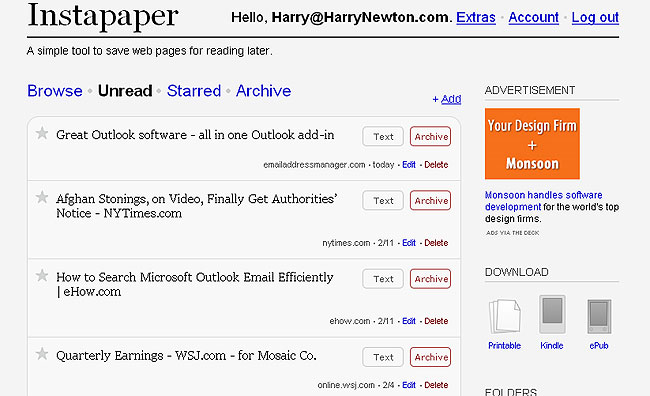
The service is free. Click here.
Tax heads-up from Scott Udine, money manager:
Just a reminder that with “managed accounts”, which throughout Wall Street is in the tens of millions in numbers, you (or your tax planner) do not need to transpose (would be extremely tedious and time consuming) each and every trade that was done throughout the year rather you can take the “bottom line” number that is reported at the end of the “Schedule D” and use that along with a “footnote” explaining that the “documentation behind the number is available upon request”.
Jack Nicholson: The lothario in winter. This wonderful piece from the latest The Week magazine
Though Nicholson has had a good run, he believes his prospects for finding love again are dim.


Two views of Jack, chosen by yours truly from Google images.
Jack Nicholson is no longer on the hunt, said Louise Gannon in the London Daily Mail. At 73, the old lion finds that his power over women has finally waned. “There were points in my life where I felt oddly irresistible to women,” he says. “I’m not in that state now and that makes me sad. I’m definitely still wild at heart. But I’ve struck bio-gravity. I can’t hit on women in public anymore. It just doesn’t feel right at my age.”
Women, he says, have always been his raison d’être. “If men are honest, everything they do and everywhere they go is for a chance to see women.” His wandering attentions, however, haven’t made for lasting relationships. “I’ve been in love in my life, but it always starts with an obsession that lasts exactly 18 months. Then it changes.”
Though he’s had a good run, he believes his prospects for finding love again are dim. “I’ve had everything a man could ask for, but I don’t know if anyone could say I’ve been successful with affairs of the heart. I would love that one last real romance. But I’m not very realistic about that happening.” He pauses, and adds wistfully: “What I can’t deny is my yearning.”
Bankruptcy court rackets. A friend is trying to buy a business out of receivership. He tells me the lawyer handling the case is being paid $600 an hour. And the salesman he has hired to sell the business is being paid by the hour, i.e. no commission.
There is an old adage in the divorce business: Namely the opposing lawyers reach a settlement when their fees equal the size of the monies being squabbled over.
I guess this also applies to the receivership business.
Toyota is recalling many cars. Toyota said the recall was caused by the cars’ electronic systems. The U.S. government ssaid sticking foot-pedals and floor mats accounted for some of the mishaps, but most were caused by “pedal misapplication” or motorists mistaking the accelerator for the brake, reported the Economist. Sounds very much like wardrobe malfunction. Remember that SuperBowl?
Favorite computer error message.

Australian Aborigines make great trackers.
Somewhere in top of the Australia, between Karratha and Onslow.
An Australian tour guide was showing a group of American tourists the Top End. On their way to Kakadu (a national park) he was describing the abilities of theAustralian Aborigine to track man or beast over land, through the air, under the sea.
The Americans were incredulous.
Later in the day, the tour rounded a bend on the highway and discovered, lying in the middle of the road, an Aborigine. He had one ear pressed to the white line whilst his left leg was held high in the air. The tour stopped and the guide and the tourists gathered around the prostrate Aborigine.
“Jacky,” said the tour guide,”what are you tracking and what are you listening for?”
The aborigine replied, “Down the road about 25 miles is a 1971 Baliant Ute (Aussie word for a pickup truck). It’s a red one.. The left pront tyre is bald. The pront end is out of whack, and him got bloody dents in every panel. There are nine black fellas in the back, all drinking warm sherry. There are three kangaroos on the roof rack and 6 dogs on the front seat.”
The American tourists moved forward, astounded by this precise and detailed knowledge.
“Good man, how do you know all that?,” asked one.
The Aborigine replied……… “I fell out off the pucken thing about half an hour ago!”.

Harry Newton who wonders why the Ichabod Crane School in Valatie, New York, just stopped its computer classes, thus leaving a large computer lab full of computers but empty of students. Onthe weekend, I met one of its students, who was lamenting the administration’s budget decision.
I believe computers and software programming should be taught in every grade. My logic is simple: a lawyer with computer skills is far more valuable than one without. Ditto for engineers, salespeople, businessmen, etc. It’s amazing how much more productive any discipline can become when a small dollup of software and computer smarts are thrown into the mix. My limited computer skills have significantly helped in all the business ventures I’ve been involved with.

“How J.C. Penney scammed Google, and us”
Scammed Google??????? You can't be serious. (Read the comments on the NY Times Article.)
Google is most likely going be headed for monopolistic and anti-trust violations.
Example: Google came out with their own driving directions software and suddenly Map Quest was below Google maps in short order. So ya think Google Algorithm just coincidently made Google #1 in search.
Whenever Google comes out with a new product they ironically are the number one in SEO.
Google is being investigated no on the EU for placing companies higher in search because they spend good deal of money on Google Adwords.
Europe Opens Antitrust Inquiry Into Google
By JAMES KANTER and ERIC PFANNER
BRUSSELS — Europe opened a formal antitrust investigation on Tuesday into accusations that Google had abused its dominance in online search, exposing the company’s zealously guarded technology to unwelcome scrutiny.
The investigation by the European Commission follows complaints from smaller Web businesses, which claim that Google downgraded their sites in its search results to weaken potential competitors for advertising. The commission said it would also look into whether Google might have given its Web services “preferential placement” in search results.
“Rigorous competition of all players, including smaller and innovative ones, must be preserved for the future,” Joaquín Almunia, the competition commissioner, told members of the European Parliament. He added, however, that the decision to upgrade the investigation from a preliminary inquiry that was started this year did not mean “that there is definitely a problem.”
Google’s dominance on the Internet has been a sore point in Europe, where it controls more than 80 percent of the online search market, compared with about 66 percent in the United States, according to comScore, a research firm.
Google already faces antitrust inquiries, as well as investigations of its privacy and copyright protection policies, in several European countries. In addition, other American companies have fought lengthy legal battles with European regulators in the past.
In a statement, Google said it had strived to “do the right thing by our users and our industry.”
“But there’s always going to be room for improvement,” the company said, “and so we’ll be working with the commission to address any concerns.”
A spokeswoman for Mr. Almunia, Amelia Torres, said the commission had notified the Justice Department in Washington about the investigation. Authorities in the United States have been examining Google’s acquisitions and actions for indications that its market power may be anticompetitive but have not brought any formal proceedings. Google had been eager to avoid a formal investigation in Brussels after watching other American technology companies, like Microsoft and Intel, battle the antitrust authorities there for years. The European Commission’s moves in antitrust matters are often followed up by American regulators at the state or federal level.
“I think we’ve all seen this movie before in the case of Microsoft,” Keith Hylton, a professor at the Boston University School of Law, said in an e-mail.
Google has become a powerhouse on the Internet by helping publishers offer Web advertising space, as well as by selling search-related ads, which appear as “sponsored links” alongside the so-called natural search results.
The commission investigation stems from complaints by three companies: Foundem, a British price comparison service; Ciao, a price comparison service in Germany owned by Microsoft; and eJustice, a French legal search tool. People with direct knowledge of the case, who were not authorized to comment publicly, said at least one additional complaint had been filed.
Foundem said that it suffered big financial losses when Google downgraded it in search results and that Google unfairly favored its other online services, which include mapping, translation and video .
The commission said it would also examine whether Google lowered the “quality score” of competing search services, making it more expensive for them to buy sponsored links.
In addition, the investigation will look into whether Google imposed exclusivity obligations on Internet companies that use Google’s advertising systems, preventing them from placing ads from Google rivals on their Web sites.
In response, Google said AdSense, its program for advertising partner sites, stopped using exclusive contracts two years ago. The company says that when it downgrades a company in its search rankings, it is often because such sites merely duplicate content from other sites, making them less useful to consumers.
“We built Google for users, not Web sites, and the nature of ranking is that some Web sites will be unhappy with where they rank,” Google said.
The company says its high share of searches does not equate to a position of dominance on the Internet because of the rise of companies like Facebook and Twitter, which, like search, also serve as a source of links to other Web sites.
Google has highlighted the role of its rival Microsoft in the antitrust complaints against it, noting its ownership of Ciao and the membership of Foundem in a Microsoft-sponsored lobbying group in Brussels, called Icomp.
European officials did not regard the current crop of complaints as sufficient to take immediate action against Google, according to people with direct knowledge of the investigation, who spoke on condition of anonymity because they were not authorized to comment publicly.
The opening of the formal investigation allows officials to send detailed questionnaires to companies doing business with Google, as well as competitors, and to demand that they provide answers in similar detail. The commission wants companies to come forward with any information about possible competitive abuses by Google, while shielding them from fear of retaliation by Google, according to the people with knowledge of the inquiry.
Jacques Lafitte, who represents eJustice, said that responses by other companies to the questionnaires could enlarge the scope of the investigation.
He said that any company that currently has a large exposure to the Internet “has, one way or the other, a serious problem with Google.”
Ms. Torres said investigators could reach a preliminary conclusion about whether Google has violated European competition law over the course of next year, and possibly within “a few months,” Ms. Torres said.
If Google is found in violation of European competition law, the commission has the power to fine it up to 10 percent of its annual revenue, which totaled more than $23 billion last year.
Before settling last year, Microsoft had paid fines of about $2.4 billion over the past decade in a long-running antitrust case in Brussels that focused on the Windows operating system.
In another case, the commission fined Intel about $1.45 billion for abusing its dominance in the computer chip market. Intel has appealed that decision to an European Union tribunal.
James Kanter reported from Brussels and Eric Pfanner from Paris.
Netflix is moving today. I shorted based on Whitney Tidon's idiotic short report. I should have listened to Stock Bodine.
Sammy Shabetai, phd
I AM A CPA AND A HOMOSEXUAL FROM SOUTHER CALI. AS A GAY MAN AND A GAY ACCOUNTANT I TOO THINK THAT THE SCOTT UNDINE SHOULD STICK TO STOCKS AND NOT THE TAX BUSINESS.
JEROME EFRIG cpa
Do you need a hearing aid?
Scott Udine, who has been calling for a correction “at any time” since last year is now in the business of tax advice. As far as not listing the schedule d detail transaction, I was admonished for doing exactly that during a federal tax audit last summer. I said I couldn't possibly log all my trades and the federal tax auditor said I should hire a helper. Apparently, the irs instructions were changed. Here is the relevant blurb from the sched d 2010 instructions: “DO NOT ENTER “AVAILABLE ON REQUEST”AND SUMMARY TOTALS IN LIEU OF REPORTING THE DETAILS OF EACH TRANSACTION ON SCHEDULES D AND D-1 OR ATTACHED STATEMENTS.”
Harry,
You might be amazed at how many things I've bought, used, read because of your referral. Not stocks or investments but stuff like the the Pop headset (love it), a scanner (worked out great for converting slides), Griftopia (hated it) etc. I can't say I do that with any other website. I just downloaded InstaPaper. Great idea. What did you decide to do about the hearing aids? I have one, need a new one but they all seem like very expensive rips. Did you go with that model? Is it worth the $3,000?
David
zheeeseeessszeeezzzzz