From the New York Times yesterday:
China Acts to Tighten Grasp on Rare Earths Production
HONG KONG — Premier Wen Jiabao of China and his cabinet decided Wednesday to “streamline” the country’s rare earth industry by consolidating production, clamping down on illegal mining and clearly deciding which government agencies would oversee it, the government said.
State media reported last summer that two government agencies had drafted proposals for the cabinet calling for a few state-owned rare earth mining enterprises to take over the country’s legal and illegal private rare earth mines and consolidate production.
In a statement on Wednesday, the government did not specify how production would be consolidated. But Beijing officials and industry executives have been predicting that the government would order mergers to produce as few as three state-owned businesses that would coordinate production and prices.
China mines 95 percent of the world’s rare earths, a group of 17 physical elements that are crucial for smartphones, computers, compact fluorescent bulbs, medical imaging equipment, oil refining and many military technologies. Chinese officials have complained for years that vigorous competition among many small rare earth mining companies had kept prices too low — a popular phrase recently has been that China was exporting “gold for the price of cabbages.”
The statement on Wednesday was vague about how regulatory authority would be clarified, but noted that the ministry of land resources in Beijing had asserted regulatory control last month over 11 rare earth mining districts totaling 965 square miles in southern Jiangxi province. Local and provincial agencies previously oversaw the districts but struggled to control environmentally destructive illegal mining by organized crime syndicates, whose huge profits allow them to buy influence with local officials.
China has been reducing its annual rare earth export quotas since 2006, and particularly in the last two years. The Chinese government set off international alarm in September when it imposed an unannounced embargo for two months on shipments of raw rare earths to Japan during a territorial dispute. It halted some shipments to the United States and Europe as well for a week in October.
Bloomberg wrote yesterday:
China Rare Earth Stocks Advance on Development Plan
Rare-earth companies in China, the world’s biggest producer, rose in Shanghai and Shenzhen trading after the government announced plans to develop the industry.
Inner Mongolia Baotou Steel Rare-Earth Hi-Tech Co. rose as much as 8.9 percent to 80.20 yuan, the highest since Nov. 15, in Shanghai, trading at 77.18 yuan as of 10:13 a.m. local time. China Nonferrous Metal Industry’s Foreign Engineering and Construction Co. gained 2.3 percent to 32.48 yuan in Shenzhen. Rising Nonferrous Metals Share Co. surged as much as 8.9 percent to 75.35 yuan in Shanghai, trading at 72.87 yuan at 10:44 a.m.
Premier Wen Jiabao said yesterday China will promote new technology in the industry and accelerate the pace of mergers and acquisitions among rare-earth producers under a five-year plan. The country controls more than 95 percent of the world’s supply of rare earths, a group of 17 chemically similar elements used in hybrid cars, iPods and weapons.
China will take “stricter” measures to control mining of rare earths and lift environmental standards, while continuing to cap production and exports with the quota system, the official Xinhua News Agency reported, citing Wen at a State Council meeting yesterday. China will encourage the development of large rare-earth companies, as well as controlling the scale of mines and boosting management, the China Securities Journal reported yesterday.
Lynas Corp., building a A$550 million ($552 million) rare earths project in Australia, advanced as much as 2.3 percent to A$1.965 today in Sydney, trading at A$1.955 as of 10:35 a.m. Shanghai time. Molycorp Inc., owner of the world’s largest rare- earth deposit outside of China, gained 1.2 percent to $48.87 yesterday in New York Stock Exchange composite trading.
China’s policy of slashing exports of the metals soured ties with major users including the U.S. and Japan, and caused prices to surge.
The government introduced its export quota system for rare earths in 1999. Last July, the country said it would slash exports 72 percent to meet domestic demand and preserve reserves. That was followed in December by a 35 percent cut in quotas to 14,446 tons for the first half of 2011.
Richard Russell writes yesterday:
I like the future of rare earths. I bought a small position in the rare earth exchange traded fund, REMX. This ETF looks OK, but nothing dramatic has occurred. The action has been slow. I’ll sit with my small position until either the ETF breaks out to the upside or until it craps out. Either way, I don’t feel under stress holding a limited position in REMX. Actually, although I like the story in REMX, I don’t have the guts to take a big position in this ETF. Wait, if REMX closes at 27 or better, I’ll add to my position. Otherwise, I’ll just sit.
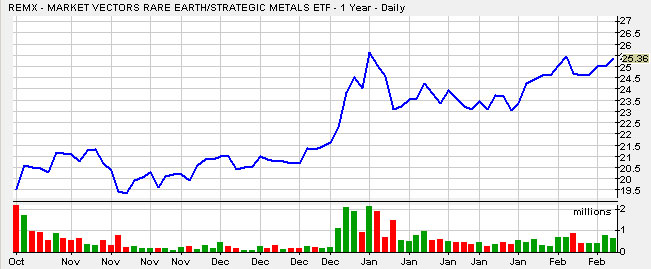
According to the Wall Street Journal,
The Fund (REMX) seeks to replicate as closely as possible the price and yield performance of the Market Vectors Rare Earth/Strategic Metals Index. The Fund tracks the overall performance of publicly traded companies primarily engaged in mining, refining and manufacturing of rare earth/strategic metals.
Why Isn’t Wall Street in Jail? A good question Matt Taibbi, author of the book Griftopia (which I recommend) and Rolling Stone reporter writes:
Financial crooks brought down the world’s economy — but the feds are doing more to protect them than to prosecute them…
Over drinks at a bar on a dreary, snowy night in Washington this past month, a former Senate investigator laughed as he polished off his beer.
“Everything’s fucked up, and nobody goes to jail,” he said. “That’s your whole story right there. Hell, you don’t even have to write the rest of it. Just write that.”
I put down my notebook. “Just that?”
“That’s right,” he said, signaling to the waitress for the check. “Everything’s fucked up, and nobody goes to jail. You can end the piece right there.”
Nobody goes to jail. This is the mantra of the financial-crisis era, one that saw virtually every major bank and financial company on Wall Street embroiled in obscene criminal scandals that impoverished millions and collectively destroyed hundreds of billions, in fact, trillions of dollars of the world’s wealth — and nobody went to jail. Nobody, that is, except Bernie Madoff, a flamboyant and pathological celebrity con artist, whose victims happened to be other rich and famous people.
The rest of them, all of them, got off. Not a single executive who ran the companies that cooked up and cashed in on the phony financial boom — an industrywide scam that involved the mass sale of mismarked, fraudulent mortgage-backed securities — has ever been convicted. Their names by now are familiar to even the most casual Middle American news consumer: companies like AIG, Goldman Sachs, Lehman Brothers, JP Morgan Chase, Bank of America and Morgan Stanley. Most of these firms were directly involved in elaborate fraud and theft. Lehman Brothers hid billions in loans from its investors. Bank of America lied about billions in bonuses. Goldman Sachs failed to tell clients how it put together the born-to-lose toxic mortgage deals it was selling. What’s more, many of these companies had corporate chieftains whose actions cost investors billions — from AIG derivatives chief Joe Cassano, who assured investors they would not lose even “one dollar” just months before his unit imploded, to the $263 million in compensation that former Lehman chief Dick “The Gorilla” Fuld conveniently failed to disclose. Yet not one of them has faced time behind bars.
Instead, federal regulators and prosecutors have let the banks and finance companies that tried to burn the world economy to the ground get off with carefully orchestrated settlements — whitewash jobs that involve the firms paying pathetically small fines without even being required to admit wrongdoing. To add insult to injury, the people who actually committed the crimes almost never pay the fines themselves; banks caught defrauding their shareholders often use shareholder money to foot the tab of justice. “If the allegations in these settlements are true,” says Jed Rakoff, a federal judge in the Southern District of New York, “it’s management buying its way off cheap, from the pockets of their victims.”
To understand the significance of this, one has to think carefully about the efficacy of fines as a punishment for a defendant pool that includes the richest people on earth — people who simply get their companies to pay their fines for them. Conversely, one has to consider the powerful deterrent to further wrongdoing that the state is missing by not introducing this particular class of people to the experience of incarceration. “You put Lloyd Blankfein in pound-me-in-the-ass prison for one six-month term, and all this bullshit would stop, all over Wall Street,” says a former congressional aide. “That’s all it would take. Just once.”
But that hasn’t happened. Because the entire system set up to monitor and regulate Wall Street is fucked up.
Just ask the people who tried to do the right thing.
Taibbi concludes his article:
All of this paints a disturbing picture of a closed and corrupt system, a timeless circle of friends that virtually guarantees a collegial approach to the policing of high finance. Even before the corruption starts, the state is crippled by economic reality: Since law enforcement on Wall Street requires serious intellectual firepower, the banks seize a huge advantage from the start by hiring away the top talent. Budde, the former Lehman lawyer, says it’s well known that all the best legal minds go to the big corporate law firms, while the “bottom 20 percent go to the SEC.” Which makes it tough for the agency to track devious legal machinations, like the scheme to hide $263 million of Dick Fuld’s compensation.
“It’s such a mismatch, it’s not even funny,” Budde says.
But even beyond that, the system is skewed by the irrepressible pull of riches and power. If talent rises in the SEC or the Justice Department, it sooner or later jumps ship for those fat NBA contracts. Or, conversely, graduates of the big corporate firms take sabbaticals from their rich lifestyles to slum it in government service for a year or two. Many of those appointments are inevitably hand-picked by lifelong stooges for Wall Street like Chuck Schumer, who has accepted $14.6 million in campaign contributions from Goldman Sachs, Morgan Stanley and other major players in the finance industry, along with their corporate lawyers.
As for President Obama, what is there to be said? Goldman Sachs was his number-one private campaign contributor. He put a Citigroup executive in charge of his economic transition team, and he just named an executive of JP Morgan Chase, the proud owner of $7.7 million in Chase stock, his new chief of staff. “The betrayal that this represents by Obama to everybody is just — we’re not ready to believe it,” says Budde, a classmate of the president from their Columbia days. “He’s really fucking us over like that? Really? That’s really a JP Morgan guy, really?”
Which is not to say that the Obama era has meant an end to law enforcement. On the contrary: In the past few years, the administration has allocated massive amounts of federal resources to catching wrongdoers — of a certain type. Last year, the government deported 393,000 people, at a cost of $5 billion. Since 2007, felony immigration prosecutions along the Mexican border have surged 77 percent; nonfelony prosecutions by 259 percent. In Ohio last month, a single mother was caught lying about where she lived to put her kids into a better school district; the judge in the case tried to sentence her to 10 days in jail for fraud, declaring that letting her go free would “demean the seriousness” of the offenses.
So there you have it. Illegal immigrants: 393,000. Lying moms: one. Bankers: zero. The math makes sense only because the politics are so obvious. You want to win elections, you bang on the jailable class. You build prisons and fill them with people for selling dime bags and stealing CD players. But for stealing a billion dollars? For fraud that puts a million people into foreclosure? Pass. It’s not a crime. Prison is too harsh. Get them to say they’re sorry, and move on. Oh, wait — let’s not even make them say they’re sorry. That’s too mean; let’s just give them a piece of paper with a government stamp on it, officially clearing them of the need to apologize, and make them pay a fine instead. But don’t make them pay it out of their own pockets, and don’t ask them to give back the money they stole. In fact, let them profit from their collective crimes, to the tune of a record $135 billion in pay and benefits last year. What’s next? Taxpayer-funded massages for every Wall Street executive guilty of fraud?
The mental stumbling block, for most Americans, is that financial crimes don’t feel real; you don’t see the culprits waving guns in liquor stores or dragging coeds into bushes. But these frauds are worse than common robberies. They’re crimes of intellectual choice, made by people who are already rich and who have every conceivable social advantage, acting on a simple, cynical calculation: Let’s steal whatever we can, then dare the victims to find the juice to reclaim their money through a captive bureaucracy. They’re attacking the very definition of property — which, after all, depends in part on a legal system that defends everyone’s claims of ownership equally. When that definition becomes tenuous or conditional — when the state simply gives up on the notion of justice — this whole American Dream thing recedes even further from reality.
You can read the rest of Taibbi’s article in the latest Rolling Stone magazine, or click here.
The best beer commercial ever. Click here.
Everything gets outsourced. Why not singing birthday wishes?

Pick a song on the web site. It’s $10 for two. Someone from India will call your friend and sing him a song (replete with Call Center accent). TajTunes will send you, the customer, a copy. It’s a hoot. Here’s a sample my daughter sent to her friend. Click here. A guy in Boston called Dave thought up the idea for TajTunes.
Ensure. Amazing stuff. My 94-year old father-in-law loves this stuff. It’s very sweet.

It’s designed to give old people nutrition and other stuff they don’t get from their increasingly lousy eating habits. The ingredients are mind-blowing:
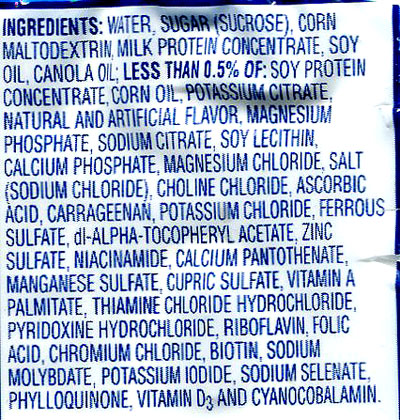
Ensure is made by Abbott Labs, a pharmaceutical company. Their stock (ABT) isn’t doing well. But I bet their Ensure sales are.

Harry Newton who knows nothing more about rare earth minerals than what he’s written above. If I get some time today, I’ll research more. The WSJ doesn’t even list the top ten holdings for RMEX. Something weird here. Meantime, if anyone has some ideas on this intriguing field, please send me an email.

Nice post. Sometimes, the problem might be caused by other issues.I do prefer using other app to fix the
Ensure is not a drink, it is a disease. It goes to show you the state of nutritional thinking in this country that Abbott's can own this segment of the business with a product that is pure poison. They virtually give the stuff away to hospitals so that when you get out of the facility you run down to CVS and buy it. It is pure crap, heck people would be better off eating a Milky Way bar or a cup of Haagen Daz ice cream than to drink Ensure. And to think that they advertise it on TV as a health drink. They should be sued, vanquished from doing business in America. It wasn't long ago that they took partially hydrogenated oil out of Ensure and yet it is the standard formulary in virtually every healthcare facility in the country (or Boost by Nestle which is just as bad.) No wonder we're an obese, sick people.
This one has popped in recent months:
http://avalonraremetals.com/