The consumer is definitely back — both in basic goods (see Home Depot below and Wal-Mart in the news, earnings up 27%) and in luxury goods. Since two-thirds of our economy is sales to the consumer, the return of the consumer is super great. Most remarkable has been the speed of that return — despite our high unemployment. I had no idea it would be that fast.
My friend Scott Udine, money manager, writes this morning:
Yes, the consumer definitely coming back, but the big question is, is it priced into the market already? We have had a huge run the last year or two. (See below.)
A little rest and contained pullback would be healthy and build a base for higher prices in the near future. But not sure if we get that because everyone continues to buy “all dips”. Today will be a good opportunity to see how confident the buyers are, futures weak pre-market and another opportunity for the bears to wrestle control. Let’s see what they can do.
Here’s Bloomberg this morning:
Home Depot Quarterly Profit Rises 72% on Customer Visits
Home Depot Inc., the largest U.S. home-improvement retailer, raised its full-year earnings forecast and posted a 72 percent gain in fourth-quarter profit after attracting customers who spent more money on average.
Net income increased to $587 million, or 36 cents, in the quarter ended Jan. 30, Atlanta-based Home Depot said today in a statement. Analysts had predicted 31 cents, based on the average of 21 estimates compiled by Bloomberg.
The number of transactions advanced 1.4 percent to 292 million as Home Depot lured customers to buy paint, light fixtures and plumbing supplies to repair their homes. The retailer also cut operating expenses by 1.9 percent in the quarter.
From Seeking Alpha this morning:
Bill Miller’s 15 Largest Long-Term Stock Picks
Legg Mason Global Asset Management is one of the largest asset management firms in the world. Assets under management as of December 31, 2010 were $672 Billion (11th largest asset manager in the world). 50% of these assets invested in fixed income securities and most of these (70%) are in the Americas Division. Legg Mason Capital Management is one of its subsidiaries. It was founded in 1982, based in Baltimore. It specializes in long-term, valuation based equity management. Bill Miller is chairman and CIO of Legg Mason Capital Management. He graduated from Washington and Lee University with a degree in economics. Before joining Legg Mason in 1981, he served as treasurer of the J.E. Baker Company. Before the subprime crisis, he was one of the most famous and successful investment managers in the world. He was named by Money Magazine as “The Greatest Money Manager of the 1990’s”. Between 1990 and 2005 Miller had a phenomenal track record by beating SPY for 15 straight years. However, between 2005 and 2010 he underperformed the SPY except 2009.
Bill Miller is a long term value investor; he says that:
We are value investors because we are persuaded of the logic of buying shares of businesses when others want to sell them, and we understand that lower prices today mean higher future rates of return, and high prices today mean lower future rates of return.
In a recent interview, Miller said, “I would look for a long- term orientation, and the evidence for that would be a relatively low portfolio turnover. In a world of 110% to 115% turnover, something in the 50% range or less — ideally in the 20% to 30% range — is what would make sense.” During the last 5 quarters, he had owned 490 different stocks and half of them are long term investments. 368 of those are still in the portfolio at the end of December 2010. As he suggested, he has a low turnover rate.
He thinks that the US economy is stronger compared to both developed and emerging economies and he is extremely bullish about the US stock market. In mid November, Bill Miller said that US stocks may rise 15% in the next 12 months because of the actions of the Fed. Since then, SPY returned 11.2%.
His 15 largest positions and 15 largest long-term picks are the same. When he invests large amounts in a stock, it is probably a long term investment. Miller had $13.4 billion invested in US equity. Below are Miller’s 15 largest long term investments at the end of December 2010:
1. The AES Corporation (AES): Legg Mason had $577 Million of AES stock, which returned 2.9% since mid February 2010. Miller reduced his AES holdings by 11%, according to the latest 13F forms filled at the end of December.
2. Texas Instruments (TXN): Texas Instruments investment returned 46.3% during the past year. The amount of investment is $403 Million. Miller reduced his TXN holdings by 25% during the last quarter of 2010. Since then the stock returned 11.1%. David Tepper also bought TXN during the third quarter.
3. Cisco Systems (CSCO): Miller had $363 Million invested in this stock. Stock holdings increased by 5% and it lost 21.9% during the last year. CSCO is Miller’s worst performing pick. John Burbank’s Passport Capital, Leon Cooperman’s Omega Advisors, and David Tepper’s Appaloosa are among the hedge funds that lost a lot of money for being bullish about CSCO.
4. Wells Fargo & Company (WFC): Miller had $361 Million WFC shares at the end of December. WFC gained 24.7% during the last 12 months and outperformed the SPY by 3.2 percentage points. Stock holdings increased by 18.5% during the last quarter and WFC returned 9.1% since then. Warren Buffett was extremely bullish about Wells Fargo during the fourth quarter, adding another 6+ Million shares to his $11+ Billion WFC holdings.
5. QUALCOMM (QCOM): Miller has returned 50.9% from his QCOM investment of $354 Million during the last 12 months. The stock outperformed the SPY by 29.4 percentage points. Miller reduced his stock holdings by 5% during the last quarter, it returned 18.5% since then. Lee Ainslie, George Soros, and Lee Hobson are QCOM investors too.
6. Microsoft Corporation (MSFT): Miller had $332 Million in MSFT shares at the end of December. These shares lost 4.2% since February 2010. Miller kept his MSFT holdings same in the fourth quarter of 2010. Stock lost 2.8% since then. Microsoft is a hugely popular stock among the top hedge funds. Thomas Steyer’s Farallon Capital, Richard Perry’s Perry Capital, Leon Cooperman’s Omega Advisors, Barry Rosenstein’s Jana Partners, Curtis Schenker’s Scoggin Capital, David Einhorn’s Greenlight Capital, Brevan Howard, and Whitney Tilson’s T2 Partners are among the hedge funds that are extremely bullish about Microsoft. We are a Microsoft investor too.
7. EMC Corporation (EMC): Miller’s $323 Million in EMC has gained 51.1% during the last 4 quarters. Miller has reduced his holdings by 4.5% during the last quarter of 2010. The stock returned 17.5% since then. Andreas Halvorsen’s Viking Global likes EMC.
8. American Express (AXP): Legg Mason Capital Management held $288 Million AXP shares on December 31st 2010. The stock holdings are almost unchanged since the end of September and it returned 8.1% since then. American Express gained 20.3% during the past 1 year, slightly underperforming the SPY.
9. International Business Machines (IBM): Legg Mason had $283 Million of IBM shares. This investment returned 30.4% during the past 1 year. Legg Mason reduced the stock holdings by 24% during the fourth quarter of 2010. Stock returned 11.4% since then and outperformed the SPY by 5.6 percentage points. Selling IBM shares was not a good decision.
10. Amazon.com (AMZN): Miller had about $270 Million of Amazon.com shares at the end of December. The stock returned 60.8% during the past 1 year, beating the SPY by a huge margin. The stock holdings were reduced by 30% during the last 3 months of 2010. AMZN returned 5% since then, 0.8 percentage points less than SPY’s return. AMZN is Miller’s best long-term pick. Facebook billionaire Chase Coleman and Roberto Mignone has large AMZN holdings as well.
11. eBay (EBAY): Legg Mason had $259 Million of eBay shares. The stock gained 47.1% during the past year and outperformed the SPY, which returned 21.5% since then. Legg Mason reduced their eBay holdings by 26.4% during the 4th quarter of 2010. Stock returned 23.8% since then, outperforming the SPY by 18 percentage points.
12. General Electric Co. (GE): Miller’s $259 Million investment in GE returned 36.4% during the past year. Stock holdings are almost unchanged during the last quarter of 2010. Stock returned 17.3% since then.
13. Citigroup (C): Citigroup is one of Miller’s long-term holdings. He had $252 Million worth of C at the end of December. During the past year, C returned 43.6% and outperformed the SPY by a huge margin. Stock holdings were reduced by 16% during the 4th quarter. Stock returned 3.8% since then, slightly underperforming the SPY’s 5.8% return. Citigroup is also a hugely popular stock among several hedge funds (see the list of hedge funds here).
14. Time Warner (TWX): Miller holds $247 Million of TWX shares. TWX returned 28.3% during the past year. Miller reduced his Time Warner stake by 14% in the 4th quarter. TWX gained 14% since then, outperforming the SPY by 8.3 percentage points.
15. JPMorgan Chase (JPM): Bill Miller had $245 Million in JPM shares at the end of December. These shares have returned 17.5% since February 2010, underperforming the SPY by 4 percentage points. Stock holdings are almost unchanged during the 4th quarter, stock returned 10.5% since the end of December.
How do you make a revolution? Have you read about a remarkable, ultra-shy 85-year old American philosopher called Gene Sharp? His ideas have inspired the revolutions we’re seeing every night on TV. He is generally considered the father of the whole field of the study of strategic nonviolent action. For the New York Times article on him, click here.
His 93 page book has been translated into many languages, including Arabic. His book is called From Dictatorship to Democracy — A Conceptual Framework for Liberation. You can download his remarkable book in English in its entirety from my site. Click here.
Hipmunk is great for checking fares on all airlines.It works on your iPhone and your laptop. I prefer the laptop version. Bigger screen.
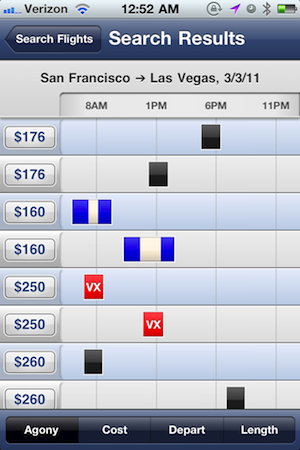
Click here.
How is your geography of the Middle East? This is a great, fun puzzle. Pick the names of the countries. No one I know has got them all right yet. The “stans” are what get most people. I confused Qatar and Bahrain. This will take two minutes of your time. Oodles of fun. Click here.
This is what happens to an economy under a long-term dictatorship.
In Egypt today, one-third of the economy is under state control, a legacy of the Nasser regime; another third is under control of the military, which owns factories, holiday resorts, construction companies, and banks. These two controlling sectors are well protected from competition by complicated administrative rules and de facto monopolies. The owners and controllers of these companies are more often rent-seekers than true entrepreneurs: they make for a wealthy elite but a poor nation.
The remaining third of the Egyptian economy-mostly farming, peddling, small repair shops, and local services, along with some professionals like lawyers and medical doctors-is in private hands. … The private economy has no access to credit, no development capacity, and it creates few professional opportunities.
Further, 92 percent of Egyptians have no legal title for their dwellings, and Egyptian law makes it all but impossible for such people to obtain credit. To open, say, a bakery, a would-be entrepreneur must endure 500 days of administrative procedures, with bureaucratic corruption involved at each step.
Africa’s longest-remaining dictator is Robert Mugabe of Zimbabwe. Latest incredible news:
Dozens of students, trade unionists and political activists who gathered to watch Al Jazeera and BBC news reports on the uprisings that brought down autocrats in Tunisia and Egypt have been arrested on suspicion of plotting to oust President Robert Mugabe of Zimbabwe.
James Sabau, a spokesman for the police force, which is part of the security services controlled by Mr. Mugabe’s party, was quoted in Monday’s state-controlled newspaper as saying that the 46 people in custody were accused of participating in an illegal political meeting where they watched videos “as a way of motivating them to subvert a constitutionally elected government.”
The evidence seized by the police included a video projector, two DVD discs and a laptop.
Lawyers for the men and women in custody said they had not yet been formally charged but had been advised that they might be accused of “attempting to overthrow the government by unconstitutional means,” a crime punishable by up to 20 years in prison.
The disgusting state of smaller muni bonds. Of a recent sample of 17,000 municipal borrowers-mostly small issuers, including as school district, more than a third hadn’t produced financial statements for at least three years, leaving investors with scant information, according to a study commissioned by the Wall Street Journal.
You’d be crazy to buy a bond issued by the West Podunk School District. I prefer ones whose interest payments are covered by a designated income stream — such as hgihway, bridge and tunnel tolls, water and sewerage payments, etc.
Immigration Officer Put Wife On Terrorist List To Get Rid Of Her. What a super idea.
A U.K. immigration officer put his wife on the terrorist list to get rid of her.
The guy was so sick and tired of his wife that when she flew back to Pakistan to visit her family, he covertly added her name to the U.K. Border Control’s list of suspected terrorists.
When she tried to return home to the UK, she was shocked to find that she wasn’t allowed to board the plane, and security refused to tell her why.
So the wife remained stuck in Pakistan. for three years.
That’s right. It wasn’t until three years later that the truth finally came out during an interview for a promotion in which the husband was questioned about his wife being a terrorist.
That’s when he confessed to putting her on the No-Fly List to get rid of her.
He was fired for gross misconduct. His wife was allowed to return to the UK to give him a good beating

Harry Newton, who apologizes for his obsession with the middle east. My limited travels in the area made me love the area. I pray for a better life for so many down-trodden but wonderful people there.

I might be missing something but Wal-Mart sales don’t seem too good in the US. I don’t think the consumer is back.
http://www.newser.com/article/d9li6drg0/drilling-down-into-wal-marts-fourth-quarter-report.html
-Thomas
Agriculture market: Bubble, Buy or Inflation