Four things we’ve learned:
+ When in doubt, stay out.
+ Saying NO is honorable. Can you imagine how many times a day Warren Buffett says NO? See below.
+ Management is key. Ones who listen are better. Try a test with a suggestion.
+ Cash is fine, even if it’s “not working.” Resist the temptation to “put it to work.”
Hence I’m not ashamed of warning against nutty investment ideas — like buying Cisco, Intel, Microsoft, GM, REMX, C, BAC and other bank stocks. Unless you’re good enough to buy them on their dips and ride them up a few points. I’m not.
Warren Buffet’s latest report to shareholders. From Warren:
The per-share book value of both our Class A and Class B stock increased by 13% in 2010. Over the last 46 years (that is, since present management took over), book value has grown from $19 to $95,453, a rate of 20.2% compounded annually.*
The highlight of 2010 was our acquisition of Burlington Northern Santa Fe, a purchase that’s working out even better than I expected. It now appears that owning this railroad will increase Berkshire’s “normal” earning power by nearly 40% pre-tax and by well over 30% after-tax. Making this purchase increased our share count by 6% and used $22 billion of cash. Since we’ve quickly replenished the cash, the economics of this transaction have turned out very well.
A “normal year,” of course, is not something that either Charlie Munger, Vice Chairman of Berkshire and my partner, or I can define with anything like precision. But for the purpose of estimating our current earning power, we are envisioning a year free of a mega-catastrophe in insurance and possessing a general business climate somewhat better than that of 2010 but weaker than that of 2005 or 2006. Using these assumptions, and several others that I will explain in the “Investment” section, I can estimate that the normal earning power of the assets we currently own is about $17 billion pre-tax and $12 billion after-tax, excluding any capital gains or losses. Every day Charlie and I think about how we can build on this base.
Both of us are enthusiastic about BNSF’s future because railroads have major cost and environmental advantages over trucking, their main competitor. Last year BNSF moved each ton of freight it carried a record 500 miles on a single gallon of diesel fuel. That’s three times more fuel-efficient than trucking is, which means our railroad owns an important advantage in operating costs. Concurrently, our country gains because of reduced greenhouse emissions and a much smaller need for imported oil. When traffic travels by rail, society benefits. Over time, the movement of goods in the United States will increase, and BNSF should get its full share of the gain. The railroad will need to invest massively to bring about this growth, but no one is better situated than Berkshire to supply the funds required. However slow the economy, or chaotic the markets, our checks will clear. …
Last year – in the face of widespread pessimism about our economy – we demonstrated our enthusiasm for capital investment at Berkshire by spending $6 billion on property and equipment. Of this amount, $5.4 billion – or 90% of the total – was spent in the United States. Certainly our businesses will expand abroad in the future, but an overwhelming part of their future investments will be at home. In 2011, we will set a new record for capital spending – $8 billion – and spend all of the $2 billion increase in the United States. Money will always flow toward opportunity, and there is an abundance of that in America.
Commentators today often talk of “great uncertainty.” But think back, for example, to December 6, 1941, October 18, 1987 and September 10, 2001. No matter how serene today may be, tomorrow is always uncertain.
Don’t let that reality spook you. Throughout my lifetime, politicians and pundits have constantly moaned about terrifying problems facing America. Yet our citizens now live an astonishing six times better than when I was born. The prophets of doom have overlooked the all-important factor that is certain: Human potential is far from exhausted, and the American system for unleashing that potential – a system that has worked wonders for over two centuries despite frequent interruptions for recessions and even a Civil War – remains alive and effective.
We are not natively smarter than we were when our country was founded nor do we work harder. But look around you and see a world beyond the dreams of any colonial citizen. Now, as in 1776, 1861, 1932 and 1941, America’s best days lie ahead.
The table on page 2 shows our 46-year record against the S&P, a performance quite good in the earlier years and now only satisfactory. The bountiful years, we want to emphasize, will never return. The huge sums of capital we currently manage eliminate any chance of exceptional performance. We will strive, however, for better-than-average results and feel it fair for you to hold us to that standard.
Yearly figures, it should be noted, are neither to be ignored nor viewed as all-important. The pace of the earth’s movement around the sun is not synchronized with the time required for either investment ideas or operating decisions to bear fruit. At GEICO, for example, we enthusiastically spent $900 million last year on advertising to obtain policyholders who deliver us no immediate profits. If we could spend twice that amount productively, we would happily do so though short-term results would be further penalized. Many large investments at our railroad and utility operations are also made with an eye to payoffs well down the road.
Charlie and I hope that the per-share earnings of our non-insurance businesses continue to increase at a decent rate. But the job gets tougher as the numbers get larger. We will need both good performance from our current businesses and more major acquisitions. We’re prepared. Our elephant gun has been reloaded, and my trigger finger is itchy.
Partially offsetting our anchor of size are several important advantages we have. First, we possess a cadre of truly skilled managers who have an unusual commitment to their own operations and to Berkshire. Many of our CEOs are independently wealthy and work only because they love what they do. They are volunteers, not mercenaries. Because no one can offer them a job they would enjoy more, they can’t be lured away.
At Berkshire, managers can focus on running their businesses: They are not subjected to meetings at headquarters nor financing worries nor Wall Street harassment. They simply get a letter from me every two years (it’s reproduced on pages 104-105) and call me when they wish. And their wishes do differ: There are managers to whom I have not talked in the last year, while there is one with whom I talk almost daily. Our trust is in people rather than process. A “hire well, manage little” code suits both them and me.
Berkshire’s CEOs come in many forms. Some have MBAs; others never finished college. Some use budgets and are by-the-book types; others operate by the seat of their pants. Our team resembles a baseball squad composed of all-stars having vastly different batting styles. Changes in our line-up are seldom required. ..
You can read his full 27-page letter to his shareholders here.
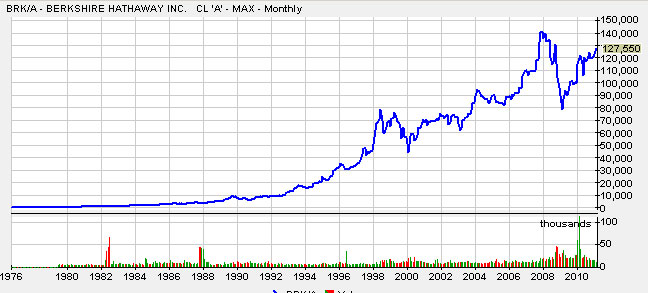
The chart of his main shares (i.e. the higher-priced ones):
Why The World Has No Choice But To Buy More And More Fertilizer. From Clusterstock:
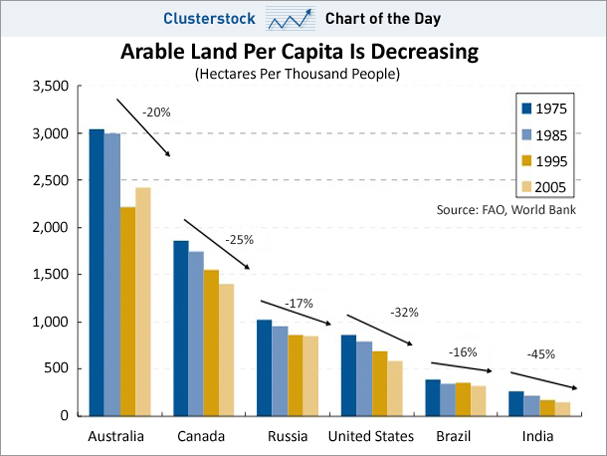
Why is everyone crazy about fertilizer and potash stocks? One part of the equation is that demand for food is growing.
But there’s another aspect: The clear trend in major regions is for less and less arable land per capita. Thus the only way to get more food is to get more yield from diminishing acres. And that means: more fertilizer!
The chart from Dundee Securities tells the story:
Apple Is Being Underestimated On Wall Street (Again). From Clusterstock:
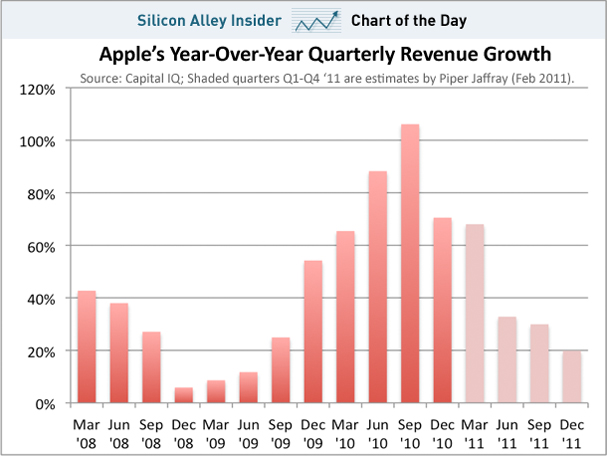
Apple had a banner year last year, posting absolutely crazy growth on a year over year basis, blowing away estimates.
Will it be able to do it again this year? Sort of.
Apple will be growing, but it won’t be crazy in the opinion of Piper Jaffray’s Gene Munster, who is admittedly a little bit conservative when it comes to Apple.
You can see the impressive rise of Apple’s sales on a year over year basis below, and the relatively tepid growth he’s forecasting. (Don’t forget Apple didn’t have full production of the iPad until the last quarter of 2010. It should be at full strength for all of 2011.)
Apple announces the iPad2 on Wednesday, two days from now.
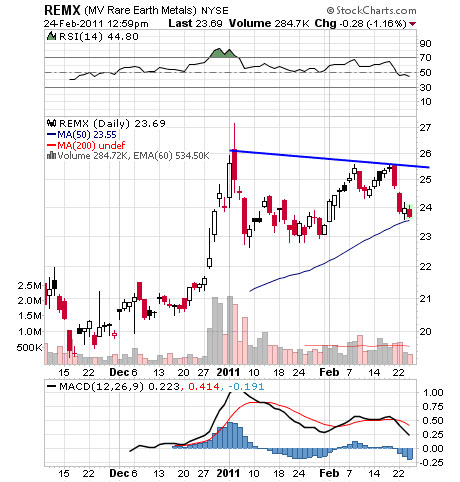
Why not to buy rare earth mineral miners. On Friday, February 18, I wrote “I’m still mulling on rare earth. Bubble or big, serious opportunity? I’m not a big fan of small mining companies.” I published the list of the major holdings in the ETF called REMX:
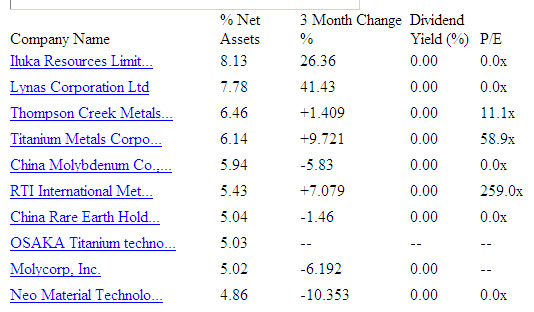
Not very inspiring. I never did get excited by REMX. Now comes words and a chart from doyen Richard Russell:
This is probably a good site for clearing up (cleaning up) my (Russell) mistakes. I recently recommended REMX, the exchange traded fund for rare earths. I’m posting the daily chart for REMX below. Frankly, I don’t like the action. If you bought this ETF, I’d now sell it. There may be too much publicity about rare earths, and the market may have discounted all the good news (and there’s been a lot of good news about rare earths). Just another Russell boo-boo. Sorry.
The danger that is the Internet.
Nothing you put on the Internet is private. Nothing.
Beware. Whatever minor comment you make or post can easily come back to haunt you — days, months or years from now. That includes looking for a job, applying for credit or even wooing a friend.
Ditto: Never put negative or rude stuff in an email. It’s always misunderstood. The phone is a much better place. No records.
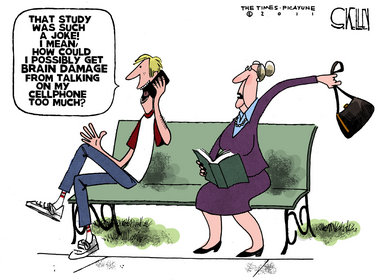
Good news. No global warming. No cellphone brain damage. We’re invincible.
Laugh Lines:
JAY LENO
+ Are you watching these protests? You know, it is scary there. They’re shouting. They’re burning people in effigy. They’re marching. And that’s just in Wisconsin.
+ South Dakota Senator John Thune announced he will not be running for president in 2012. I think I speak for all Americans when I say, who?
DAVID LETTERMAN
+ I’m worried about Wisconsin. If Governor Walker actually is driven out of power, there will be a vacuum and it could be filled by the Muslim Brotherhood.
CRAIG FERGUSON
+ I’m glad we have a day for the presidents. But shouldn’t we also have a day that honors Congress? You know, when the Senate and House can kick back and not worry about getting anything done?

Harry Newton who wonders why he still can’t beat Skip. Maybe there are some people who are simply better at tennis? Banish that thought.

The phone is a much better place. No records…Unless you say something of interest to the NSA!