The shorts that keep on giving:
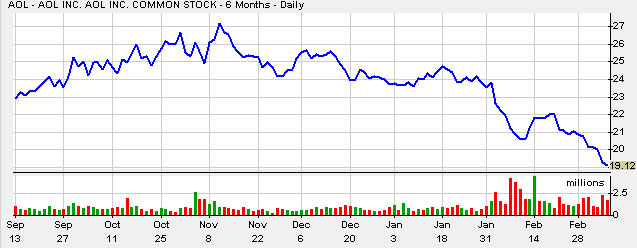
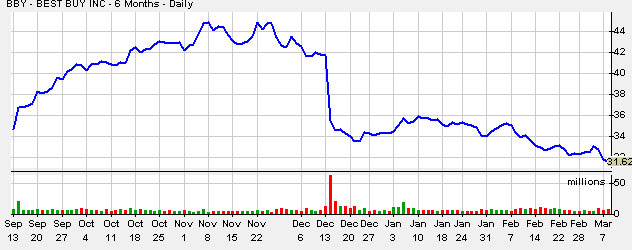
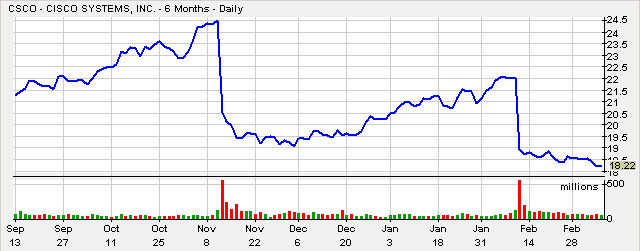
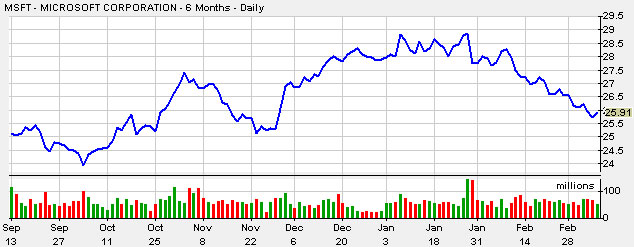
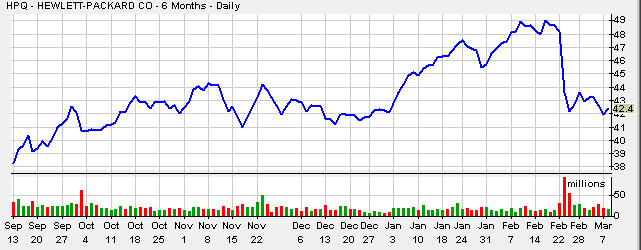
Chalk these miserable charts up to a “The Changing of the Guard” in technology companies. We’re switching generations in technology.
And now for The Next Generation of Technology Companies.
+ HubSpot Takes $32 Million Investment From Sequoia, Google Ventures And Salesforce.
In January we (TechCrunch) reported that digital marketing startup HubSpot was close to taking a new venture round. That deal is now closed, and the company will announce that they’ve taken $32 million from Sequoia Capital, Google Ventures, Salesforce and previous investors. HubSpot, which is headquartered in Cambridge, Massachusetts, has raised a total of $65 million in venture capital.
The company has 4,000 customers, they say, who use HubSpot to help manage their website and generate leads. Revenue is at a $25 million run rate annually, up from $10 million a year ago, says CEO Brian Halligan.
“The way humans shop is fundamentally changing,” Halligan says, and traditional marketing approaches – PR, ad buys, etc. don’t really work. HubSpot helps businesses build blogs and engage directly with customers via social networks, and lead generation increases severalfold on average within six months, he says. HubSpot charges customers between $250/month and $1,500/month.
+ Foursquare Nears 7 Million Users
This week in our blogosphere recap we’ll review four blog posts from last week that discuss Bing advancing social search with Facebook Like data, Forbes & Overstock facing accusations from Google, marketers’ projections for future social media spend and Foursquare’s steady growth. Below are some of the highlights from these articles:
* Last week Bing announced they’re now annotating URLs within search results with Facebook Likes.
* Following the recent news of J.C. Penney’s ‘black hat’ SEO tactics and subsequent penalties issued by Google, Forbes and Overstock are now facing similar accusations by the search giant.
* Marketers plan to make social media spend as much as 9.8% of their marketing budgets within the next 12 months.
* Foursquare’s expected to hit 7 million registered users within the coming weeks.
+ Warner Tests Renting Film on Facebook for Web Cash
Warner Brothers became the first major media company to offer a movie for rent on Facebook, a move that could position the social network to become a force in the digital distribution of movies, rivaling services like Netflix and iTunes.
Warner said on Tuesday that it would allow Facebook users in the United States to rent the film “The Dark Knight” directly on the social networking site, and pay for it using Credits, Facebook’s virtual currency. If other studios make similar moves, Facebook could tap a significant revenue stream, bolstering its Credits currency as it seeks to create a rival to PayPal and other payment systems.
Warner said it might make other movies available on Facebook over time.
“This is definitely a test,” said Thomas Gewecke, president of Warner Brothers Digital Distribution, in a telephone interview.
While some analysts saw the move as a danger to Netflix — a threat investors seemed to take seriously as shares of Netflix dropped more than 5 percent on Tuesday — others said that for Facebook, which is already one of the most popular places to watch videos online, the payoff from Warner’s move might be more in the expansion of its online currency.
“I think this is much more about payments than about movies,” said Alex Rampell, the chief executive of TrialPay, an advertising company that offers free Facebook Credits to people who buy certain products.
Mr. Rampell said that millions of Facebook users were using Credits to pay for virtual goods inside games like FarmVille and Mafia Wars. “It seems like a logical step to use the currency to pay for movies,” he said.
Facebook began testing Credits in virtual games nearly two years ago. But the company, which keeps 30 percent of all transactions conducted through Credits, has made it clear that it wants to turn its virtual currency into a payment mechanism for all sorts of digital goods.
To expand the use of the currency, Facebook last year began selling Credits through prepaid gift cards at Wal-Mart, Target and Best Buy. Earlier this year, it opened up Credits to all application developers on Facebook. Warner appears to be the first major media company to take advantage of the service to charge for content.
Facebook said that more than 400 developers were already using Credits.
“We’re looking forward to seeing the new and interesting ways that developers and partners use Credits to offer virtual and digital goods in the future,” Jonathan Thaw, a Facebook spokesman, said in a statement.
Like other Hollywood studios, Warner is racing to figure out how to deal with two significant problems: piracy and plummeting DVD sales, both of which are growing worse as broadband access spreads across the globe. The industry’s best hope for a solution is to make more content available for digital purchase on more platforms.
But Hollywood is also fretting that certain delivery systems — particularly Netflix, with its rapidly growing streaming service — are becoming too powerful. If Warner’s go-straight-to-the-fans Facebook experiment is successful, it could be a way of skirting those middleman distributors.
It chose the “The Dark Knight” in part because a related Facebook page run by the studio has a robust four million fans. The rental costs $3, or 30 Facebook Credits.
For now, Facebook is hardly a rival to online movie rental services, and it is not clear if the company plans to become one. It did not specifically help Warner and has not signed a licensing or distribution deal with the studio. And even if other studios follow Warner’s lead, Facebook lacks a feature for users to find movies.
But some analysts said that Facebook could eventually inch its way more aggressively into the movie rental business.
“On a longer-term basis, we think that Facebook could become a credible threat” to Netflix, Ingrid Chung, an analyst with Goldman Sachs, wrote in a note to investors. Ms. Chung noted that for now, however, Facebook “lacks content, does not have wide distribution across devices that connect to the living room TV, has few people on the payments platform.”
Warner’s Mr. Gewecke is bullish on another experiment, this one involving the sale of movies through a newly introduced iPad app. Warner now offers “App Editions” for two films, “The Dark Knight” and “Inception.” Rather than gaining access to the films through iTunes, consumers instead download a free app, which lets them buy the movies for unlimited streaming.
The app route is significant because it allows Warner to sell “Inception” and “The Dark Knight” in 23 countries where iTunes does not currently operate a video store — including fast-growing and highly pirated markets like China and Russia. “This platform allows us to experiment with an early version of what you might call a ‘connected movie’ — the ability for us to offer new extras over time as updates,” Mr. Gewecke said.
“We think that is a great way to add more value to the digital ownership experience,” he added.
The above from the New York Times.
“Search” — as in Google is changing from the Google model to the Facebook model, where you and I rely on recommendations from our friends on Facebook.
Call the switch from a search engine to a recommendation engine.
Do not underestimate the importance of Facebook. It’s slated to hit one billion users by the end of 2011.
The big growth in marketing is sway from Google’s clicks to Facebook’s recommendations and ultra-targeted, granular advertising. Mention stuff you like. Watch the ads appear.
The Internet is moving inside Facebook.
This is a game being played in and around Facebook by innumerable startups. Check out Zinga — a gaming platform wholly within Facebook (Mafia Wars and Farmville).
Items to read:
+ Secret Fears of the Super-Rich
Does great wealth bring fulfillment? An ambitious study by Boston College suggests not. For the first time, researchers prompted the very rich—people with fortunes in excess of $25 million—to speak candidly about their lives. The result is a suprising litany of anxieties: their sense of isolation, their worries about work and love, and most of all, their fears for their children. Atlantic Monthly.
+ How to Run an Online Background Check for Free. From PC World.
This is me with the number tennis player in the entire world. Eat your hearts out.

His name is Graydon Nichols. He is presently number one in the 85 and older singles. He is 86. When he was younger, he was also ranked number one in the 80 and older singles. We didn’t play because he presently has an infection in his finger. Which was good for me, since he would have killed me. We were photographed on my trusty iPhone 4 at the Morningside Country Club in the Coachella Valley, near Palm Springs, CA.
There are lots of old guys out here playing tennis. They talk about tennis prolonging their life.
The investment talk out focuses on estate planning — and whether the kids need more or less. Usually less.
The jokes they tell in the Coachella Valley
Arthur is 90 years old. He has played golf every day since his retirement 25 years ago. One day he arrived home looking downcast.
“That’s it,” he told his wife. “I’m giving up golf. My eyesight has gotten so bad that once I’ve hit the ball, I can’t see where it went.”
His wife sympathized and makes him a cup of tea. As they sat down, she said, “Why don’t you take my brother with you and give it one more try.”
“That’s no good,” sighs Arthur. “Your brother’s a hundred and three. He can’t help.”
“He may be a hundred and three,” says the wife, “but his eyesight is perfect.”
So the next day, Arthur headed off to the golf course with his brother-in-law. He teed up, took an almighty swing, and squinted down the fairway. He turned to the brother-in-law. “Did you see the ball?”
“Of course I did!” replies the brother-in-law. “I have perfect eyesight.”
“Where did it go?” asked Arthur.
“I don’t remember.”

Harry Newton who wonders at the shortsightedness of firms. Several years ago, a company called Edwards Brothers printed the 23rd edition of my dictionary. They were slow and late. I vowed never to use them again. Yesterday — totally out of the blue — they faxed me a bill for $70. It was for their storing the flats they used to print the dictionary. They should have called and asked Would I like them to print the upcoming 26th edition — a job worth maybe $50,000. Instead they chose to irritate me with a $70 “surprise invoice. Who taught these people selling?

Harry, why is the #1 tennis player in the world holding a golf club? 🙂
And thanks for the great information on doing a back ground check.