The Japanese Nikkei average dropped 10.6% today.
The headline reads “Japan shares crash on nuclear fears.“
Hopefully our shares will also crash, giving us a great opportunity to buy quality cheap.
Advice: Do not sell into this. Do not get stopped out.
Today’s nuclear meltdown is a perfect example of why your stops should not be sitting out there already in place — waiting for some sneaky trader to drive down your prices, grab your shares and then run your stocks up.
Today is the Ides of March.
The Ides of March is best known as the date that Julius Caesar was killed in 44 B.C.
Caesar was stabbed 23 times in the Roman Senate led by Marcus Junius Brutus, Gaius Cassius Longinus and 60 other conspirators.
On his way to the Theatre of Pompey (where he would be assassinated), Caesar saw a seer who had foretold that harm would come to him not later than the Ides of March.
Caesar joked, “Well, the Ides of March have come.”
The seer replied “Ay, they have come, but they are not gone.”
This meeting is dramatized in William Shakespeare’s play Julius Caesar.
Caesar is warned to “Beware the Ides of March“
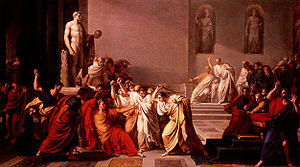
Vincenzo Camuccini, Mort de César, 1798, courtesy Wikipedia.
Warren Buffett on derivatives: From the New York Times:
Derivatives, as Accused by Buffett
By ANDREW ROSS SORKIN
Andrew Harrer/Bloomberg News Warren E. Buffett spoke to the financial crisis panel.
Warren E. Buffett’s “elephant gun” and itchy “trigger finger” may be the market chatter, after Berkshire Hathaway announced a $9 billion deal to buy Lubrizol on Monday.
But Wall Street denizens have been focused on something else in recent days: Mr. Buffett’s private interview before the Financial Crisis Inquiry Commission, a transcript of which has been whizzing around e-mail inboxes.
Mr. Buffett, in a two-hour interview transcribed by the newsletter Santangel’s Review, touched on everything from ratings agencies to the dangers of leverage.
But the most provocative moments centered on derivatives, the complicated investments at the heart of the financial crisis. It is perhaps the first time that Mr. Buffett has opened up so publicly about the topic.
Mr. Buffett once described derivatives as “financial weapons of mass destruction.” Yet some of his most ardent fans have quietly raised eyebrows at his pontifications, given that he plays in the opaque market. In the fourth quarter alone, Berkshire made $222 million on derivatives. TheStreet.com published a column last spring with the headline: “Warren Buffett Is a Hypocrite.”
His comments, which were released last month by the financial crisis commission, come as the government is writing rules for derivatives as part of the Dodd-Frank financial regulatory overhaul. And the statements could influence the debate.
Mr. Buffett appeared to backpedal from his oft-quoted line, explaining: “I don’t think they’re evil per se. It’s just, they, I mean there’s nothing wrong with having a futures contract or something of the sort. But they do let people engage in massive mischief.”
The problems arise, Mr. Buffett said, when a bank’s exposure to derivatives balloons to grand proportions and uninformed investors start using them.
It “doesn’t make much difference if it’s, you know, one guy rolling dice against another, and they’re doing $5 a throw. But it makes a lot of difference when you get into big numbers.”
What worries him most is the big financial institutions that have millions of contracts. “If I look at JPMorgan, I see two trillion in receivables, two trillion in payables, a trillion and seven netted off on each side and $300 billion remaining, maybe $200 billion collateralized,” he said, walking through his thinking. “That’s all fine. But I don’t know what discontinuities are going to do to those numbers overnight if there’s a major nuclear, chemical or biological terrorist action that really is disruptive to the whole financial system.”
“Who the hell knows what happens to those numbers?” he asked. “I think it’s virtually unmanageable.”
Mr. Buffett defended Berkshire Hathaway’s use of derivatives, arguing that the company maintains a limited amount. At the time of the interview, the company had only about 250 derivative contracts. (It’s now down to 203.) “I want to know every contract, and I can do that with the way we’ve done it. But I can’t do it with 23,000 that a bunch of traders are putting on.”
He noted that when Berkshire bought General Re in 1998, the reinsurance company had 23,000 derivative contracts. “I could have hired 15 of the smartest people, you know, math majors, Ph.D.’s. I could have given them carte blanche to devise any reporting system that would enable me to get my mind around what exposure that I had, and it wouldn’t have worked,” he said to the government panel. “Can you imagine 23,000 contracts with 900 institutions all over the world with probably 200 of them names I can’t pronounce?” Berkshire decided to unwind the derivative deals, incurring some $400 million in losses.
Mr. Buffett said he used derivatives to capitalize on discrepancies in the market. (That’s what other investors must think they are doing — just not as successfully.)
Perhaps the most insightful nugget in the interview was Mr. Buffett’s explanation of why corporations use derivatives — and why they probably shouldn’t.
Many companies, as diverse as Coca-Cola and Burlington Northern, argue that they employ derivatives to hedge their risk.
The United States-based Coca-Cola tries to protect against fluctuations in currencies since it does business around the world. Burlington Northern, the railroad giant, uses the investments to limit the effect of fuel prices.
Mr. Buffett, who has interests in both companies, claimed there was another agenda. “The reason many of them do it is that they want to smooth earnings,” he said, referring to the idea of trying to make quarterly numbers less volatile. “And I’m not saying there’s anything wrong with that, but that is the motivation.”
The numbers all even out eventually, he cautioned, so derivatives don’t really make much difference in the long term.
“They’re going to lose as much on the diesel fuel contracts over time as they make,” he said of Burlington Northern. “I wouldn’t do it.”
Microsoft releases its updated browser Internet Explorer 9. Pick your free copy up here. Apparently IE9 it works and faster. I personally prefer Firefox.
IE 9 supports the HTML5 technology for playing video, thus dealing another blow to Adobe Systems (ADBE)’s Flash — the most popular software for watching video clips on the Internet.
Apple has limited the use of Flash on its iPhone and iPad, endorsing HTML5 also. Steve Jobs said Flash was too slow to run on mobile devices. Frankly, I think it’s too slow to run on computers also.
Microsoft (MSFT) rose 1 cent to $25.69 yesterday. The shares have fallen 8 percent this year.
Do not buy shares in Microsoft.
The family is hooked on Sonicare toothbrushes.

But the things are ultra-expensive and useless for overseas travel. The charger only works here.
Good news: I just discovered Philips makes a battery-powered Sonicare, which uses two AA batteries. List on the thing is $29.95. I got mine from Walgrens for $20. Amazon has it for $25. Click here.
Indian Wells (California) Tennis. All the tennis greats are here for the BNP Paribas tournament. It’s on The Tennis Channel for most of the day. We’re going today.
Our economy must be doing OK. The tournament is sold out on most days. Tickets are not cheap. (I’m not bragging.)

Harry Newton who wonders at the idiocy of TV remote designers. I am holding a remote whose smallest buttons are ON/OFF and MUTE. They’re the only two buttons I use. Why make them so difficult to find?

Harry, the comment you make more than any is your “involatile 15% rule” or less. Now you say “your stops should not be sitting out there already in place”. Isn't this a bit contradictory?
The issue is how you place your stops. Automatic stops are viewed by too many trading computers. Place them by hand. Do I make sense?
Harry
We have been using Sonicare tooth brushes for years and have taken them with us all over the world. (China, Europe…where ever) I always travel with one or two converters from Radio Shack and they charge perfectly. I use the same converters for my iPod and my computer. The iPod will work on DC but I still use the converter. Same for my electric razor. I also carry my Altec Lansine inMotion portable speakers for my iPod uses the same DC/AC converter. They are fantastic. I use my iRecord unit to record hours and hours of our favorite music off Dishnet and have our favorite music in our car or anywhere in the world we travel.