Strange world. Continuing headlines of nuclear Armageddon have freaked the stockmarket and pushed the Yen through the roof.
This is a bumpy, weird ride. There remains only one lesson: Do not be panicked into indiscriminatory selling.
This will blow over. And blow over pretty soon.
Only sell if a company’s prospects have seriously soured.
The most obvious souring: any stock with nuclear leanings — including miners and manufacturers (including GE).
I hold to my position: The economy that affects our shares the most — the U.S. — is improving. Check out today’s employment numbers and yesterday’s ebullient earnings from FedEx.
Apple hits the skids, sort of. The last ten days have not been pretty for Apple’s stock. This chart compares Apple in blue with the Dow Jones in purple.
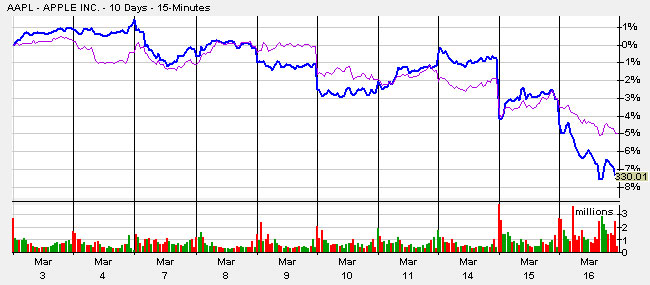
Several learned Wall Street analysts have downgraded the stock. They instance Japan, China, etc. Most analysts still love the stock. It’s down nearly 8% since the beginning of March — not enough to panic sell.
Comments on Apple from Seeking Alpha: click here.
So how bad is this nuclear thing really? In Australia, there’s a newspaper called the Melbourne Herald Sun. Andrew Bolt wrote the following:
THIS disaster may mark the moment when the nuclear industry learnt to survive.
IT’S not bad enough that thousands of people may be dead from Japan’s earthquake and devastating tsunami. No, the media is instead obsessing over a nuclear reactor that has killed no one and probably never will.
This scaremongering over the crippled Fukushima nuclear complex is extraordinary.
Already anti-nuclear activists, rebadged as nuclear “experts”, are out spreading terror.
There’s Dr Tilman Ruff, actually a Nossal Institute infectious diseases expert and long-time anti-nukes activist, everywhere warning we might be “looking at a Chernobyl-type disaster or worse” and describing in lascivious detail the ways people could get sick from the fallout.
And what’s a nuclear holocaust story without Helen Caldicott, actually a paediatrician and anti-nuke hysteric? So there she was, too, on 3AW, warning that if the reactor blew up, “hundreds of thousands of Japanese will be dying within two weeks of acute radiation illness”, with countless more later suffering an “epidemic” of cancers.There’s Dave Sweeney, actually a professional activist from the Australian Conservation Foundation with zero formal qualifications in nuclear science, warning the reactor was potentially like a kettle without water, and “sooner or later, it superheats and it blows”.
But wait. Time to check the facts and get some perspective.
Let’s start with Dr Ruff.
If the Fukushima reactor indeed becomes a “Chernobyl disaster”, it will still be as nothing compared to the devastation the Japanese have already suffered.
Right now, rescue workers are combing through the ruins of the seaside cities swamped by the tsunami, looking for 10,000 missing people.
By contrast, Chernobyl, the world’s worst nuclear power station disaster, is known to have killed no more than 65.
Yes, I know this doesn’t fit with all the horror stories that activists and journalists spread about Chernobyl.
Yes, I know that even the Gillard Government’s Education Minister, Peter Garrett, has warned that the 1986 explosion at Chernobyl’s shambolic nuclear reactor “caused the deaths of more than 30,000 people”.
I know that Mr Sweeney’s ACF once published on its website a paper claiming the death toll was actually 250,000 people. And I heard Ms Caldicott on Wednesday trump them all by insisting “nearly a million” died.
But the most reliable assessment of the deaths in that iconic disaster comes instead from the Chernobyl Forum, which represents Ukraine, Russia and Belarus, as well as all relevant United Nations agencies, including the World Health Organisation and International Atomic Energy Agency.
After reviewing countless studies, the forum in 2005 concluded much of the reporting of the deaths was a beat-up.
“Claims have been made that tens or even hundreds of thousands of persons have died as a result of the accident. These claims are highly exaggerated.”
In fact, there was “no demonstrated increase in the incidence of solid cancers or leukaemia due to radiation in the most affected populations”, and no “clear and convincing evidence for a radiation-induced increase in general population mortality”.
There was only one exception: thyroid cancer in children, which killed 15.
Thankfully, this is treatable, which is why Japanese authorities are handing out iodine tablets.
To those 15, the Chernobyl Forum added 28 reactor workers who died from acute radiation sickness, three more who died at the explosion from other causes and 19 who died over the years that followed from various causes related to the blast.
The deaths of these 65 people is undoubtedly a tragedy. But when set beside the 10,000 feared drowned by this tsunami, they are almost as nothing.
And they represent a fraction of the heartache caused not by the Chernobyl explosion but by the panic-merchants who stampeded more than 200,000 women from Italy to Norway into having abortions, through a baseless fear their child would be deformed.
But is Fukushima even likely to become a “Chernobyl-type disaster”?
No, say the true experts.
First, “there is no possibility of a nuclear explosion”, says Richard Wakeford of the University of Manchester’s Dalton Research Institute.
Ziggy Switkowski, former chairman of the Australian Nuclear and Scientific Organisation, agrees. There just isn’t enough uranium in the reactor.
And don’t let the breathless reports of three explosions already at the Fukushima complex fool you.
They are not nuclear explosions but the detonation of hydrogen released through the emergency cooling process.
These explosions, outside the steel and concrete containment vessels in which the nuclear fuel is held, are very different to the ones at Chernobyl, which occurred within the vessel and tore apart the reactor. That in turn caused the graphite used in that reactor to catch fire and burn for four days, releasing plumes of highly radioactive waste into the air.
Fukushima, though, uses not graphite but water, which does not burn. What radioactivity has been released is some caesium-137 and iodine-131 carried with the steam that’s been vented to ease pressure in the reactors, where the cooling systems have been crippled.
Not healthy, but so far not likely to kill you even if you breathed deeply. And the winds are taking it out to sea.
So far, the vessels containing the fuel rods themselves are intact and the reactor is also built to contain any “meltdown”, avoiding the Hollywood scenario of a “China syndrome”, in which the molten reactor core burns right through, figuratively, to China.
Much may yet go wrong. More explosions may crack the containment vessels, potentially releasing radiation.
More steam will be vented. But with the area evacuated, the risk of people being killed is close to nil – except for about 50 brave staff who are taking the chance of being blown up.
With luck, the moral of this emergency may turn out to be the opposite of the one now preached by people who prefer myths to fact, fear to understanding.
Fukushima is one of the very oldest of the nuclear power stations that supply a third of Japan’s electricity, and has been rocked by the worst earthquakes in Japan in a century.
It has suffered multiple failures of its cooling systems. It has been battered by explosions. And if it can take all that without cracking . . .
Add to that the lessons Japan’s experts will learn from this and these grim days may yet mark the time not when the nuclear industry died, but when it learnt how to survive even an apocalypse.
From last night’s Indian Wells Tennis. Guess who served?


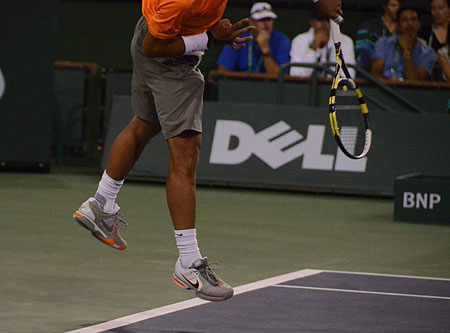

From top down: India’s Somdev Devvarman, Roger Federer, Rafael Nadal and America’s rising star, 18-year old Ryan Harrison. It’s amazing how high these guys lift off the ground as they serve.
While most people wore ultra-casual (and ultra-dreadful) T-shirts and shorts, these wonderful two dressed up. They willingly posed for my new Nikon D7000, which I’m still learning how to use.

No time for jokes this morning.

Harry Newton who loved last night’s tennis. Upcoming matches in the next few days promise even more excitement. Watch tennis, not the ticker. Tennis is on The Tennis Channel. Get Hi-Def. It’s much better than “normal” TV.

People are like other machines, some come with certain features others not; “business” people are often easy to spot because many of them come equipped with little or no empathy or sympathy- $$ first and foremost, that's just how they're built.
An extraordinary (to put it mildly) event like this brings out both sides of humanity-
a. The people who see this as the beginning of the end.
b. The apologists and minimizers- “this is not so bad” they say, “we stand behind nukes, it's a sound technology”…
Both groups contain a large percentage of fools. The first group, a, is amusing at best.
The second, b, we pay the price for their small thinking (they often speak well and have academic degrees) and shortsightedness on a daily basis, they put a big anchor on our quality of life as a nation and planet.
Russian Nuclear Experts: Chernobyl radiation fallout killed almost 1,000,000 people worldwide
NEW YORK, New York, April 26, 2010 (ENS) – Nearly one million people around the world died from exposure to radiation released by the 1986 nuclear disaster at the Chernobyl reactor, finds a new book from the New York Academy of Sciences.”
The book, “Chernobyl: Consequences of the Catastrophe for People and the Environment,” was compiled by authors Alexey Yablokov of the Center for Russian Environmental Policy in Moscow, and Vassily Nesterenko and Alexey Nesterenko of the Institute of Radiation Safety, in Minsk, Belarus.
The authors said, “For the past 23 years, it has been clear that there is a danger greater than nuclear weapons concealed within nuclear power. Emissions from this one reactor exceeded a hundred-fold the radioactive contamination of the bombs dropped on Hiroshima and Nagasaki.”
The book explores effects of Chernobyl fallout that arrived above the United States NINE DAYS after the disaster. Fallout entered the U.S. environment and food chain through RAINFALL. Levels of iodine-131 in milk, for example, were 7 TO 28 TIMES above normal in May and June 1986. The authors found that the highest U.S. radiation levels were recorded in the Pacific Northwest. “
You are SO Right. How could Harrry even think only 65 people died. He is beginning to sound as dumb as me Democratic friends who thinl illegals in the united stated only number 1 million! WOW!
Yes, using this sort of reasoning no one has ever died from smoking or lack of exercise sense it takes decades for the cause to have effect. :~)
Looks like Bob and Ross did not notice (even though Harry CLEARLY indicated the name of the author as well as the publication) that the article was NOT written by Harry thus making the name calling by Bob rather “dumb” to borrow Bob's own expression. I bet Bob's democratic friends can read and comprehend better than Bob can. Right, Bob?
Harry
The lack of quality scientific education provides tremendous opportunities for the reasonably-educated, non-emotional investor in tragedies such as Japan. Notwithstanding the horrific local impact, this radiation danger will have little direct impact on the US. Even Chernobyl, which was a Seven on the 1-7 nuclear scale, amounted to less than the impact of a chest x-ray on the US. I made money on the over-reactions to GE shares this week. Thank you Kismet! My condolences to Japan. But the sad reality is life is for the living. It is our obligation to live it as well as we can, and not looking backwards.
You're basicaly agreeing with me that we shouldn't be panicking? Correct?
Absolutely.